Tarot Card Combinations
Four of Wands and Two of Cups
The Four of Wands and Two of Cups tarot combination signals a promise ready for a home and a party. Four staves hold up a garland of green leaves and red roses against a yellow sky. On the other card, two people, one wreathed in green, one in red, meet over gold cups. They wear the garland's colors. Asking about a ring or a lease? Start with the cups.

Climate scientist, ashtanga practitioner, and advocate for human rights and LGBTQIA+ equality.
What each card means before they meet
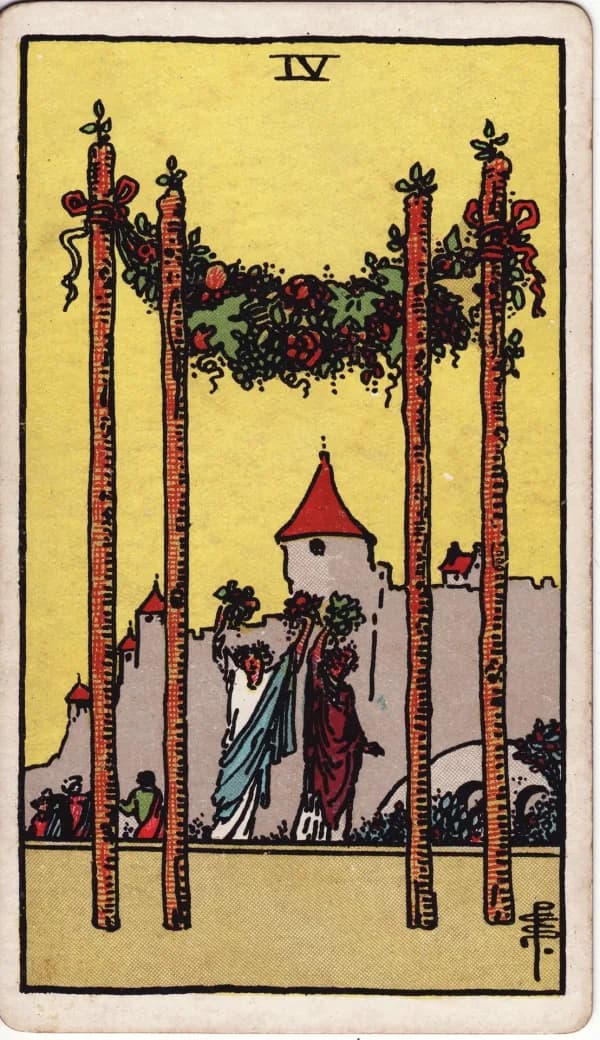
Look at the Rider-Waite-Smith Four of Wands. Four tall staves sprout green leaves, and a heavy garland of leaves, red roses and red fruit hangs across their tops. The sky is a flat, warm yellow. Under the garland, two figures lift bouquets over their heads. Behind them stand a castle wall, a red-roofed tower and a few small guests.
In The Pictorial Key to the Tarot, A.E. Waite describes "a great garland suspended" over the scene, and below it "two female figures uplift nosegays" (small bouquets). Waite names no couple and no wedding. His meanings read like a homecoming: country life, a haven of refuge, peace, perfected work. But the wedding reading came later.
It's the fourth card of Wands, the suit of Fire, whose Hebrew letter is Yod, meaning hand. The Golden Dawn, the magical order Waite belonged to, put every Four in Chesed (Mercy), the fourth of ten spheres on the Qabalah's Tree of Life, and titled this one Lord of Perfected Work. Rachel Pollack, in Seventy-Eight Degrees of Wisdom, notes where the figures are going: "They are leaving a walled city for the open bower."
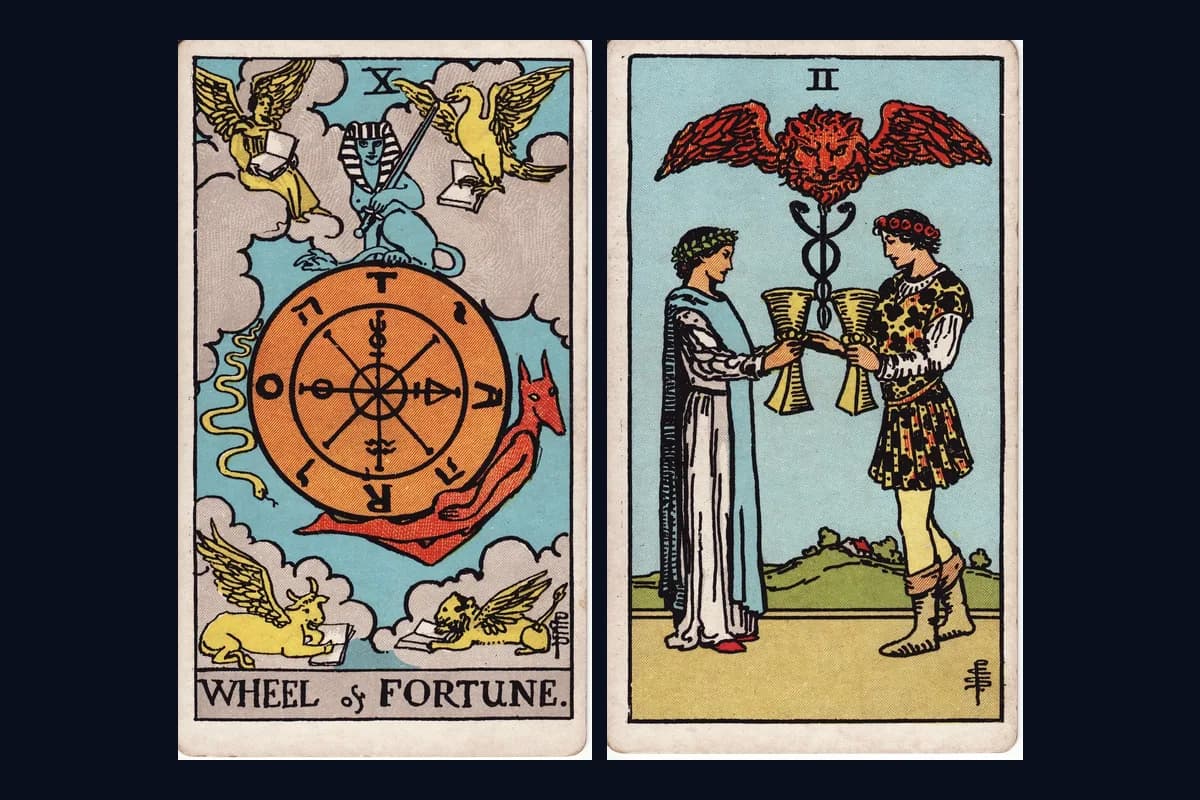
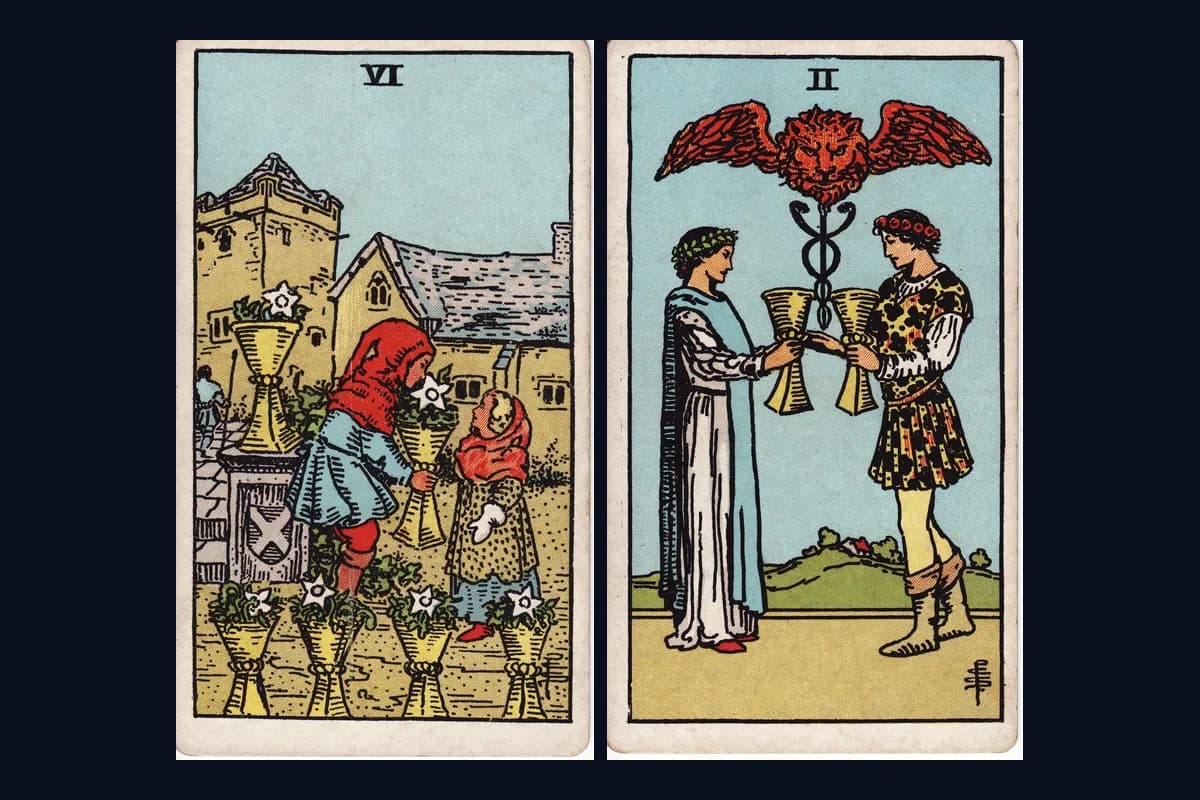
Now look at the Two of Cups.
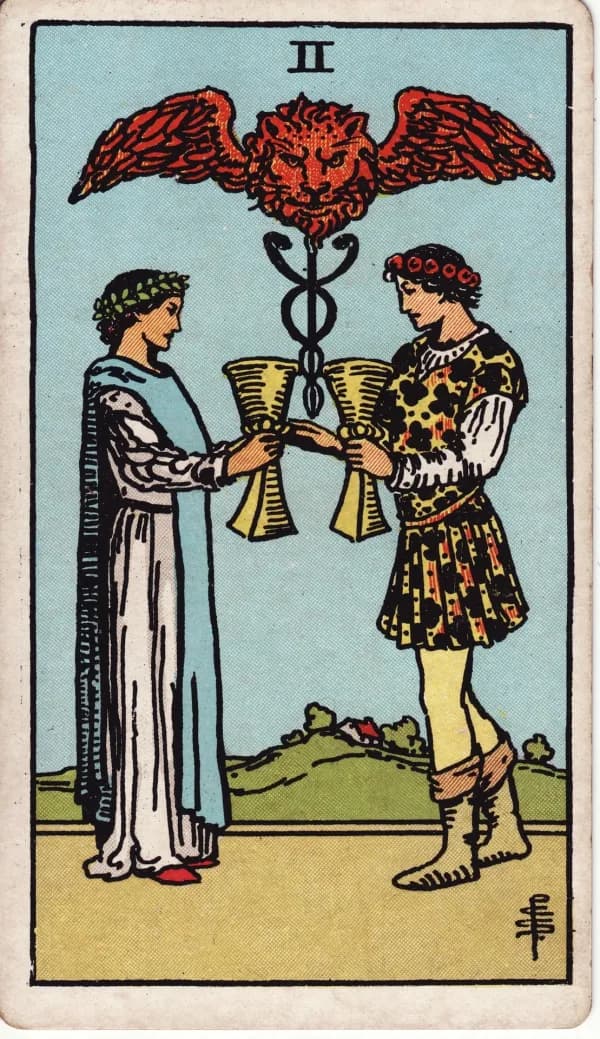
Two young people stand face to face under a pale blue sky, each holding a gold cup. She wears a wreath of green leaves. He wears red flowers, and his free hand reaches toward her cup. Beside them, the Four's garland looks woven from both colors. The pictures make that link. Waite never does.
Pollack reads the figures as two qualities: "While the man symbolizes action and movement, the woman symbolizes emotion, sensitivity, and an appreciation of experience." Any two people can carry them. "By uniting these two qualities we give our lives value." The Golden Dawn titled the card Lord of Love. Like every Two, it's set in Chokmah (Wisdom), the second sphere. Its element, Water, takes the letter Heh, meaning window.
Step into the Four of Wands. Are you under the garland with your flowers raised, or by the castle wall, watching? And in the Two of Cups, are you the one reaching across?
Why the Four of Wands and Two of Cups read as an engagement
Of all the Wands, the Golden Dawn gave Venus exactly one card. This one. In Book T, the order's own handbook, the Four of Wands is Venus in the last ten degrees of Aries, and the Two of Cups is Venus in the first ten of Cancer.
Both are pips, the numbered cards of the suits, so this pair deals in things people do: asking, answering, signing a lease, sending invitations.
T. Susan Chang, author of Tarot Correspondences, tells clients which cards she hopes to see for a happy relationship, and this pair heads the list. "I am hoping to see the 2 of Cups, the 4 of Wands," she writes. In her essay on the Four's ten degrees, she limits what the card promises: "This is the wedding party, not the long marriage."
So the reading has two layers: the promise, and the people around it. Together, the Four of Wands and Two of Cups say the promise between you is ready for a home, and for the people you'd invite into it. That's what the two cards' own meanings add up to. Nobody has written rules for this exact pair.
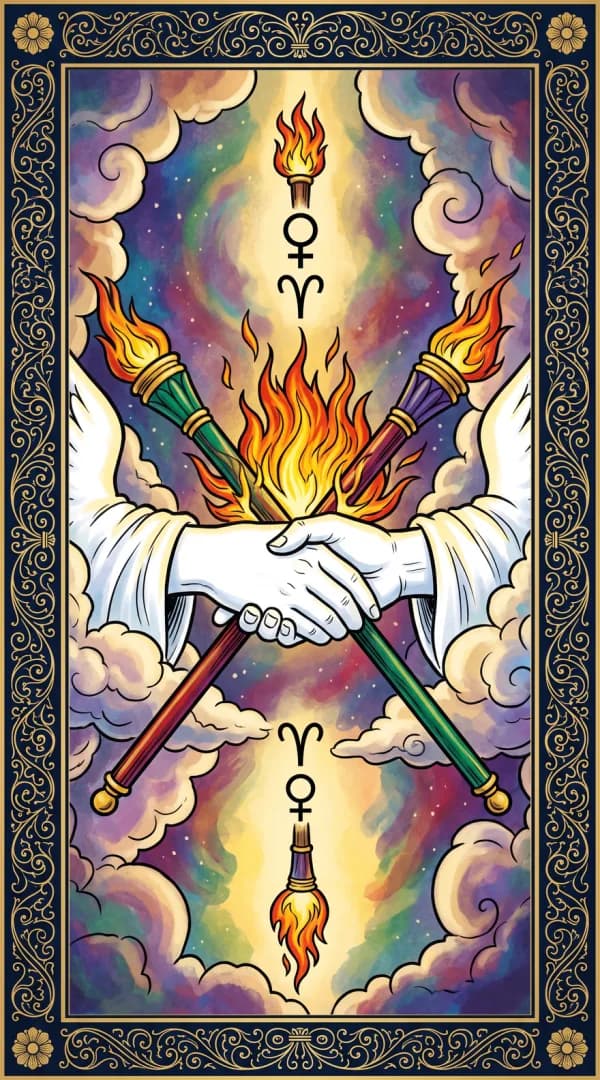
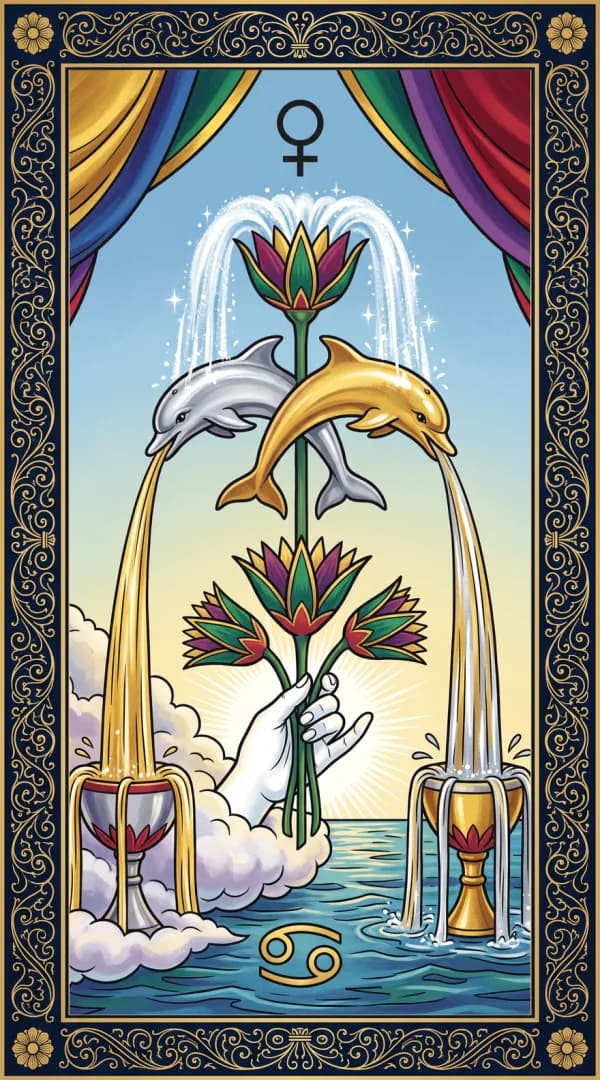
On the Golden Dawn Four of Wands below, two hands reach out of clouds and clasp over crossed, flaming wands: a handshake, on the suit whose letter means hand. Book T glosses the card as "Settlement, arrangement, completion." The matching Two of Cups trades the couple for a hand holding lotus stems while water pours through gold and silver dolphins into two overflowing cups. So the agreement sits on the Four, and the Two is love too full for its cups.
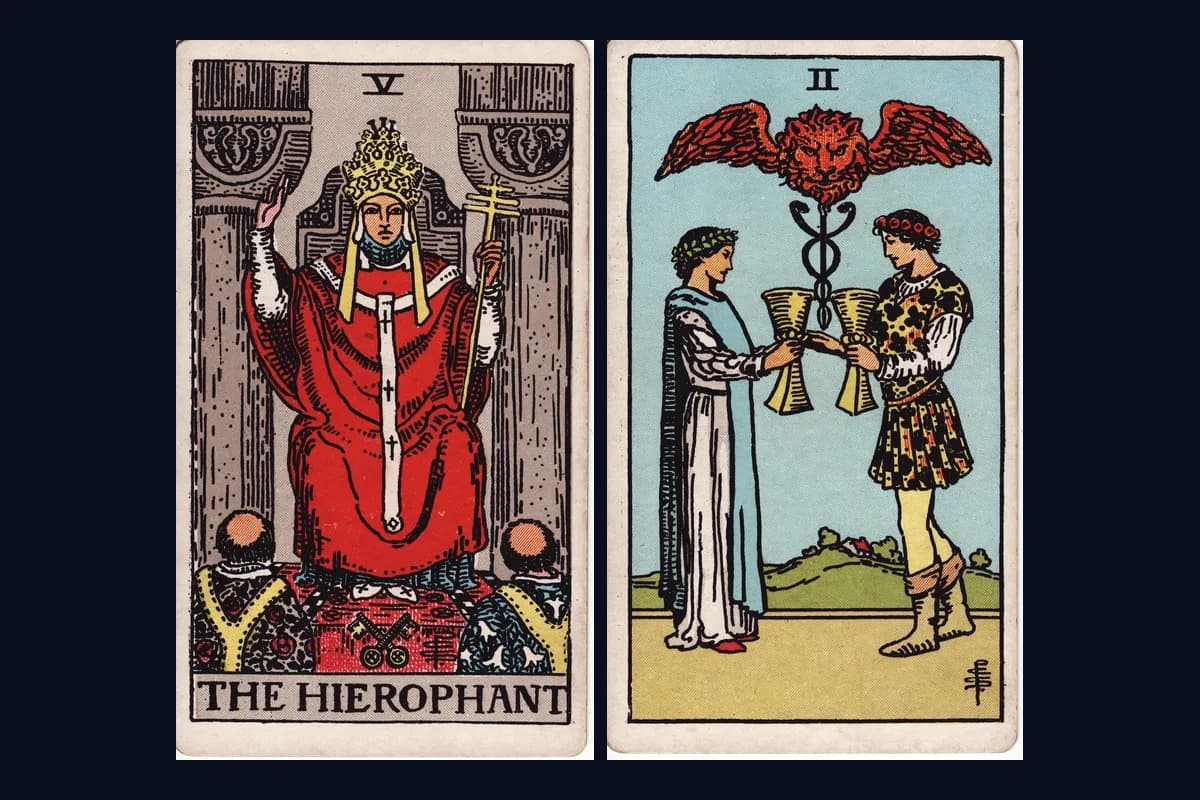
If the Hierophant takes the Four's place, the promise gets an officiant: in the Hierophant and Two of Cups combination, the question is who blesses it. Here the question is where the promise will live, and who'll come to the party.
If a friend asked each of you, separately, what comes next for you two, would your answers match? Who would mention a date, and who a feeling?
What the pair says about an engagement, a wedding or moving in
Whichever you're asking about, the Two of Cups is the promise and the Four of Wands is everything built around it. Neither card names a date or answers for your partner.
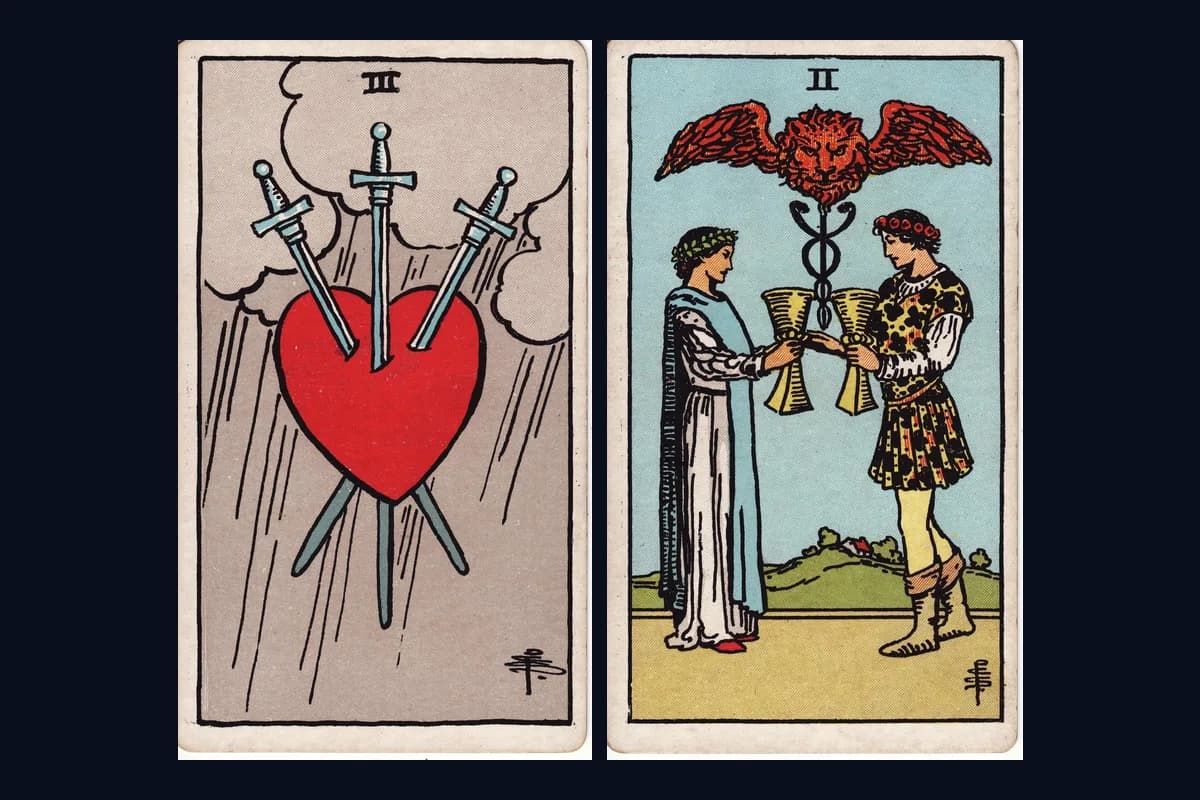
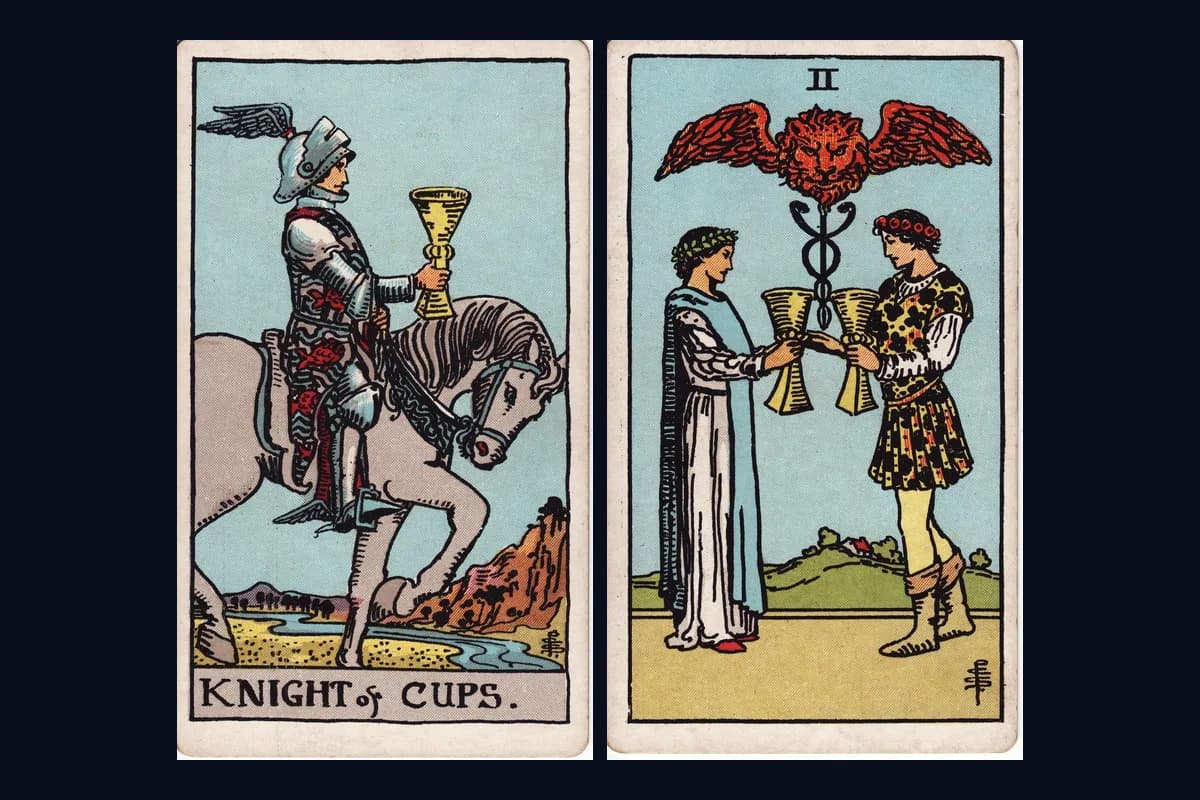
If you talk about the future but aren't engaged, the Four is the news you'd share, and the Two needs the feeling to be mutual. If you're waiting to be asked, the Knight of Cups and Two of Cups combination follows the offer, and whether it comes through.
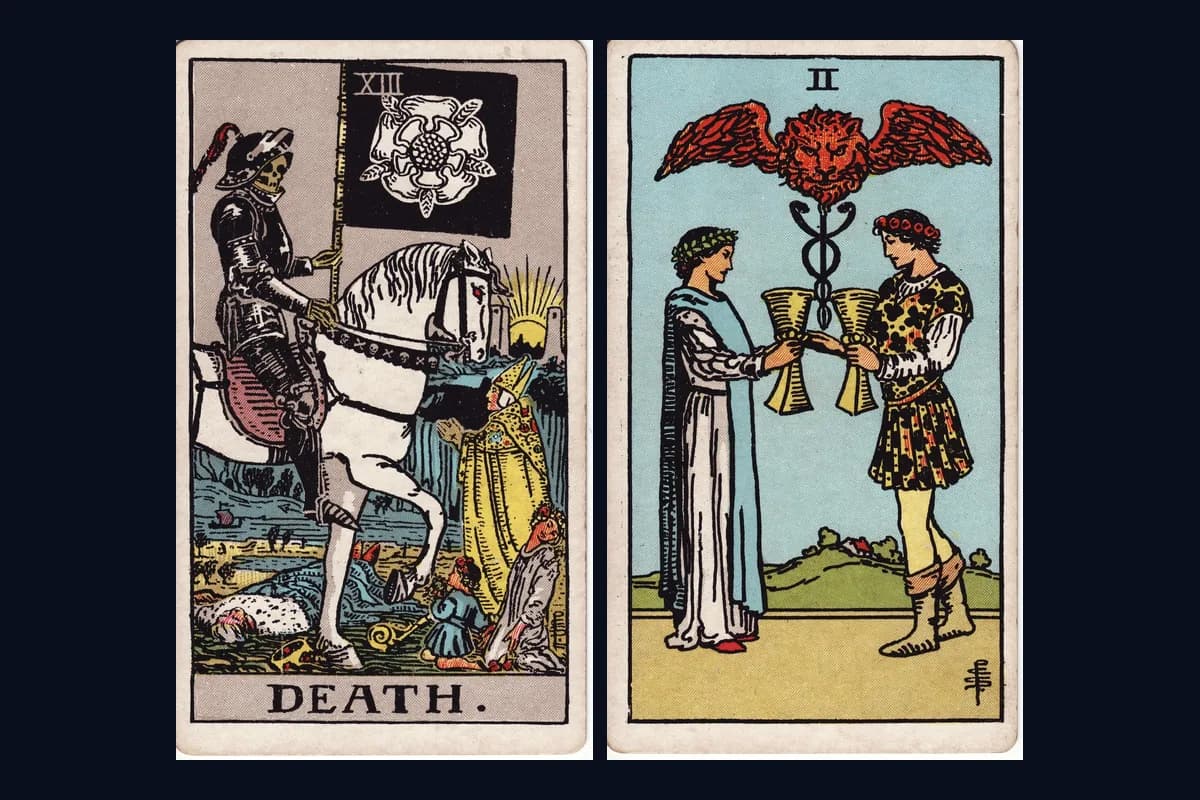
Already engaged? Then the Four is the planning, and the Two is the reason. Every yes also ends something, and the Death and Two of Cups combination weighs what that is. But Aeclectic Tarot warns that a couple can feel finished when only the first part is done: "Many see marriage as the goal of a relationship rather than the completion of a stage."
For moving in together, the Four is a warm card for the home itself. Theresa Reed, The Tarot Lady, is plain: "If you are asking about buying or decorating a home, the presence of this card says: go for it." Whether you both want to share one is the Two's question. Once you've unpacked, the Ten of Cups and Ten of Pentacles combination reads the household you build there.
Sometimes the bond and the ceremony don't line up. Maybe one of you wants the big party and the other wants the courthouse, or no wedding at all. Maybe the families are planning faster than you two are. A small party is still a party, and if neither of you wants a wedding, one dinner can be the Four. No venue fixes a promise only one of you has made. And if the plans outrun you, you can slow them down. If the real gap is in who carries the feeling, the Queen of Cups and King of Cups combination reads that.
For couples back together after a breakup, first ask what's changed. The Judgement and Two of Cups combination is built around that question. The Four can celebrate a return as happily as a first time, but the promise has to be a new one.
In a new relationship, the Four is less likely a ring than a friend's birthday where you arrive as a couple. If you're single, the most the pair offers is a connection that could grow. After a first date, start with the Wheel of Fortune and Two of Cups combination, which is about the meeting itself.
In a Celtic Cross, the pair shows which half is already real. Waite's third card crowns you: "the best that can be achieved under the circumstances, but that which has not yet been made actual." The fourth lies beneath you: whatever "has already passed into actuality" for you. Two beneath, Four crowning: the promise is under you and the party is what you're reaching for. Swap them, and the house came first. (Teachers number this spread differently.)
Yes or no? Both upright, yes, if the feeling runs both ways and you've each said so out loud. The Four is the steadier vote, since Waite reads it the same reversed, but the condition rests on the Two.
Forget the venue photos. When you picture the two of you celebrating, who's standing closest? What would your Four of Wands look like with its garland strung from your own life? That image belongs in your deck.
How card order and reversals change the reading
Books leave this pair's order open, so let the first card say which led: the promise or the party.
The Two of Cups first, then the Four of Wands is the hopeful order: the promise, then the party. The risk sits in the Four. In The Book of Thoth, Aleister Crowley writes that because the card is Venus in Aries, "one cannot establish one's work without tact and gentleness." So don't let the planning get louder than the two of you. If it already has, read the Three of Swords and Two of Cups combination.
With the Four of Wands first, the announcement beats the conversation. Maybe you moved in to split the rent. But plenty of couples find the promise inside the house. Just check the Two is really there. If what came first is an old love moving back in, the Six of Cups and Two of Cups combination reads that return.
In a three-card spread of past, present and future, if the Two falls behind you and the Four ahead, read the middle card as a bridge. Waite's Four has one: "a bridge over a moat." Whatever lands in the present is what you cross: a money talk, a lease, meeting the parents. Fire and Water are contrary, and Book T explains why the card between them keeps its meaning: "If a card fall between two other which are mutually contrary, it is not much affected by either."
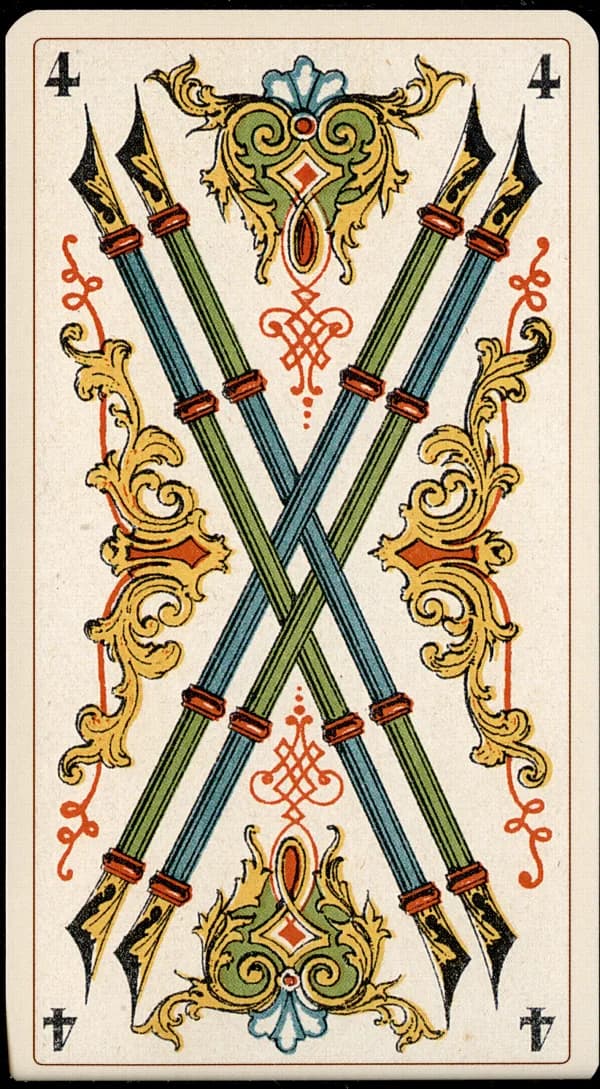
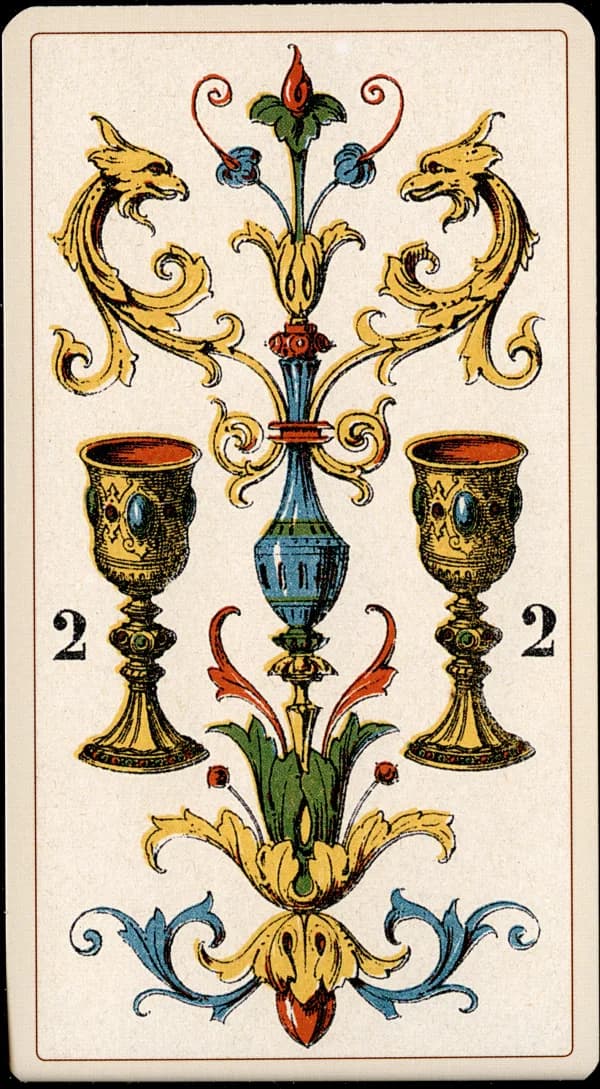
The Milanese pair below has no garland and no couple: four crossed batons, two goblets and a tall vase. There's no scene, so a reader leans on number and suit.
Orientation matters too. Waite kept the Four cheerful upside down: "The meaning remains unaltered; it is prosperity, increase, felicity, beauty, embellishment." Tina Gong of Labyrinthos says the reversed Four "can signal incompatibilities between your larger community of friends and family, and your partner." When the reversed Two stands for you, Pollack finds "a split between what we do and what we feel, between action and emotion." That's this pair's worry.
| Orientation | Reading |
|---|---|
| Both upright | The promise and the party agree; a proposal, a move, a wedding or a quieter commitment, whichever you both choose |
| Both reversed | Neither the bond nor the home feels steady yet; not now, which isn't never |
| Four of Wands upright, Two of Cups reversed | The party is ready before the promise is; make sure you both mean the yes before the lease or the invitations |
| Four of Wands reversed, Two of Cups upright | A sound bond with an awkward ceremony; maybe a smaller wedding, a later move or a promise that needs no crowd |
Think about the last good news you two got. Did you keep it to yourselves, or was it in the family group chat within the hour? Which card does that habit put first for you?
What the planets add to an engagement reading
Where Venus sits changes her mood. Aries is Mars's sign and Cancer is the Moon's. Robert Wang, author of The Qabalistic Tarot, says that on the Four she "is activated by the Mars energies of Aries." A Golden Dawn manuscript that Mary K. Greer published calls her "especially Venusian" in the Moon's sign.
The sources split over Aries. Chang notes that Venus is in detriment there, a sign where a planet works against its grain: "her halo dimmed and her powers abated." But the same Golden Dawn manuscript says the opposite: "Venus in the fiery Aries has her full fruition."
The elements clash outright. In elemental dignities, the Golden Dawn's rules for how neighboring cards strengthen or weaken each other, Book T is blunt: "Wands are inimical to Cups." Greer adds a harder edge: Mathers, the order's co-founder, "often cancelled out the effect of cards with contrary elements." By her account, he didn't read such pairs at all. That's likely why one tarot site calls this pair challenging. If you read dignities, hold the yes more loosely; if not, the clash only sets the pace. Fire wants the party. Water wants the quiet talk after everyone's gone home.
Aries comes before Cancer, so Venus reaches the Four's degrees first (all dates Universal Time). Venus enters the Four of Wands' ten degrees on May 6, 2027, and meets Saturn there on May 7, 2027, at 21 degrees of Aries. Astrologers tie Saturn to commitments. Venus enters Cancer on July 3, 2027, and clears the Two of Cups' ten degrees by July 11, 2027.
So read that meeting honestly. It's an echo of your cards, not a wedding date. In traditional astrology, neither planet is at full strength in Aries, which is also Saturn's fall, a sign that weakens it. Book T's warning for the Four is "hurriedness of action."
Venus in Aries wants to say yes tonight. Venus in Cancer wants to know whose kitchen it'll be. Which one is setting your pace?
The couple hidden in the sum
Add the Four of Wands to the Two of Cups and you get 6. That's the Lovers.
Six is one digit, so there's nothing to reduce. Adding card numbers is a reader's habit; the Golden Dawn never made it a rule. The Two is the promise and the Four is the party, so their sum is the couple.
And Crowley's Lovers is an alchemical wedding. In The Book of Thoth, he writes: "The Hebrew letter corresponding is Zain, which means a Sword, and the framework of the card is therefore the Arch of Swords, beneath which the Royal Marriage takes place." Now look back at the Four of Wands' garland, slung between four staves. That's an arch too, made of wands and flowers instead of swords.
The Tree of Life reaches 6 by another road. Your two cards already sit in Chokmah and Chesed. Six is Tiphareth (Beauty), the Tree's center, and Crowley writes of it: "It is fed directly from Chokmah and Binah; also from Chesed and Geburah." So the spheres behind your cards both pour into their sum. Any Two beside any Four does the same.
The Rider-Waite-Smith Lovers shows two people under an angel. Take the garland and the cups out of your own relationship. What's still there?
Questions readers ask about this combination
Does the Four of Wands and Two of Cups mean we'll get engaged?
The Four of Wands and Two of Cups lean toward an engagement, if you both want one. The Two of Cups is the promise two people make to each other, and the Four of Wands is the home and the celebration built around it. Upright, the pair reads as a promise ready to go public: an engagement, a wedding or a move-in. Neither card names a date, and neither can answer for your partner.
What does the Four of Wands and Two of Cups mean in a love reading?
In love, the Four of Wands and Two of Cups read as a promise ready for a home, and for the people you'd invite into it. The Two of Cups is the private side, two people face to face. The Four of Wands is the shared side: moving in, an engagement, a party with the people you love. If you're single, the most this pair says is that a connection could grow.
What does it mean when the Two of Cups comes before the Four of Wands?
With the Two of Cups first, it's the hopeful order: the promise, then the party. You choose each other, then you tell everyone. With the Four of Wands first, the announcement beats the conversation. Plenty of couples still find the promise once they've moved in. Just check the promise is really there. Books leave this pair's order open.
What planet connects the Four of Wands and the Two of Cups?
Venus. The Golden Dawn made the Four of Wands Venus in Aries, the only Wands card she rules, and the Two of Cups Venus in Cancer. Their elements clash: the Four's Fire and the Two's Water are contrary in elemental dignities, the Golden Dawn's rules for how neighboring cards affect each other. That's likely why one tarot site calls the pair challenging. Under those rules, both cards speak more quietly; without them, the clash only sets the pace.
Is the Four of Wands and Two of Cups a yes or no combination?
Both upright, the Four of Wands and Two of Cups say yes, if the feeling runs both ways. The Four of Wands is the steadier vote, since Waite reads it the same reversed. With only the Two of Cups reversed, it's not yet: settle the promise first. With only the Four reversed, it's yes to each other, maybe not to the party you pictured. Both reversed, it's no for now.