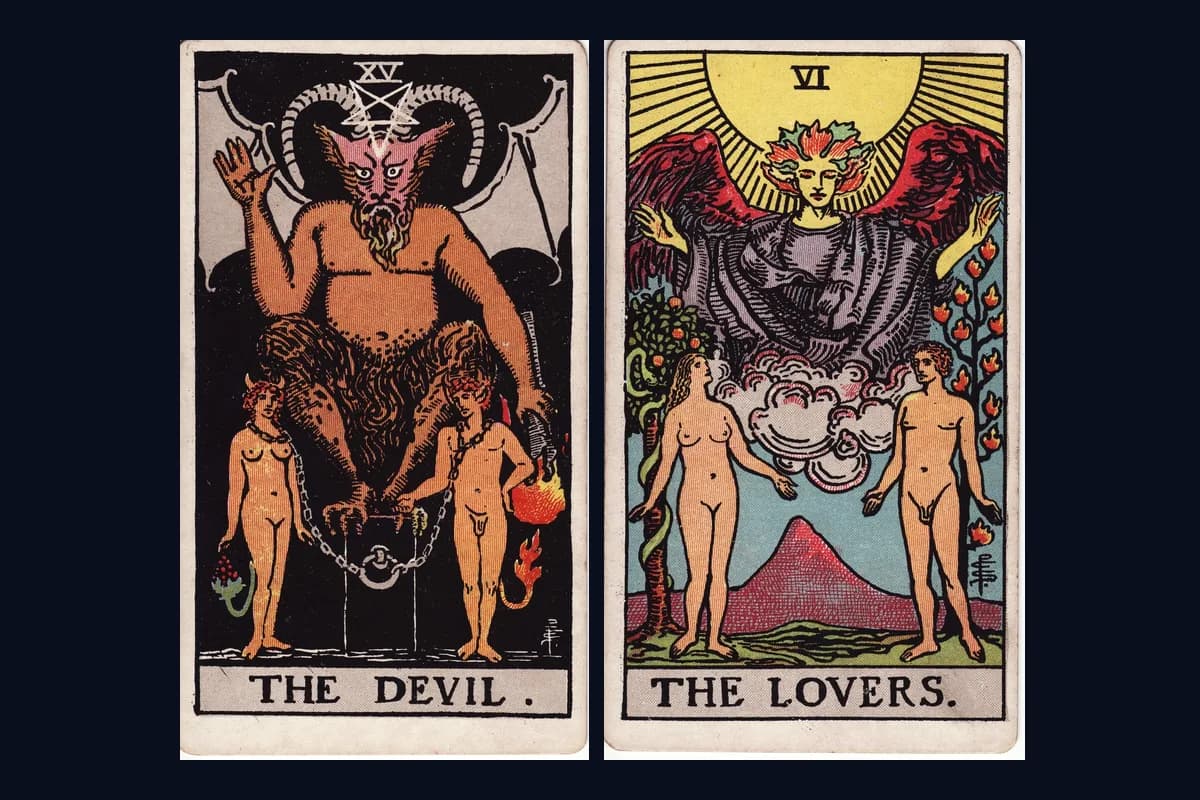
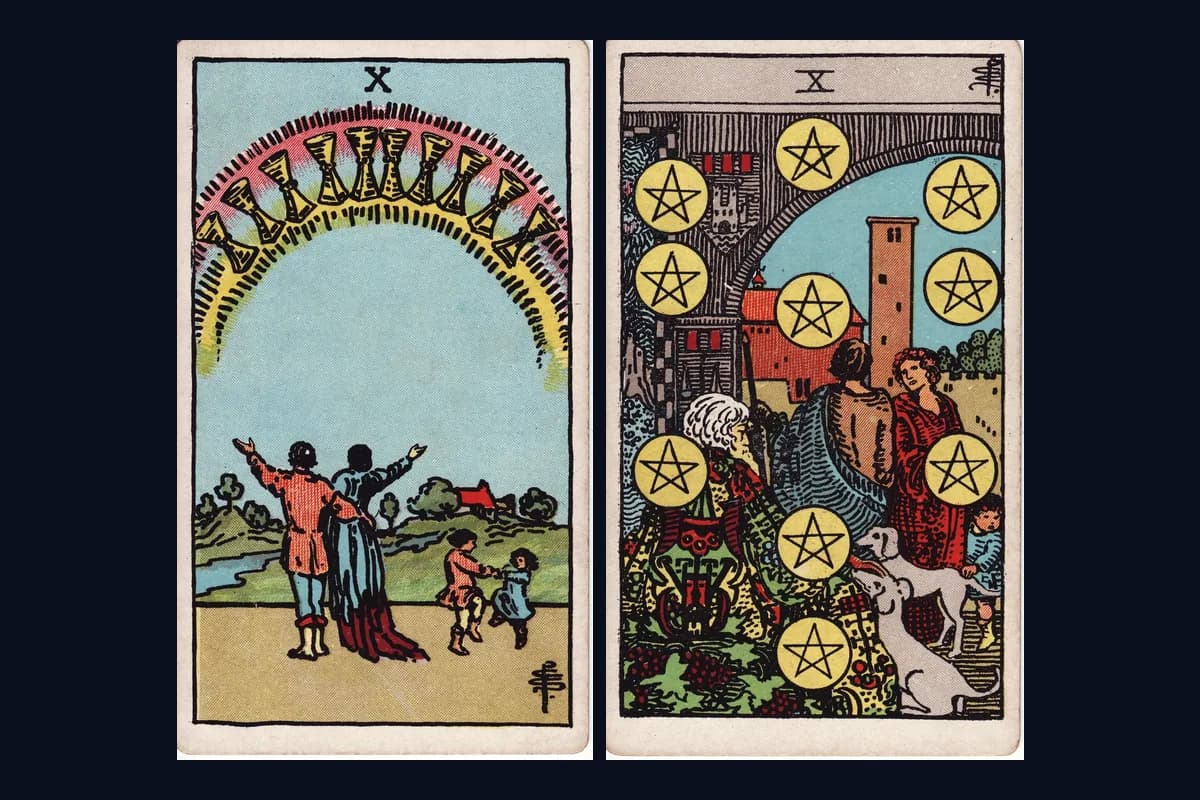
Tarot Card Combinations
The Wheel of Fortune and the Two of Cups
The Wheel of Fortune and Two of Cups tarot combination signals a meeting that feels fated. A snake slides down one side of a wheel in the clouds, a jackal-headed figure rises on the other, and a sphinx sits on top. On the next card, two people face each other, cups held out. If you're asking whether this is your soulmate, look past the wheel to the other person's cup.

Climate scientist, ashtanga practitioner, and advocate for human rights and LGBTQIA+ equality.
What each card carries into a reading
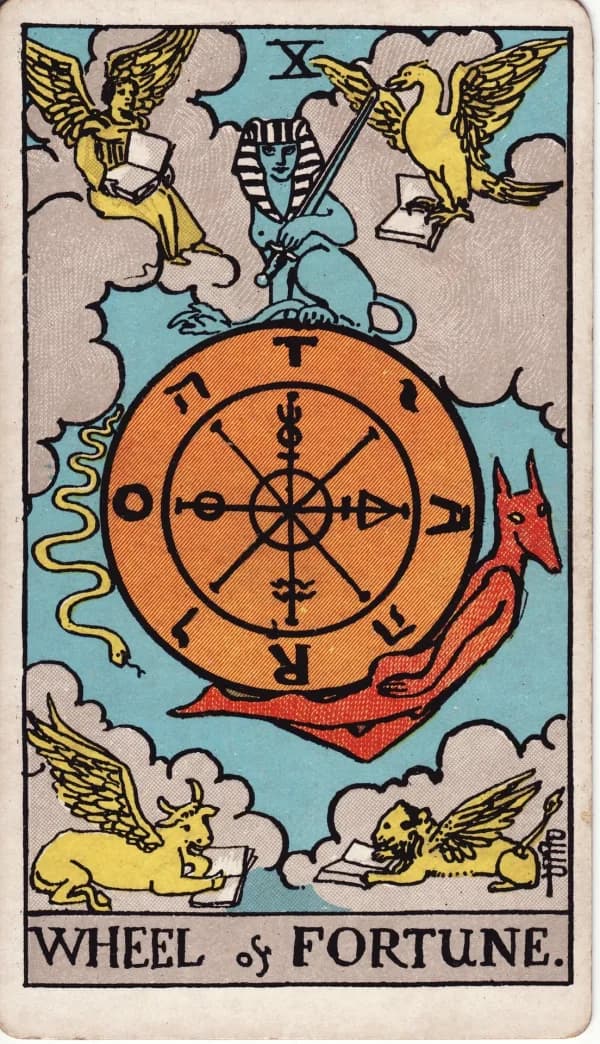
Look at the Rider-Waite-Smith Wheel of Fortune first. It's card X. The wheel is orange against a blue sky, with a yellow snake diving headfirst down the left side and a red, jackal-headed figure riding up the rim on the right. A blue sphinx holding a sword crowns the wheel. In the four corners, an angel, an eagle, a bull and a lion rest on clouds, each with a book.
A.E. Waite, who planned the card's symbols, named the snake himself: "I have, however, presented Typhon in his serpent form." And of the whole design: "Behind the general notion expressed in the symbol there lies the denial of chance and the fatality which is implied therein." Whatever his wheel is, it doesn't spin at random.
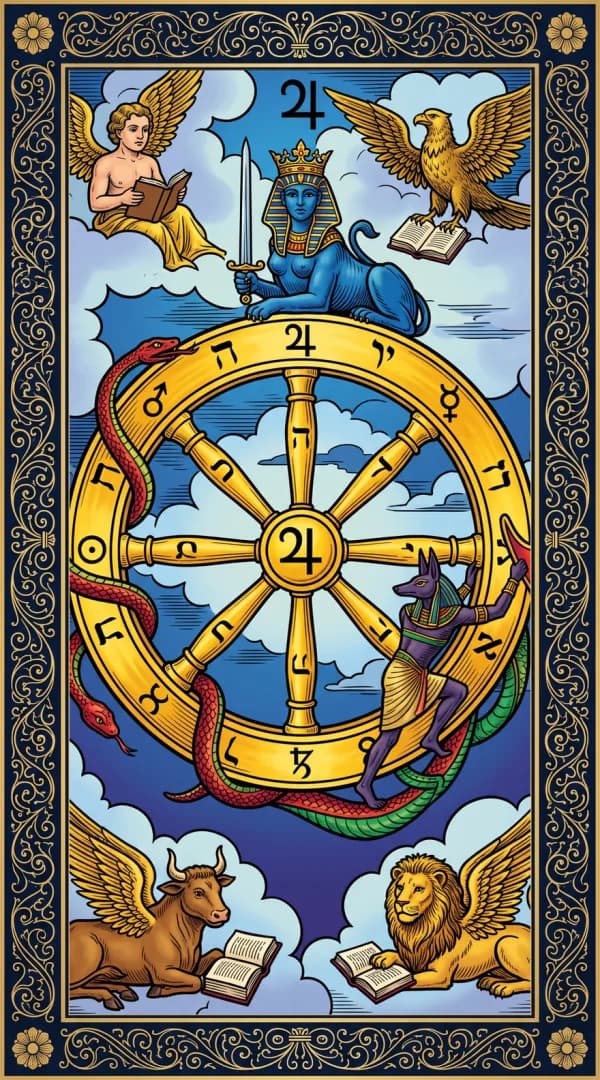
The Golden Dawn, the occult order Waite belonged to, gave the card the planet Jupiter and the Hebrew letter Kaph. Aleister Crowley glosses Kaph as the palm of the hand, where an old tradition reads a person's fortune. Book T, the order's tarot manual, titles the Wheel the "Lord of the Forces of Life."
Rachel Pollack, in Seventy-Eight Degrees of Wisdom, keeps the meaning plain: "In divinatory readings the Wheel of Fortune signifies some change in the circumstances of a person's life." Often you can't see the cause. Then comes the line this pair turns on: "The important thing about change is the reaction."
People used to ride the wheel. Pollack traces the card to medieval warnings against pride and to King Arthur's dream, in which "the goddess Fortuna turns the wheel and the king gets crushed at the bottom." Waite's card has no king. A snake and a jackal-headed god take the fall and the climb, and you're left off the wheel. It turns near you, not under you.
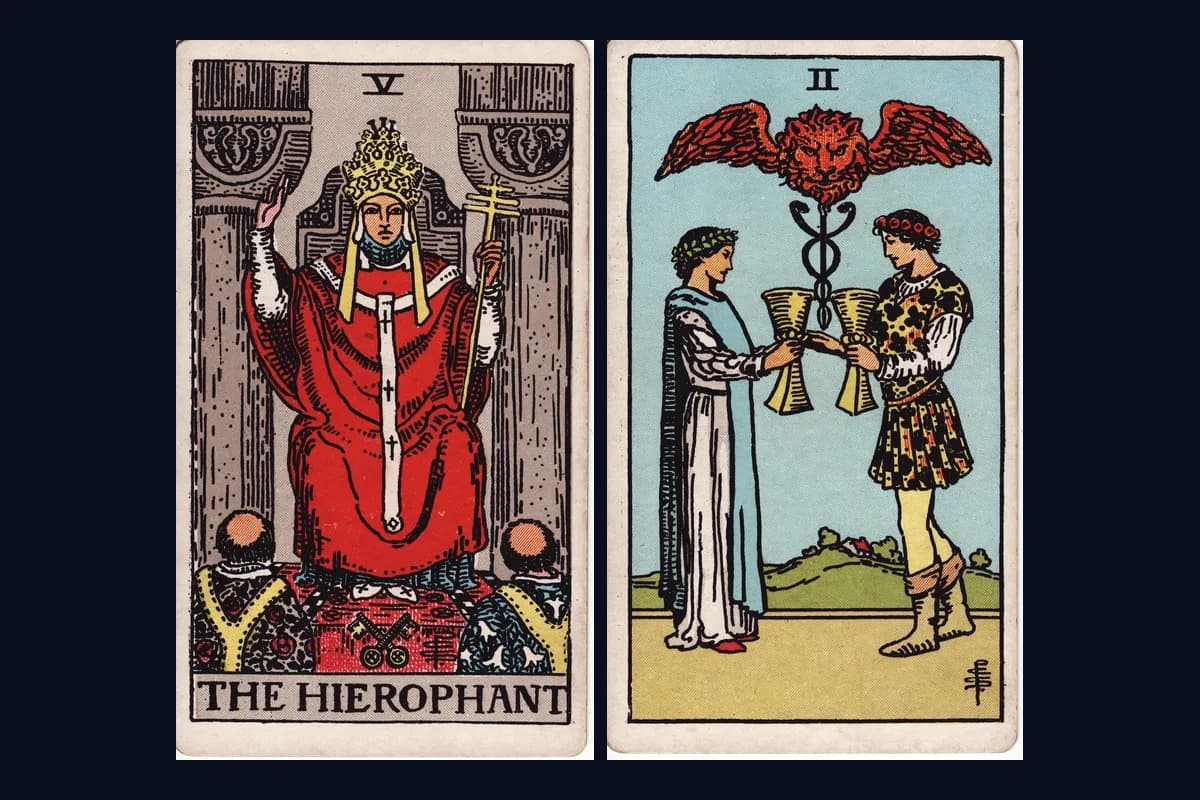
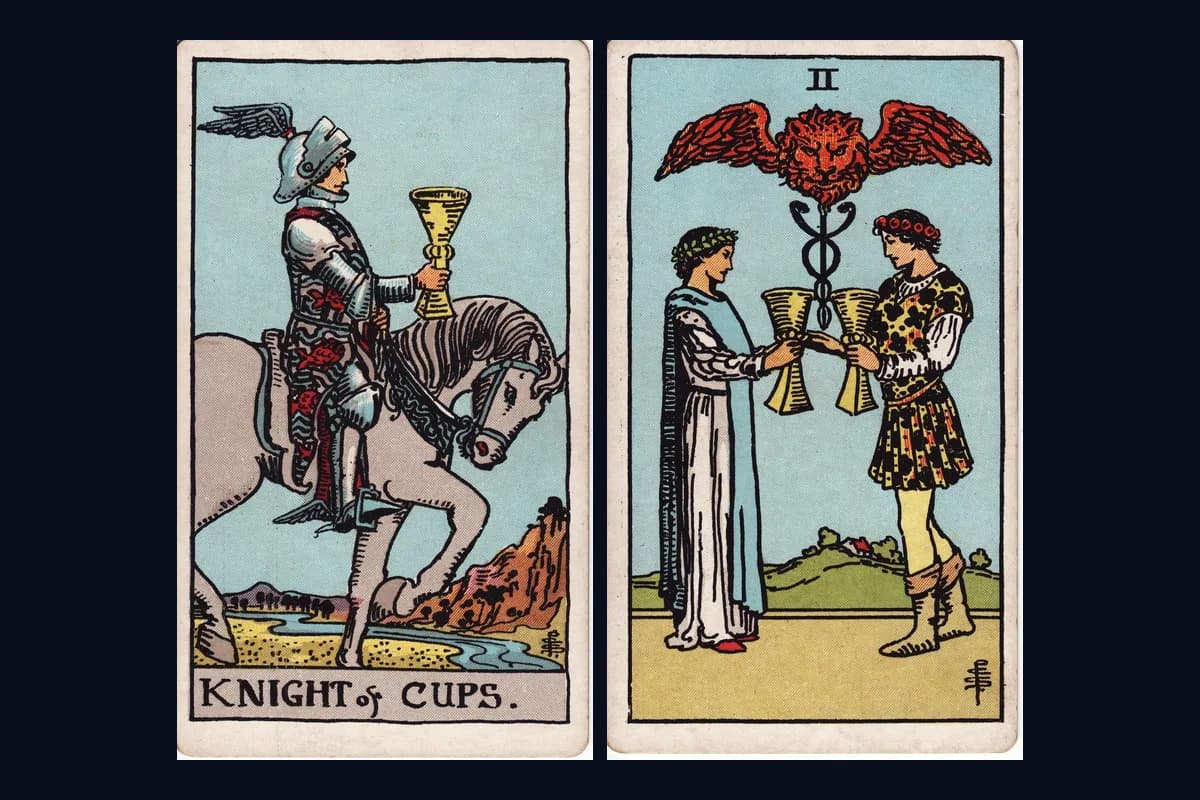
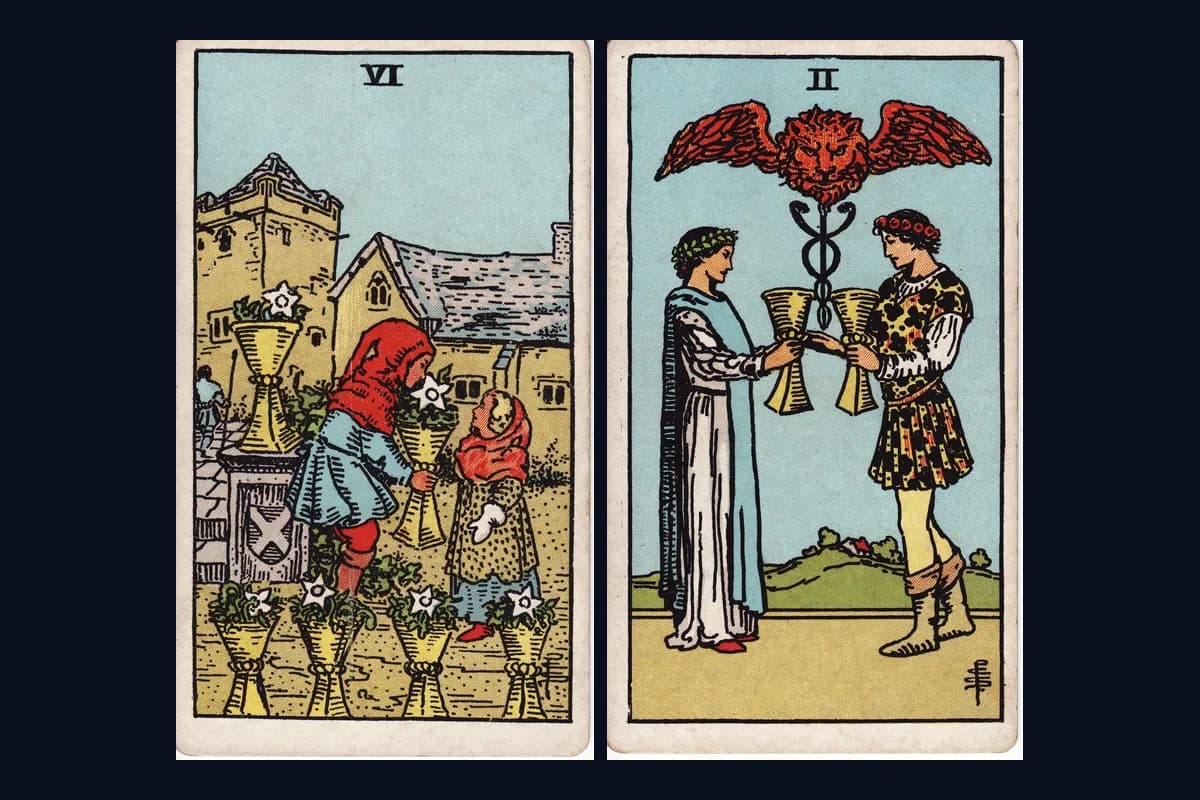
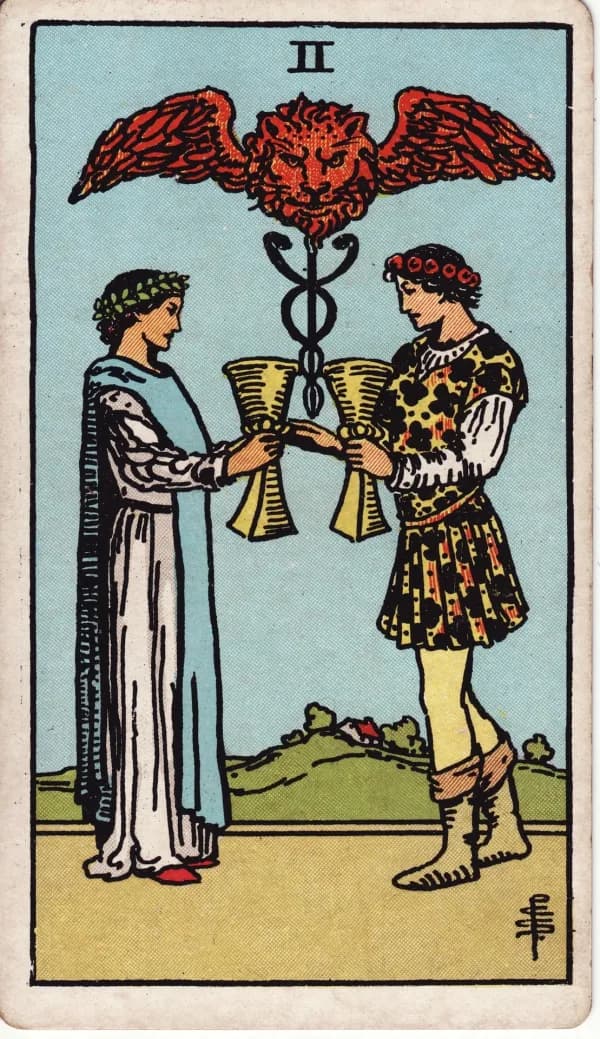
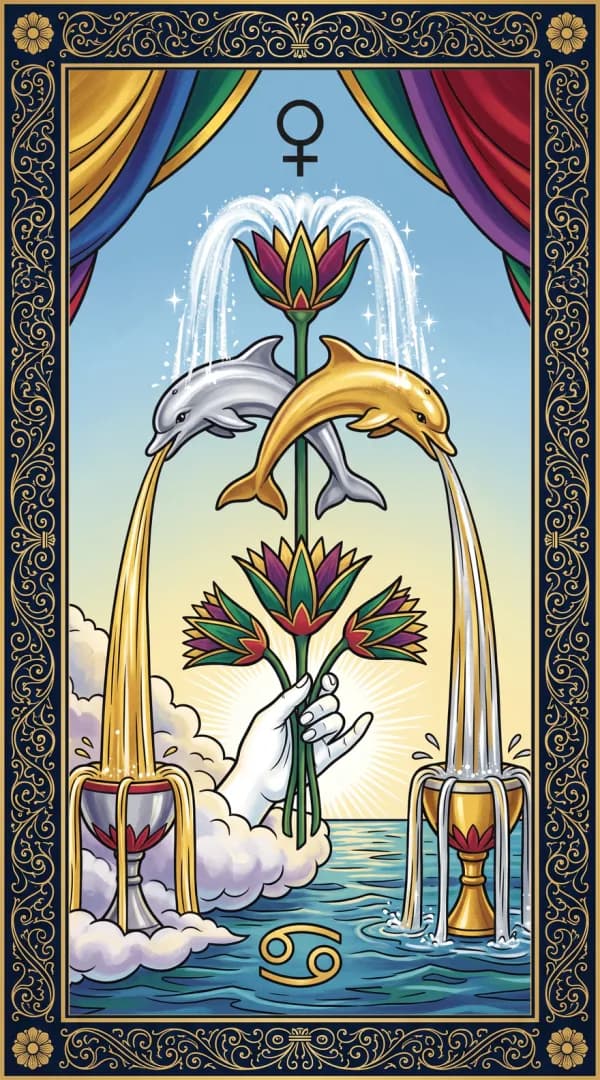
Now the Two of Cups. A young woman and a young man face each other, and each holds a gold cup. Between them rises the caduceus of Hermes, a staff wound with two snakes, topped by a red, winged lion's head. The Two is the second card of Cups, the suit of Water, and the Golden Dawn gave it Venus in the first ten degrees of Cancer. Crowley's deck simply calls it Love.
Pollack reads the gesture as joint work: "two people by uniting their separate qualities and abilities through love, produce something in their lives beyond what either would have achieved alone." Crowley writes that the card "might really be renamed the Lord of Love under Will." Love under will is love on purpose. And any two people can stand where these two stand.
Which figure were you most like when this person came into your life: the jackal-headed one on the way up, the snake on the way down or the sphinx that stays put? And in the Two, whose hand reached first?
What the Wheel of Fortune and Two of Cups mean together
Few pairs hold both of astrology's lucky planets. In 1647 the astrologer William Lilly called Jupiter "the greater Fortune" and Venus "the lesser Fortune." The Wheel is Jupiter's card, and the Two of Cups carries Venus. That's the astrological case for reading this pair as good news in love. Look at the Golden Dawn pair below: Jupiter's symbol sits at the top of that wheel and again at its hub.
This pair also sets a Major Arcana card beside a Minor, so read it at two heights. From above, the Wheel is a turn you'll date things from: before you met, and after. Up close, the Two is two people and two cups. A Major makes the moment bigger without settling how it ends.
Nobody agrees on what that turn is. Waite's design denies chance, while Crowley treats Jupiter as chance itself. Pollack says the person the Wheel happens to "is likely not to be responsible in any normal sense of the word." Robert Wang, in The Qabalistic Tarot, answers, "We are solely responsible for our own destinies." And Theresa Reed, The Tarot Lady, says she believes "nothing is fated, that everything is fluid."
So the two cards, read together, split the work: the Wheel can decide when you meet, but only the two of you decide what the meeting becomes.
The Golden Dawn added a condition. Book T reads the Wheel this way: "Good fortune and happiness (within bounds), but sometimes also a species of intoxication with success, if the cards near it bear this out." Beside a Cups card, that intoxication has a familiar shape: the first month, when everything feels arranged and nobody has had to choose anything yet.
Go back to how the two of you met. Which parts were chance, and which parts has each of you chosen since?
What the pair says about meeting your soulmate
No card can tell you whether someone is your soulmate. What this pair can show is the shape of the connection. The Wheel puts your meeting on a turn neither of you planned, and in the Two both people hold a cup out, so the feeling runs both ways, at least for now. Forever isn't on either card. Here, a soulmate is someone you keep choosing, and who keeps choosing you.
With someone you've just met, the Wheel is the train you nearly missed, the friend of a friend. Then come the weeks after. Who texts first. Who shows up.
In an existing relationship, the Wheel brings a change you go through together, such as a move or a job in another city. Biddy Tarot notes, "In some cases, the Two of Cups can refer to a marriage, proposal or engagement." The same change can step things up or test you. If it's a wedding, the Hierophant and Two of Cups combination asks who blesses it.
For the right person at the wrong time, the Wheel is the card of things coming back around. Sometimes a person does. Sometimes only the memory does. The Six of Cups and Two of Cups combination reads that kind of return up close.
If you're waiting for them to make a move, notice what the Wheel can't do. It can put two people in the same room. It can't walk either of them across it. The Knight of Cups and Two of Cups combination takes that question head-on. And if they've already said no, believe them over the cards.
Say either of you is already promised to someone else. A meeting that felt arranged doesn't cancel that pledge. If a relationship hurts you, the sense that it was fated is no reason to stay.
In a Celtic Cross, suppose the Wheel lands in the eighth position and the Two in the tenth. Brigit Esselmont of Biddy Tarot describes the eighth as the "people, energies or events which will affect the outcome of the question and are beyond the querent's control." The tenth is the outcome, with a condition: "It assumes the outcome based on the querent continuing their current course of action." That's as close to fated as a spread gets, and it still has an if in it. The other person is one of those people beyond your control, so the if is theirs too.
Yes or no? Upright, it leans yes. Crowley reads the Wheel as a change of fortune that "generally means good fortune because the fact of consultation implies anxiety or discontent." It's yes to the timing and yes to the feeling, and the bond stays a yes while both of you keep choosing it. But with the Wheel reversed, it's not yet: the feeling is there and the timing isn't. With the Two reversed, it's no, however good the timing, because the feeling has to run both ways. With both reversed, it's no, as far as this reading can see.
Picture the week you met. What would your Wheel of Fortune look like if it held that moment, and what would sit on top in place of the sphinx? That image belongs in your deck.
The Wheel first, or the Two first
In a three-card spread of past, present and future, order changes the reading. Tina Gong of Labyrinthos says a line of three cards is good at suggesting "some sort of linear path, sequence of events, cause and effect."
The Wheel first, then the Two of Cups is the hopeful order, the one people mean when they call a relationship fated. Something shifts (a new job, or a plan that fell through), and it puts someone in your path. And then the meeting becomes a pledge. With the Wheel in the past and the Two in the present, that part has happened. The Wheel did its share. The two of you made the pledge. With the Wheel in the present and the Two in the future, the pledge is still to come, if you both make it.
The Two of Cups first, then the Wheel runs the other way. The bond is already there when the turn arrives: a family that needs one of you, a season that won't last. Pollack doesn't soften it. A love affair can end, she writes, "simply because life continues." Read that as the reason the pledge matters, not as a forecast.
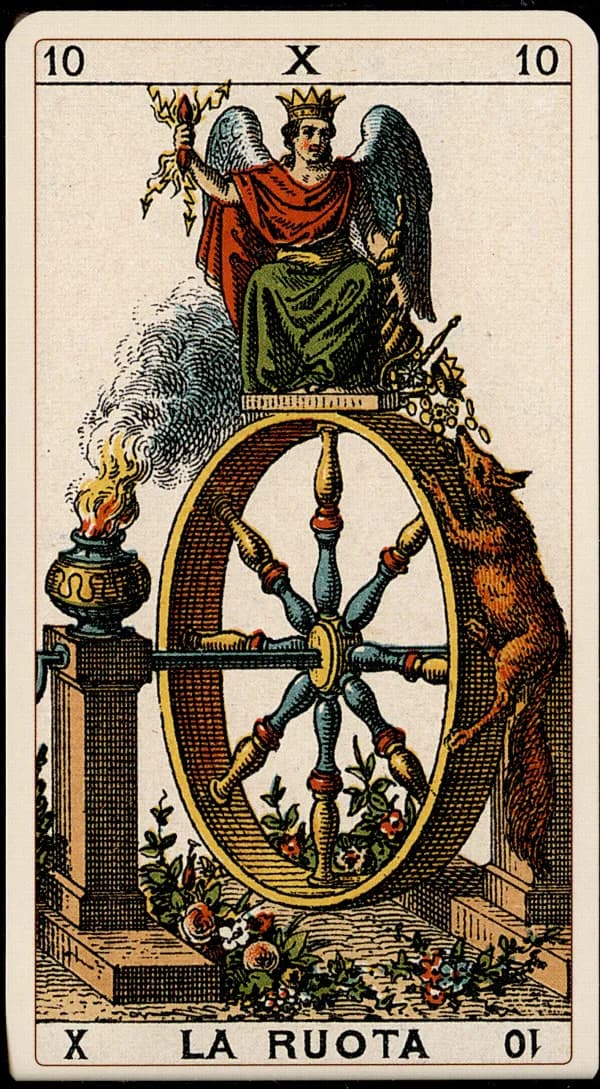
The Milanese Wheel below has no snake and no sphinx. A crowned, winged figure on top raises a thunderbolt, the weapon of Jove (another name for Jupiter), while a horn of plenty spills down the rim and a fox climbs after whatever falls. Plenty for one, a scramble for another: the same split runs through the reversed Wheel.
Orientation matters too. If you read reversals, one reversed card shows which half is stuck: the timing or the two of you. Waite's reversed Wheel is a surprise: "Increase, abundance, superfluity," more of everything. But Pollack reads it as "a struggle against events," and Biddy Tarot lists bad luck and resistance to change. The table sides with Pollack and Biddy Tarot.
| Orientation | Reading |
|---|---|
| Both upright | Good timing and a feeling that runs both ways; the pledge is mutual, and keeping it takes both of you |
| Both reversed | The timing is off and the feeling is out of step; let this turn pass, then see whether it was the person or the moment |
| Wheel upright, Two reversed | The timing is right, but the feeling runs one way; a well-timed meeting can't make someone reach back |
| Wheel reversed, Two upright | The bond looks real, but circumstances won't cooperate; distance or timing is the obstacle, so give it time instead of forcing it |
Which came first in your reading, the Wheel or the Two? If it was the Two, what's about to change, and are you both willing to move with it?
What Jupiter and Venus add to this reading
The Two of Cups is Venus in Cancer, the Moon's sign, and Cancer is Jupiter's exaltation, astrology's word for a sign that lifts a planet up. That puts the Moon, Venus and Jupiter in one card. Crowley says as much in his entry for the Two, then adds, "These are, superficially, the three most friendly of the planets." Notice the hedge: friendly on the surface.
Elemental dignities are the Golden Dawn's rules for how the elements of neighboring cards help or hinder each other. They can't settle this pair, because in that system the Wheel is a planet card with no element of its own.
The Tree of Life, the Qabalah's map of ten spheres joined by twenty-two paths, draws a cleaner line. Wang writes that the Wheel's path "runs from Chesed to Netzach." Chesed (mercy) is Jupiter's sphere. Netzach (victory) belongs to Venus. The Wheel's own path starts at one Fortune and ends at the other.
The sky stages a meeting of its own in 2027 (all dates Universal Time). On July 26, 2027, Jupiter leaves Leo for Virgo. On August 26, 2027 (the evening of August 25 in the Americas), Venus catches it at six degrees of Virgo. The two Fortunes meet. But look where. Virgo is Venus's fall and one of Jupiter's detriments, which means each planet works against its grain there. And both planets sit about four degrees from the Sun, lost in its glare.
Fortune can arrange your meeting. Whether it becomes anything gets settled in ordinary weeks, Virgo's territory. The sky can't tell you who'll call.
Which ordinary week with this person told you more than the day you met?
The number beneath the meeting
Add the Wheel's 10 to the Two's 2 and you get 12. That's the Hanged Man.
He's card 12 in all three decks on this page, called L'Appeso (the hanged one) in the Milanese. On the Rider-Waite-Smith card, a man hangs upside down by one foot from a living tree, hands behind his back, a halo around his head. Waite points out that "the face expresses deep entrancement, not suffering." After a card of constant motion, you get a man who isn't going anywhere, and doesn't seem to mind.
You can't turn a fated meeting into a mutual bond by wanting it harder. The Hanged Man waits on purpose. But that isn't the same as putting your life on hold for someone who hasn't decided, and you get to choose how long a pause lasts.
The Golden Dawn gave him Water, the element of Cups. His Hebrew letter is Mem, meaning water, and Book T titles him "The Spirit of the Mighty Waters." So Jupiter's card plus a Water card adds up to the Major Arcana's elemental Water card.
Reduce 12 and you get 3 (1 + 2), the Empress, who is Venus's card in the Golden Dawn, so the reduction lands back on the planet that rules the Two's slice of Cancer. Not every reader adds card numbers, and nothing breaks if you don't.
Turn the connection upside down, the way the Hanged Man sees it. From the other person's side, does it look like fate, or like a choice they're still making?
Questions readers ask about this combination
Does the Wheel of Fortune and Two of Cups mean I've met my soulmate?
No card can confirm a soulmate, but the Wheel of Fortune and Two of Cups describe the shape of one. The Wheel puts the meeting at a turning point you didn't plan, and the Two shows a feeling that runs both ways, for now. Whether it lasts depends on both people choosing it, again and again. If the other person has told you no, believe them over the cards.
What does the Wheel of Fortune and Two of Cups mean in a love reading?
In a love reading, the Wheel of Fortune and Two of Cups describe a turn of events that brings two people together, or one that moves an existing couple forward or tests it. For a new connection, it's a meeting that feels arranged. For a couple, it's a change you go through together, such as a move or a job in another city. The timing comes from outside you. The bond is chosen.
What does it mean when the Wheel of Fortune and Two of Cups are both reversed?
With the Wheel of Fortune and Two of Cups both reversed, the timing is off and the feeling is out of step, so the answer is no, at least in this reading. Let this turn of events pass, then see whether it was the person or the moment. A.E. Waite's reversed Wheel is surprisingly generous, listing increase and abundance, while Rachel Pollack reads it as a struggle against events. Not every reader uses reversals.
What planets connect the Wheel of Fortune and the Two of Cups?
Jupiter and Venus. The Golden Dawn gives the Wheel of Fortune to Jupiter and the Two of Cups to Venus in Cancer. In 1647 William Lilly called Jupiter the greater Fortune and Venus the lesser, so the pair holds both of astrology's lucky planets. Cancer ties them closer, because it's the sign where Jupiter is exalted. In the Golden Dawn's scheme the Wheel has no element of its own, so the planets carry the link.
Is the Wheel of Fortune and Two of Cups a yes or no combination?
Upright, the Wheel of Fortune and Two of Cups lean yes: yes to the timing and yes to the feeling. The bond stays a yes only while both people keep choosing it. With the Wheel reversed, it's not yet, because the timing is off. With the Two reversed, it's no, because the feeling isn't running both ways. With both reversed, it's no, as far as the reading can see.