Tarot Card Combinations
Knight of Cups and Two of Cups
The Knight of Cups and Two of Cups tarot combination signals a romantic offer moving toward a bond that could be mutual. A knight holds out a gold cup while his horse steps toward a stream. No gallop. A walk. On the next card, two people stand so close their cups nearly touch. If you're wondering whether he'll make a move, watch the pace as closely as the cup.

Climate scientist, ashtanga practitioner, and advocate for human rights and LGBTQIA+ equality.
What each card says before they meet
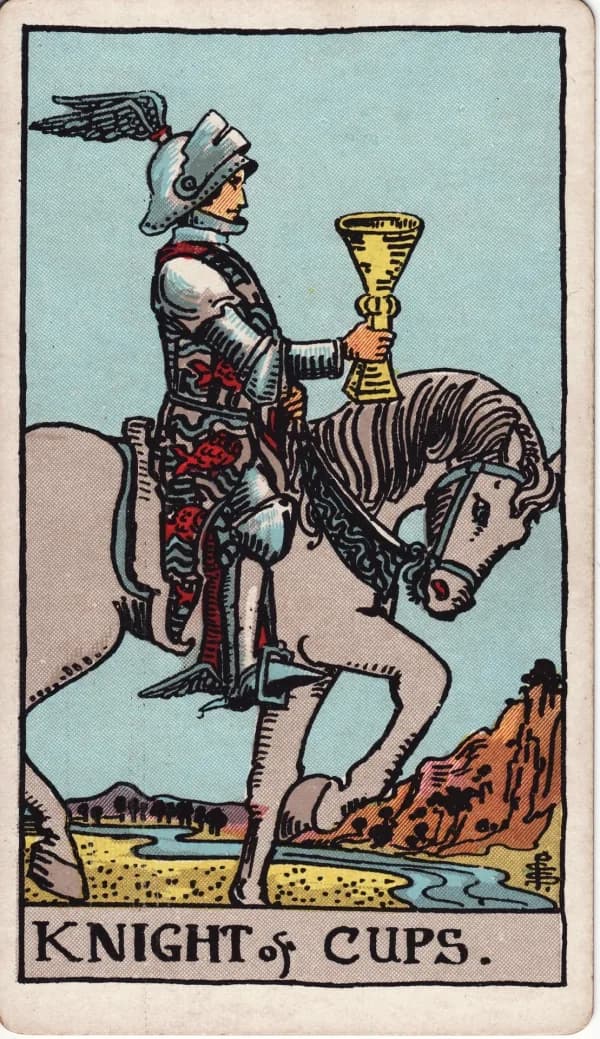
Start with the horse. In the Rider-Waite-Smith Knight of Cups, it walks with its head bowed and one front leg lifted high, caught mid-step at the edge of a narrow stream. Its rider wears silver armor, red fish on his tunic, wings on his helmet and heel. He holds a gold cup out in front of him. You can't see what's in it.
Rachel Pollack, in Seventy-Eight Degrees of Wisdom, names the pull inside this card. A Knight is built for action, she says, and then: "Water, on the other hand, symbolizes passiveness." He's both, so he rides at a walk. Slow isn't stopped, though. In her words, "his horse is spirited in its slowness."
The card carries no number. The Golden Dawn, the magical order A.E. Waite belonged to, has two figures for him. Book T, its tarot manual, keeps a mounted Knight of Cups, the fiery part of Water. Robert Wang, in The Qabalistic Tarot, and the deck in section II use the Prince of Cups, the airy part of Water, instead.
Your question is older than this picture. In the Grand Etteilla, a French fortune-telling deck named for the card reader Etteilla, this Knight's word is Arrivée, arrival. Upside down it becomes Friponnerie, roguery. Waite's list runs the same way, from arrival upright to fraud reversed. So will he come, and does he mean it? Both questions have sat on this card for well over a century. Upright, it's mostly about the first.
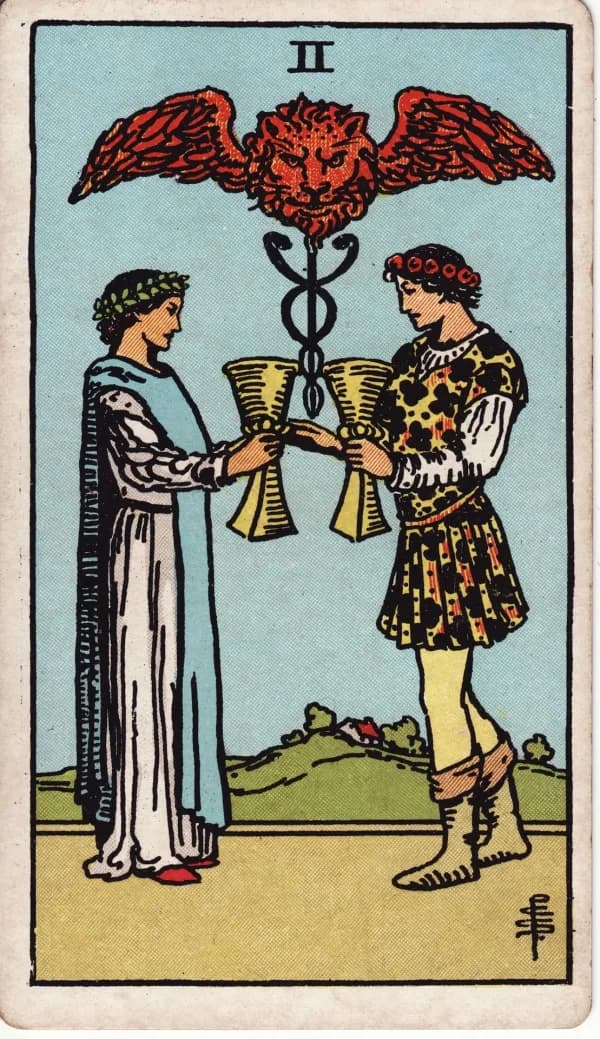
Now the Two of Cups, where a cup gets an answer. A young woman with laurel in her hair stands face to face with a young man wearing red flowers in his. Their gold cups almost touch. Look at their eyes. She's looking at him. His are lowered to the cups. Between them rises what Waite calls the "Caduceus of Hermes," two snakes twined around a staff, crowned by a winged red lion's head. Behind them, a red-roofed house sits on a green hill.
Pollack reads the Two as a start. Comparing it with the Lovers, she writes, "the Minor card emphasizes the beginning of a relationship." It's card two, so the Golden Dawn set it on Chokmah (Wisdom), the second sphere of the Tree of Life. The order called it the "Lord of Love" and gave it Venus in the first ten degrees of Cancer.
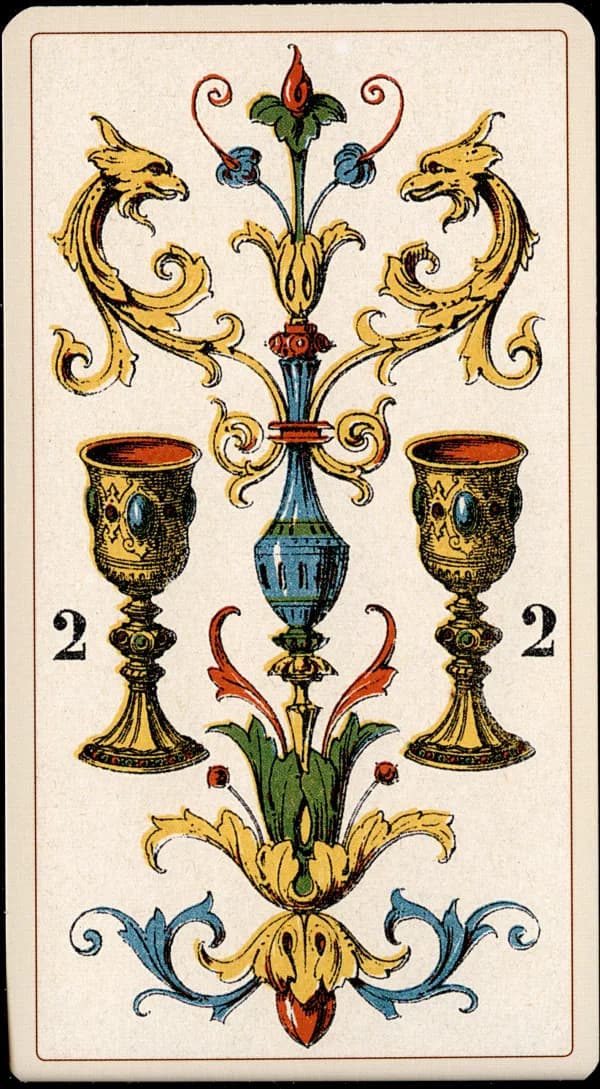
The couple is newer than the card. Waite says the emblem above them came from older cards: "It is a variant of a sign which is found in a few old examples of this card." The Milanese Two in section IV has no people at all. But the love meaning didn't wait for the lovers. The Grand Etteilla already called this card Amour.
Count the figures across these two cards: one rider still on the way, and two people close enough to touch cups. Which one are you right now?
What the Knight of Cups and Two of Cups mean together
Most pairs don't share a messenger. This one does. Waite's meanings for the Knight open with arrival and approach, sometimes a messenger's. His helmet and heel carry wings like the ones Hermes wears. Waite ties the helmet to imagination instead, so the likeness comes from the picture, not his text. The Two holds Hermes' own staff between its cups: the caduceus, the herald's wand the messenger god carried. One card is the message on its way. The other is the message received.
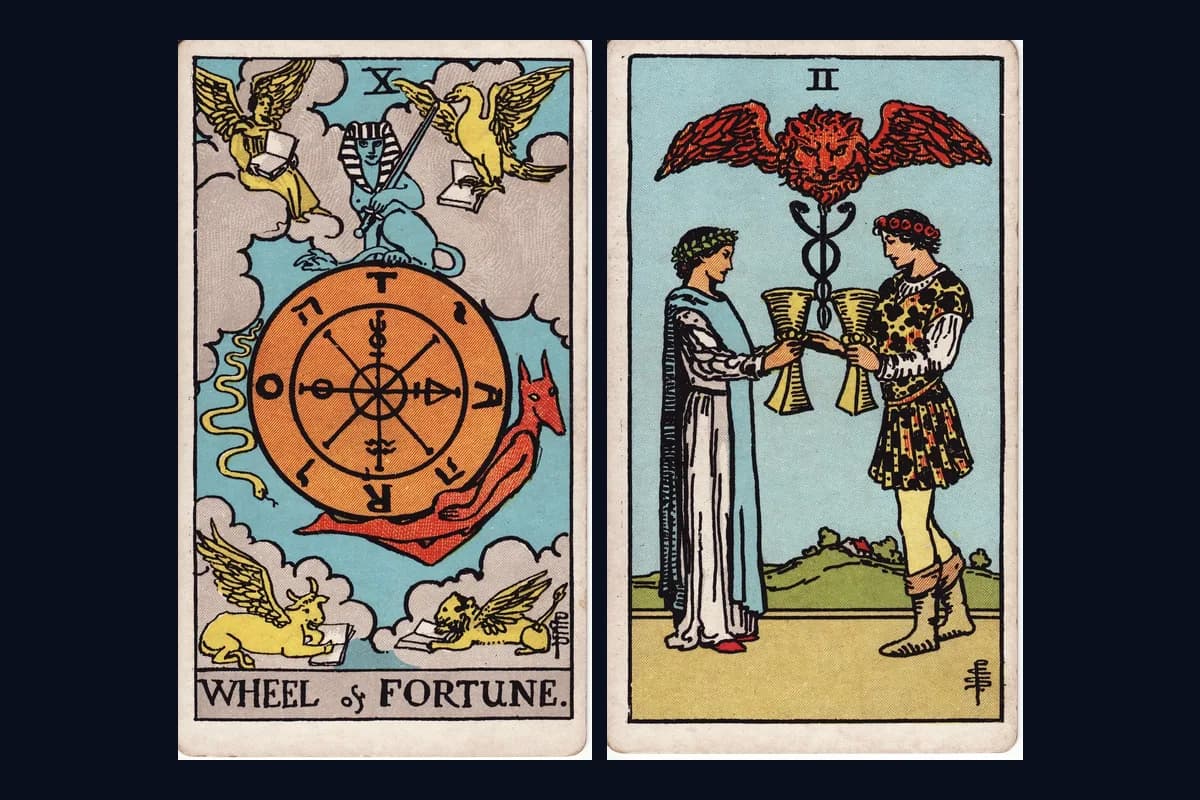
Neither is a Major Arcana card, so the scale is everyday: a message, a first date, a question finally asked out loud. A court card beside a numbered card gives you a who and a what. The Knight is a person, or an approach, and the Two is what he's riding into. Swap the Knight for a Major and the scale jumps: the Wheel of Fortune and Two of Cups combination asks about fate.
Astrology.com's page on this pair says "both individuals should be willing to express their emotions and passions openly and honestly." Both. The rider isn't the only one who can move.
Upright, the Knight's known weak spot isn't dishonesty. Brigit Esselmont of Biddy Tarot puts it kindly: "He shares his love freely with others, without constraint or worry; he is in love with love itself." Someone can mean every word and still be more in love with the feeling than the person. The Two is two particular people, face to face. Next to it, the Knight's romance has an address.
So the pair comes down to one sentence: the interest looks mutual, but this Knight rides at a walk. Whether someone follows through will show in what they do.
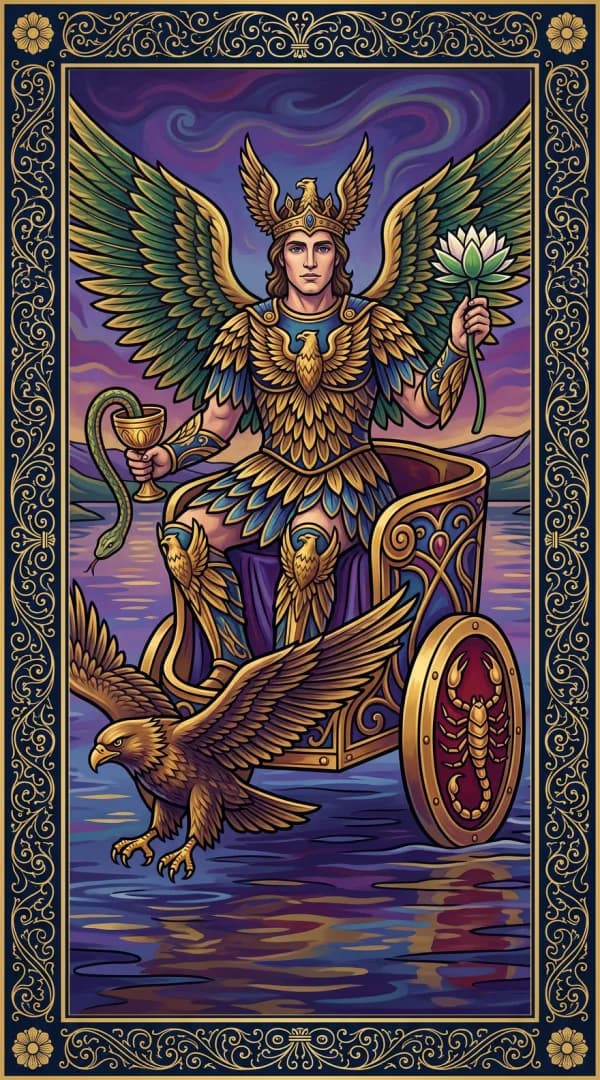
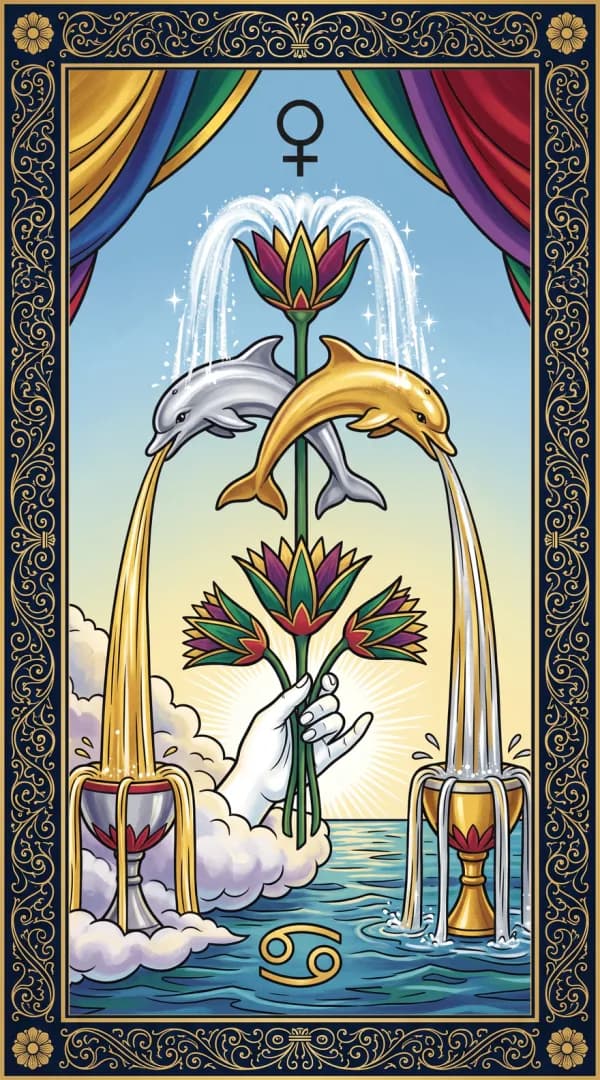
The Golden Dawn deck below trades the horse for an eagle-drawn chariot. Its Prince of Cups doesn't set his own pace. Book T says of its Princes: "Yet is his power illusionary, unless set in motion by his Father and Mother," meaning the two court cards ranked above him. That's about who starts things, not whether he means it. Look at the Golden Dawn Two. A silver dolphin pours gold into one cup, a gold dolphin pours silver into the second, and neither waits for the other.
If the message you're waiting for arrived tonight, what would it have to say for you to believe it? And would you answer?
What the pair says about whether he'll make a move
If you're asking whether he'll make a move, this pair leans yes, at the Knight's pace. Joan Bunning of Learning the Tarot writes of the Two: "Whenever two forces are drawn together, there is the potential for bonding." Potential is the honest word. Neither card carries a date. But weeks of nothing at all are an answer too, and it's the other person's, not the cards'.
The Knight doesn't have to be him. A court card can stand for anyone, of any gender, including you. Theresa Reed, The Tarot Lady, doesn't hedge: "Make your move, playa. Go for it!" And a no you've already heard still stands.
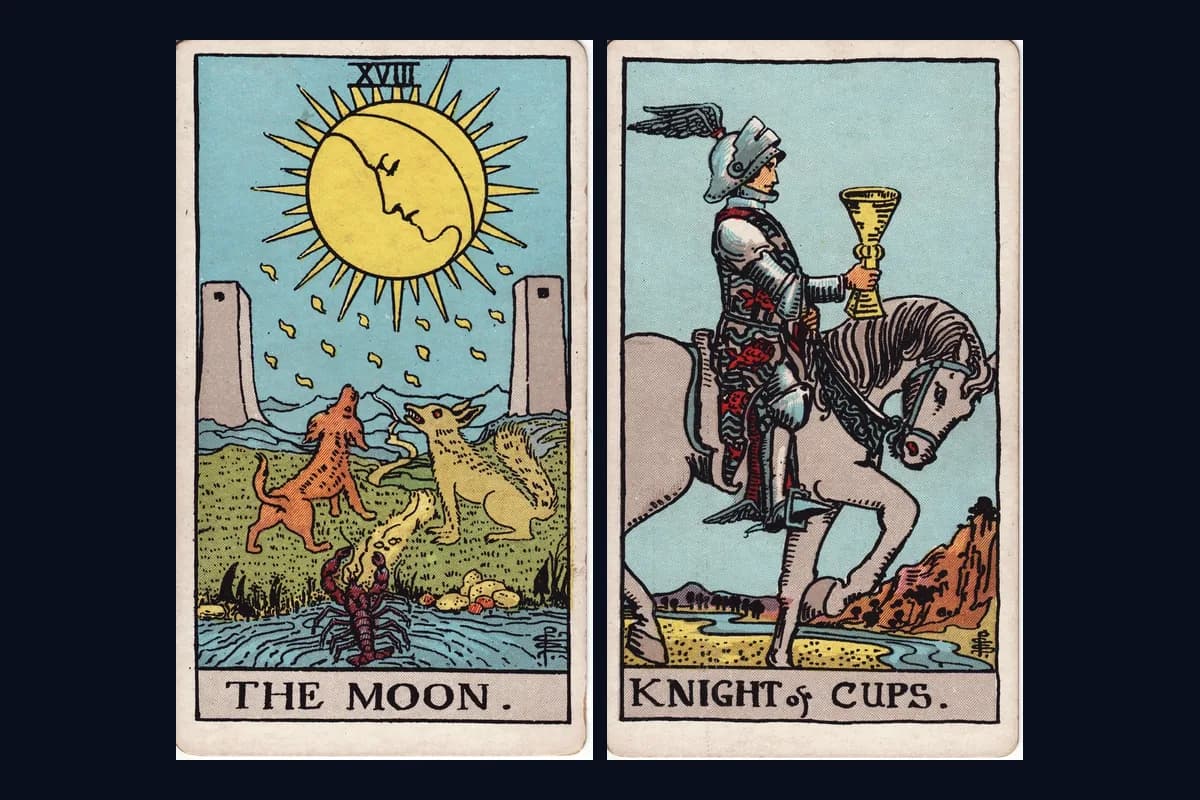
When the question is whether the offer is genuine, the upright pair is reassuring. But no card can vouch for a person. Tina Gong of Labyrinthos warns about the Knight reversed: "Be wary of lovers that whisper sweet nothings, and make sure that they truly mean what they say." You find that out the ordinary way. Do they follow through? Does a direct question get a straight answer? Or maybe your real question is whether someone's being honest with you. Read the Moon and Knight of Cups combination.
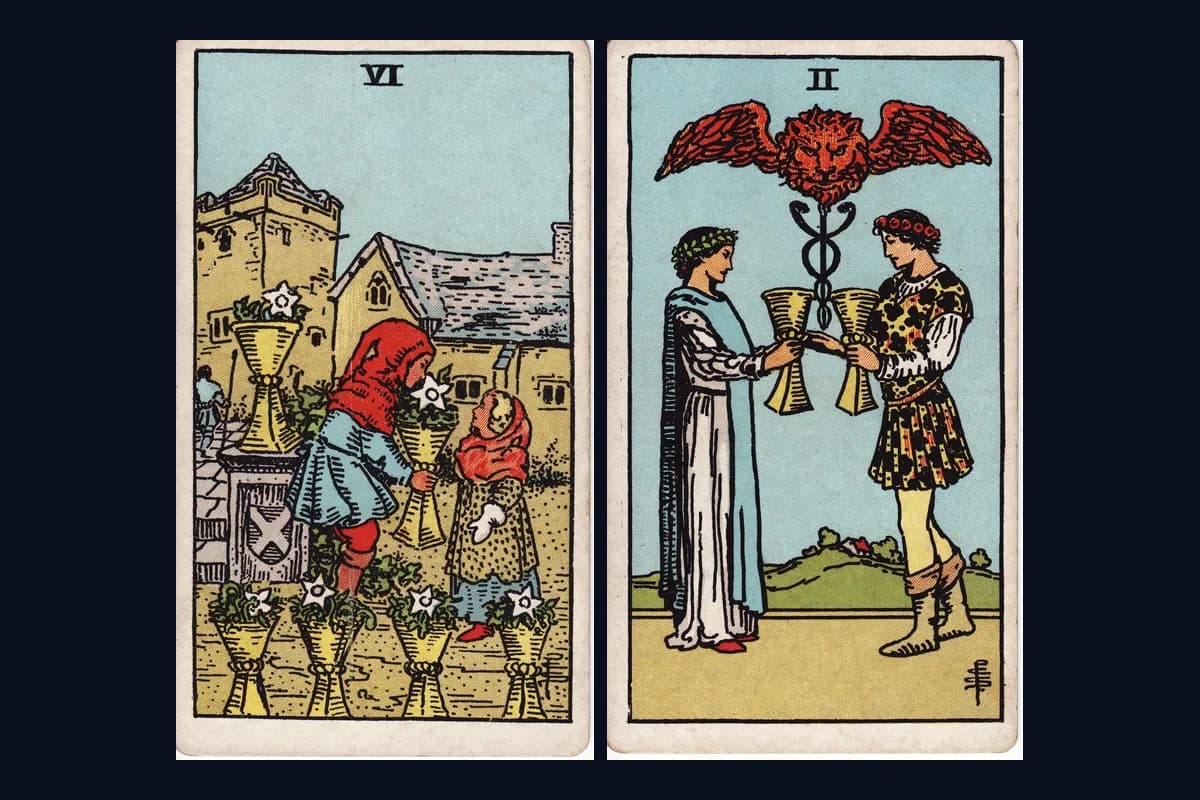
If the rider is someone from your past, the Two has room for that: Bunning's list of actions for it includes "healing a severed relationship." The Six of Cups and Two of Cups combination reads that kind of return more closely.
If the person you're hoping will move is with someone else, go back to the Two. It shows a pledge between two people. It doesn't say which two. If they're still in it, that comes first, and you don't have to wait on them.
In a Celtic Cross, say the Knight lands in the near-future position and the Two in hopes and fears, the ninth card. Reed describes the near-future slot as "something that is coming into being soon." That's a place in the spread, not a date. In the ninth, the Two is the bond you're hoping for and afraid you won't get. Tarot author Mary K. Greer's reminder about hopes and fears: "They aren't predictions."
Yes or no? Upright, it leans yes, slowly. The condition is that someone acts, and that can be you, because no card can promise what another person will do. With one card reversed, it's not yet, and it may be no: the welcome or the follow-through is missing. With both reversed, it's no for now.
Look at the house on the hill behind the couple in the Two. If your Knight were riding toward it, what would he carry instead of a cup? That image belongs in your deck.
The Knight first, or the Two first
The Knight of Cups first, then the Two of Cups is the hopeful order. It's how the cards sit in section I: the Knight faces right, toward the couple. The pair pictures an approach that's met.
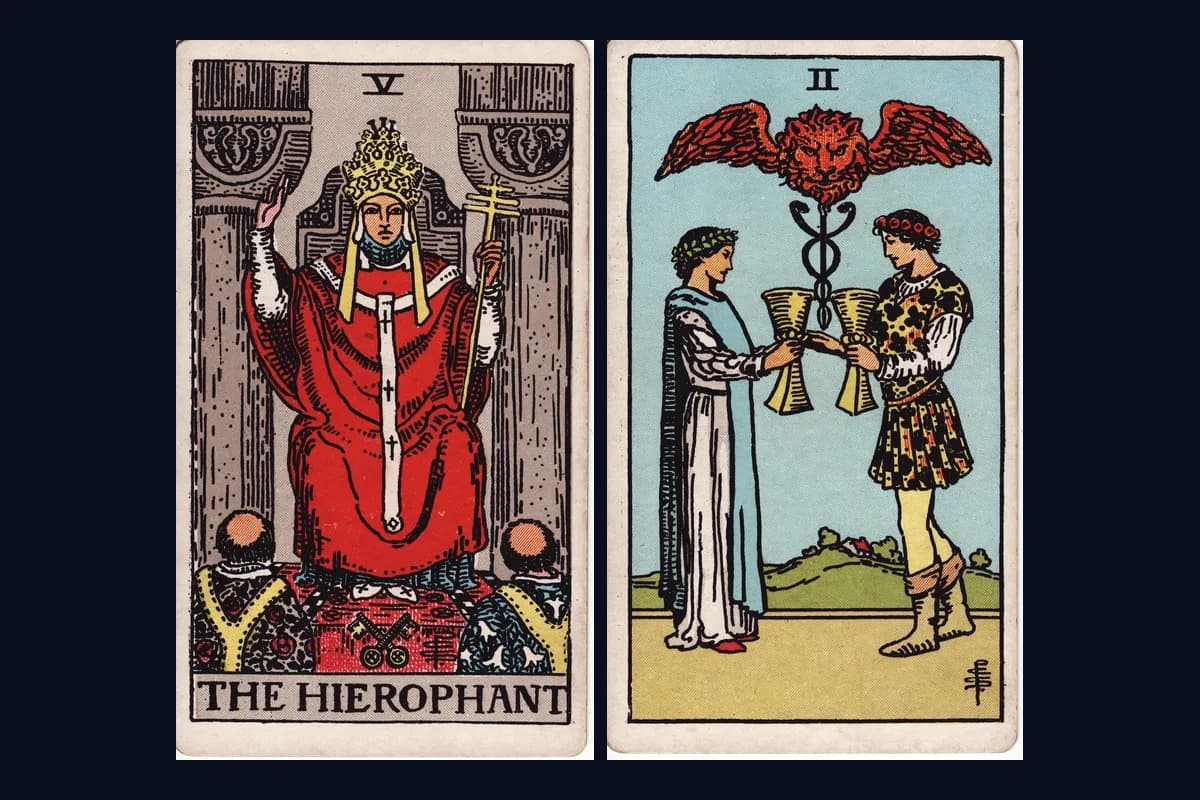
The Two of Cups first, then the Knight is the cautionary one. Here he rides away. The feeling came first. But nobody has acted on it. Often it's shared and never spoken. If you want it named, you can name it. If the unspoken thing is a proposal, the Hierophant and Two of Cups combination asks who else needs to hear it.
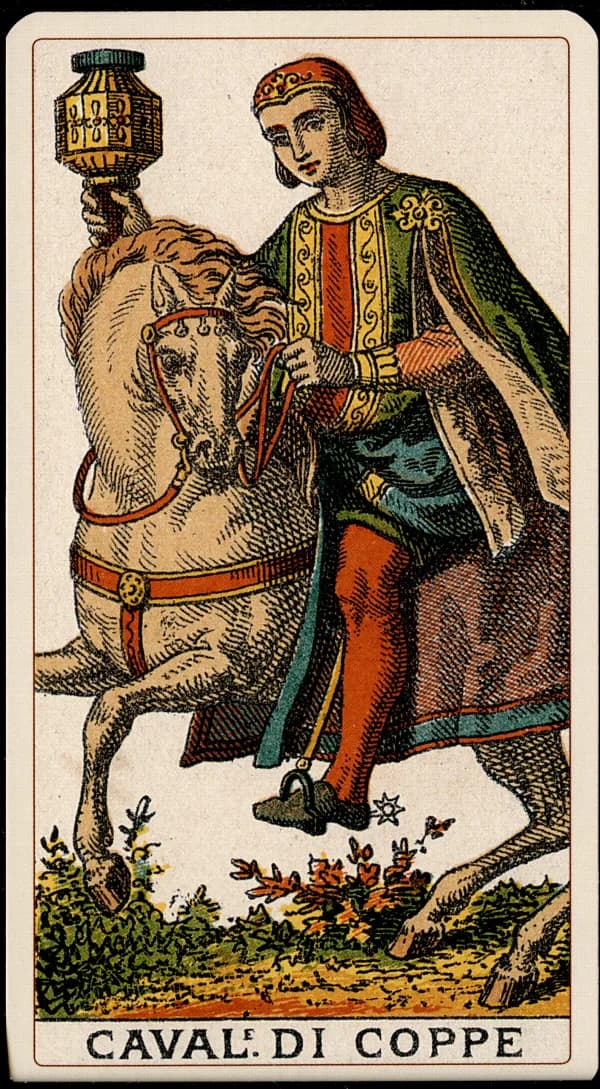
Not every reader minds which way a figure faces, and not every deck agrees: the Milanese rider below faces left, his lidded cup held high.
In a three-card spread of "You, Relationship, Partner," one of the layouts Labyrinthos lists, put the Knight in the partner slot and the Two in the middle. Now move him into your slot. Same cards, and this time you're holding out the cup. Either way, the partner card shows how someone comes across, not what's in their head.
Orientation matters too. If you read reversals, one reversed card shows which side the snag is on: the offer or the answer. Waite's notes give the reversed Knight "Irregularity," milder than fraud, and the reversed Two "Passion," which reads as feeling out of balance rather than feeling gone. The table draws on those notes and modern readers.
| Orientation | Reading |
|---|---|
| Both upright | Interest that looks mutual, moving at the Knight's pace; speak up clearly rather than wait |
| Both reversed | Promises outrun follow-through and the bond is out of balance; it's no for now, and a plain conversation will tell you more than another spread |
| Knight upright, Two reversed | The offer reads as sincere, but the welcome isn't there yet; the feeling may run one way, and a no is an answer |
| Knight reversed, Two upright | The bond may be real, but the follow-through runs hot and cold; judge by what happens over weeks, not by what's promised in one evening |
Is the feeling between you already there, waiting for someone to say it out loud? Or is someone saying it first and hoping the feeling catches up?
What the sky says about timing
The Golden Dawn gave the Two of Cups to Venus in Cancer, a Water sign ruled by the Moon. The Two in section II carries the glyphs for Venus and Cancer. The Prince beside it, standing in for the Knight, rules from 20 degrees of Libra to 20 degrees of Scorpio, so most of his sky is Scorpio, Water too. By element, these two agree.
That matters in elemental dignities, the Golden Dawn's way of weighing a card by the cards on each side of it. Same-suit neighbors add weight, and that weight can tip either way. Book T gives the Two itself a range, from "Harmony, pleasure, mirth" to "folly, dissipation, waste, and silly action, according to dignity." So this pair alone can't tell you whether an offer is genuine. The cards beside it shade the reading, and what the person does settles it.
The timing systems don't agree, though. The Two's slice of Cancer runs from the solstice into the first days of July. The Prince's sky runs from mid-October to mid-November. Book T's mounted Knight sits in late winter. Three seasons, one pair. A timing system tells you which season a card belongs to. It can't tell you when a person will decide something.
Two stretches of 2027 echo this pair. Mercury, named for the god the Romans matched with Hermes, turns retrograde in Cancer on June 10, 2027, and turns direct on July 4. Astrologers read those weeks as slow ones for messages. Venus, the Two's own planet, enters Cancer on July 3, 2027, and stays until July 27 (all dates Universal Time). Draw this pair in those weeks and the sky matches your cards. But a retrograde doesn't explain anyone's silence. If you need to know something, ask.
Think about the last time you made the first move. What had to be true before you felt ready?
Where two ways of counting agree
The Two of Cups is 2. The Knight of Cups takes more work.
Court cards carry no printed numbers, so any sum starts with a choice. The plainest keeps going after the Ten. Page 11, Knight 12. Add the Knight's 12 to the Two's 2 and you get 14, Temperance. Plenty of readers leave court cards out of sums like this. And that's fair.
Pollack calls Temperance "a card of behaviour, not concepts." Its angel stands with one foot on land and one in the water, and Pollack reads the land as everyday life and the people in it. The Knight has only reached the water's edge. Temperance has already stepped in.
Reduce 14 and you reach 5 (1 + 4), the Hierophant. On the Rider-Waite-Smith card, two figures kneel in front of him. The Two of Cups is a promise between two people. The Hierophant is a promise said in front of someone else.
The Golden Dawn gives its court cards Hebrew letters instead of card numbers. The Prince, the Knight's stand-in, takes Vau, meaning nail or hook. On the Tree of Life, Vau is also the Hierophant's letter, on the path that runs down from Chokmah, the sphere where every Two sits. Two systems that can't agree on the Knight's number still arrive at the same card.
In the Golden Dawn's version of the Sepher Yetzirah, the old Book of Formation, Vau's sense is hearing. So the Hierophant stands for what's actually been said, and Temperance for what gets done. Both are things you can check.
Set aside what you imagine this person feels. What have you heard them say, in plain words, and what have you watched them do?
Questions readers ask about this combination
Does the Knight of Cups and Two of Cups mean he'll make a move?
Upright, the Knight of Cups and Two of Cups lean yes, at a slow pace. When the Knight comes first, he rides toward the couple, and in the Rider-Waite-Smith card, his horse is walking, not charging. Neither card gives a date, and no card can promise what another person will do. If you've been waiting a while, the first move can also be yours. A plain, friendly question often tells you more than another reading.
Does the Knight of Cups and Two of Cups mean his feelings are genuine?
Upright, the Knight of Cups and Two of Cups are reassuring, and the feeling looks mutual. The catch is the Knight's known weak spot. Biddy Tarot describes him as someone who can fall for love itself, so he can mean every word and still be more taken with being in love than with you. No card can vouch for a person. Watch whether he follows through and whether a direct question gets a straight answer.
What does it mean when the Knight of Cups and Two of Cups are both reversed?
With the Knight of Cups and Two of Cups both reversed, the offer and the welcome have gone quiet or out of balance. In A.E. Waite's short notes, the reversed Knight means irregularity and the reversed Two means passion, which reads as feeling that's uneven rather than gone. Promises outrun follow-through. It's no for now, not proof that anyone lied. Not every reader uses reversals, and a plain conversation will tell you more than another spread.
What element connects the Knight of Cups and the Two of Cups?
Water connects the Knight of Cups and the Two of Cups. Both belong to the suit of Cups, and the Golden Dawn gives the Two to Venus in Cancer, a Water sign. In elemental dignities, the Golden Dawn's way of weighing a card by its neighbors, same-suit cards add weight to each other for good or ill. So this pair alone can't tell you whether an offer is genuine. The cards beside it shade the reading.
Is the Knight of Cups and Two of Cups a yes or no combination?
Upright, the Knight of Cups and Two of Cups lean yes, slowly, and the interest looks mutual. The condition is that someone acts, and that can be you: no card can promise what another person will do, and neither card gives a date. With one card reversed, it's not yet, and it may be no, since the welcome or the follow-through is missing. With both reversed, it's no for now.