Tarot Card Combinations
Six of Cups and Two of Cups
The Six of Cups and Two of Cups tarot combination signals a shared past reaching into the present. In an old garden, a child holds out a cup of flowers to a smaller one, who hasn't reached for it. On the other card, a couple pledge each other. Eye to eye. If you're asking whether your ex is coming back, notice who holds out a cup, and who reaches back.

Climate scientist, ashtanga practitioner, and advocate for human rights and LGBTQIA+ equality.
What each card says by itself
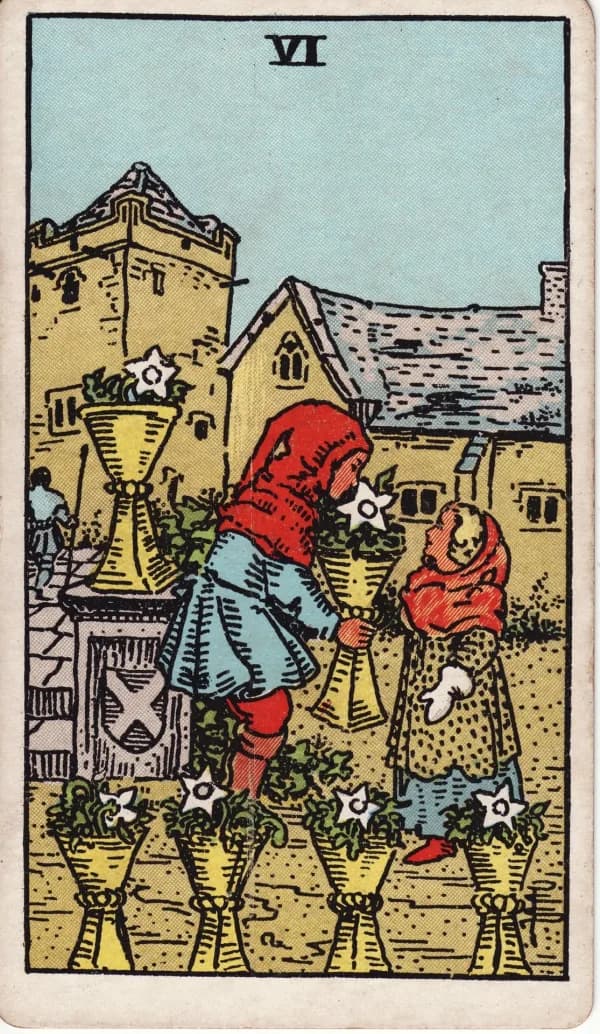
Start with the Rider-Waite-Smith Six of Cups. Two children stand in an old courtyard. The taller one, in a red hood, bends low and holds out a cup topped with a white star-shaped flower. The smaller one looks up. She hasn't taken it yet. And at the far left, a man with a staff is walking up the steps and out of the picture.
A.E. Waite gives the whole scene one line in The Pictorial Key to the Tarot: "Children in an old garden, their cups filled with flowers." His meaning looks backward, to memories and to things already gone. Then he adds a second reading that's easy to miss: "new relations, new knowledge, new environment." Same picture. Going back, or starting fresh.
Rachel Pollack, in Seventy-Eight Degrees of Wisdom, reads the taller figure as a dwarf. For her the card shows "the past (the dwarf) giving a gift of memories to the future, symbolized by the child." But a gift can be refused.
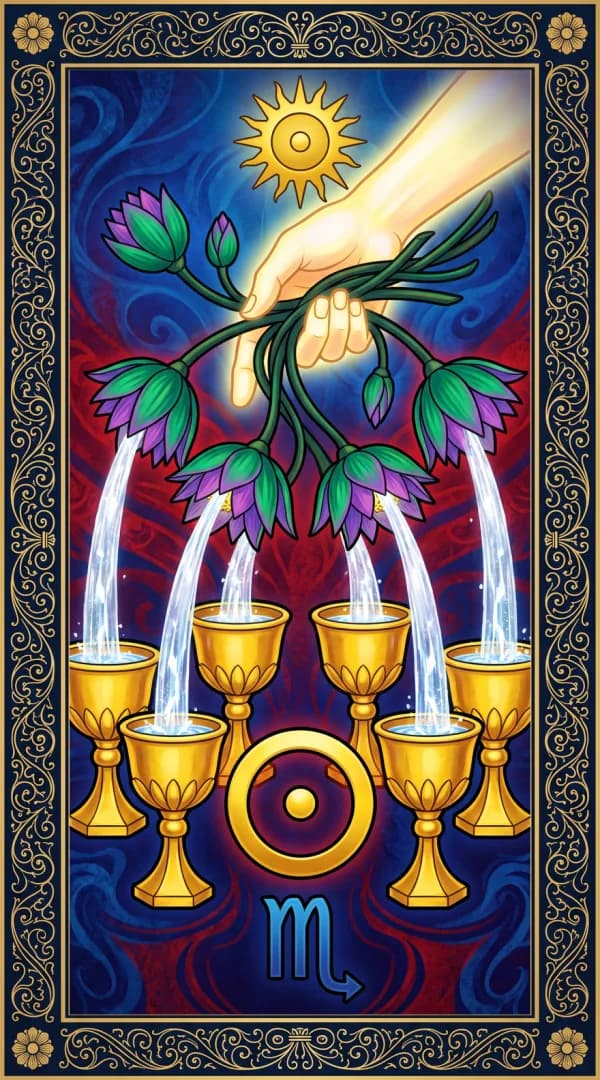
The Six sits on Tiphareth (Beauty), the sixth sphere and the center of the Tree of Life. Book T, the Golden Dawn's tarot manual, assigns it to the Sun in Scorpio and titles it the Lord of Pleasure (ease and well-being, not a fling). The Golden Dawn Six, pictured in the next section, has no children. Lotus flowers pour water into six cups that haven't filled yet, and the meaning is blunt: "Commencement of steady increase, gain and pleasure, but commencement only."
Robert Wang, in The Qabalistic Tarot, adds the honest part: "There is the implication, though not the assurance, that it will build."
The Two of Cups is a different scene.
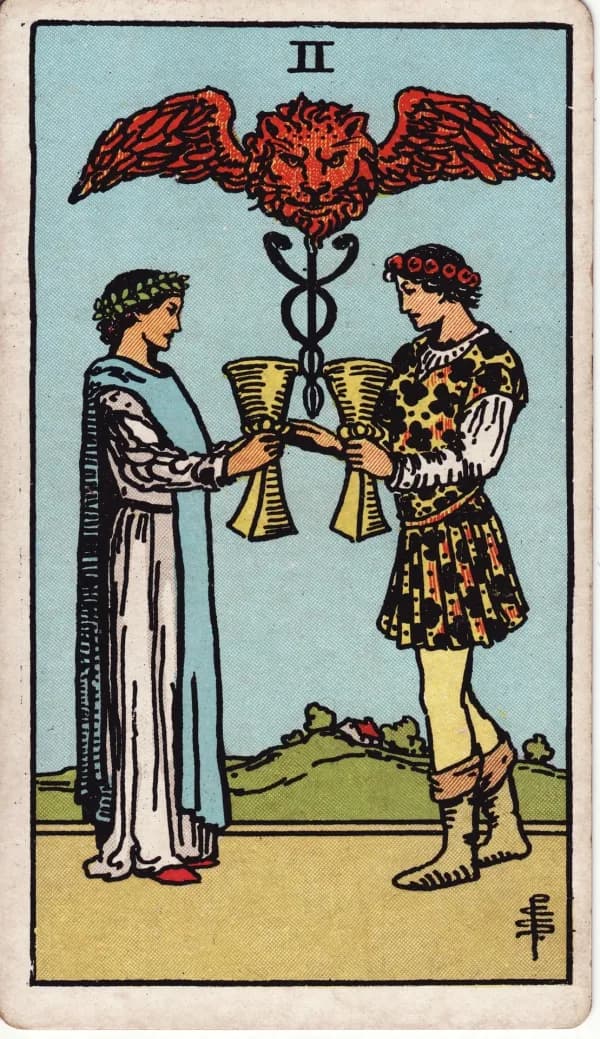
A young man and woman face each other, each holding a gold cup, and he reaches across with his free hand toward hers. Above them a red lion's head spreads its wings over the staff of Hermes, with two snakes wound around it. "A youth and maiden are pledging one another," Waite writes. Not handing over. Pledging. Both of them.
Pollack calls it "a lesser version of the Lovers," a card that most often "indicates the pledging of friendship, the beginning of a love affair." As a Two, it sits on Chokmah (Wisdom), the second sphere, and Book T makes it the Lord of Love, ruled by Venus in Cancer. Both cards, like every Cups card, take the Hebrew letter Heh, which means window.
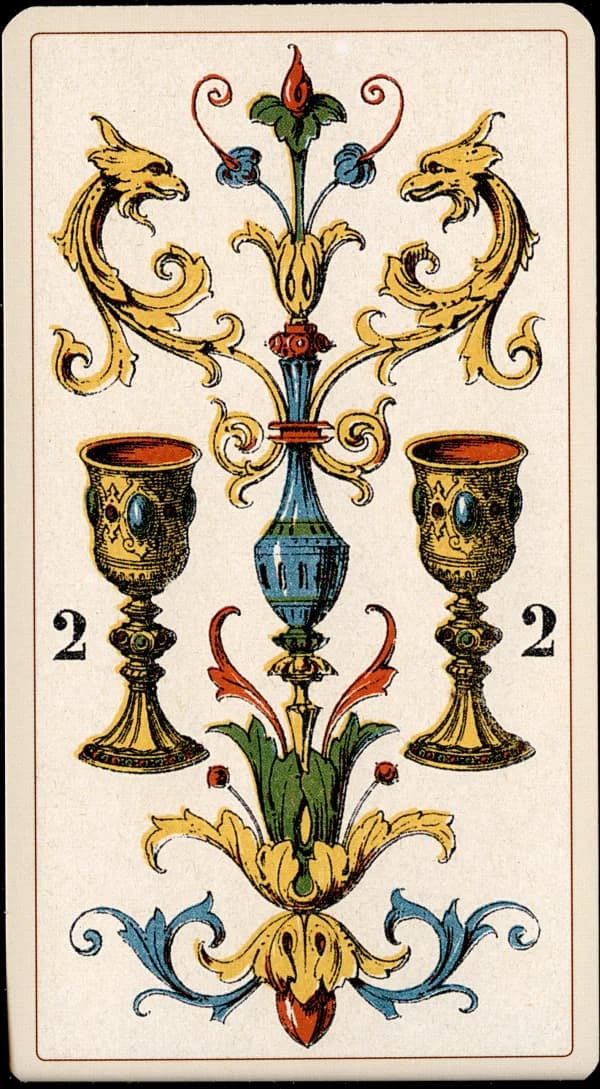
Older decks don't draw the couple. The Milanese Two in section IV has two jeweled cups flanking a flowering column and nobody holding them. The love meaning is older than the lovers that Pamela Colman Smith, Waite's artist, painted onto the card.
Look at the two children one more time. Are you the one holding out the flowers, or the one being handed them? And who comes to mind when you picture the other child?
What the Six of Cups and Two of Cups mean together
Put the two cards side by side and look at the hands. In both, cups are held out across the space between two people. The gesture matches. The terms don't. The Six is a gift that travels one way. The Two only works if both people raise a cup.
Combination guides treat this as a reconciliation pair. The psychic-reading site Kassie Kai reads it as "the potential for a reunion with a past love, or a deepening of a current relationship." The tarot site Angelorum calls the Two "the ultimate reciprocity card."
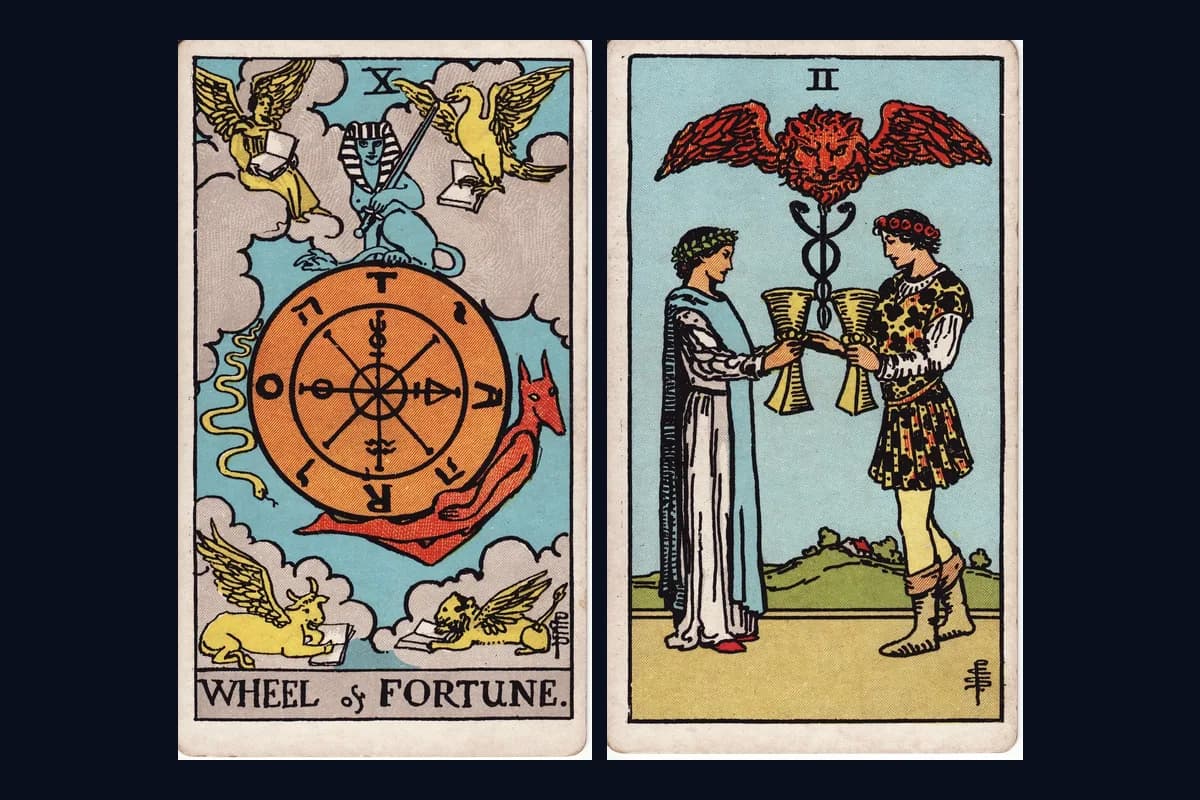
Notice there's no Major Arcana card here. Readers tend to give the Majors life's big turns and the Minor Arcana the everyday. So unlike the Wheel of Fortune and Two of Cups, where a Major raises the question of fate, nothing here does. Whatever happens runs on ordinary things: a text, a coffee, whether both of you turn up.
Elemental dignities are the Golden Dawn's rules for how neighboring cards affect each other. Book T says cards of the same suit on either side of a card "strengthen it greatly either for good or evil, according to their nature." Not every reader uses dignities. For those who do, the pair makes whatever's already there louder, the warmth and the unfinished business alike.
Together, the pair says one thing: an old bond is stirring, and it only comes back if it runs both ways. The history is real, and so is what you feel. But whether the bond becomes a relationship again isn't up to the cards. It isn't all up to you, either.
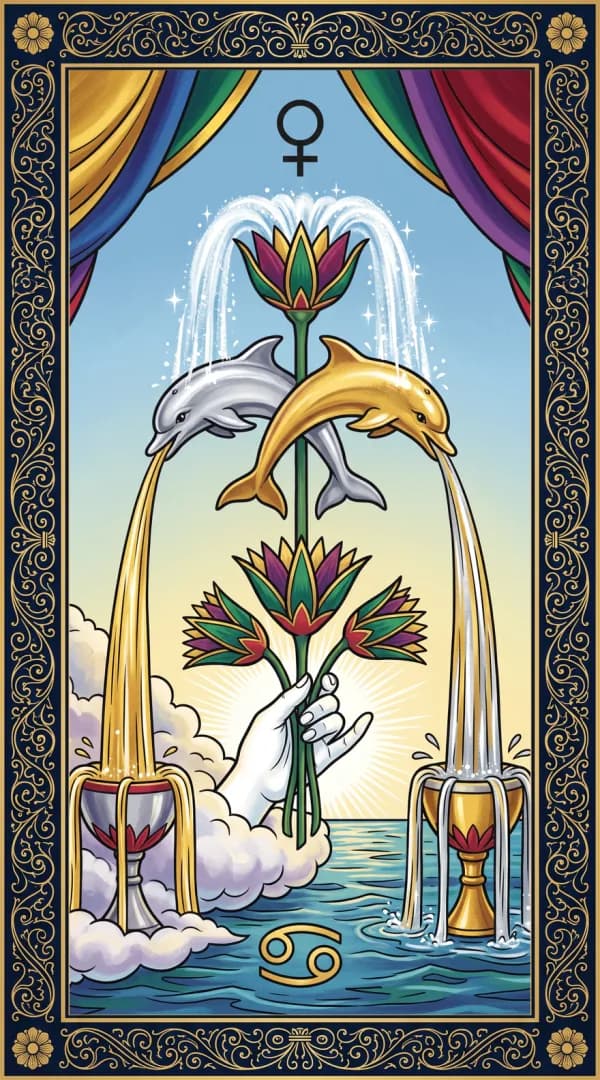
In the Golden Dawn Two below, one lotus stem feeds a gold dolphin and a silver one, and each pours into its own cup. One source. Two cups.
Picture the two of you as one of these cards. Which is it right now: a gift handed down, or a pledge made at eye level?
What the pair says about an ex coming back
When the question is whether your ex is coming back, this is probably the pair you hoped to see. Brigit Esselmont of Biddy Tarot writes of the Six: "A teenage sweetheart or past lover may turn up again." The Two beside it is what a reunion needs to be real. Two people, choosing each other now.
Look at the Six again. Only one child is giving. A card can describe a feeling, but it can't make anyone act on it. And memory edits. Pollack warns that "a fixation on the past can prevent a person from facing current problems." The Six can show warmth that's still real. It can also show you missing a version of your ex that time has softened.
If it ended because of how you were treated, no card outranks that. If they asked for space, a reading doesn't overrule it. Reading this because you hope they stay gone? The pair isn't a summons. The Two takes two willing people, and you don't have to be one.
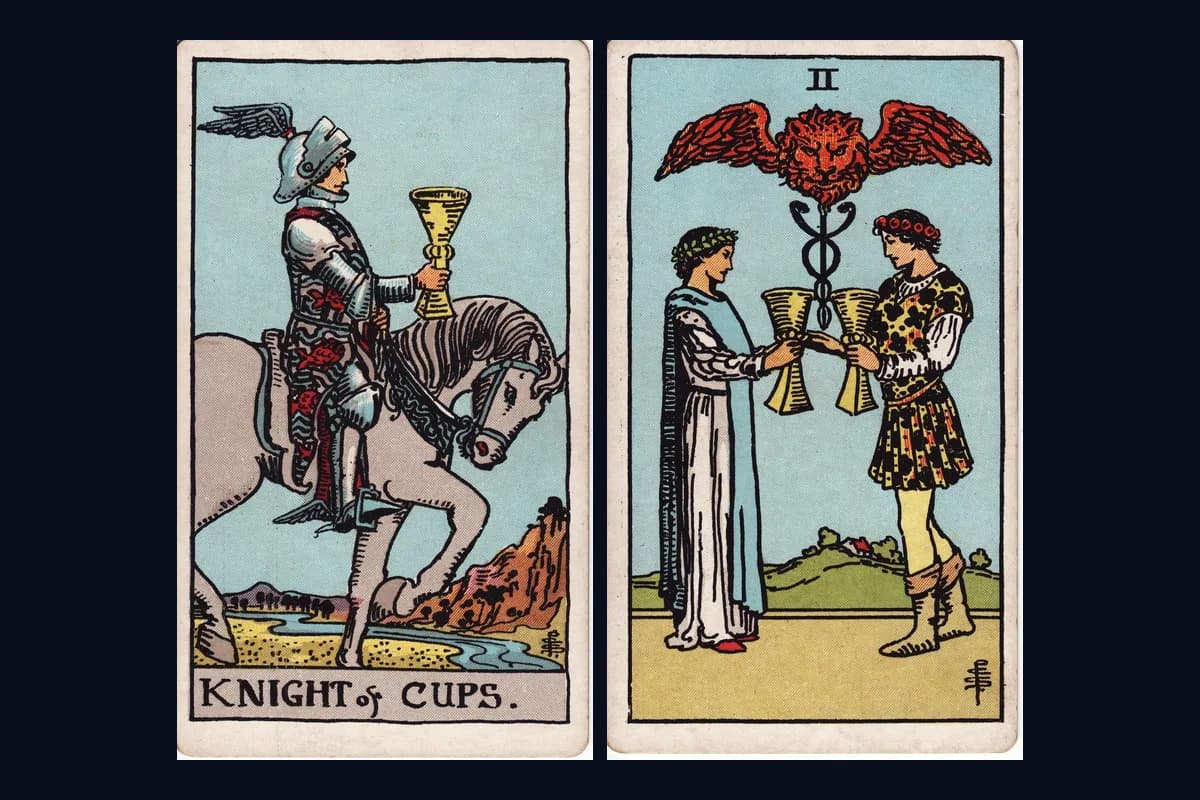
For couples still together, the pair points back to shared roots: the first apartment, the joke nobody else gets. Bring that warmth forward, and don't grade the present against it. In a new relationship, it's someone who feels familiar at once, or who isn't new at all. A true newcomer reads more like the Knight of Cups and Two of Cups.
With old friends and family, a reunion isn't romantic: a friendship you pick back up, or a sibling you've lost touch with. In career questions, it's a former colleague reaching out, maybe as a business partner.
In a Celtic Cross, if the Six crosses the Two in the first position, the thing in your way is comfort: an earlier chapter competing with this one. The Six in the outcome position (the tenth card) brings the past back into view, as a person or only as a memory. Theresa Reed, The Tarot Lady, defines that slot as "the future, result, or likely outcome." Likely. Not promised.
Yes or no? It leans yes on reconnecting, with two conditions. The Two's picture sets the first: the feeling has to run both ways. The second: whatever ended things has to have changed. With one card reversed, one of those conditions is missing, so it's no as things stand. With both reversed, it's no for now, which isn't the same as never. Before you take someone back, remember all of it, including the parts that weren't flowers. And neither card tells you when.
Think of a place from your own past that felt like the Six's garden. Where were you, and what was in your hands? What would your Six of Cups look like if its garden were that place, instead of one you've never seen? That image belongs in your deck.
The gift first, or the pledge first
In a three-card spread of past, present, and future, the order changes the reading: the first card names the subject and the second shows where it's heading. That's one of the basics of how to read tarot card combinations.
Six of Cups first, then Two of Cups: the past is the subject, and it's moving forward. The most hopeful way this pair can fall.
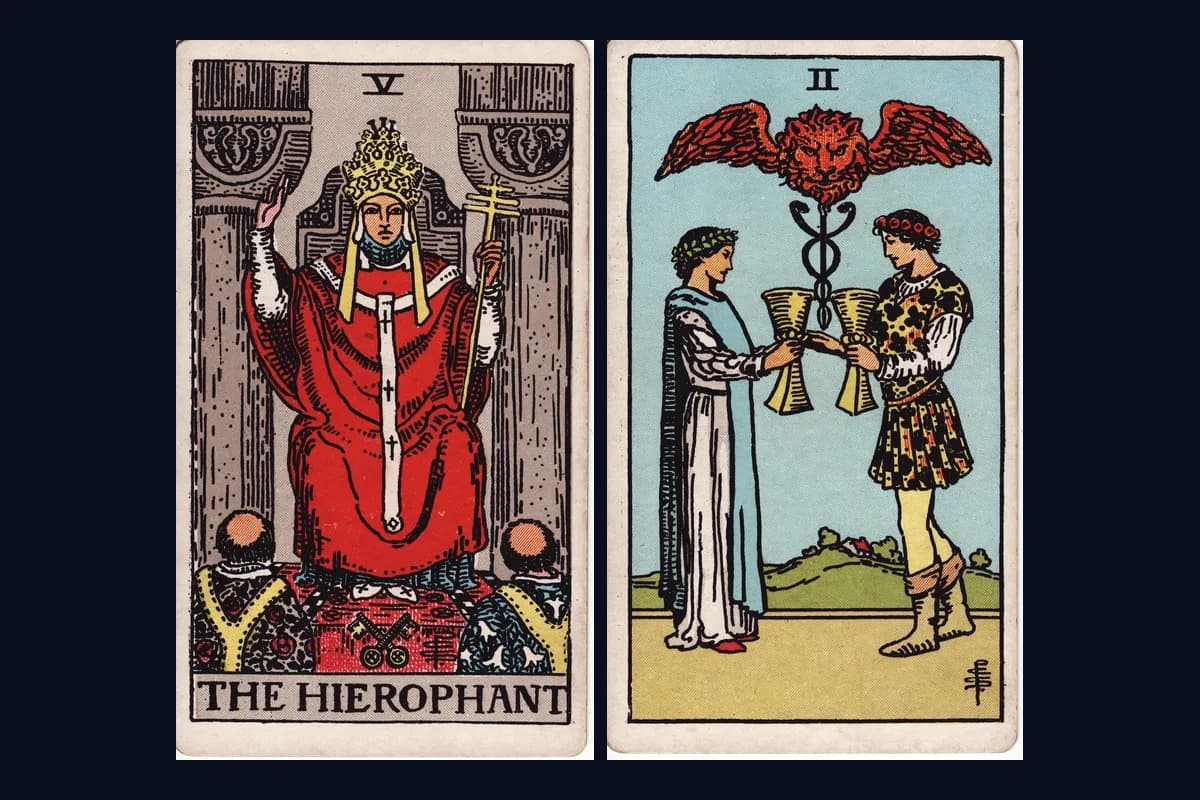
Two of Cups first, then Six of Cups: the pledge is the subject, and it's sliding backward into memory. For an ex, that's the harder order: the pull runs toward remembering, not rebuilding. For a couple still together, it's gentler. A bond fed by shared roots. If that couple is talking about marriage, the Hierophant and Two of Cups combination reads what changes when a pledge goes public.
An older rule, from the eighteenth-century French card reader Etteilla, makes the Six the hinge. Tarot author Benebell Wen explains that "Etteilla instructs that the positioning of this card in a reading marks the boundary between past and future." So with the Six upright, a Two after it falls on the spread's future side. A Two before it, the past side.
Orientation matters too. If you read reversals, a single one shows you where the snag is: in the history or in the present. Waite reads the reversed Six forward, as "the future, renewal," and Pollack agrees it shows "looking towards the future, rather than the past." Most modern readers see it as a pull backward, and the table follows them.
| Orientation | Reading |
|---|---|
| Both upright | A shared past meets an opening now; an old bond can become a mutual one, if both of you choose it |
| Both reversed | The past is unprocessed and the present is guarded; name what went wrong before asking whether the relationship can come back |
| Six upright, Two reversed | The memory is warm, but the give-and-take isn't there now; the past alone can't make someone meet you halfway |
| Six reversed, Two upright | The bond in front of you has real footing, but an old story keeps pulling at it; stop comparing now with then |
Which card turned up first for you, the gift or the pledge? And if one came up reversed, is the snag in what happened then, or in what's happening now?
Why the sky keeps these two close
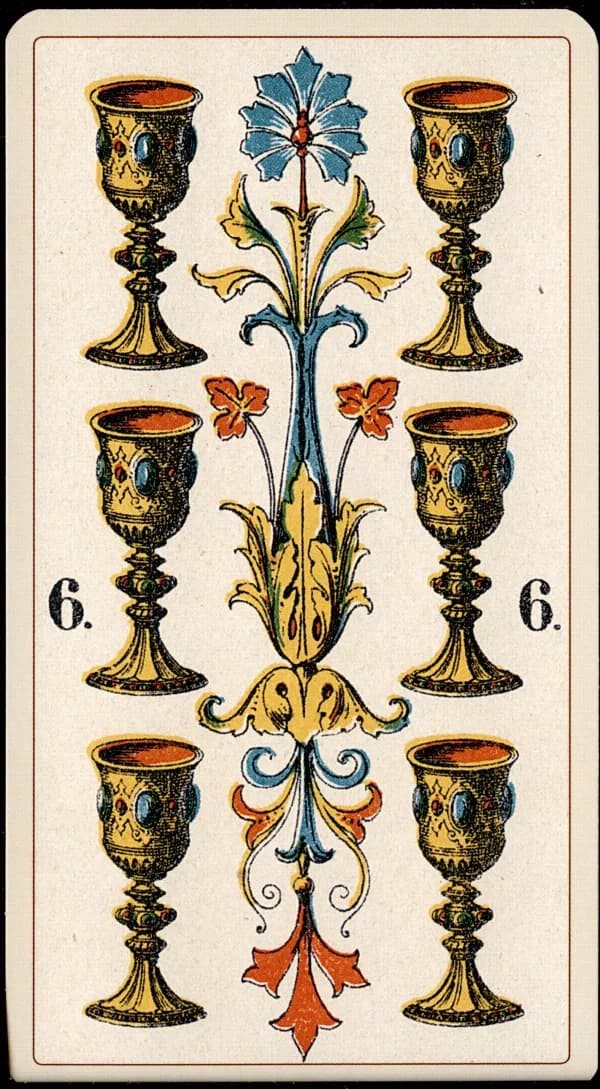
Book T gives the Six of Cups to the Sun in Scorpio's middle decan, or ten-degree slice, and the Two of Cups to Venus in Cancer's first. Both cards are Water, and so are both signs. Cancer and Scorpio sit 120 degrees apart, the angle astrologers call a trine and read as easy contact. By element and sign, this pair doesn't pull against itself.
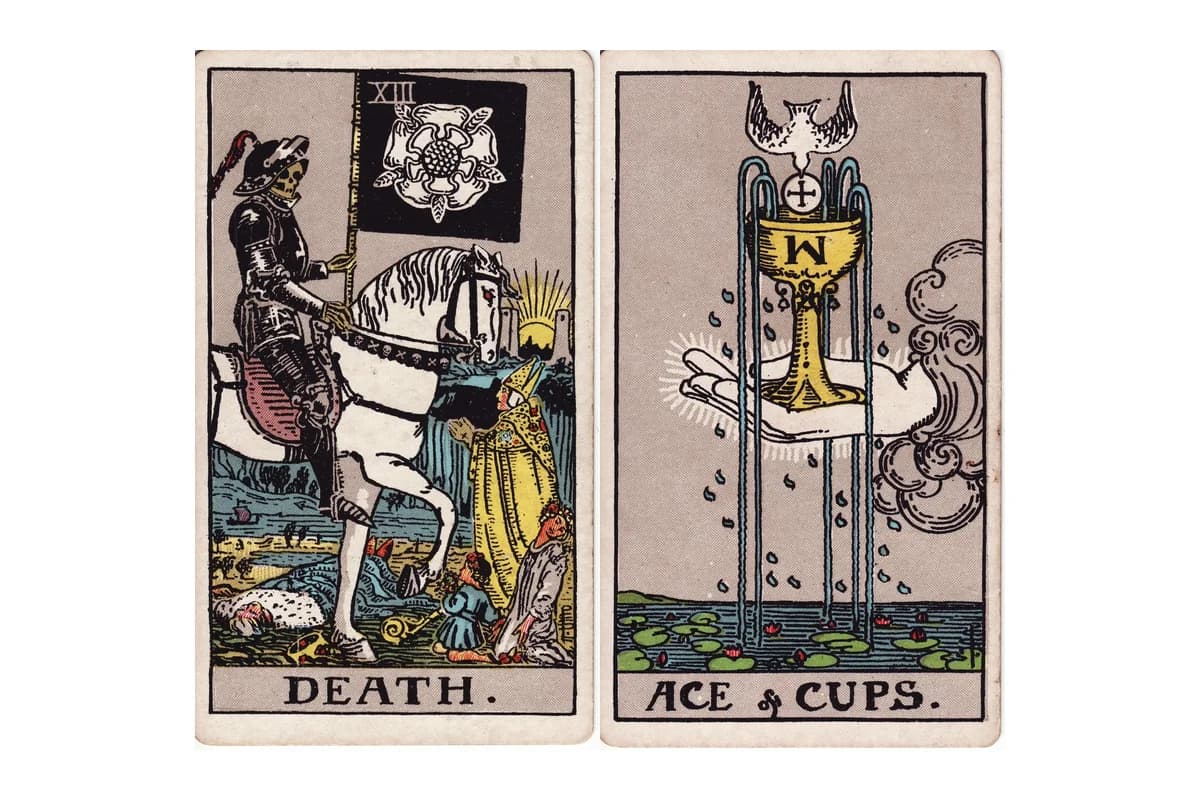
The Tree of Life adds a twist. Tiphareth, where the Six sits, is the Sun's own sphere, and the Six is the only Cups card the Sun rules. The path the Golden Dawn gave to Scorpio runs from Tiphareth to Netzach, the sphere of Venus. That makes the Six's sign the road between the two cards' planets, and that road belongs to the Death card. Read that kindly. An old version of a relationship ends before a new one starts, which is the whole arc of the Death and the Ace of Cups combination.
Venus enters Scorpio on December 4, 2026, and stays until January 7, 2027: the Two's planet in the Six's sign. Astrologers call that Venus's detriment, because Scorpio lies opposite Taurus, a sign Venus rules. It isn't an easy stay. The Sun returns the visit on June 21, 2027, when it enters Cancer at the June solstice. Draw the pair in either window and the sky is echoing your cards. But whether anyone comes back is still up to two people. Neither of them is a planet.
Reversals split the pair, though. Venus turns retrograde every year and a half or so, but the Sun never does. So a reversed Two reads like Venus retrograde, the bond under review, and a reversed Six reads more like an eclipse. A total solar eclipse falls on August 2, 2027, when, along a narrow track, the Moon hides the Sun completely for a few minutes. The past behind a reversed Six is like that. Still there, still pulling, even when you can't see it.
Is there a time of year when this person, or this feeling, tends to come back to you? What was going on in your life the last time it did?
What six plus two adds up to
Add the Six of Cups to the Two of Cups and you get 8. Which card? That depends on your deck.
In the Rider-Waite-Smith deck, 8 is Strength. Pollack sets the Fool apart and lays the other Majors out in three rows of seven, and Strength opens the second row, right under the Magician. Over both their heads floats the infinity sign, a figure eight lying on its side. On Strength, a woman in white holds a lion's jaws, and she isn't straining. Now look back at the Two of Cups. There's a lion over that couple too.
Strength doesn't fight the lion. She calms it. You can't make another person return. But you can choose what you do with the wanting, and patience with your own feelings isn't the same as putting your life on hold.
In the Tarocchino Milanese (the deck in section IV) and the Tarot de Marseille, 8 is Justice. The Golden Dawn swapped the two cards so its trumps would line up with the zodiac, and Waite kept the swap. Justice holds scales. She wants an honest account of why it ended and what would have to change. The Six remembers the sweet parts. Justice checks them against what happened.
The Golden Dawn gave Strength to Leo, ruled by the Sun, and Justice to Libra, ruled by Venus. Some readers find sums like this telling; others don't. But whichever deck you read with, the sum lands on a card ruled by one of this pair's own planets.
Strength or Justice: which do you need more right now, patience or an honest account of what went wrong?
Questions readers ask about this combination
Does the Six of Cups and Two of Cups mean my ex is coming back?
Combination guides read the Six of Cups and Two of Cups as a sign an old love may return. The Six is the past coming back into view, and the Two is a pledge two people make together. So the pair leans toward reconciliation. But only if both people want it, as the Two shows. The cards can't make another person's choice, and if the relationship ended because of how you were treated, no card outranks that.
What does the Six of Cups and Two of Cups mean in a love reading?
In a love reading, the Six of Cups and Two of Cups point to a bond with history behind it. For couples still together, that's shared roots. In a new relationship, it's someone who feels familiar at once, or who isn't new at all. Old friends and family count too. The caution is memory: it edits, so check the warm version against what actually happened.
What does it mean when the Six of Cups and Two of Cups are both reversed?
Both reversed, the Six of Cups and Two of Cups show the past unprocessed and the present guarded, so a reunion is blocked at both ends for now. It isn't a verdict that someone will never return, or a judgment on either of you. Name what went wrong before you ask the cards again. Not every reader uses reversals, and Waite even read the reversed Six as facing forward.
What element connects the Six of Cups and the Two of Cups?
Water, twice over. Both are Cups, and the Golden Dawn gives the Six to the Sun in Scorpio and the Two to Venus in Cancer, both Water signs. In elemental dignities (the Golden Dawn's rules for how neighboring cards affect each other), cards of the same suit strengthen one another. That works for good or ill, so the pair makes whatever you're already feeling louder.
Is the Six of Cups and Two of Cups a yes or no combination?
The Six of Cups and Two of Cups combination leans yes when you're asking about reconnecting, on two conditions: the feeling has to run both ways, and whatever ended things has to have changed. With one card reversed, one condition is missing, so it's no as things stand. With both reversed, it's no for now, which isn't the same as never. If you're asking whether one particular person will come back, the cards can't answer for them.