Tarot Card Combinations
The Devil and The Lovers
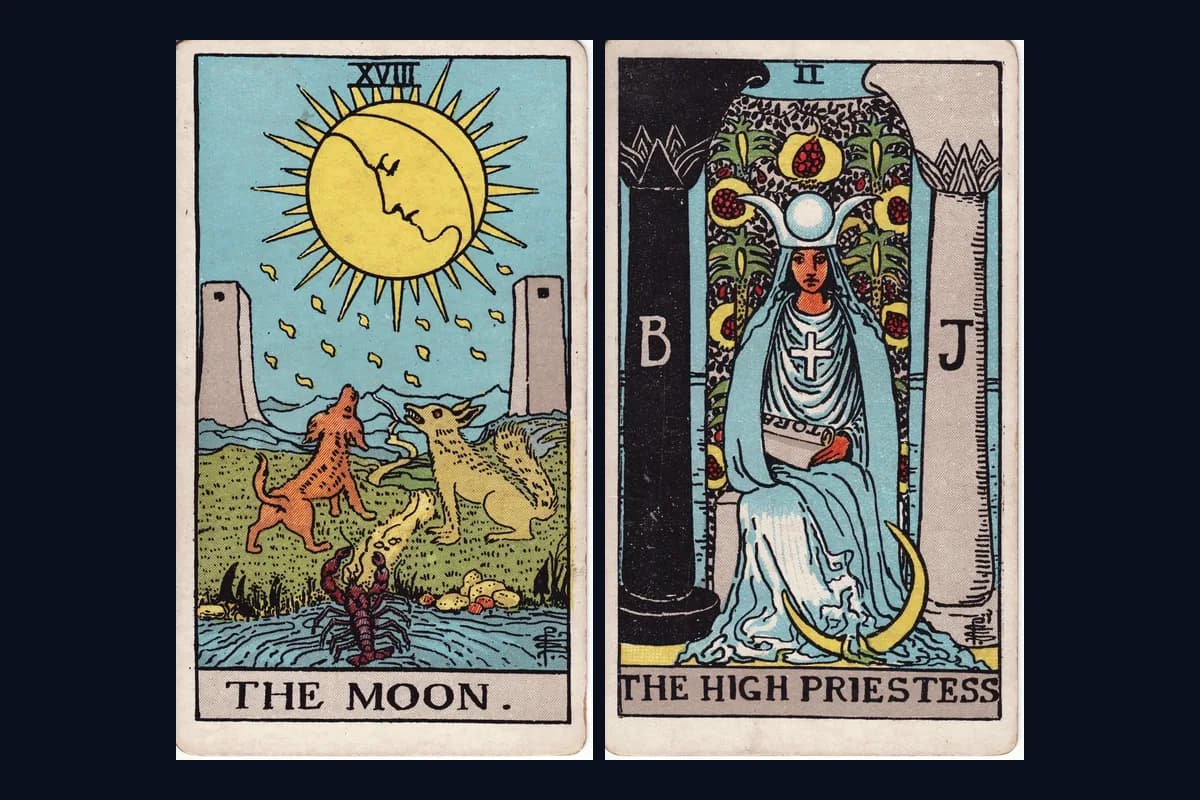
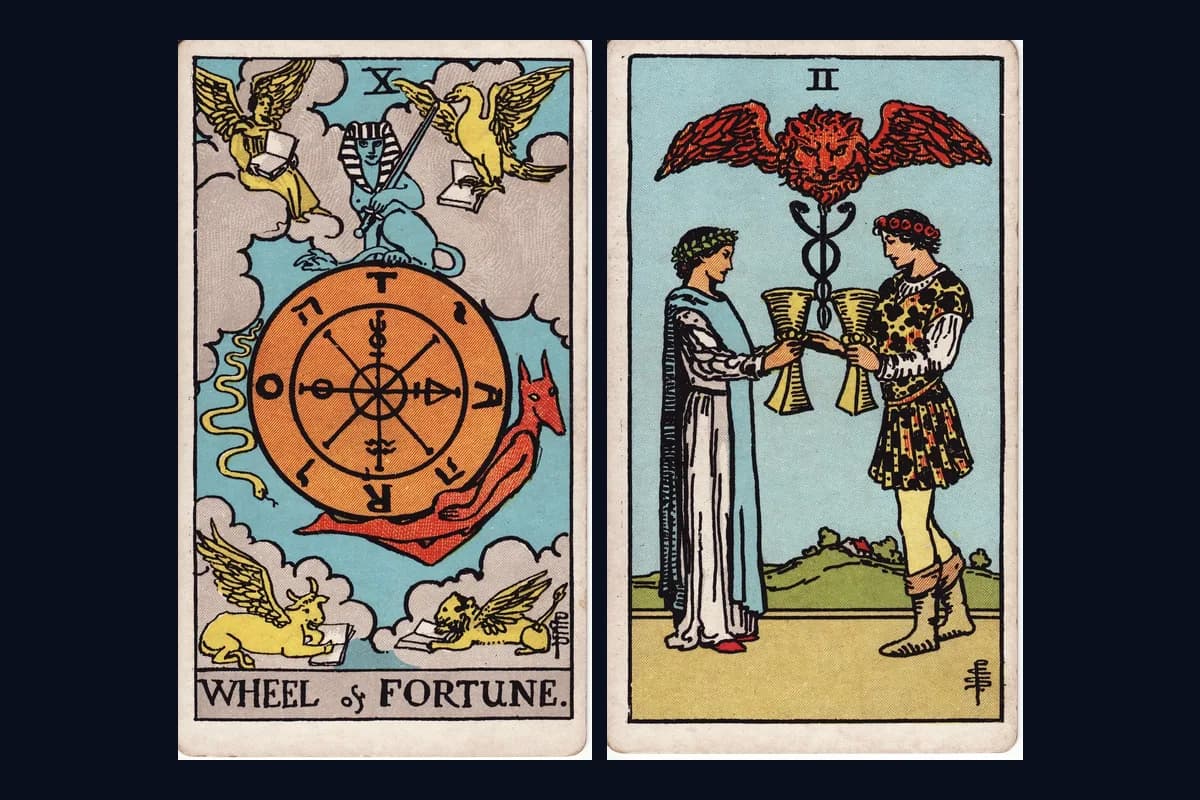
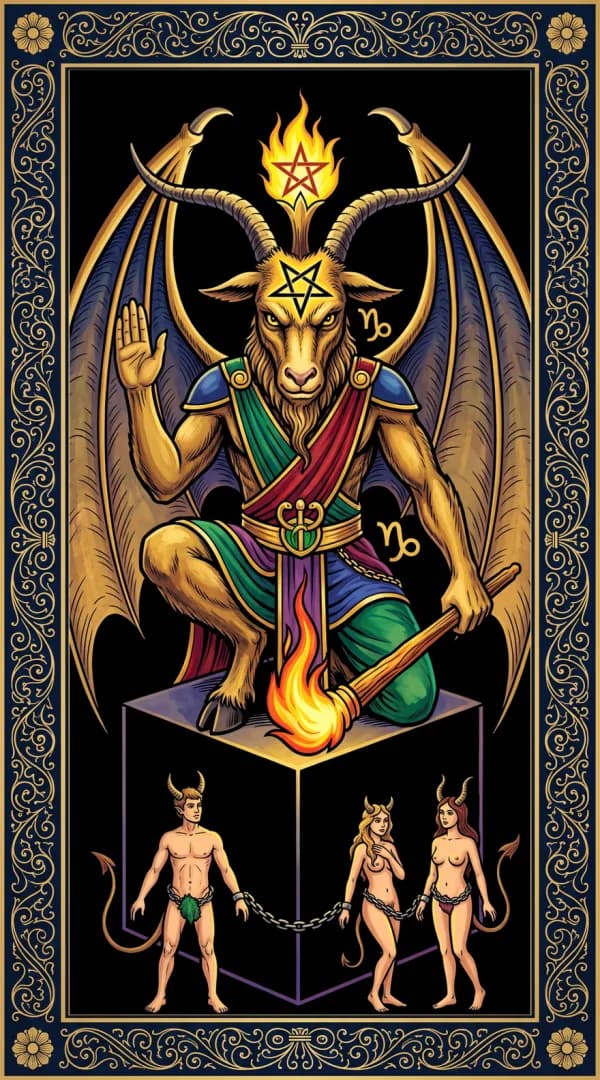
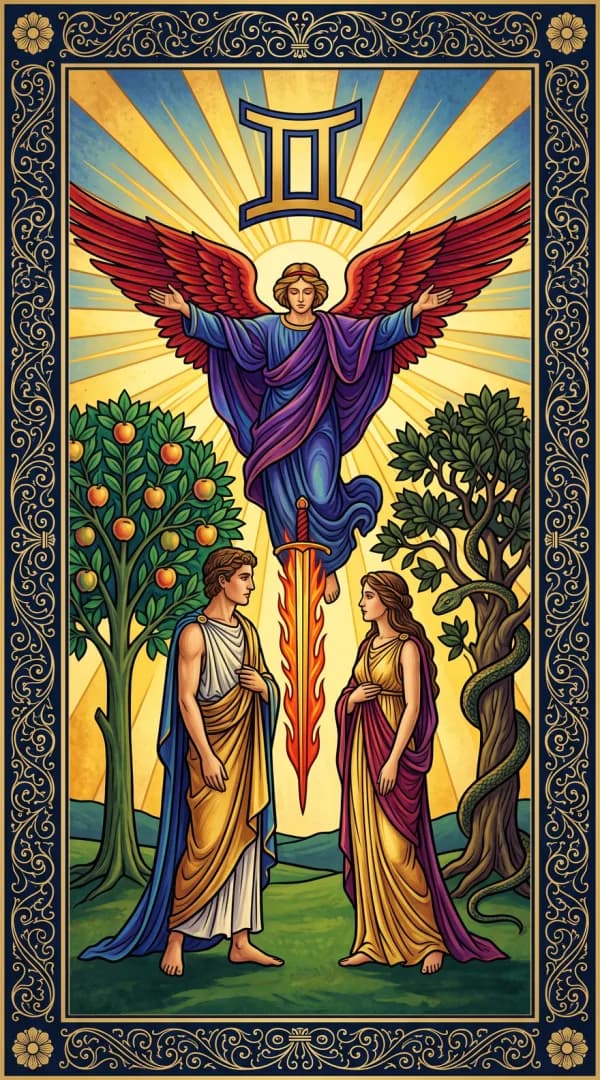
The Devil and Lovers tarot combination asks whether a bond is love or unhealthy attachment. A naked man and woman stand chained by the neck to a black block, a horned, bat-winged figure crouched above them. Their chains hang loose. On the other card, the same two stand free in a garden under a high sun, an angel's arms spread over them. Which card is your relationship standing in?

Climate scientist, ashtanga practitioner, and advocate for human rights and LGBTQIA+ equality.
What each card means on its own
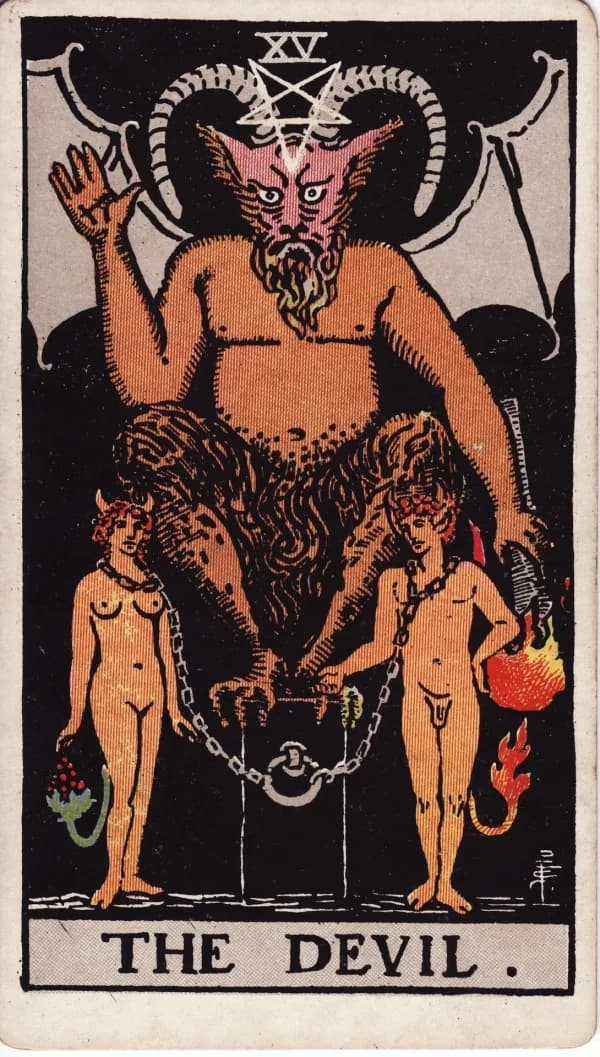
Start with the Rider-Waite-Smith Devil. The horned figure crouches on a black half-block, right hand raised, a torch in his left pointed at the ground. The naked pair below each have small horns and a tail: grapes on hers, a flame on his. A chain runs from a ring on the block to each neck. A.E. Waite calls the figure "The Horned Goat of Mendes."
Then look at the chains. They hang in wide loops. Rachel Pollack, in Seventy-Eight Degrees of Wisdom, puts it plainly: "the chains do not really hold them; the large loops can easily come off." Waite adds that the horned figure "is not to be their master for ever." That's a hold made of belief, the sense that there's nowhere else to go. It isn't a verdict on anyone who stays. But in real life some chains are money, children, or fear, and they aren't loose at all.
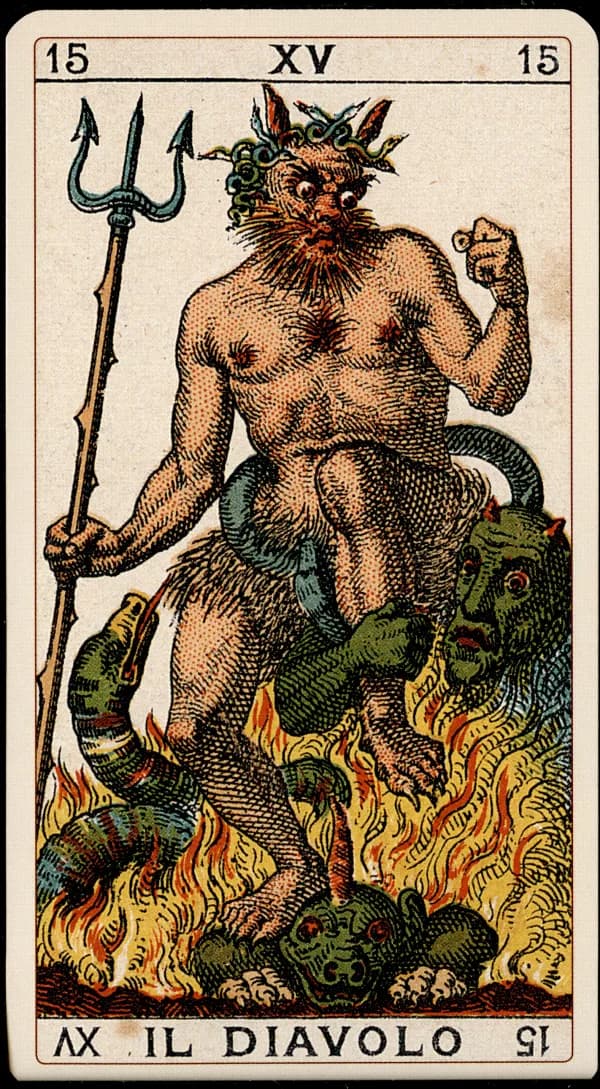
The Devil is card XV, with the Hebrew letter Ayin, which Aleister Crowley says "means an Eye," and the sign Capricorn, ruled by Saturn. Its captives weren't always human. Waite describes the older card with "two small demons" tied to the pedestal, and says the French occultist Papus swapped them for a naked man and woman "yoked only to each other."
The card also has a past in love magic. Tarot author Mary K. Greer, summarizing Andrea Vitali's research into 16th-century Venetian trials, describes a rite that used the Devil card "when a lady wanted to satisfy a sinful lust or coerce an unresponsive gentleman." Love that wasn't freely given, called up with a Devil card.
Now look at the Lovers.
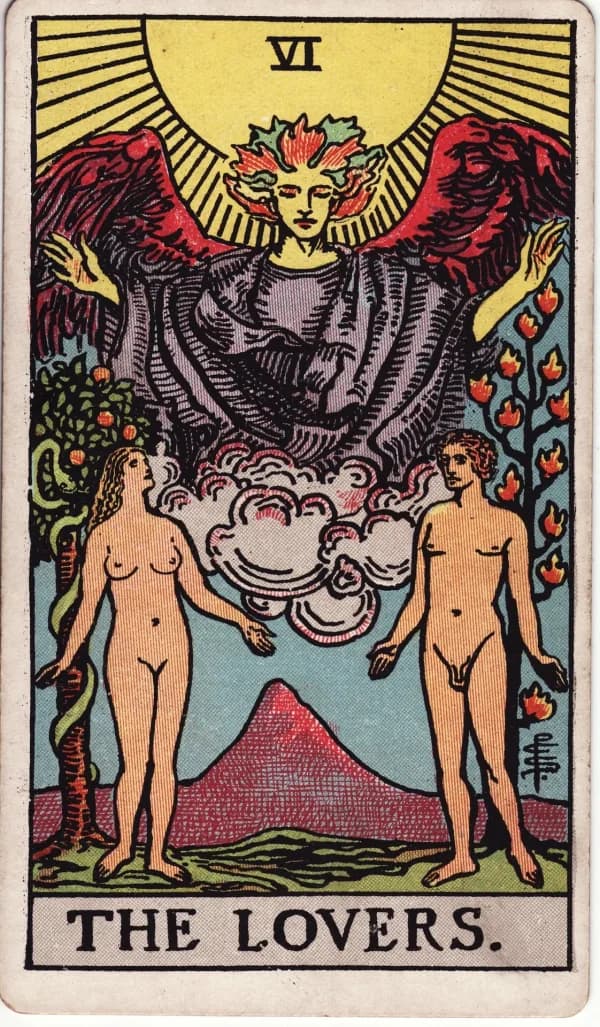
A sun blazes at the top, and under it hovers Waite's "great winged figure with arms extended." Below, a naked man and woman stand with no chain in sight. She's by a tree with a serpent wound round it. He's by a tree whose fruits are flames. Waite calls this "in all simplicity the card of human love."
It's card VI, with the Hebrew letter Zain, which Crowley says "means a Sword," and the sign Gemini, ruled by Mercury. The Golden Dawn's original design for this card told a sharper story. Robert Wang, in The Qabalistic Tarot, says it showed Perseus "rescuing Andromeda from her earthly shackles." On that card, love is what takes the chain off.
Put the two of you on these cards for a moment. Are you in the garden, where neither of you needs a chain to stay? Or at the block, where the chain does the staying for you?
Why the Devil and the Lovers look like one picture drawn twice
Set the two Rider-Waite-Smith cards side by side and count what's the same. A winged figure above. A naked couple below, the woman on the left and the man on the right in both. Waite even describes the two pairs in matching words. The lovers are "as if Adam and Eve when they first occupied the paradise of the earthly body." The chained pair are "as if Adam and Eve after the Fall."
Pollack thinks the echo is on purpose. The Devil's 15 reduces to 6, the Lovers' number. In her words, "we can say that Waite worked backwards from the Devil when he designed his radical version of the Lovers." Two books name this pair outright, too. Book T, the Golden Dawn's manual on the cards, gives the Devil "sometimes obsession, especially if associated with the Lovers." Pollack makes it about love: "If it appears in connection with the Lovers it shows that a relationship which began with love has turned into a trap."
Both are Major Arcana, so this pair points to a pattern, not one bad week. And the Devil comes nine cards after the Lovers. In love, that order makes sense. You choose first. The test of the choice comes later.
It's love if you'd still choose this with every other road in view, and a chain if no other road feels open to you. The want can be the same on both cards. What changes is whether a choice is still in it. Pollack explains the Devil's hold: "The Devil's power rests in the illusion that nothing else exists."
Waite draws the line with one word: material. His Lovers shows "love before it is contaminated by gross material desire," and his Devil is "the chain and fatality of the material life." Money can be part of it. But mostly he means wanting, with nothing past the want.
Remember Papus's couple, tied only to each other. Sometimes the bond itself has become the chain. The Golden Dawn Lovers below swaps Perseus and Andromeda for a robed couple, with a flaming sword hanging point down between them. You can read that sword as Zain, the Lovers' letter.
Say staying and leaving would cost you exactly the same: no history thrown away, no one to disappoint. Which would you pick?
Love or attachment: what it means for your relationship
In an existing relationship, a chain can look like peace. Pollack points out that the chained couple show no "discomfort in their faces or posture," and she reads that calm as "the acceptance of a bad situation." So don't judge the bond by how calm it feels. Can you say no to this person about something that matters and have it heard? Can they say no to you? Do you still see your own people? Three yeses sound like the Lovers; a flinch sounds like the Devil.
In a new relationship, this pair often shows up around a strong pull. The pull is real. It tells you little about the person. Pollack notes that "many men and women find themselves powerfully attracted to people they actively dislike." The Lovers is what you like about this person in daylight. The Devil is what you'd give up to keep feeling this way.
If you're asking about an ex you keep going back to, the Devil can be the pull and the Lovers the memory that makes it feel worth it. Pollack writes of leaving: "Sometimes we can find the period of transition unbearably painful and slip back to our chains." Hurting after you go doesn't mean you chose wrong. Often it's what a loosening chain feels like.
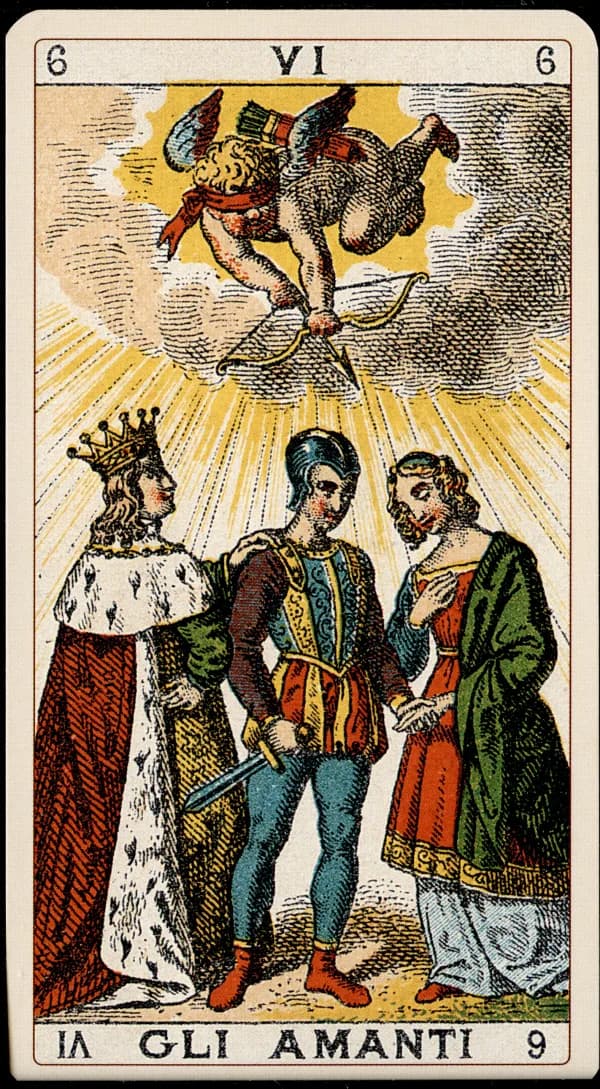
For temptation or fidelity, Book T lists "Material temptation" among the Devil's meanings. And the older Lovers, like the Milanese card below, puts a young man between two figures. In Pollack's reading, that earlier card means "an important choice between two desires." These cards can name a third pull: another person, a secret, or a want nobody has said out loud. They can't prove a partner is cheating. That evidence lives in what someone does.
A card can't tell you whether a relationship is safe. If you're afraid of what a partner will do when you say no, that isn't a tarot question: talk to someone you trust, or a domestic violence hotline where you live. And if the chain is a drink, a drug, or a habit you can't put down, the cards are not a medical opinion either. Talk to someone who went to school for it.
If you're asking yes or no whether this bond is good for you as it runs today, it's closer to no than yes. A no to the pattern, not an order to stay or go. If you can each say no and be heard, there's room for a yes, because the bond is still being chosen.
Name what actually keeps you here: the person, the history, the fear of starting over, the years already spent. If you drew your own Devil, what would the chain be made of? That image belongs in your deck.
Two orders, two different stories
The Devil first, then the Lovers: this is the hopeful order. Pollack writes in Seventy-Eight Degrees of Wisdom: "Before you can slip off the chains you must become conscious of them." Once you can see the pattern, the Lovers says you get to decide again. It promises a choice, not the same person on the other side of it. That choice could be a repaired bond, a different one, or time on your own.
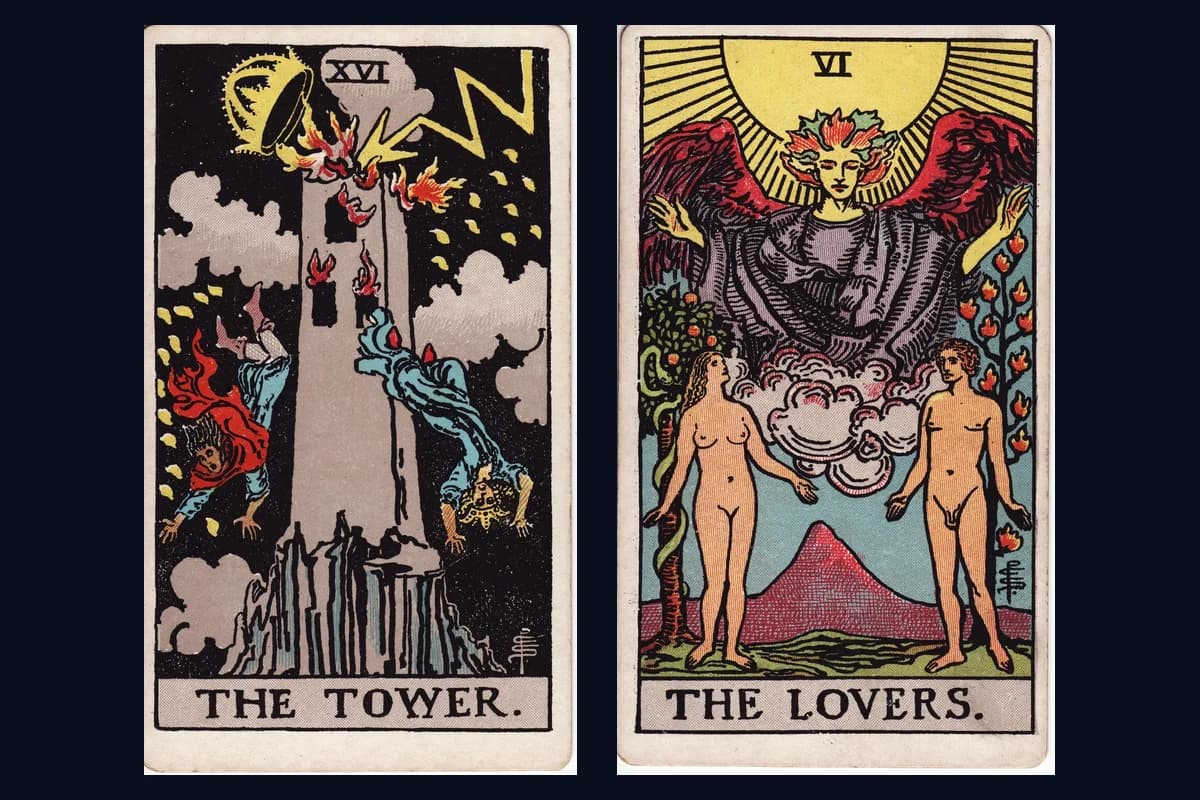
The Lovers first, then the Devil: the love came before the hold. The risk is that the memory of it now does the holding, what Pollack calls "a crippling nostalgia for a past love." Noticing when the hold began can help you start to loosen it. If the garden fell in one sudden crash instead, the Tower and Lovers combination covers that ending.
In a Celtic Cross, watch the crossing card, position 2, laid sideways over the first. The Devil there names the obstacle outright: the hold itself, or the belief that there's no way out. The Lovers there is subtler. Brigit Esselmont of Biddy Tarot warns that even a good card in that spot "will still represent a challenge." The love may be real. But it's also what's in the way.
In a three-card spread of past, present, and future, the Lovers behind you with the Devil in the present can be the love story you keep staying for. Swap them and the chain may already be behind you. Lay the cards as Tina Gong of Labyrinthos does, "You, Relationship, Partner," and a Devil in the Partner position shows their part in the pull, what they do rather than who they are.
Orientation matters too. Waite reads the reversed Devil as darker still: "Evil fatality, weakness, pettiness, blindness." But Pollack reads it as "an attempt to break loose from some misery or bondage, either real or psychological." For readers who use reversals, the table follows Pollack.
| Orientation | Reading |
|---|---|
| Both upright | Love with the hook already set; it's still a choice only while you can each say no and be heard |
| Both reversed | A love gone sour and a hold starting to loosen; breaking loose can hurt for a while, and that hurt isn't proof you chose wrong |
| Devil upright, Lovers reversed | The chain is winning; the pull outweighs the love, and staying no longer feels like a choice |
| Devil reversed, Lovers upright | The chains are slipping; you can name the pattern now, and staying or going is a real choice again |
If the Lovers came first, has staying stopped feeling like a decision, and when? If the Devil came first, what's one choice in front of you that's entirely yours?
What the planets add to the question
Book T gives the Devil Capricorn, an Earth sign ruled by Saturn, the planet of limits. And the Lovers? Gemini, an Air sign ruled by Mercury, the planet of speech. Saturn sets the terms. Mercury talks them over.
The elements clash. In elemental dignities, the Golden Dawn's method of reading a card by the elements of the cards beside it, Book T says: "Air and Earth are contraries." Contrary cards weaken each other. Book T states that rule for the suits, so applying it to two Major Arcana is a reader's extension. If you use it, these two don't blend.
The planets get along better. William Lilly, the 17th-century astrologer, listed Saturn and Mercury as friends of each other. But the signs don't share a thing. Capricorn and Gemini sit 150 degrees apart, a spacing Ptolemy classed as disjunct, meaning unconnected. Nothing in their signs holds these two together, so any bond between them has to be built and kept on purpose.
Each card also carries the other's planet. Waite's text puts "the sign of Mercury" at the pit of the Devil's stomach. On the Tree of Life, the Kabbalistic map of ten spheres joined by paths, the Devil's path runs from Tiphareth, the heart, down to Hod. Robert Wang calls Hod the "sphere of Mercury and of the intellect." The Lovers' path comes into Tiphareth from Binah, Saturn's sphere.
Two events stand out (dates in Universal Time). Mercury, the Lovers' planet, enters Capricorn, the Devil's sign, on December 25, 2026, and stays until January 13, 2027. On April 19, 2027, Mercury meets Saturn at 19 degrees of Aries, the sign of Saturn's fall, where Saturn loses strength. Neither event settles whether a bond is healthy, but both can mark a season for noticing which of its terms were ever said out loud.
When did the two of you last talk about the terms of this bond, and who set them?
What the numbers say about the chain
15 + 6 = 21. That's the World, the last numbered card of the Major Arcana.
Picture it. A figure dancing inside an oval garland, a wand in each hand, with no iron on her and nobody standing over her. The Lovers and the Devil each show two people under a winged figure. But their sum shows one. Waite describes that garland "as if it were a chain of flowers," and adds, by way of the occultist Eliphas Levi, that a chain of roses is "less easily broken than a chain of iron."
You can read that two ways. A bond you both keep choosing holds better than one that's forced. But a chain made of something you enjoy is also harder to notice, and harder to leave, than one that hurts. Not every reader puts weight on sums like this. If you do, Book T's meaning for the card fits the question: the World is "The matter itself," the subject of your reading.
Pollack sets the numbered trumps in three rows of seven. The Lovers sits in her first row, the one for love and social life. The Devil, whose 15 reduces back to the Lovers' 6, opens the last. The test comes two rows after the choice.
Ayin, the Devil's letter, is an eye. Zain, the Lovers', is a sword. One sees the chain. The other cuts it.
If the chain of flowers came off tomorrow, which parts of this bond would you weave back in?
Questions readers ask about this combination
Does the Devil and the Lovers mean a toxic relationship?
Not on its own, though it's a warning. The Devil and the Lovers describe a pattern between two people, not a verdict on either one. The test is whether the bond is still chosen: can each of you say no to the other about something that matters and be heard? A card can't tell you whether a relationship is safe. If you're afraid of a partner, talk to someone you trust or a domestic violence hotline where you live.
What does the Devil and the Lovers mean in a love reading?
In love, the Devil and the Lovers ask whether a bond is love or attachment. A chain can look like calm in an existing relationship, so judge the bond by whether you can each say no and be heard. In a new one, the pull is real but proves nothing yet. With an ex you return to, the Devil can be the pull and the Lovers the memory that makes it feel worth it. The cards don't judge either person.
What does it mean when the Devil and the Lovers are both reversed?
With the Devil and the Lovers both reversed, the reading is a love gone sour and a hold starting to loosen. Rachel Pollack sees a reversed Devil as an attempt to break loose. That can hurt for a while, and the hurt isn't proof you chose wrong. A.E. Waite reads the reversed Devil more darkly, as weakness and blindness. Not every reader uses reversals.
What number connects the Devil and the Lovers?
Six. The Devil is 15, and 1 + 5 = 6, the Lovers' own number. Rachel Pollack thinks Waite designed his Lovers by working backwards from the Devil. Add the two cards instead and you get 21, the World: one figure dancing free inside a garland Waite compared to a chain of flowers. Not every reader puts weight on sums like this.
Is the Devil and the Lovers a yes or no combination?
If you're asking whether this bond is good for you as it runs today, the Devil and the Lovers lean closer to no than yes. That's a no to the pattern, not an order to stay or go. If you can each say no and be heard, there's room for a yes, because the bond is still being chosen. With the Lovers first, the answer leans further toward no. With the Devil first, there's more room for a yes.