Tarot Card Combinations
The Moon and The High Priestess
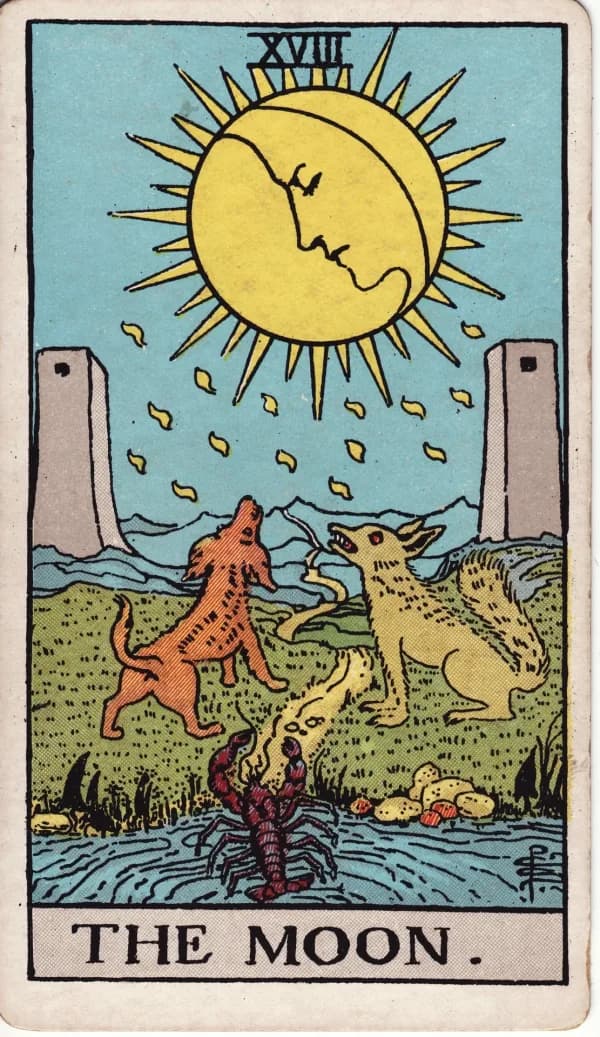
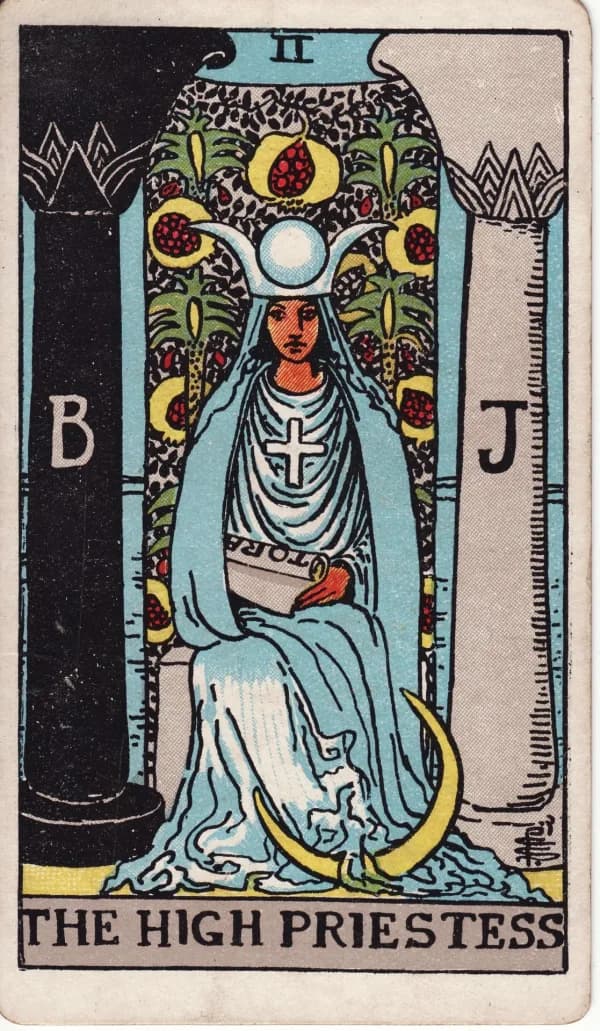
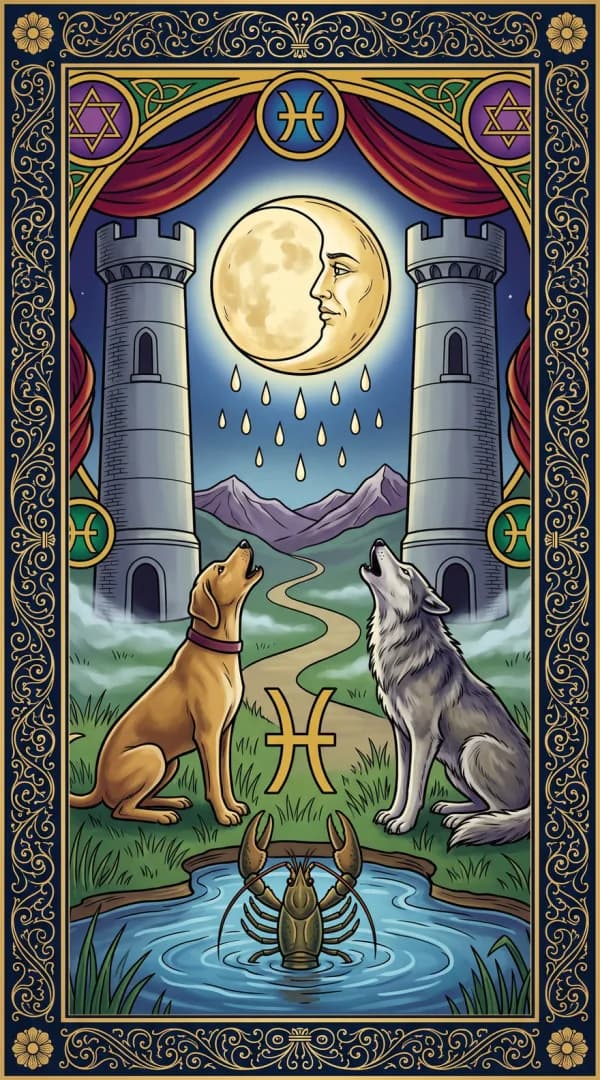
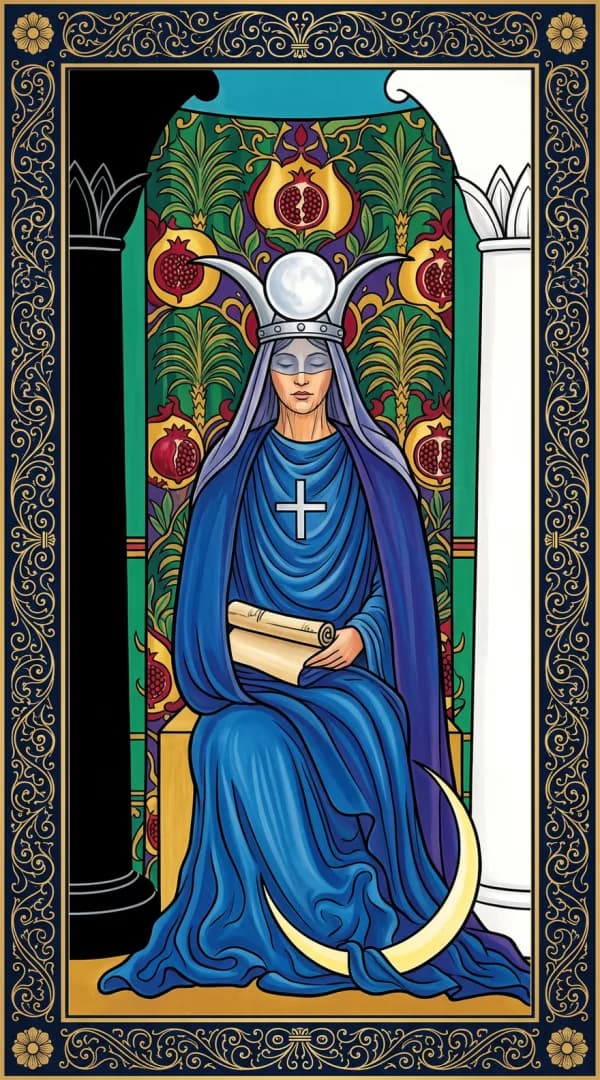
The Moon and High Priestess tarot combination asks whether a gut feeling is intuition or illusion. A woman sits between a black pillar and a white one, a scroll half hidden in her lap, a crescent moon at her feet. On the other card, that moon has risen, and a dog and a wolf are baying at it. You already sense something. Whose voice is it: hers, or theirs?

Climate scientist, ashtanga practitioner, and advocate for human rights and LGBTQIA+ equality.
What each card holds on its own
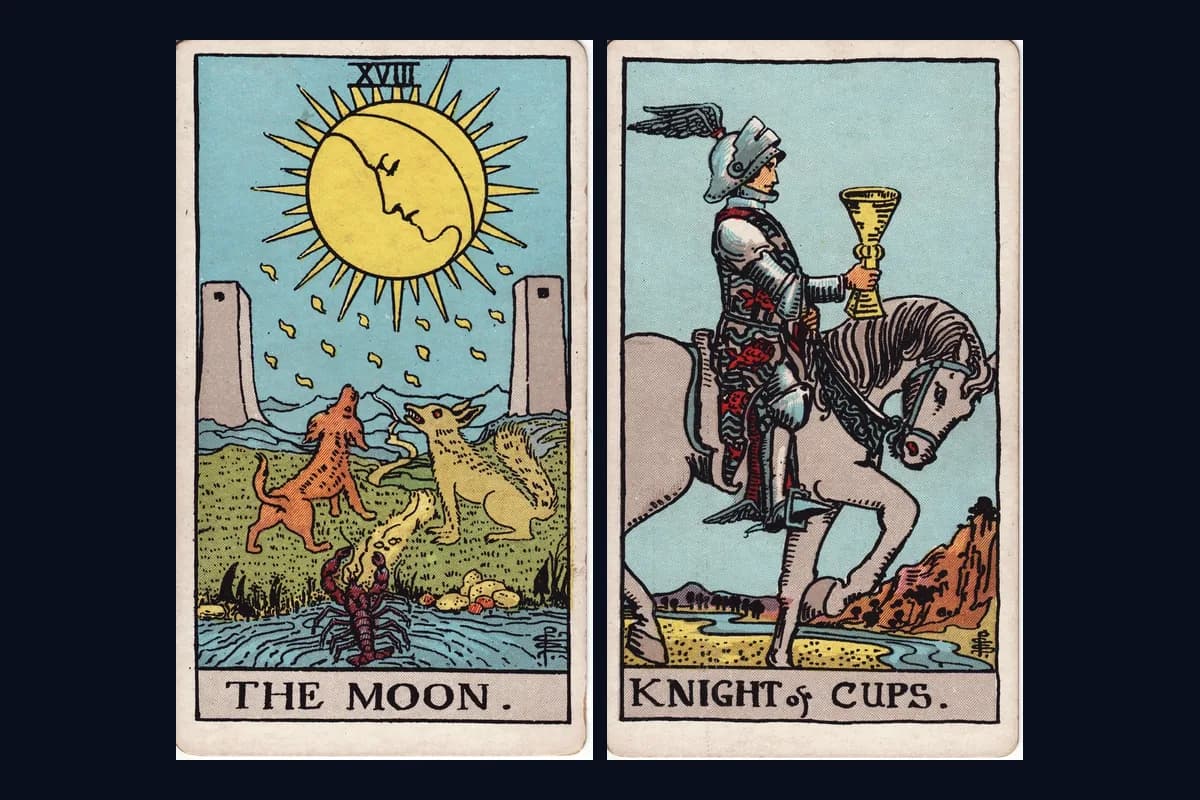
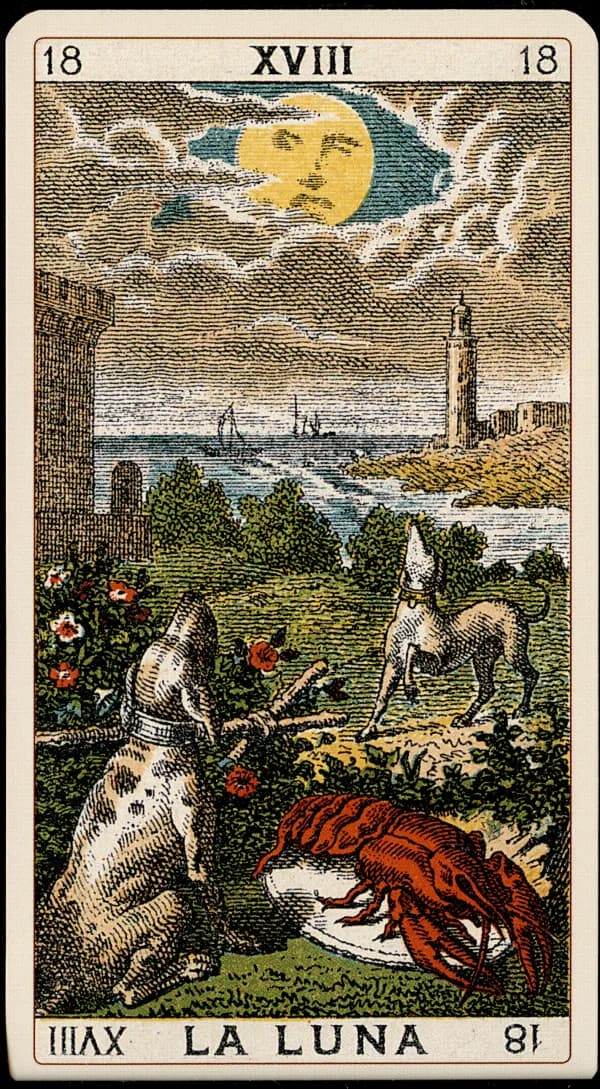
Look up first. The Rider-Waite-Smith Moon has a face drawn in profile inside the disc, its eyes shut. A.E. Waite, who wrote the meanings for the deck Pamela Colman Smith drew, even counts the rays: "It has sixteen chief and sixteen secondary rays." Drops shaped like the Hebrew letter Yod drift down. Below, an orange dog and a pale wolf strain upward with open mouths, and a crayfish has hauled itself half out of a pool.
Waite puts words to that split. "The face of the mind directs a calm gaze upon the unrest below," he writes in The Pictorial Key to the Tarot. The calm sits overhead. The panic is on the ground. His meanings still lean dark ("darkness, terror, deception"), though he calls most fortune-telling meanings of the Majors "artificial and arbitrary."
In the Golden Dawn, the occult order Waite belonged to, card XVIII took Pisces, a Water sign, and the Hebrew letter Qoph. Robert Wang, in The Qabalistic Tarot, explains the letter: "The meaning of Qoph is the back of the head." It's the spot where a hunch prickles before you can say why.
Then check which way the moon is growing. Waite observes that "Some eighteenth-century cards shew the luminary on its waning side," and on his own card "the moon is increasing." But Aleister Crowley turned it back in The Book of Thoth: "This is the waning moon." On Waite's card, the light is on its way in.
Now look at the High Priestess.
She sits between two pillars, a black one lettered B and a white one lettered J, in front of a hanging sewn with palms and pomegranates. Her crown is a pair of horns around a white globe, and a crescent moon lies at her feet. A scroll marked TORA rests in her lap. Waite says why part of it is hidden: "It is partly covered by her mantle, to shew that some things are implied and some spoken."
In Seventy-Eight Degrees of Wisdom, Rachel Pollack points to a detail that's easy to miss: look through the gap beside the hanging and you'll find a still pool. "The pool signifies the unconscious and the truth hidden there."
The Priestess is card II, and her Hebrew letter is Gimel, "which means a Camel," in Crowley's gloss. And her planet, in the Golden Dawn's system, is the Moon. Not the Moon card's. Hers.
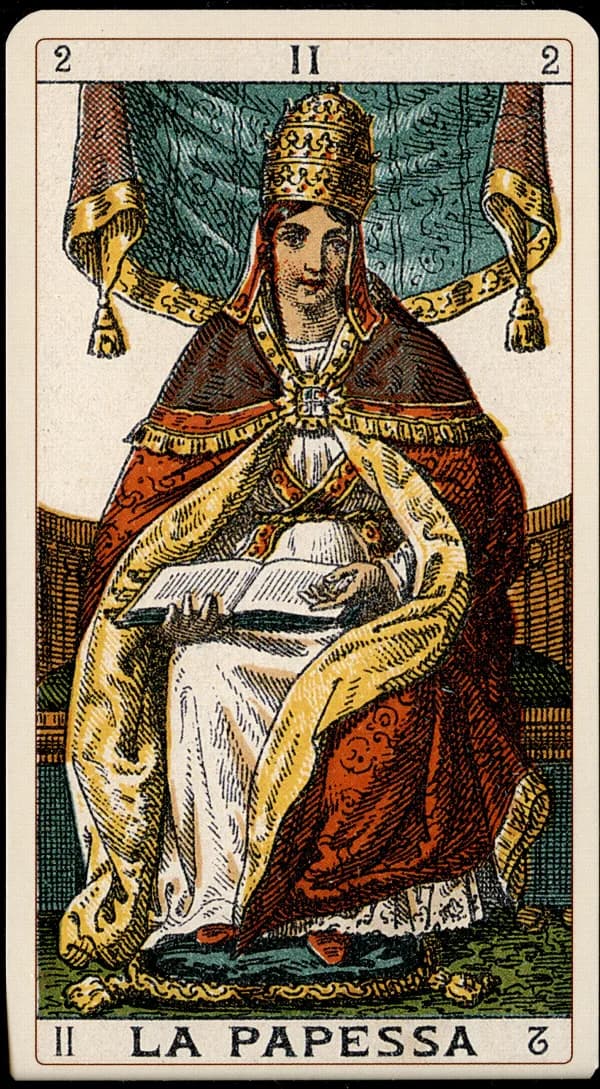
She wasn't always a priestess. On older Italian and French cards she's the Popess, a woman in a papal tiara. Sherryl E. Smith of Tarot Heritage dates the name High Priestess to Antoine Court de Gébelin's book of 1781. The Milanese Papessa further down this page holds her book open, with no moon anywhere on her card. Waite's Priestess keeps part of her scroll covered, and that covered part is what a gut feeling often is: experience you haven't put into words yet.
Where are you standing right now: on the Priestess's seat with the scroll in your lap, or out on the Moon's path between the dog and the wolf?
What the Moon and the High Priestess mean together
Both cards run on borrowed light. Waite calls the High Priestess "the Queen of the borrowed light, but this is the light of all." Pollack writes that "the Moon reflects the hidden light of the Sun." A gut feeling arrives that way. So does a fear. You sense something you can't see directly, and you fill in the rest.
Pollack even sets the two side by side: "Like the High Priestess the Moon indicates turning away from outer concerns and becoming introspective." Then comes the split: "while the High Priestess symbolizes quiet intuition, the Moon is excited." Same inward turn. One card is quiet. The other throws pictures at you faster than you can check them.
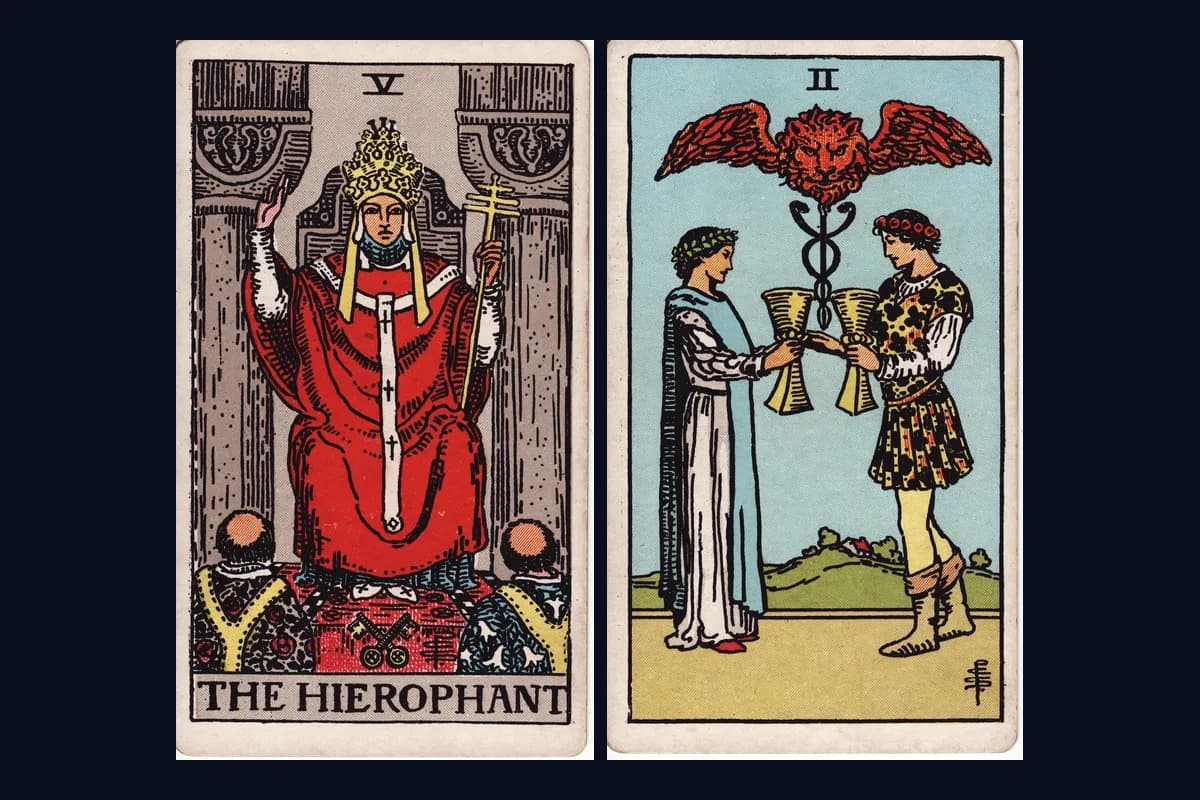
They're both Majors, and reading two Major Arcana cards together means reading a stretch of your life, not a passing mood. And nobody acts in either card. Waite notes that, unlike the Hierophant, "the High Priestess makes no sign." The Moon has no people in it at all. Whatever this pair is about starts inside you.
Barbara Moore of Llewellyn says the Moon's reading depends on the cards around it, and she names this neighbor outright:
So while you wait, the pair hands you a test. Waite's list for the Priestess includes "tenacity." Fear can have it too. But fear is loud, and it swings with your sleep, your mood and the last thing someone said to you, while a real hunch comes back quietly, in the same shape. The knowing that stays quiet and steady is the one to trust. The feeling that changes with the hour belongs to the Moon, along with the worry that loops and keeps you checking.
One exception comes first. If the feeling's about your safety or health, or someone else's, act on it now. The cards will keep.
Think of the last hunch that turned out right and the last worry that turned out wrong. Before you knew how either one ended, what felt different about them?
How to tell intuition from illusion in a reading
In a Celtic Cross, watch for the Moon in the ninth position. Waite's instructions say, "The NINTH CARD gives his hopes or fears in the matter," and Labyrinthos adds that "what we fear the most is sometimes what we also truly have been hoping for all along." With the Priestess in the first position, you already know something. The Moon in the ninth can mean you want the outcome and dread it. Both at once. And the fear is loud because the thing matters.
In love, the pair usually means something is going unsaid, on the other person's side or on yours. If your gut says something is off, these cards give the hunch a hearing, and no further. But they can't tell you whether anyone is hiding anything. Watch what happens over a few weeks, and ask the plain question. If what you really doubt is someone else's honesty, the Moon and Knight of Cups combination takes that question on.
For career decisions, the Moon says you won't get every fact you want, and some things stay dark. The Priestess gives your gut a vote. Gather the facts you can, write the pros and cons, then notice which option still feels right the next morning.
For health questions, this pair is about the worry that keeps you up at night, not about outcomes. A worry that never lets go and only gets louder isn't the quiet knowing this pair means, and no spread can tell a hunch from an anxiety that needs care. The cards are not a medical opinion. If the worry is about your body or your mind, talk to someone who went to school for it.
If you're asking yes or no about your own next step, the first answer is not tonight, unless anyone's safety or health is at stake. Upright together, the pair leans yes to what your quiet knowing still says after a few nights' sleep. The Moon reversed beside an upright Priestess is the clearest yes. Both reversed means wait. With the Priestess reversed beside an upright Moon, it's no as things stand. Theresa Reed of The Tarot Lady says of the reversed Priestess: "Sometimes intuition can be faulty. This may be time to rely on facts rather than your feelings."
What's the one thing you already know about this question but haven't said out loud? What would your High Priestess look like with it written on her scroll? That image belongs in your deck.
The Moon first, or the High Priestess first
The Moon first, then the High Priestess is the hopeful order. The fog comes first: worry, mixed signals, dreams you can't make sense of. Then she arrives, seated and still. Whatever you were straining to see in the dark can settle into something you simply know. What changed? Mostly time, letting what you'd already seen sink in.
The High Priestess first, then the Moon is the cautionary one. You knew something, calmly. Then doubt came in, through a bad week or a story you told yourself at night. If nothing actually happened, the knowing hasn't gone anywhere; it's just harder to hear, so go back to what you knew before the worry started and write it down. But if something did happen, that's news. Look at it.
In a three-card spread of past, present and future, look first at the future slot. With the Priestess there, the answer comes from you. And if the Moon lands there, things may get harder to see before they clear, so give the question more time.
Orientation matters too. Waite puts one word on both cards: "silence." It's in the upright Priestess's list and the reversed Moon's, so a reversed Moon can move toward her quiet. His reversed Priestess has "surface knowledge," reading only what's on top. Not every reader uses reversals, and for the reversed Moon the table follows many modern readers, who see the fear lifting, though Waite's version keeps some deception.
| Orientation | Reading |
|---|---|
| Both upright | A hunch still taking shape; keep listening, and give it a few nights before you act on it |
| Both reversed | Surface knowledge and a fear that's loosening its grip; neither is solid enough to act on, so wait until you can hear yourself again |
| Moon upright, Priestess reversed | The hardest mix; the fear is loud and your own knowing has gone shallow, so act on neither as things stand |
| Moon reversed, Priestess upright | The fog is lifting and your knowing is intact; it's the clearest go-ahead this pair gives, so act on what you already know |
Which came first in your spread, the fog or the knowing? And if it was the knowing, what did it say before the worry got loud?
What the sky adds to the gut-feeling question
You've met the swap already: the planet Moon sits with the High Priestess, and the Moon card gets Pisces. Crowley says so in his section on the Priestess: "The card refers to the Moon."
He also puts the two at opposite ends of one scale. The Priestess is "the purest and most exalted conception of the Moon." Then he adds, "At the other end of the scale is Atu xviii." That's the Moon card, which he calls the planet's "lowest avatar." You get the calm version and the churned-up one. Same planet.
Not every reader works with elemental dignities, the Golden Dawn's method of reading a card through the elements of the cards beside it. If you do, the Moon card is Water through Pisces, and the Priestess's planet, the Moon, rules Cancer, another Water sign, so you can count her as Water too. Read that way, the pair strengthens whatever is already there. It won't sort a hunch from a fear. Book T, the order's tarot manual, reads the Priestess as change, and says the cards beside her show whether it goes well or badly. So check this pair's neighbors.
Her planet also rules five decans, the ten-degree slices of the zodiac the Golden Dawn gave to numbered Minor cards. One is the Two of Swords, the Moon in Libra: her number and her planet together. On the Rider-Waite-Smith card, a blindfolded woman holds two crossed swords under a crescent moon. Beside this pair, it's a picture of deciding without looking.
The New Moon falls in Pisces on March 8, 2027, the Priestess's planet in the Moon card's sign with its lit side turned away. If you pull this pair around then, write your hunches down with the date and check them a month later. And the Full Moon in Pisces follows on September 15, 2027 (US time), the same planet fully lit and still running on borrowed light.
If you know your birth chart, find where your Moon sits. Is the feeling you're testing coming from that part of your life?
What the numbers say about a gut feeling
The Moon is 18. The High Priestess, 2. Add them and you get 20. That's Judgement. Some readers treat this kind of numerical sum as meaningful; others don't.
Picture the card. An angel blows a trumpet from the clouds, and the dead rise to answer. Waite reads that call as one the listener answers from inside. The creature climbing out of the Moon's pool tries for land, Waite writes, "but as a rule it sinks back whence it came." On the Moon, what surfaces slips back under. But on the card these two add up to, it stands up.
Pollack makes the link in her section on the Priestess: Judgement, with the World, "resolves the duality by uniting the inner mysteries with the outer awareness." What the Priestess keeps to herself, Judgement says out loud.
Now reduce 20: 2 + 0 = 2. You're back at the High Priestess. That's the Moon's doing. Its 18 reduces to 9, and adding 9 never changes what a number reduces to, so the Moon can't change the Priestess's number. Here, that's the point. However much fog the Moon adds, the number that comes back is still hers.
The Golden Dawn drew these cards as roads on a map. On its Tree of Life, ten spheres joined by twenty-two paths numbered 11 to 32, the Priestess is the 13th path, from Kether, the Crown at the top, straight down to Tiphareth at the heart. The Moon takes the 29th, from Netzach, the sphere of feeling, to Malkuth, the physical world. Wang calls it a path "where the student must face and conquer the phantoms of the darkest recesses of his own mind." One starts at the top. The other ends at the bottom.
Which feeling keeps coming back in the same shape, even on a calm, clear day? And which one only gets loud after dark?
Questions readers ask about this combination
Does the Moon and High Priestess mean I should trust my gut feeling?
The Moon and High Priestess combination says the feeling deserves a hearing, not that it's proven. The Priestess is the quiet knowing; the Moon is the fog around it. Trust the hunch that comes back quiet and in the same shape after a few nights' sleep, and be wary of the one that swings with your mood or keeps you checking. If the feeling is about your safety or health, or someone else's, act on it now.
What does the Moon and High Priestess mean in a love reading?
In love, the Moon and High Priestess usually point to something going unsaid, on the other person's side or on yours. The cards give a hunch a hearing, and no further. They can't tell you whether anyone is hiding anything or lying. If you feel unsafe, get help now. Otherwise, watch what happens over a few weeks, and ask the plain question you've been putting off.
What does it mean when the Moon and High Priestess are both reversed?
With the Moon and High Priestess both reversed, the pair points to a fear that's loosening its grip and to what A.E. Waite called surface knowledge in the reversed High Priestess: reading only what's on top. Neither is solid enough to act on, so the answer is wait. Set the question aside until you can hear yourself again, unless anyone's safety or health is at stake; then act now. Not every reader uses reversals.
What planet connects the Moon and the High Priestess?
The Moon, but not on the card you'd expect. In the Golden Dawn's system the planet Moon belongs to the High Priestess, under the Hebrew letter Gimel, while the Moon card takes Pisces, a Water sign, under Qoph. Aleister Crowley puts the two at opposite ends of one scale: the Priestess is the planet at its highest, and the Moon card at its lowest.
Is the Moon and High Priestess a yes or no combination?
The Moon and High Priestess answer yes-or-no questions about your own next step, not about someone else's choices. The first answer is not tonight, unless anyone's safety or health is at stake; then act now. Both upright leans yes to what your quiet knowing still says after a few nights' sleep. The Moon reversed beside an upright Priestess is the clearest yes. Both reversed means wait. The Priestess reversed beside an upright Moon is no as things stand.