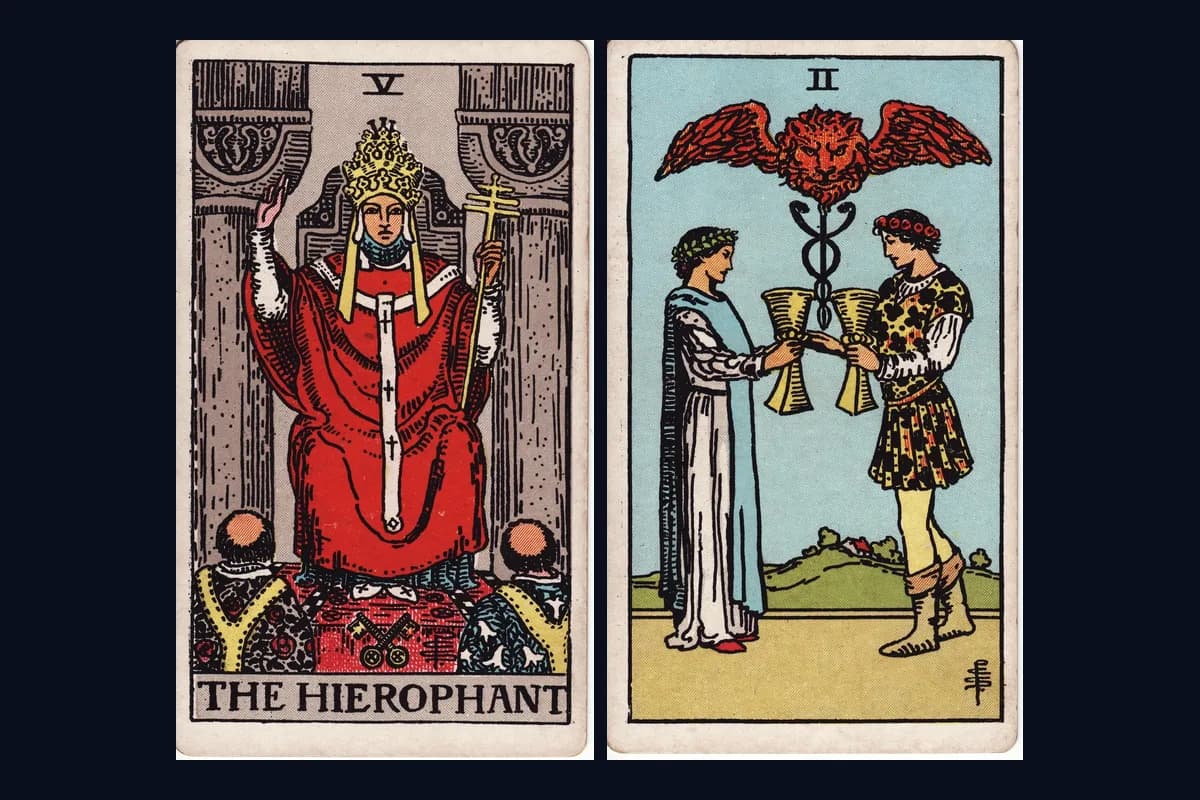
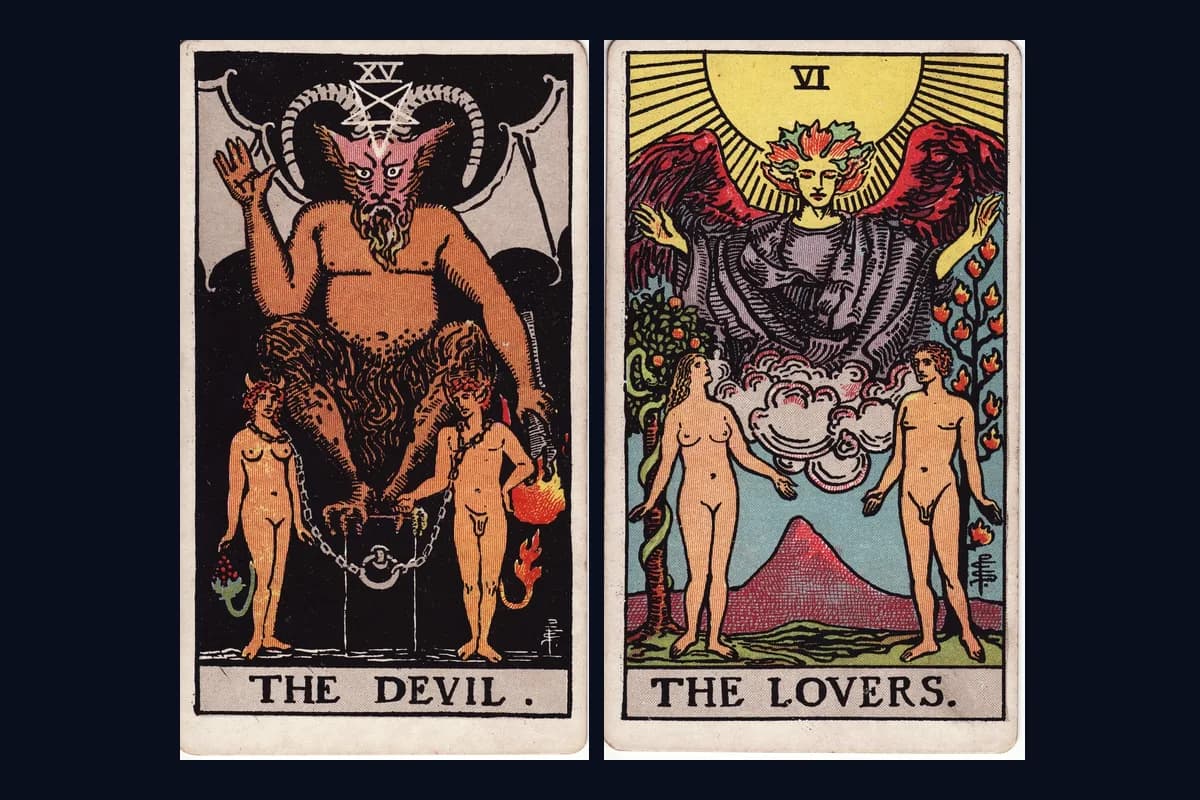
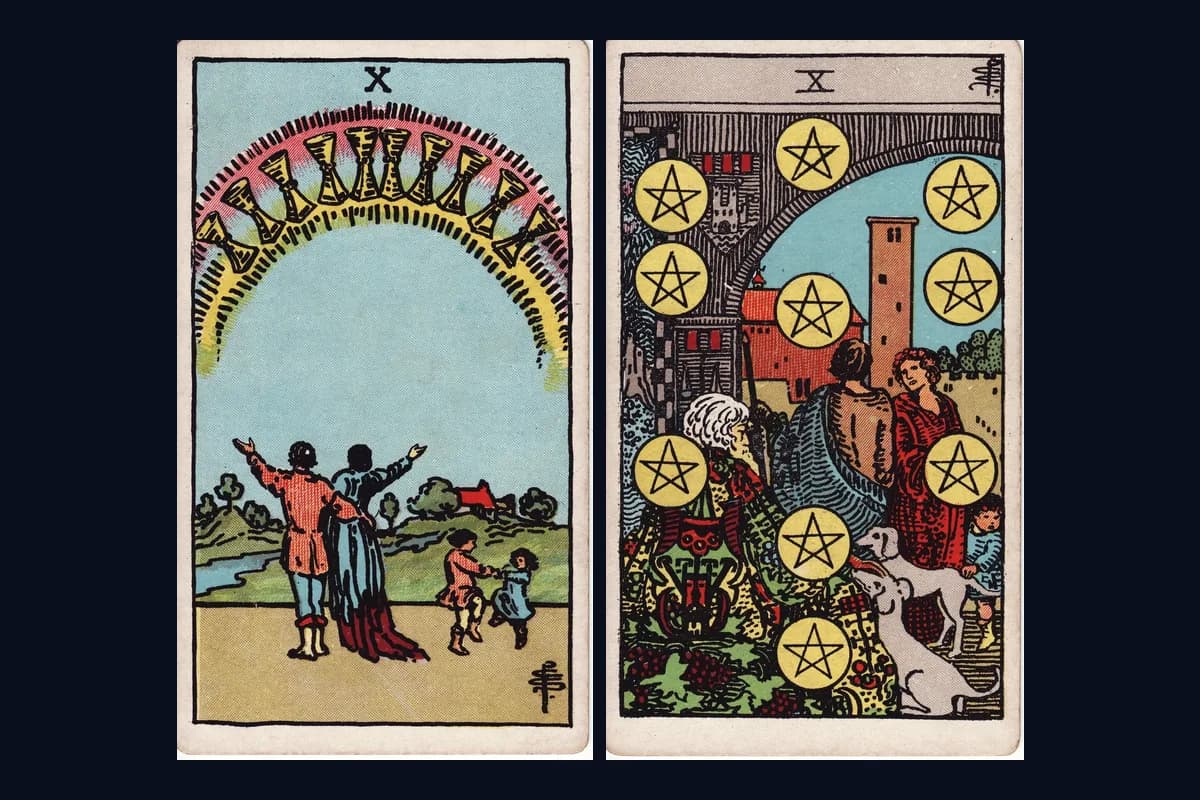
Tarot Reading
How to Read Tarot Card Combinations
You know your card meanings. But two cards land side by side and your mind goes blank. That wall is the most common problem in tarot. It has nothing to do with intuition or talent. It's a skill gap. And a handful of learnable techniques can close it.

Climate scientist, ashtanga practitioner, and advocate for human rights and LGBTQIA+ equality.
Why your brain goes blank at two cards
Brigit Esselmont of Biddy Tarot puts the math plainly: there are over 3,000 different two-card combinations in a standard tarot deck. Three thousand. Nobody memorizes them. The readers who make combinations look effortless aren't pulling from some hidden encyclopedia. They're using a handful of learnable techniques and applying them to whatever cards show up.
The freeze happens because most tarot books teach cards one at a time. You learn The Empress. You learn the Nine of Cups. But nobody tells you how to read tarot cards together once they land in the same spread. Dusty White, who has taught tarot professionally for years, nails the problem: "Too many tarot readers read cards individually but fail to blend them together into deeper meanings."
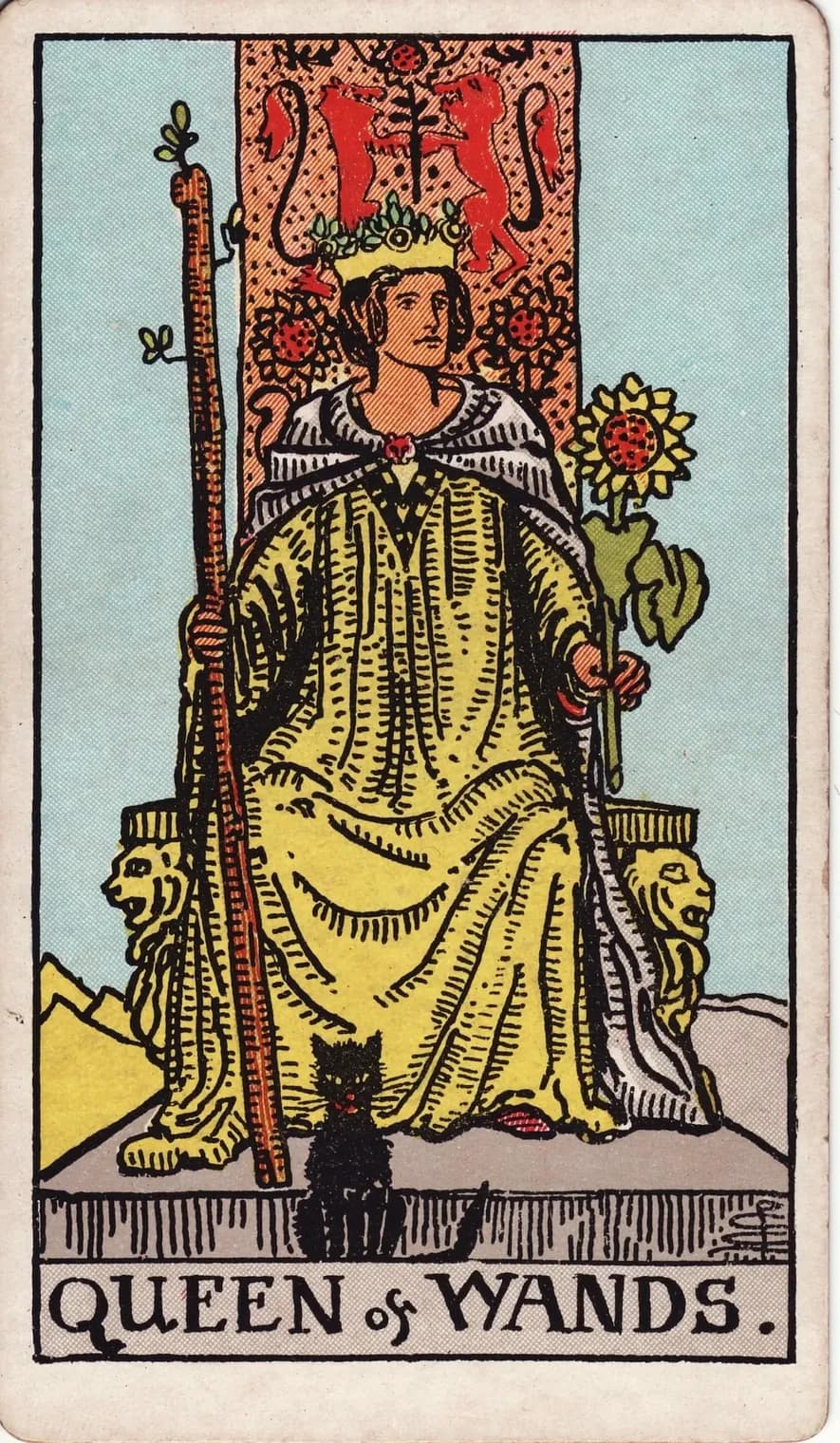
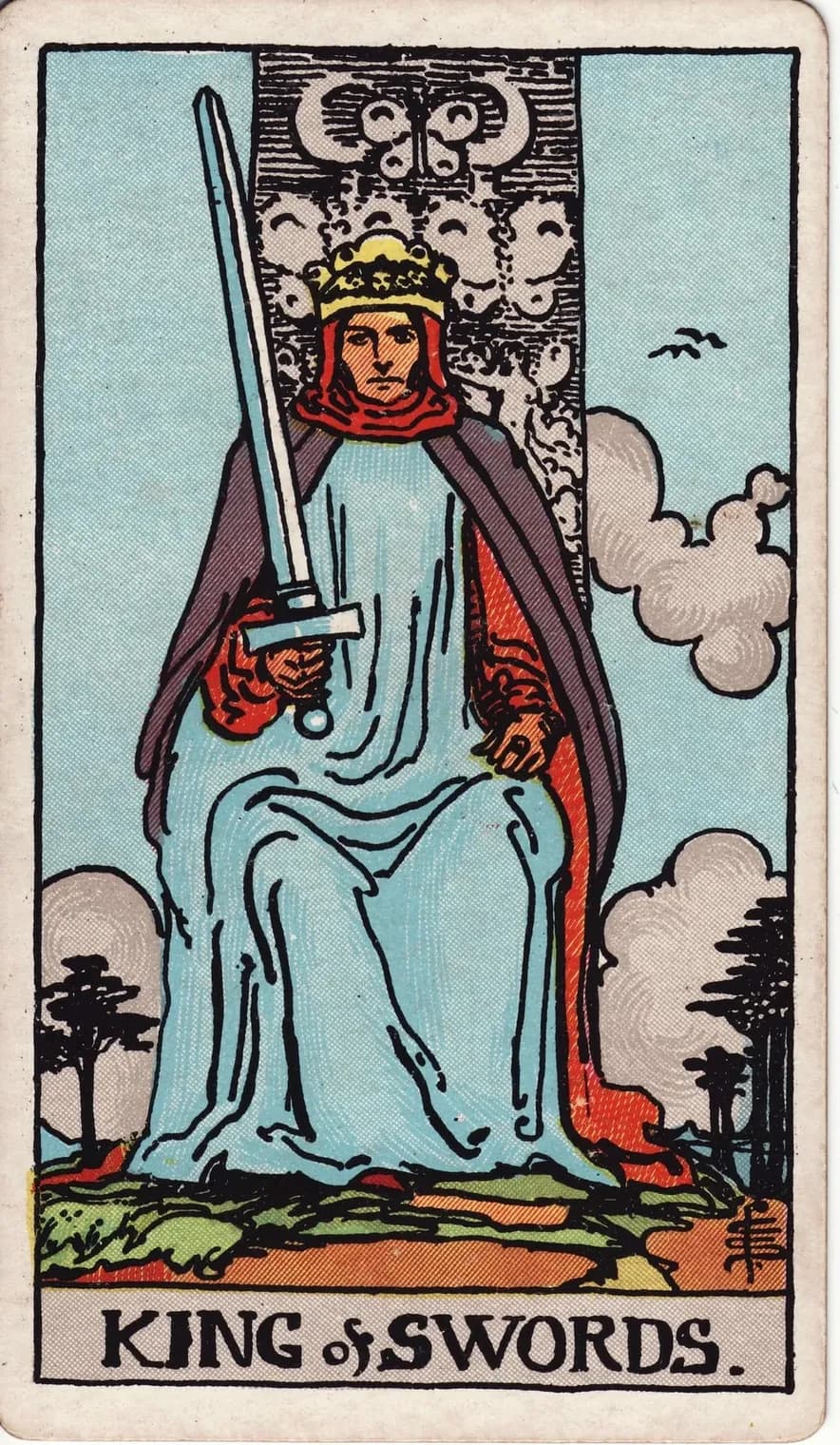
Look at the two court cards below. A confident queen holding a sunflower and a stern king gripping a sword. Right now they might feel like two separate characters in two separate stories. By the end of this guide, you'll have several distinct ways to read them as a single message.
Think about the last time you pulled two cards and felt stuck. Which part tripped you up: not knowing what each card meant, or not knowing how to put their meanings together? That distinction matters, because you probably already have the first part handled.
The sentence technique
Jeannie Reed, author of The Language of Tarot (Llewellyn, 2019), realized something that changed her practice entirely. Cards laid out in a row can be read the same way you read words in a sentence. Each card contributes a fragment of meaning. Strung together, they say something none of them say alone.
Marcus Katz and Tali Goodwin made this more structured in their book Tarot Face to Face (2012). They assign each category of card a grammatical role. Major Arcana cards become nouns (the subject, the big theme). Minor Arcana cards become verbs (the action, what's happening). Court cards? They're the adjectives or adverbs (the style, the personality coloring the action).
Try it with the Queen of Wands and the King of Swords. The Queen of Wands (court card, adjective) brings confident, fiery warmth. The King of Swords (court card, adjective) brings sharp, disciplined clarity. Two court cards together bend the sentence technique, because you have two adjectives and no verb. In practice, two court cards shift the reading from action to relationship: who are these two people, and what is the dynamic between them? Here, a bold creative woman sits across from an analytical, direct man. Or, if both cards describe you: you're feeling torn between your passionate instincts and your logical mind.
Gina Wisotzky of Incandescent Tarot recommends a related approach: the tarot thesis statement. Before you interpret individual cards, form one sentence that captures the entire spread. That sentence becomes your anchor. When you get lost in the details of a reading, come back to it.
Rachel Pollack, whose Seventy-Eight Degrees of Wisdom has been in print since 1980, approaches combinations as a relational practice: every card modifies the one beside it. Joan Bunning sees them as characters who are interacting, cooperating, conflicting. And Dorothy Kelly dedicated an entire book, Tarot Card Combinations, to turning card pairs into plain-English sentences. Whether you build a grammatical sentence or spin a narrative, the principle is the same: stop reading cards in isolation. Let them talk to each other.
Pull two or three cards right now and try building a single sentence from them. Don't worry about getting it "right." The sentence doesn't need to be grammatically perfect. It just needs to feel true.
Bridge cards and what connects them
Every three-card spread has a hidden structure. The middle card is the bridge. It connects the meaning of the first card to the meaning of the third, like the hinge of a door. It tells you whether two energies flow together or push apart.
Nadia Gilchrist of Ruby Slipper Astrology designed a spread she calls "The Bridge." Card 1 represents you. Card 3 represents another person or a goal. Card 2, in the center, is the bridge energy connecting or blocking the two. If your bridge card is the 8 of Wands reversed, you know there's a block. If it's the 10 of Swords, the connection is going nowhere. But if it's the 2 of Cups, something real is pulling those two sides together.
This concept goes back further than most readers realize. Jean-Baptiste Alliette, better known as Etteilla, published some of the earliest printed material on card divination in the 1770s and 1780s. His three-card layouts assigned positional meaning to each card, placing the center card as the link between what came before and what follows.
Marcus Katz and Tali Goodwin teach a related exercise they call bridging. Place two random cards side by side and find what connects them. Not the meanings. The visual details. Similar colors. Shared symbols. Matching body language. They stress: "The important thing is not to try and interpret the cards, nor make sense of them individually." Just look for the thread.
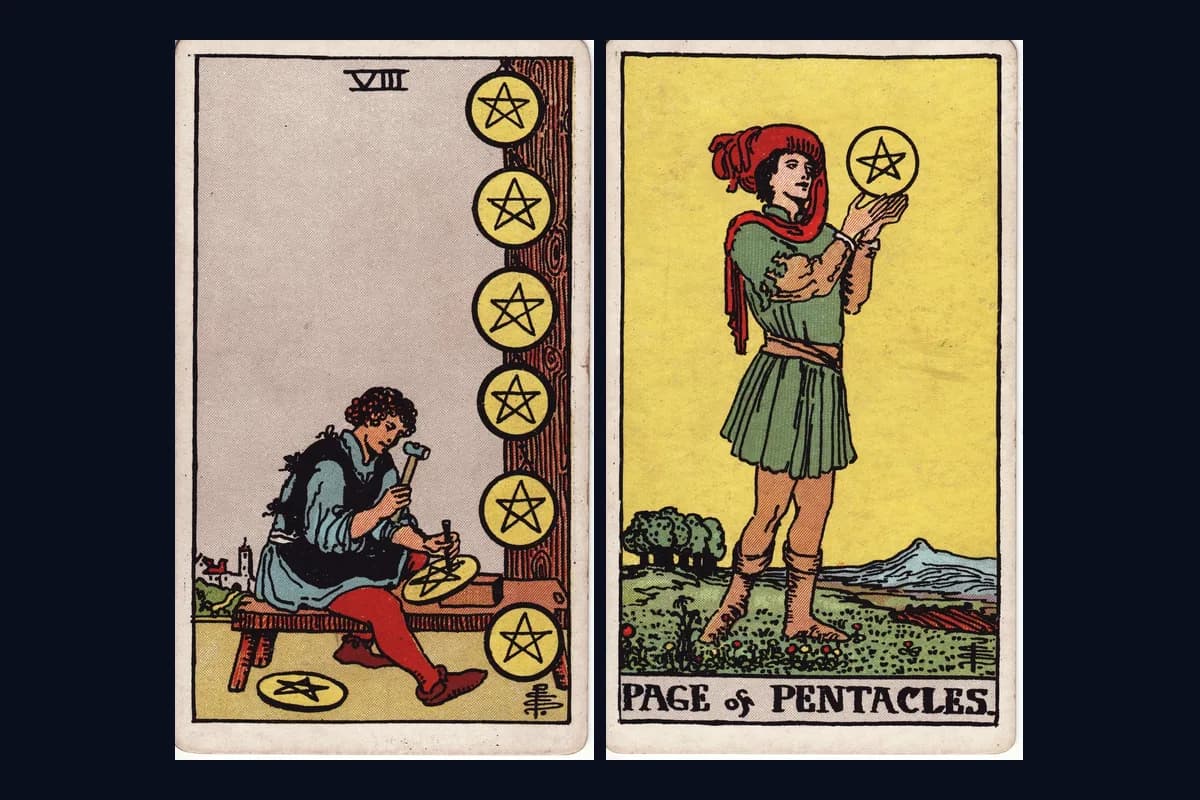
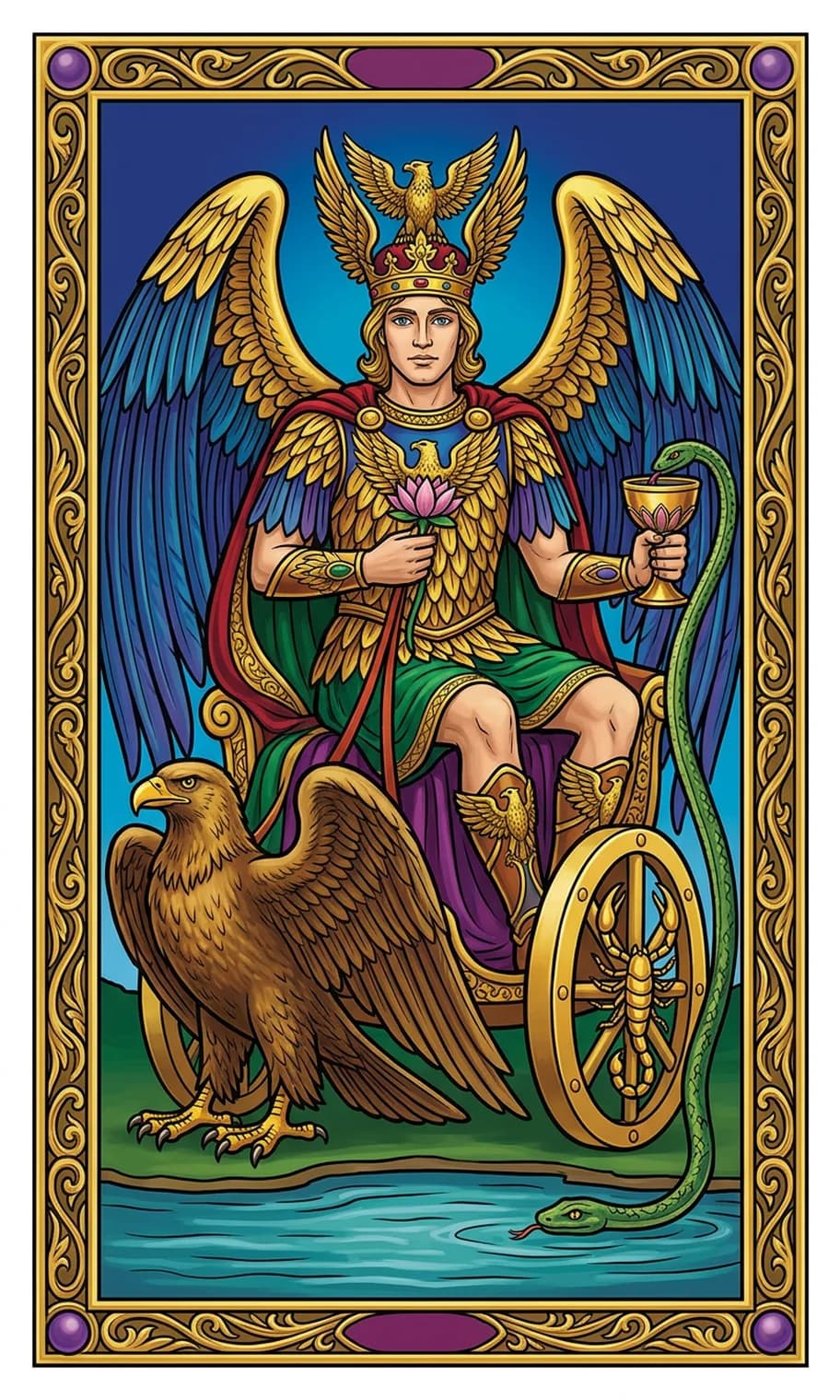
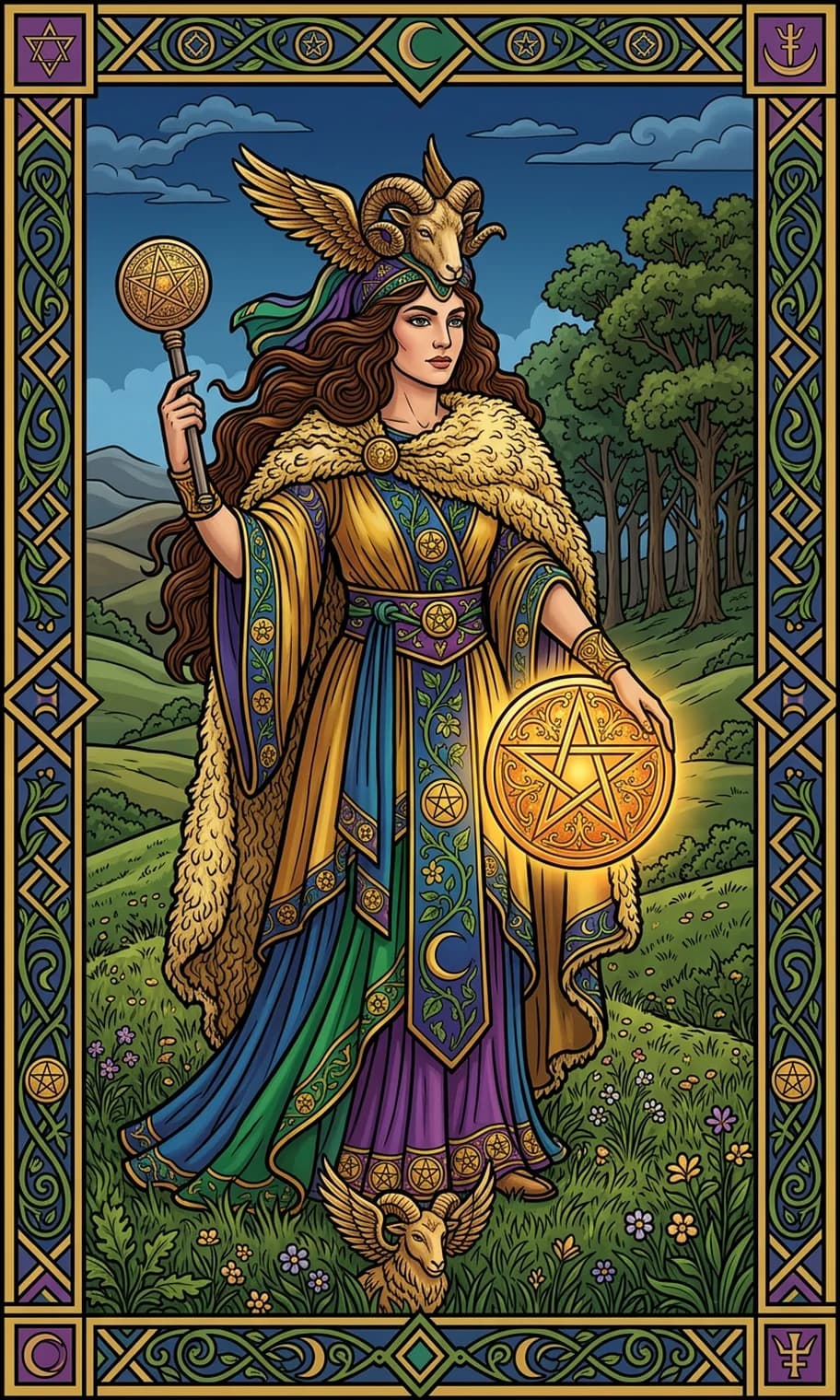
Look at the two Golden Dawn cards below. A Prince holding a cup and a Princess with a pentacle. Before you think about what either one "means," notice what they share. Both are young. Both face a similar direction. Both carry something in their hands. That common ground is the bridge between them, and it tells you more about their relationship than any keyword definition can.
The next time you pull three cards, try reading just the center one first. Ask it: what are you holding together? What are you keeping apart? Sometimes the bridge card says more about your situation than the two it connects.
Elemental dignities from the Golden Dawn
Some card combinations feel like they amplify each other. Others seem to cancel out. In the late 1880s, S.L. MacGregor Mathers wrote a manuscript called Book T for the Hermetic Order of the Golden Dawn that explains why. He called the system elemental dignities. The premise is ancient: everything is made of four elements, and those elements either cooperate or fight.
Mathers's rule was blunt: "A card is strong or weak, well dignified or ill dignified, according to the cards next to it on either side." Two Wands cards together? The fire doubles. A Cups card flanked by two Wands cards? Fire and Water are enemies, and the Cups card is weakened. The card is still there, but its voice is quieter.
The original system has three categories, not four. Anthony Louis argues that many modern books and videos add a "neutral" category that the Golden Dawn material does not clearly support. The real system is simpler. Cards of the same element greatly strengthen each other. Fire and Water are enemies, as are Air and Earth; they greatly weaken each other. Every other pairing is friendly. (You can see the same-element strengthening in action in the Death and Ace of Cups combination, where doubled Water creates a reading you feel in your body before your head catches up.)
Why these specific pairings? It goes back to Aristotle. Fire is Hot and Dry. Air shares that Heat but swaps in Wetness. Water goes Cold and Wet, and Earth rounds it out as Cold and Dry. Elements that share a quality are friendly. Elements that share nothing are enemies.
| Combination | Suits | Effect |
|---|---|---|
| Same element | Wands + Wands, Cups + Cups, etc. | Greatly strengthen each other |
| Fire + Air | Wands + Swords | Friendly (share Heat) |
| Water + Earth | Cups + Pentacles | Friendly (share Cold) |
| Fire + Earth | Wands + Pentacles | Friendly (share dryness) |
| Air + Water | Swords + Cups | Friendly (share wetness) |
| Fire + Water | Wands + Cups | Enemies; greatly weaken each other |
| Air + Earth | Swords + Pentacles | Enemies; greatly weaken each other |
Court cards get trickier because each one carries two elements. The rank supplies one element (Kings = Fire, Queens = Water, Knights = Air, Pages = Earth) and the suit supplies another. (A note on naming: the Golden Dawn called these ranks Knight, Queen, Prince, and Princess. Waite renamed them when he published the RWS deck. The elemental assignments stayed the same.) The Queen of Cups is Water of Water: emotion through and through. The King of Wands is Fire of Fire: will meeting will. But the Knight of Pentacles is Air of Earth: thought directed at material concerns. And a Page of Swords is Earth of Air: the very beginning of intellectual growth, still close to the ground.
If you only remember one rule from this table, let it be the enemies: Fire and Water weaken each other, and so do Air and Earth. That single fact will change how you read about half the combinations you see.
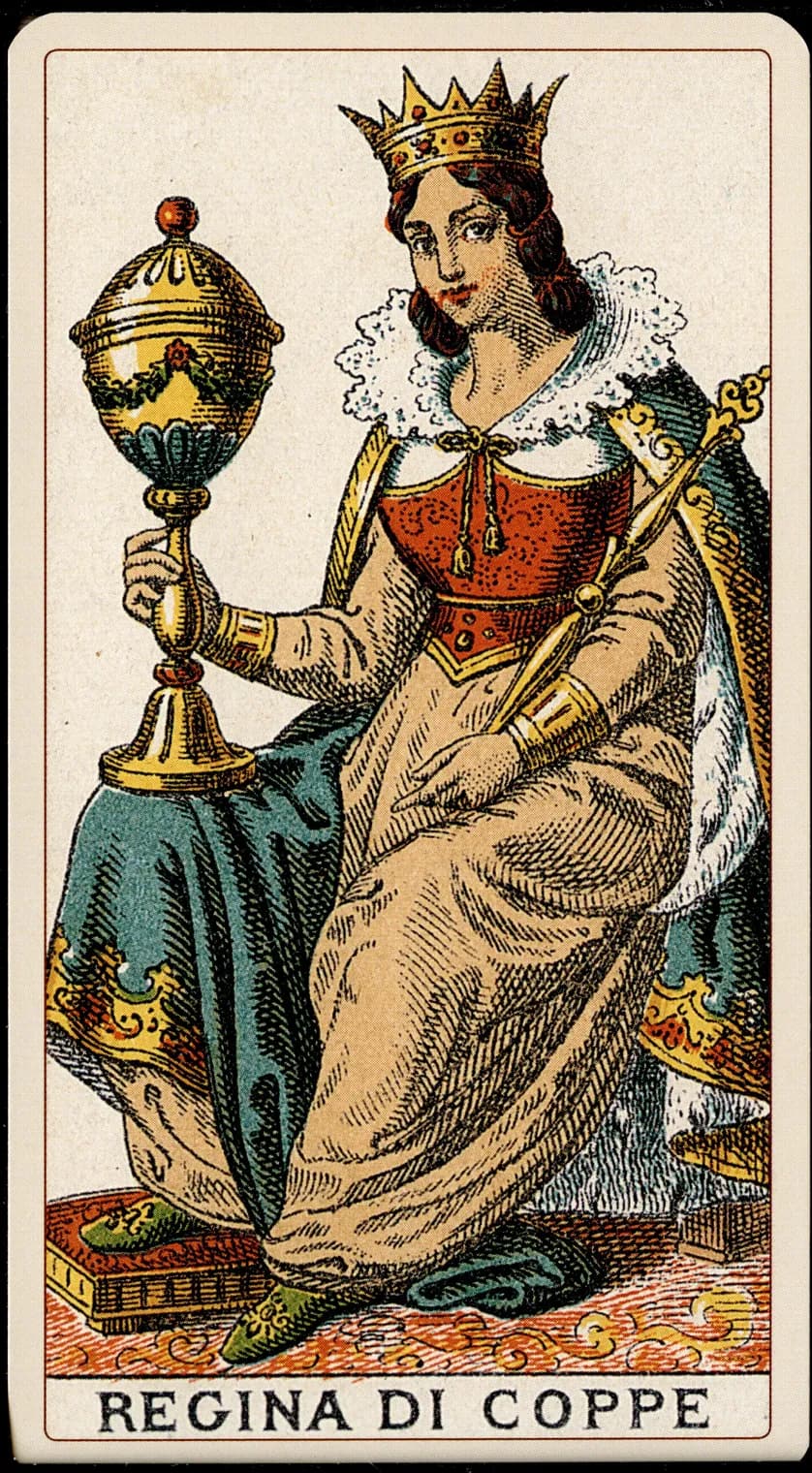
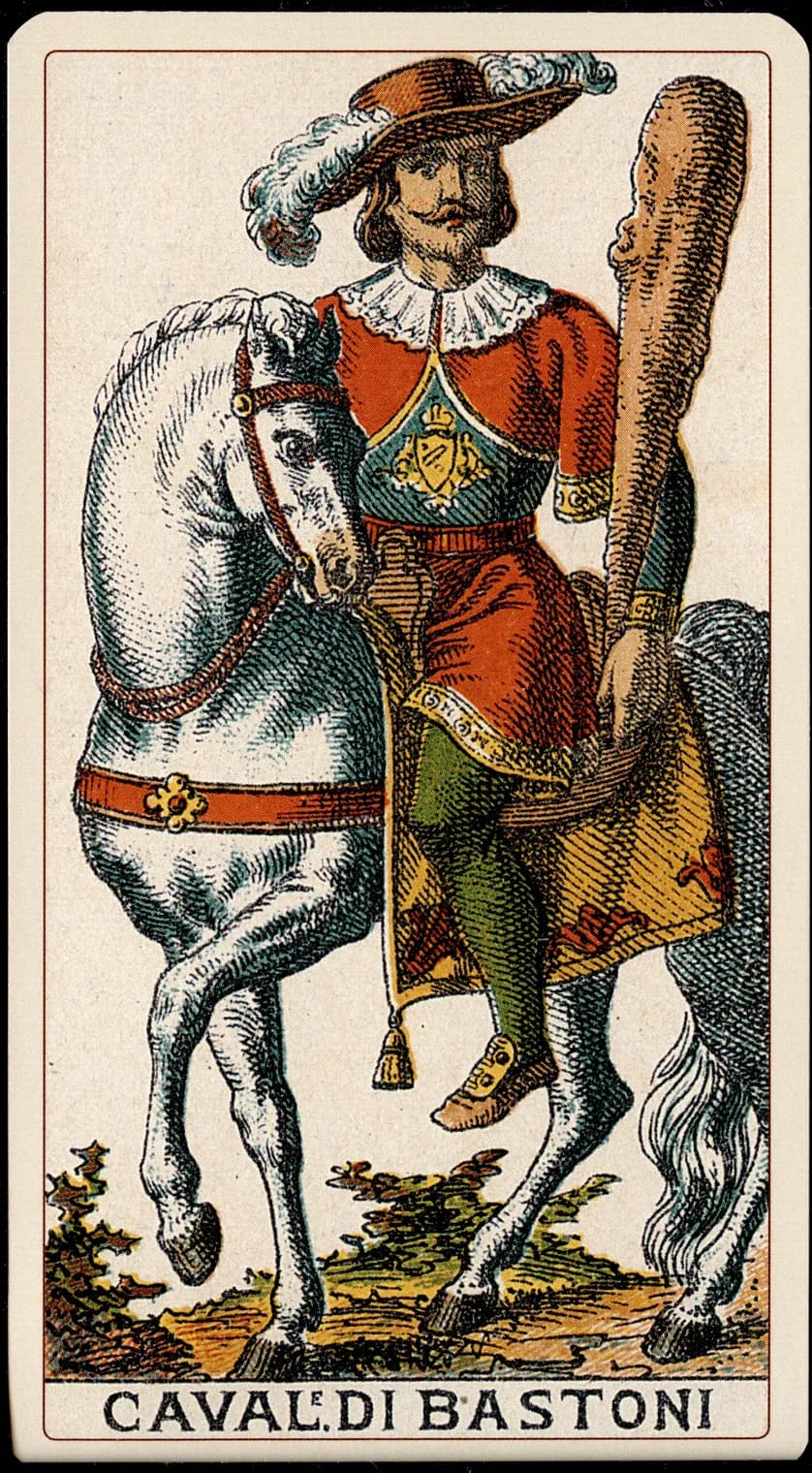
The two Milanese court cards below make this concrete. The Regina di Coppe gazes down at an overflowing chalice, all stillness and depth. The Cavaliere di Bastoni charges forward on horseback, club raised, all movement and force. As elements: the Queen of Cups is Water of Water. The Cavalier of Wands is Air of Fire. Water opposes Fire. The suit elements are enemies: they weaken each other. But the rank elements (Water and Air) are friendly. What you get is a reading where the emotional and passionate sides pull against each other, but something about the way these two people think keeps them connected. Tension and attraction at the same time.
Pull two court cards from your deck right now. Check their suit elements first: same element, enemies, or friends? Then check the rank elements. Where the elements agree, the energy flows. Where they clash, you'll feel it in the reading.
When you design your own deck, the color palette you choose carries elemental weight. A Cups card painted in deep blues doubles down on Water. A Wands card in cool silver introduces tension. Every color choice you make is a meaningful decision about how your cards will speak to each other.
Visual flow: what the pictures show you
Mary K. Greer named the technique "Tarot Flow" in a 2011 blog post, building on something that hides in plain sight. The figures in Rider-Waite-Smith cards are posed like actors on a stage. They face specific directions. They gesture toward or away from each other. Their backgrounds connect. Pamela Colman Smith studied illustration at the Pratt Institute under Arthur Wesley Dow and later worked as a stage designer. She built both sensibilities into every card.
Gaze direction is the simplest place to start. A figure facing right looks toward the future. Left means the past. Straight ahead means the figure is addressing you. When two cards sit side by side, notice whether the figures face each other, face away, or whether one looks while the other turns its back.
Biddy Tarot teaches this with a direct example: "Is the Page of Swords looking at the Queen of Cups? Well, depending on how you lay out your Tarot cards, the Page may be staring down the Queen, but she is turned the other way!" Two figures facing each other suggest a close relationship, active communication. Two facing away suggest a break, disconnection, people who aren't hearing each other. One looking at the other without the look being returned? A one-sided situation.
Color tells a story too. Truly Teach Me Tarot maps suit colors to emotional temperature: Wands run warm (oranges, reds, yellows), Swords run cool (pale blues, greys), Cups bring calm blues, Pentacles bring greens. A single warm Wands card sitting among cool Swords cards stands out like a lit match in a dim room. That card is doing something different from everything around it.
Recurring symbols across cards carry meaning too. Biddy Tarot recommends pulling out every card in your deck that shares a specific image, like castles, and studying how the same symbol shifts across different contexts. If two cards in your spread both feature water, or both show mountains in the background, that shared symbol is a thread connecting them.
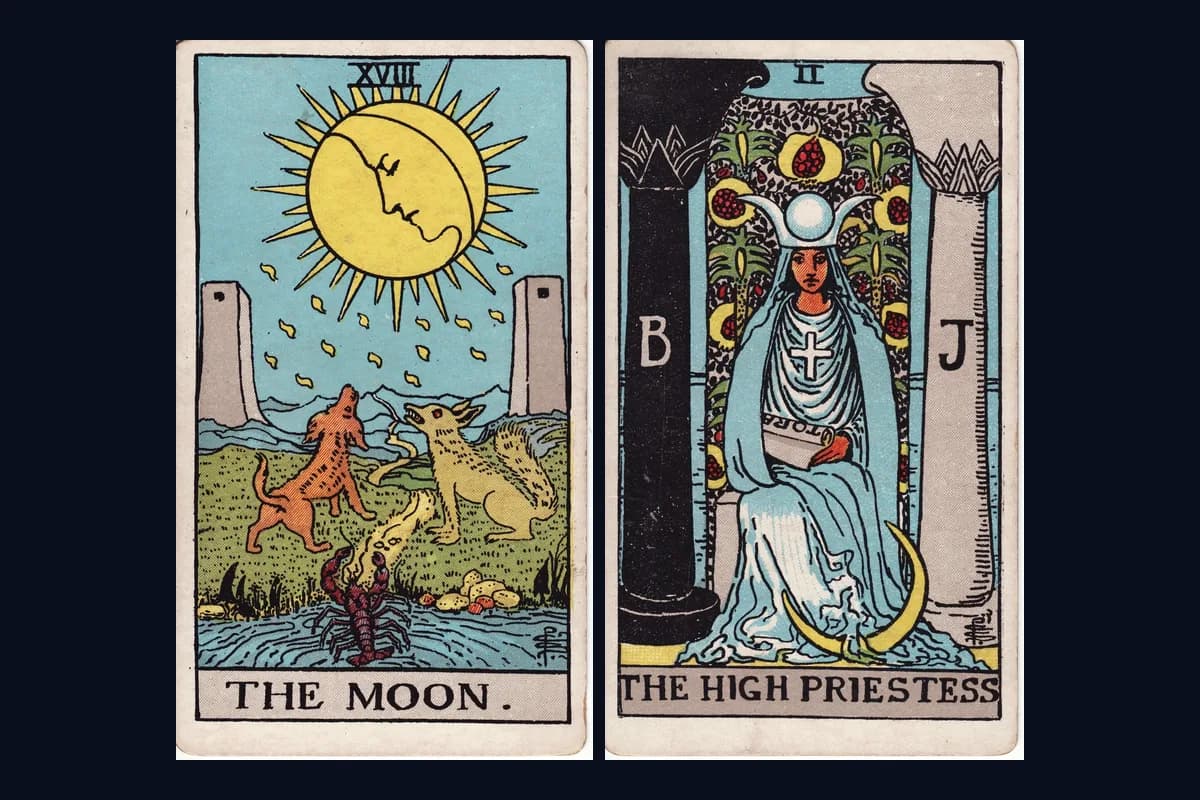
Greer's most practical advice is to place cards physically next to each other and look at how the images connect. She gives a specific example: the churning waters of The Moon, placed beside another card, become a heavy cloak that is almost too much to carry. The meaning shifts when the pictures touch. This is why readers who use trimmed, borderless decks often report richer visual readings. The images flow together without interruption.
Reversed cards add another layer to visual flow. A figure that normally looks right now looks left. A card that usually feels open suddenly feels closed off. If one card in a pair is reversed and the other isn't, the visual relationship between them shifts: one faces into the conversation while the other pulls away.
And don't forget what's missing. Mary K. Greer points out that absence tells a story. If you're doing a love reading and no Cups cards appear, that's information. No Wands in a career spread? The drive may not be there yet. Pay attention to what the deck chose not to show you.
The next time you lay out a spread, step back and look at the whole thing before you start interpreting. What colors dominate? Where are the figures looking? Which cards seem to be having a conversation, and which ones are ignoring each other? What you see in your own deck will tell a different story than what you see in someone else's.
This is why the imagery in your deck matters so deeply. When you envision your own Queen of Wands, the direction she faces, the colors she wears, the symbols she holds, those choices shape every combination she appears in. An intentional design decision becomes part of every reading.
Major meets minor, and what the numbers say
Not all cards carry the same weight. Two Major Arcana cards together? You're looking at a life theme. Something that shapes your story at a deep level. Two Minor Arcana cards point to an everyday situation, temporary and specific. But one Major paired with one Minor creates a useful split: the Major card tells you what or why. The Minor card tells you how.
Brigit Esselmont gives a clear example. The High Priestess (Major) paired with the Three of Wands (Minor) reads as "connecting deeply with your intuition (the what) by creating a vision for the future (the how)." The Major card provides the theme. The Minor card provides the action plan. That split works in almost any Major-Minor pairing.
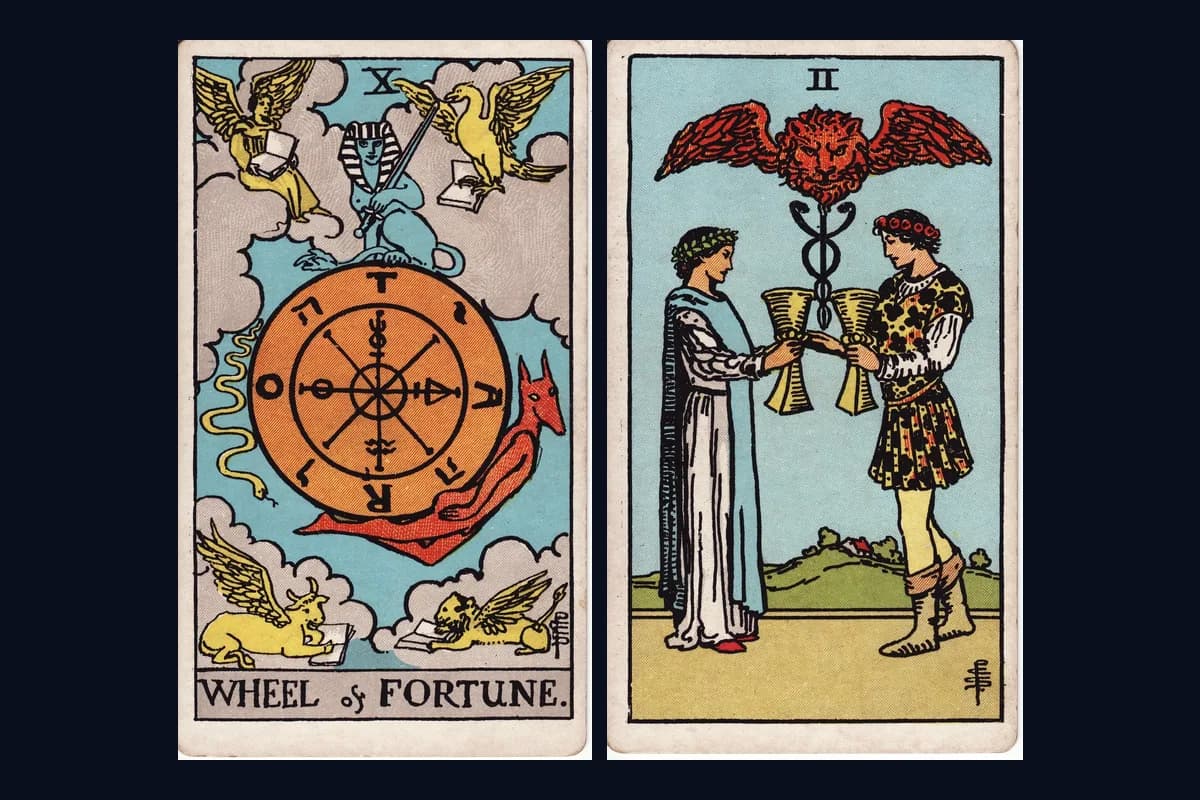
Numbers tell their own story. When cards share the same number, their energy reinforces itself. Two Twos (like the Two of Cups and Two of Wands) point to partnerships and planning at the same time. Numbers also create arcs. Cards numbered 1 through 3 sit near the beginning of a cycle. 4 through 6 mark the middle, where things get tested. 7 through 10 approach completion.
Biddy Tarot gives a memorable example of how number sequence changes meaning. The Two of Cups followed by the Eight of Cups reads as: "Despite a promising beginning to the relationship, both parties decide to go separate ways." But reverse the order. Eight of Cups followed by Two of Cups. Now: "The end of one relationship opens space for a new one." Same two cards. Same numbers. Completely different story based on which comes first.
Watch for suit dominance too. When one element fills most of the spread, it tells you what kind of energy is running the situation. If Cups dominate, emotions are calling the shots. A spread full of Swords means the issue lives in the mind. Pentacles pull toward money, health, or work. And Wands? All ambition and action. When a single card of a different suit shows up in an otherwise uniform spread, pay extra attention to it. That card is the outsider, and outsiders in tarot usually carry the most important message.
One last technique worth knowing: the Quint. Add together the numbers of all the Major Arcana cards in your spread and reduce to a single number between 0 and 21. That number points to another Major Arcana card, the spiritual theme that holds your entire reading together. A Tower and Lovers combination, for instance: 16 + 6 = 22. Reduce: 2 + 2 = 4, The Emperor. (Some readers stop at 22 and assign The Fool instead of reducing further.) The hidden theme beneath that explosive pair is structure, boundaries, and the need to rebuild authority on honest ground.
After your next reading, add up the Major Arcana numbers and find the Quint. What Major Arcana card would you want as the hidden theme of your life right now? That's worth knowing, because it belongs to your reading and nobody else's.
Questions readers ask about tarot card combinations
How many tarot card combinations are there?
A standard 78-card tarot deck produces over 3,000 unique two-card combinations. Memorizing them all isn't practical or necessary. Instead, learn techniques like the sentence method, elemental dignities, and visual flow reading to interpret any combination on the spot.
What are elemental dignities in tarot?
Elemental dignities are a system from the Golden Dawn that explains how neighboring cards strengthen or weaken each other based on their elements. Wands (Fire), Cups (Water), Swords (Air), and Pentacles (Earth) interact according to three rules. Same elements greatly strengthen each other. Fire plus Water or Air plus Earth greatly weaken each other. All other pairings are friendly.
Does the order of tarot cards matter in a reading?
Yes. Card order changes interpretation. In a left-to-right reading, the first card often represents the starting condition and the second represents what follows. The Tower followed by The Lovers reads as destruction clearing the way for honest love. Reverse the order and the reading shifts: a choice or relationship leading to sudden upheaval.
How do I read two Major Arcana cards together?
Two Major Arcana cards together signal a major life theme, not an everyday event. Each Major card carries a deep archetypal message, and together they point to a turning point or spiritual lesson. Focus on the story between the two archetypes rather than isolated keyword meanings.
What does it mean when two court cards appear together?
Two court cards usually represent two people in a relationship, each expressing a distinct personality. Compare their suits (element compatibility) and ranks (maturity level). Sometimes two court cards describe different sides of a single person, like the tension between your passionate impulses and your analytical mind.
Do I need to memorize all tarot card combinations?
No. Brigit Esselmont of Biddy Tarot says it directly: rote learning 3,000 meanings isn't an option. Instead, learn a few reliable techniques. The sentence method, bridge card concept, elemental dignities, and visual flow reading will give you what you need to read any combination you pull.
How do reversed cards affect tarot combinations?
A reversed card in a combination can point to blocked energy, an internal rather than external expression, or a need to revisit the prior card in sequence. Both cards upright often suggests things are flowing freely in the outer world. Both reversed points to something stuck or playing out privately. One upright and one reversed creates a mix of inner and outer dynamics. In elemental dignity terms, a reversed card doesn't change its element, but it may weaken that element's expression.