Tarot Card Combinations
The Moon and the Knight of Cups
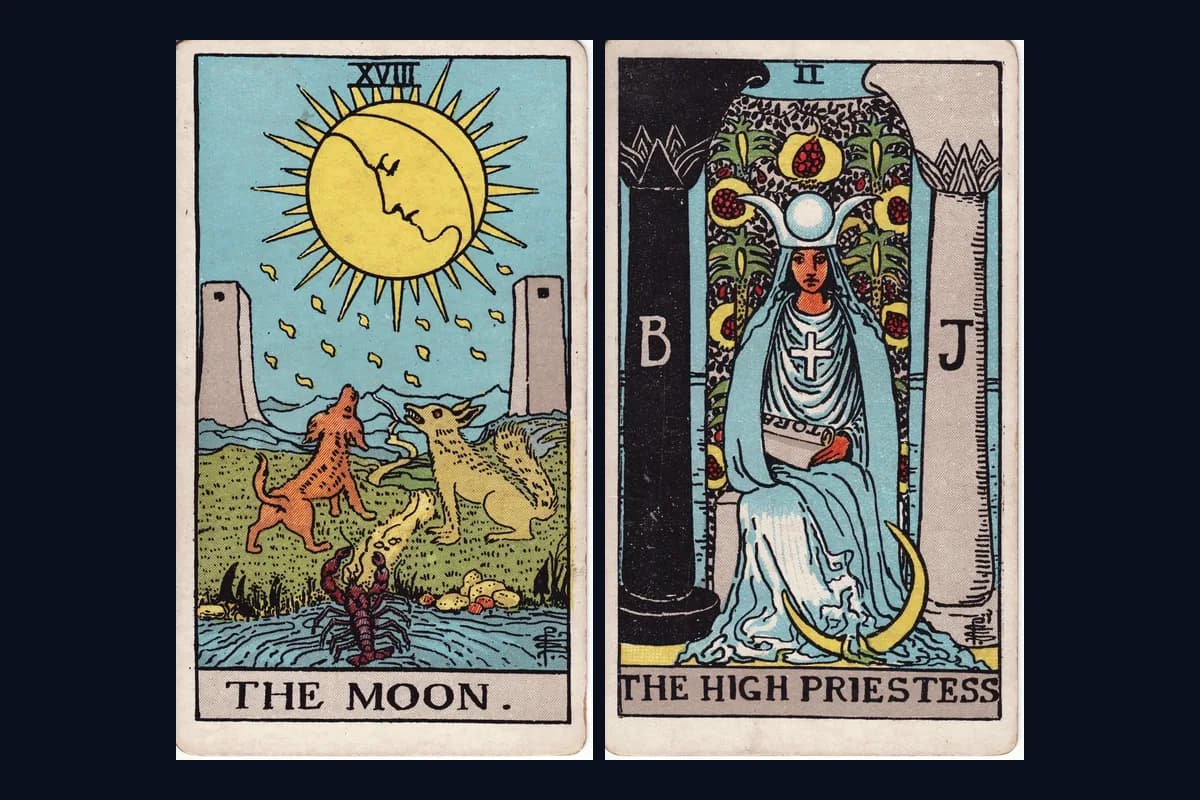
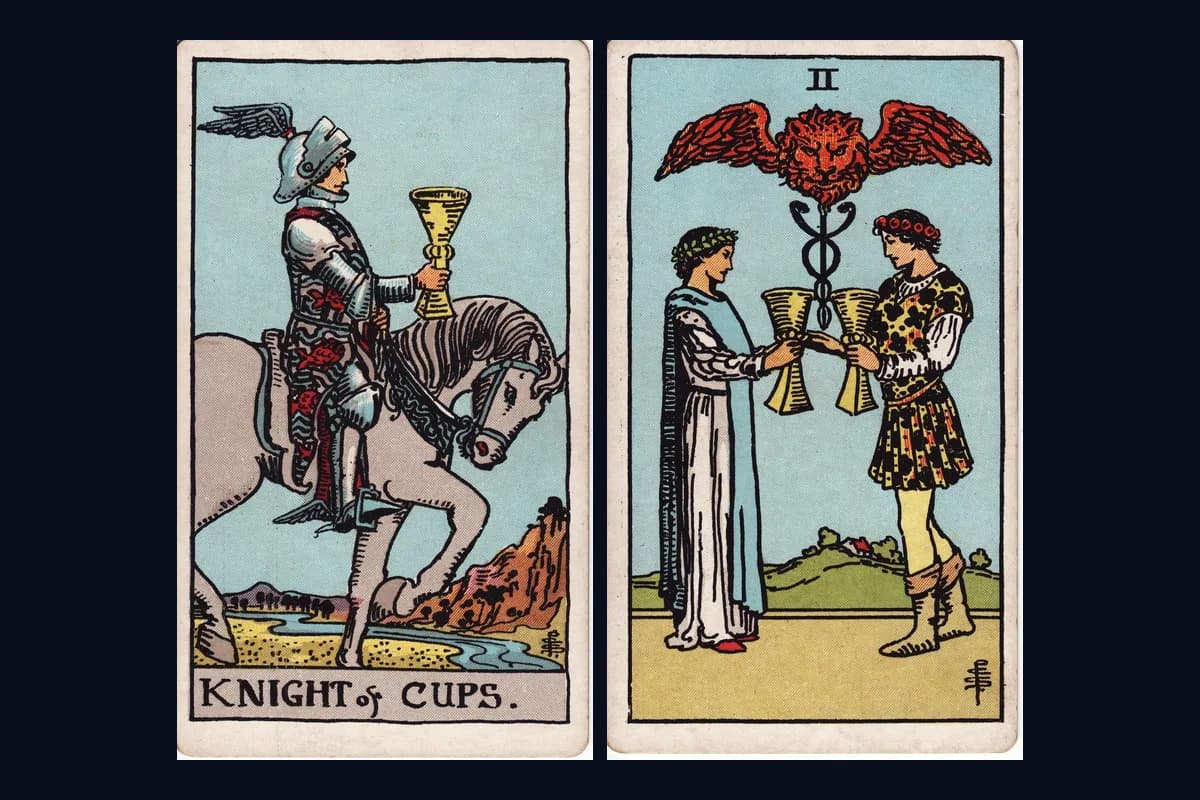
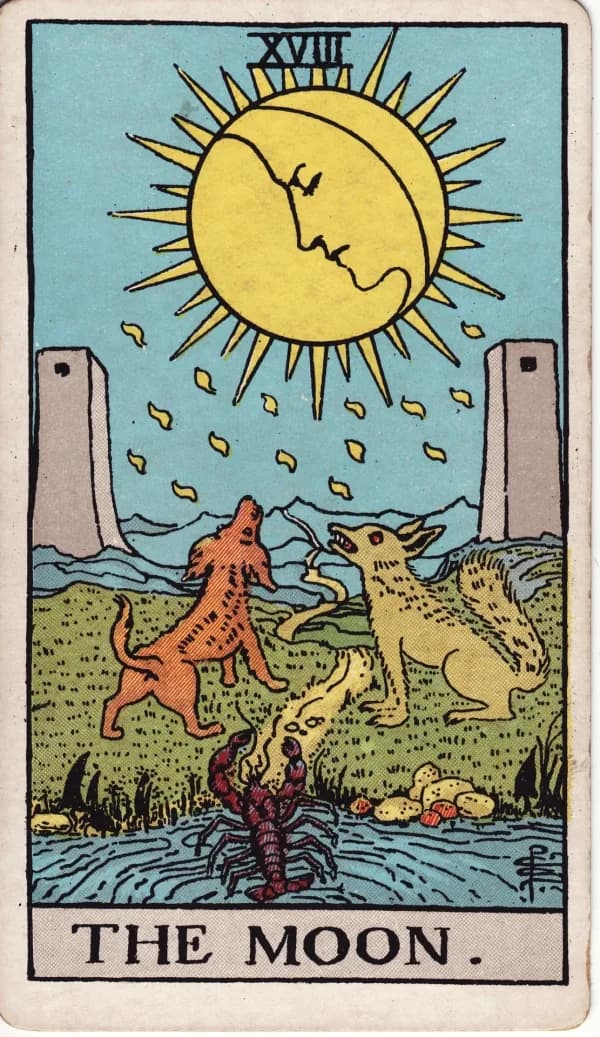
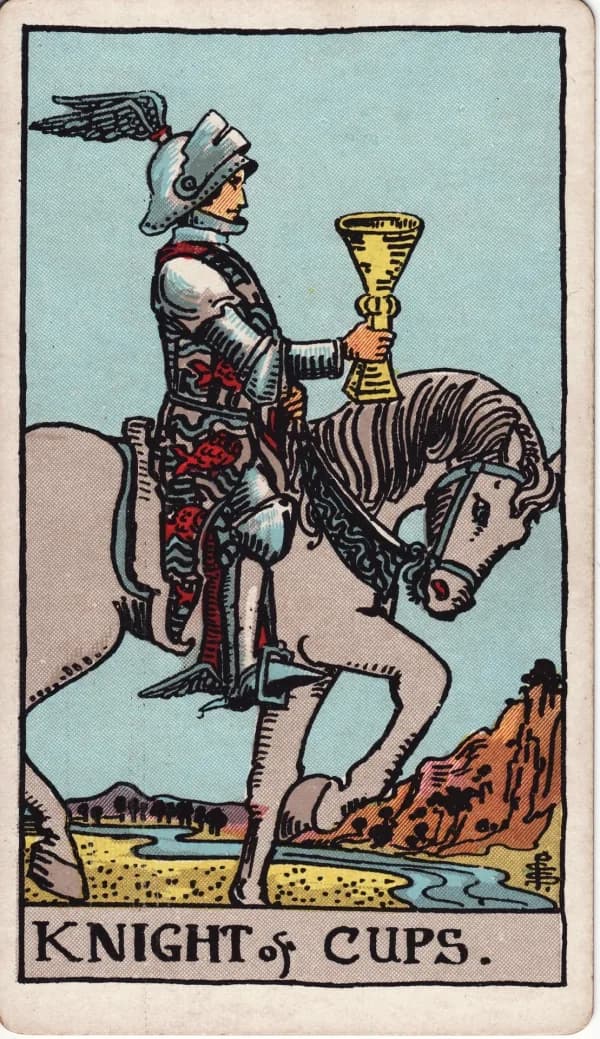
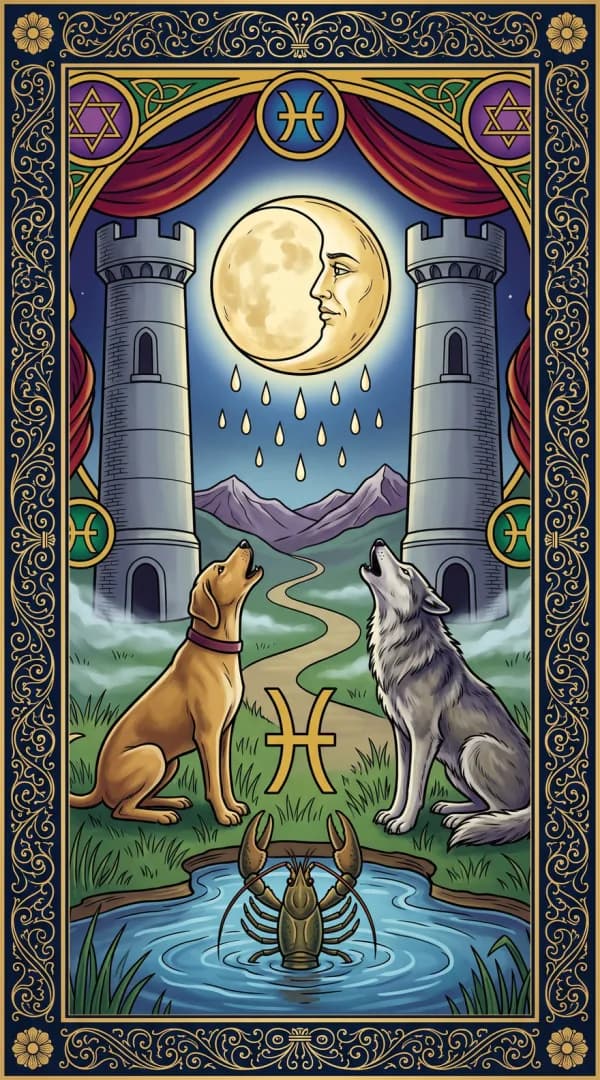
The Moon and Knight of Cups tarot combination signals a romantic offer you can't see clearly yet. Two towers. A moon with a sleeping face hangs between them, and below it a dog and a wolf howl while a crayfish crawls up out of a pool. On the next card, a knight walks his horse forward, cup held out. Does he mean it? Start with how much you can see.

Climate scientist, ashtanga practitioner, and advocate for human rights and LGBTQIA+ equality.
What each card shows on its own
In the Rider-Waite-Smith Moon, look for the people. There aren't any. Rachel Pollack makes the point in Seventy-Eight Degrees of Wisdom: "But there are no people on trump 18." A yellow moon, rayed like a sun, hangs between two gray towers, a face in profile inside it, eyes closed. A dog and a wolf lift their heads and howl. At the bottom, a crayfish crawls halfway out of a pool where a narrow path begins, winding off between the towers toward blue hills.
A.E. Waite gave the card its key sentence: "The dog and wolf are the fears of the natural mind in the presence of that place of exit, when there is only reflected light to guide it." Reflected light. The moon makes none of its own. Waite's list of meanings for the card includes "deception" and "error," and also "calumny," an old word for a false accusation. So the Moon covers being lied to and being lied about. Both happen by this light.
The Moon is card XVIII. The Golden Dawn gives it Pisces, the last sign of the zodiac, and the Hebrew letter Qoph, which means the back of the head: the one part of yourself you can never see without a second mirror.
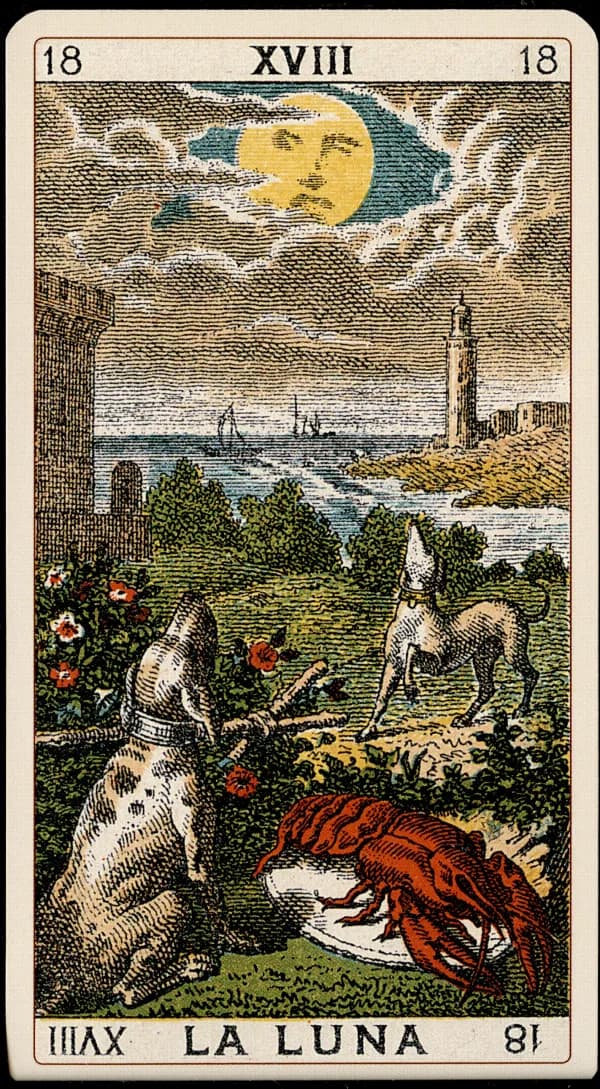
The wolf wasn't always there. On older Tarot de Marseille cards, both animals are typically dogs, and the Milanese Moon further down this page shows two dogs in collars. Waite worked from Eliphas Levi's 1856 description of the card, which has a dog and a wolf.
On the older cards, neither animal is wild. The problem is the light. Sherryl E. Smith of Tarot Heritage puts both risks plainly: "At night, we can easily misinterpret what we see and be frightened by a rock or tree branch. At the same time, we can mistake a vicious wolf for a friendly dog."
Now look at the Knight of Cups.
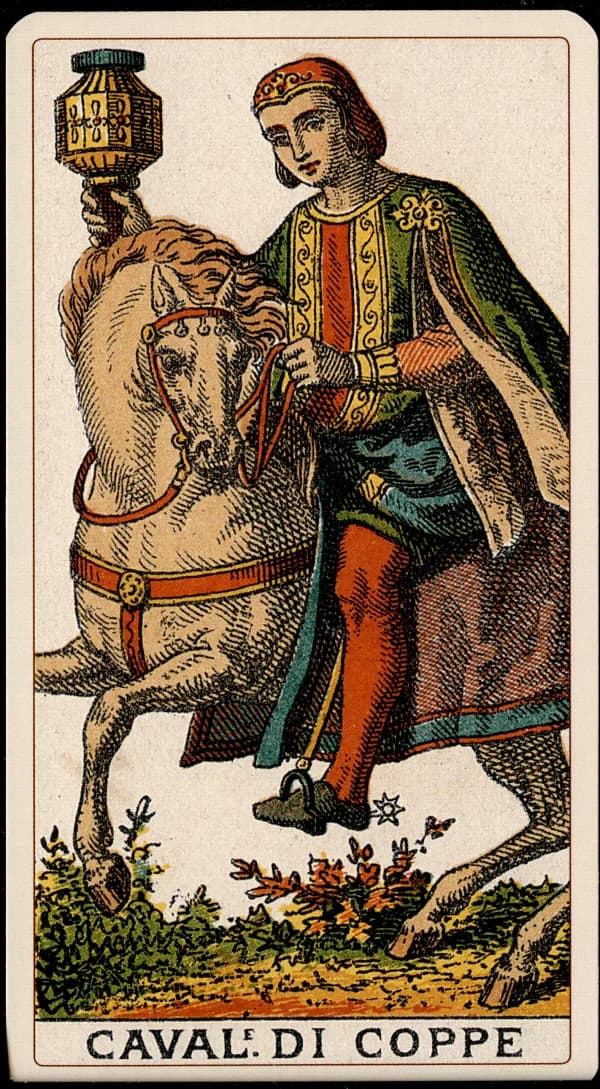
A young knight in silver armor walks a white horse toward a narrow stream. He holds a gold cup straight out in front of him, level, the way you'd offer something. Wings rise from his helmet and his heels, and fish swim across his tunic. Waite called him "Graceful, but not warlike" and had him "riding quietly." It's an approach, not a charge.
Pollack explains why: "As a less developed figure than the Queen or King, he has not learned to direct his imagination into the world." He feels a great deal. But turning that into plans is the part he hasn't learned yet. The Golden Dawn deck on this page gives his place to the Prince of Cups, Air of Water, whose Hebrew letter is Vau, meaning a nail or hook.
Picture yourself on the Moon's path with the Knight coming toward you, cup in hand. What would you need to see by daylight before you took it?
What the Moon and the Knight of Cups mean together
These two cards share a word. Most pairs don't. Waite says the Moon "represents life of the imagination apart from life of the spirit." He ties the Knight's winged helmet to "those higher graces of the imagination." Imagination, twice. Pollack does too, calling the Moon "the card of the imagination" and the Knight's cup a "symbol of the imagination."
That shared word changes the question. Asking whether he's lying assumes he's hiding a truth he knows. A dreamer can believe every word while he's saying it. The Moon is the other kind of dreaming, the 2 a.m. kind, when hope and worry fill in what you can't see. Sincere isn't the same as reliable. And doubt isn't evidence, though it's a good reason to look closer.
So this pair can't tell you whether he's lying. Cards can show you the light is poor, not what another person means. Whether your doubt is your gut or your fear is the question the Moon and High Priestess combination takes up.
This is also a case of reading a Major Arcana card beside a court card, so take the helicopter view. The Moon is the aerial picture, a stretch of life you can't see well. The Knight is the ground-level detail, one person's approach.
Vivien Ní Dhuinn of Truly Teach Me Tarot writes that the Knight's "agenda and outward appearance need close examination and scrutiny," especially next to cards like the Moon.
An overpromise isn't always a lie. Read together, the cards say something calmer than the fear behind the question: the feeling may be real, but you're still seeing it by moonlight. What the Moon holds back is whether anyone follows through. Sometimes it holds back your own clear view, too.
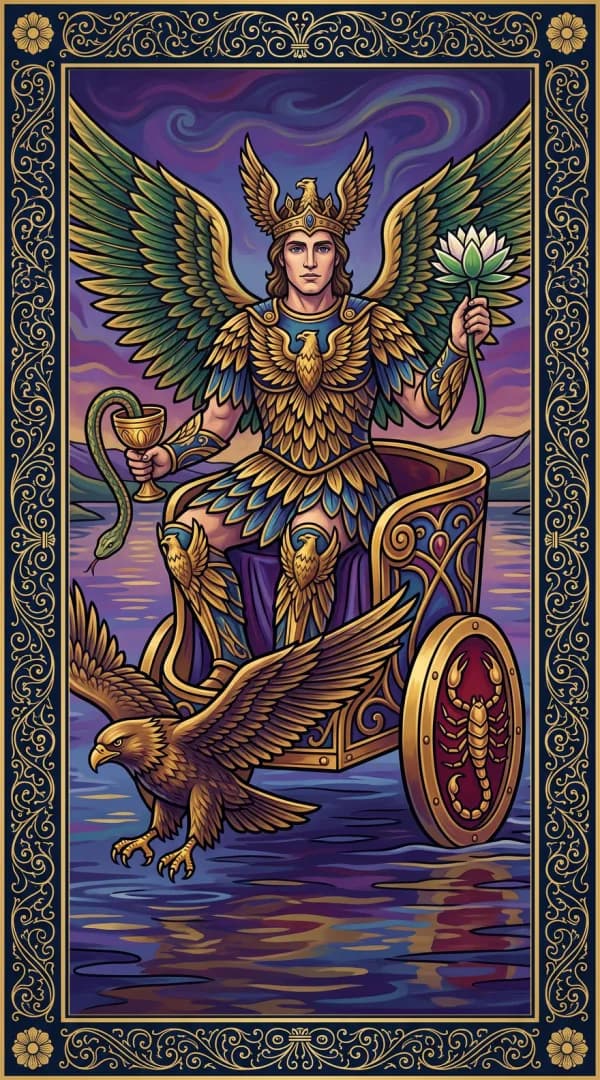
Golden Dawn writers never settled which of their figures is Waite's Knight. Book T, their tarot manual, gives the title Knight of Cups to a mounted rider. Robert Wang, in The Qabalistic Tarot, picks the Prince, and so does the deck below. Its Prince of Cups is a winged, crowned figure in an eagle-drawn chariot with a scorpion on its wheel. Don't read the snake issuing from his cup as betrayal. Book T calls for the snake, the eagle and the scorpion, and gives him most of Scorpio.
The same manual puts the hard word right on the Moon: "Error, lying, falsity, deception." Then it makes the meaning depend on dignity: whether the cards on either side support the card or weaken it. Its mounted Knight of Cups gets the same treatment: "Ill-dignified, he is sensual, idle, and untruthful." Where this tradition names lying, it hangs on the surrounding cards. Not on one card alone.
Of everything you believe about this person right now, how much have you watched them do, and how much have you filled in by moonlight?
What the pair says about honesty in love
For new relationships, this is the familiar start: long messages, big plans, the feeling that someone finally gets you. The Moon is everything you don't know yet. That's not a verdict. It's early. Waite's Knight rides at a walk, so let this go at that pace. And if someone you've only met online asks you for money, you don't need a card to answer that one.
When the question is fidelity, the tradition doesn't dodge it. Reverse the Knight and Waite's list turns blunt: "Trickery, artifice, subtlety, swindling, duplicity, fraud." That list belongs to the reversed card, though. With both upright, the Moon's deception could sit on either side, as a secret, a silence or something you've filled in. No card can prove an affair or rule one out. A direct question tells you more, and so do a few weeks of watching whether actions match words.
Theresa Reed of The Tarot Lady reads the Moon as a warning against "projecting fears or fantasies on a situation," and sometimes that's exactly what's happening. But she also writes, "If your fears are real, heed them." And if asking a simple question feels risky or gets an angry response, or if you keep hearing that you imagined what you saw, that says more than any spread. Talk it through with someone you trust.
Sometimes the Knight is you, hesitating, or in love with a story you've told yourself. A court card isn't always another person, and the Knight can be anyone, of any gender.
In a Celtic Cross, Pollack gives a real example: "The first two cards were the Three of Wands crossed by the Knight of Cups." He wasn't a suitor. He stood for the querent's own hesitation: "But the Knight of Cups is the least connected to action of any of the Knights." Now put the Knight in the first position with the Moon crossing him. The feeling sits at the heart of the matter, and what's in your way is how little you can see.
If you're asking yes or no, split the question in two. Is the feeling there? The Knight leans yes. He's the suit of Cups on horseback. Can you trust the whole picture yet? Not yet, and that's a wait, not a no. With the Knight reversed, it's no to taking promises at face value, which still isn't proof that anyone lied.
In your version of this night, what's climbing out of the pool, and what's in your knight's cup? That image belongs in your deck.
The Moon first, or the Knight of Cups first
The Moon first, then the Knight of Cups is the hopeful order. A stretch of not knowing comes first, then someone rides up offering a cup, and a message out of the dark can start to clear it. But you still met them in the dark.
The Knight of Cups first, then the Moon is the cautionary one. The charm arrives and the doubt follows: a lovely start, then vaguer plans and a feeling you can't name. The Moon here says the offer came before the facts did. So hold off on big steps, like moving in or lending money, until the light improves. The Knight of Cups and Two of Cups combination is the same offer, answered in daylight.
In a three-card spread, try the Situation, Problem, Action layout Brigit Esselmont teaches at Biddy Tarot. With the Knight as the situation and the Moon as the problem, you have a heartfelt offer you can't check yet. Read the third card as what to do in the meantime.
Orientation matters too. The table follows Waite's reversals, and not every reader uses them. His reversed Moon surprises people. Many modern readers see fear lifting there, but Waite wrote "lesser degrees of deception and error." Lesser, not none.
| Orientation | Reading |
|---|---|
| Both upright | A warm approach seen in poor light; the feeling may be real, so let time and plain questions fill in the rest |
| Both reversed | Silence from the Moon, trickery from the Knight; ask directly, and don't rely on promises yet, though none of this proves a lie |
| Moon upright, Knight reversed | The pair's clearest caution, with the Moon's deception at full strength; trust what's done over what's said |
| Moon reversed, Knight upright | Less deception and error than upright, though some remains; trust the Knight's warmth slowly |
Which came first in your spread, the Moon or the rider? Are you still waiting in the dark for someone to show up, or holding an offer you've started to doubt?
The sky and the honesty question
Both cards are Water. The Golden Dawn gives the Moon to Pisces, the mutable Water sign, and the Knight belongs to the suit of Cups. Pisces has two rulers: Jupiter in traditional astrology and, in modern astrology, Neptune, the planet of dreams and illusion. That last word is the one you're worried about.
In elemental dignities, the Golden Dawn's way of reading a card through its neighbors' elements, two Water cards agree. In Book T, a card flanked by its own suit gets stronger: its neighbors "strengthen it greatly either for good or evil, according to their nature." If you read with dignities, this pair adds weight to whatever is already there, so its neighbors matter. And Book T sets Fire against Water, so Wands crowding the Knight weaken him.
Pisces holds one more link. Its three decans, ten-degree slices of the sign, are all Cups cards, as in every Water sign. The Golden Dawn gives Saturn in Pisces to the Eight of Cups, Jupiter to the Nine and Mars to the Ten. The Knight's suit, three times over. If one of those three lands beside this pair, the spread has Pisces in it twice.
The Sun enters Pisces on February 18, 2027 (Universal Time), and stays until the March equinox on March 20. Mercury, the planet of messages, turns retrograde in Pisces on February 9, 2027, and turns direct in Aquarius on March 3. Astrologers tie Mercury retrograde to crossed wires. So if you pull this pair while texts feel slippery, ask a plain question, and don't let one reading from those weeks be the last word.
When has something looked different to you by daylight than it did at night? What changed: the thing itself, or the light you saw it by?
Adding up the Moon and the Knight of Cups
The Moon is 18. The Knight of Cups has no number at all.
To add him in, you have to pick a system. Take the Prince as your Knight, the way Robert Wang and this page's Golden Dawn deck do, and you get 6 twice. The Prince takes Vau, the third letter of God's four-letter name and worth 6, and Wang places the Princes in Tiphareth, the sixth sphere on the Tree of Life.
Add 18 and 6 and you get 24. The Major Arcana stops at 21, so reduce it: 2 + 4 = 6, the Lovers. Some readers skip arithmetic like this, and that's fair.
Reduce the Moon's 18 and you get 9, and Pollack spells it out: "Remember that the Moon's number adds up to 9, the Hermit." Nine is the one number that disappears when you add it. Add 9 to anything and it still reduces to the same digit. So whatever number a chart gives the Knight, the Moon hands it straight back. It returns what you brought, the way the moon returns the sun's light.
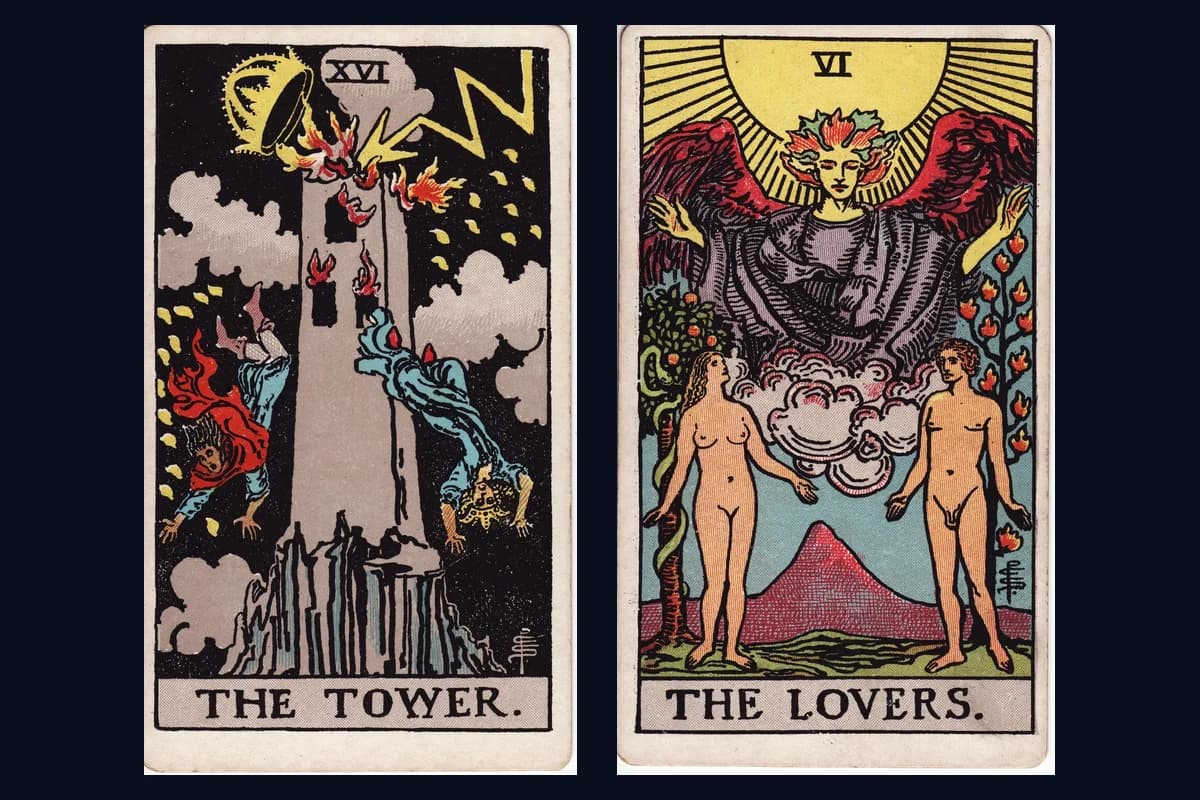
And 6 holds two cards, not one. The Devil is 15, and 1 + 5 = 6 as well. In the Rider-Waite-Smith deck, they're nearly the same picture: a naked man and woman beneath a winged figure. In the Lovers they stand free under an angel. In the Devil they're chained at the neck. The numbers land on both couples at once, so they can't tell you which one you're looking at. What this person does, week after week, can.
From where you stand, which couple does this feel like? And what has this person done, not said, to put you both there?
Questions readers ask about this combination
Does the Moon and Knight of Cups mean he's lying?
Not on its own. The Moon and Knight of Cups describe a warm approach seen in poor light. The Moon says you can't see the whole picture yet; it doesn't say who's hiding it, or whether anyone is. With the Knight reversed, A.E. Waite's meanings do include trickery and fraud, but even then a card can't prove what a person did. A direct question and a few weeks of watching will tell you more.
What does the Moon and Knight of Cups say about his feelings?
In a feelings question, the Moon and Knight of Cups lean toward real feeling that isn't clear yet. The Knight is the suit of Cups on horseback, and A.E. Waite ties him to imagination. The Moon adds that you're seeing him by reflected light. Whether his actions will match his words is the part you can't see yet.
What does it mean when the Moon and Knight of Cups are both reversed?
With the Moon and Knight of Cups both reversed, A.E. Waite's meanings pair the Moon's silence with the Knight's trickery, so don't rely on promises yet. The cards alone don't show that anyone lied. A plain, direct question helps, and so does watching what the other person does afterward.
What element connects the Moon and the Knight of Cups?
Water. The Golden Dawn gives the Moon to Pisces, a Water sign, and the Knight of Cups belongs to the Water suit. In elemental dignities, the Golden Dawn's way of reading a card through the cards beside it, two cards of one element strengthen each other for good or ill. So the pair adds weight to whatever's already there. Like every Water sign, Pisces has three Cups cards as its decans: the Eight, Nine and Ten.
Is the Moon and Knight of Cups a yes or no combination?
The Moon and Knight of Cups answer two questions differently. If you're asking whether the feeling is there, the Knight leans yes. If you're asking whether you can trust the whole picture, the answer is not yet, and that's a wait, not a no. With the Knight reversed, it's no to taking promises at face value, which still isn't proof that anyone lied.