Tarot Card Combinations
The Hierophant and Two of Cups
The Hierophant and Two of Cups tarot combination signals a private promise that wants a public blessing. On one card, a crowned priest in red raises his hand over two kneeling ministers. On the other, a young couple stand face to face under a winged lion's head, cups raised. If you're asking whether you'll get married, notice who's kneeling and who's standing.

Climate scientist, ashtanga practitioner, and advocate for human rights and LGBTQIA+ equality.
What each card brings to the question
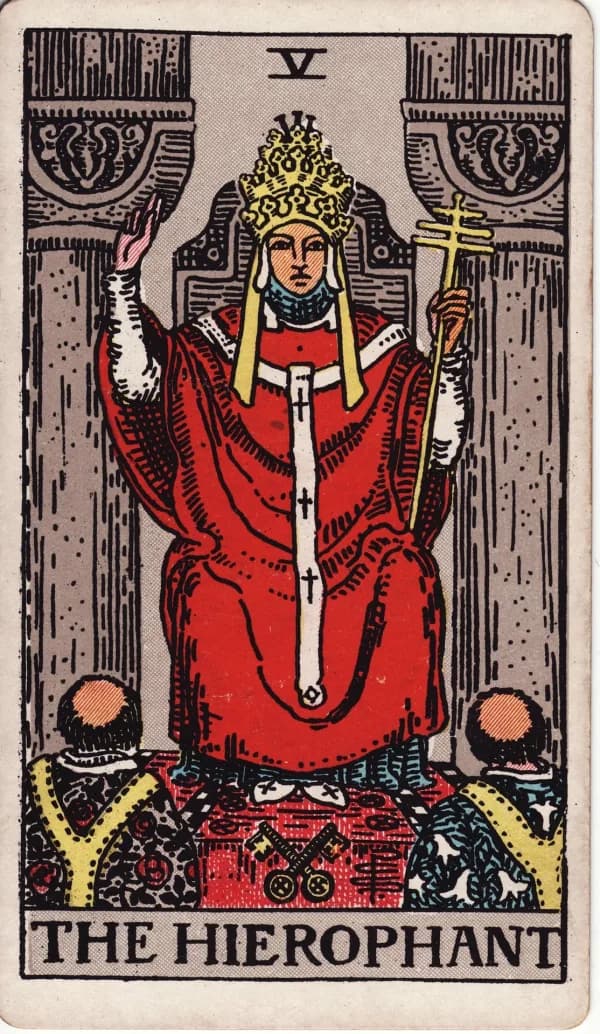
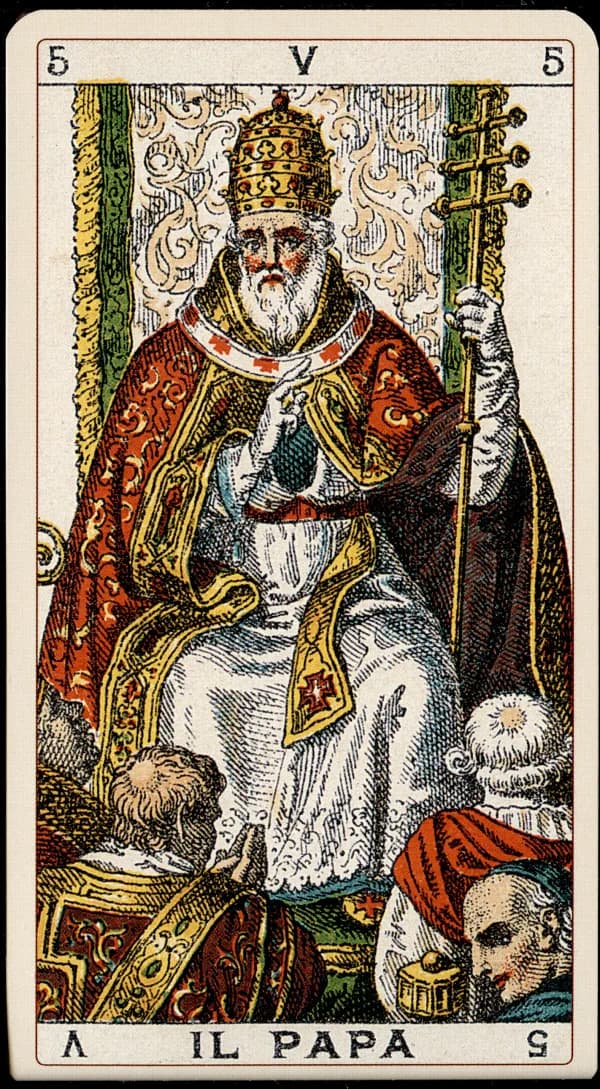
The Rider-Waite-Smith Hierophant (V) is an indoor card. A figure in a red robe and a gold triple crown sits between two gray stone pillars. His right hand is raised in blessing, and his left holds a gold staff topped with a triple cross. Two gold keys lie crossed at his feet. Below, two tonsured ministers kneel, one robe covered in red roses, the other in white flowers.
A.E. Waite, who designed the deck with the artist Pamela Colman Smith, didn't want the figure called a pope. That title, he wrote, is "a particular application of the more general office that he symbolizes." For a marriage question, that office belongs to the one a community trusts to witness a promise.
The Golden Dawn, the magical order Waite belonged to, gave card V the sign Taurus and the Hebrew letter Vau, which means nail. Written in front of a word, the same letter is how Hebrew says and. Aleister Crowley's Thoth deck puts the sign's planet in the picture: "The ruler of this sign is Venus; she is represented by the woman standing before the hierophant." His Venus doesn't kneel. She stands, and she wears a sword.
Now the Two of Cups.
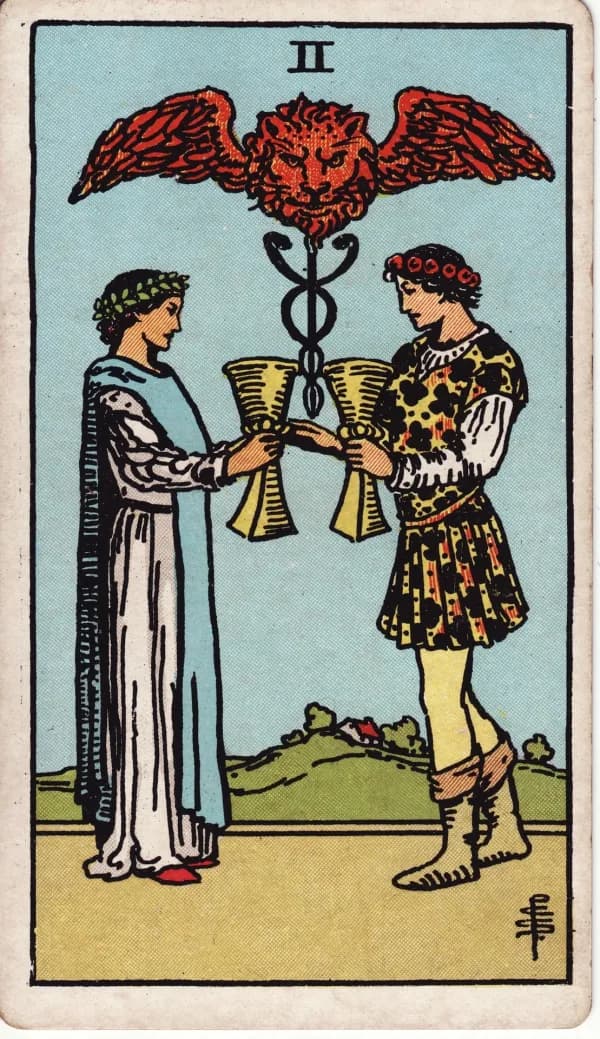
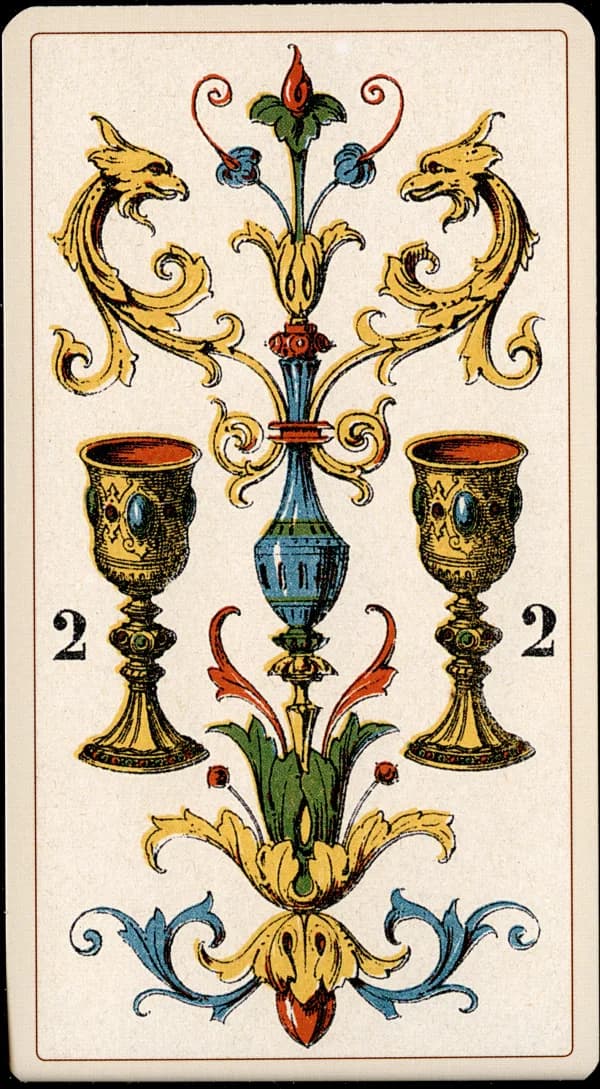
Two young people stand face to face in open country. Each holds a gold cup, and nobody kneels. Above them, a red lion's head with wide red wings crowns a staff wound with two snakes. Rachel Pollack, in Seventy-Eight Degrees of Wisdom, writes: "In the Two of Cups we see the winged lion over the caduceus of Hermes, symbol of healing and wisdom."
It's the second card of Cups, the suit of Water, and the Golden Dawn gave it Venus in the first ten degrees of Cancer. Waite's meanings for it open with "Love, passion, friendship, affinity, union, concord" and keep going. Notice what isn't on the list. The word marriage.
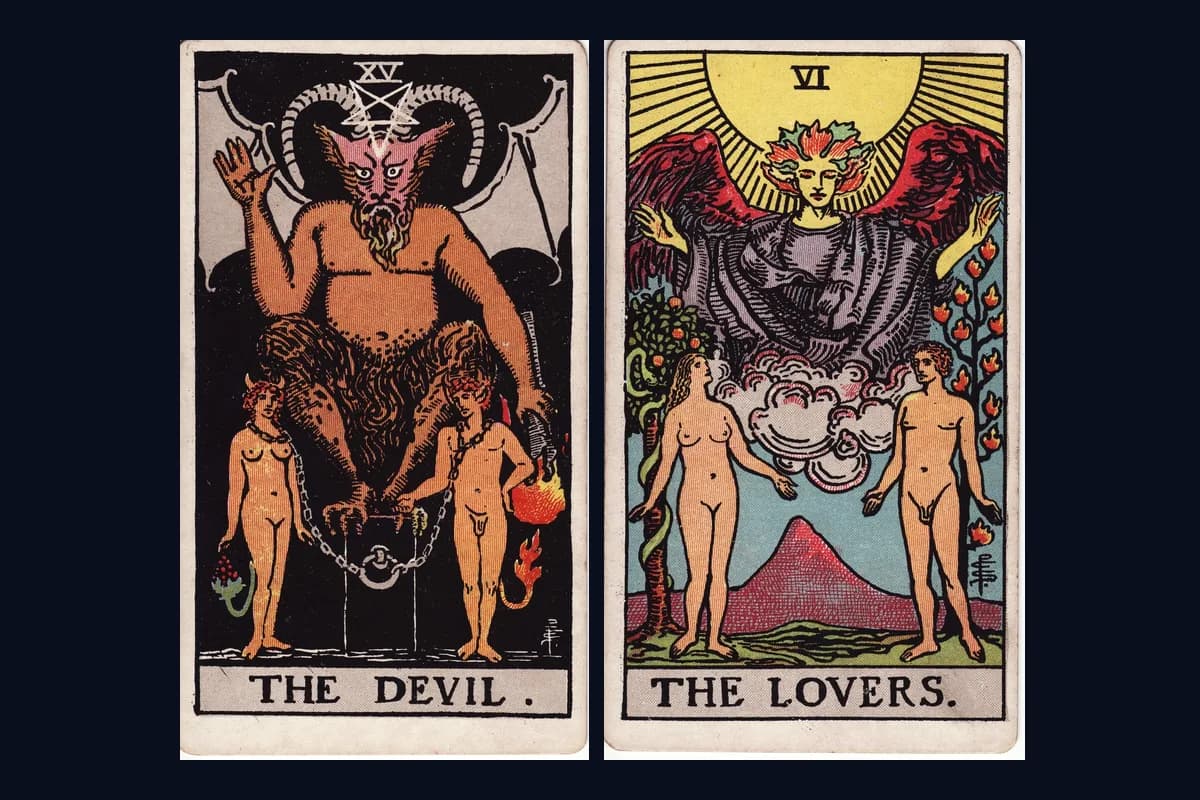
Set the two pictures side by side. Each has one presence above two people, the layout Pollack describes as "a large figure presiding over two smaller ones on either side." But the pairs look in different directions. The ministers face the priest. The couple face each other and don't look up at the lion. Kneeling is how you receive a blessing. Standing face to face is how you make a promise.
The ministers kneel with their backs to you, so you see the priest the way they do. If you knelt there, whose blessing would you be waiting for: your family's, or a faith's? Or would it be your own?
What the Hierophant and Two of Cups mean together
This pair has something most don't: the same first word, in two different books. Waite's meanings for the Hierophant begin "Marriage, alliance, captivity, servitude." Book T, the Golden Dawn's own manual of card meanings, opens its short entry for the Two of Cups with "Marriage, love, pleasure. Warm friendship." Draw both, and the books agree.
But Waite's next two words count as much as his first two. A vow binds, and that's why the same card can describe a bond you chose or one you were pushed into. Where Waite lists marriage with captivity, Book T's fuller entry for the Two lists it with home: "Marriage, home, pleasure."
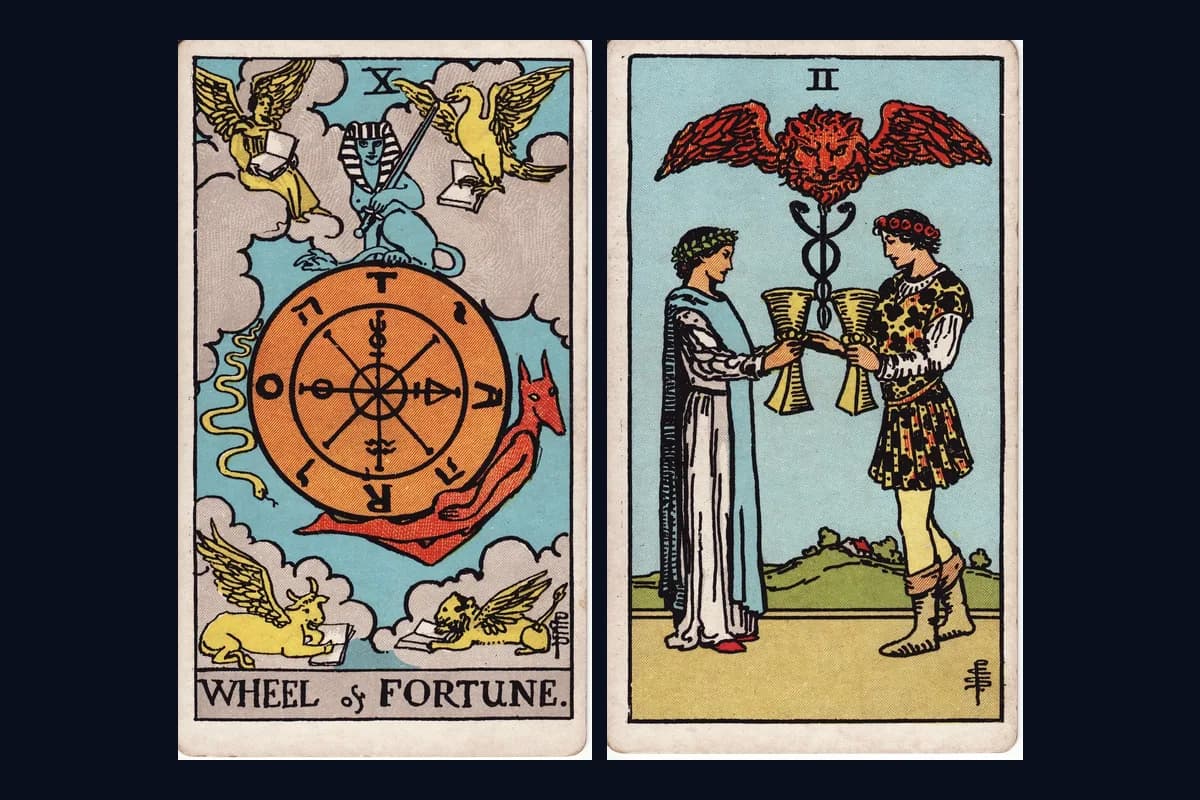
This is a Major Arcana card beside a Minor, so try what Brigit Esselmont of Biddy Tarot calls the helicopter view. The Hierophant is the view from above: vows, families, a tradition older than both of you. The Two of Cups is the ground. Two people, at eye level. Put a different Major beside the same Two and the question changes. The Wheel of Fortune and Two of Cups combination asks whether you were meant to meet. This one asks whether you'll make it official.
Waite also measures both cards against Nature. His Hierophant is "the channel of grace belonging to the world of institution as distinct from that of Nature." At the end of his Two of Cups entry, in a phrase he sets apart from fortune-telling, he names "that desire which is not in Nature, but by which Nature is sanctified." One card's grace comes from outside the couple. The other's starts inside it. So in this reading, a bond that runs both ways already carries its own blessing, and the open question is whether you both want one from the outside too.
When you picture yourself married, what do you see first: the two of you, face to face, or the room full of people who came to watch?
What the pair says about whether you'll get married
If you're asking whether you'll get married, this pair shows whether your private promise and its public side line up. It can't give you a date or speak for your partner.
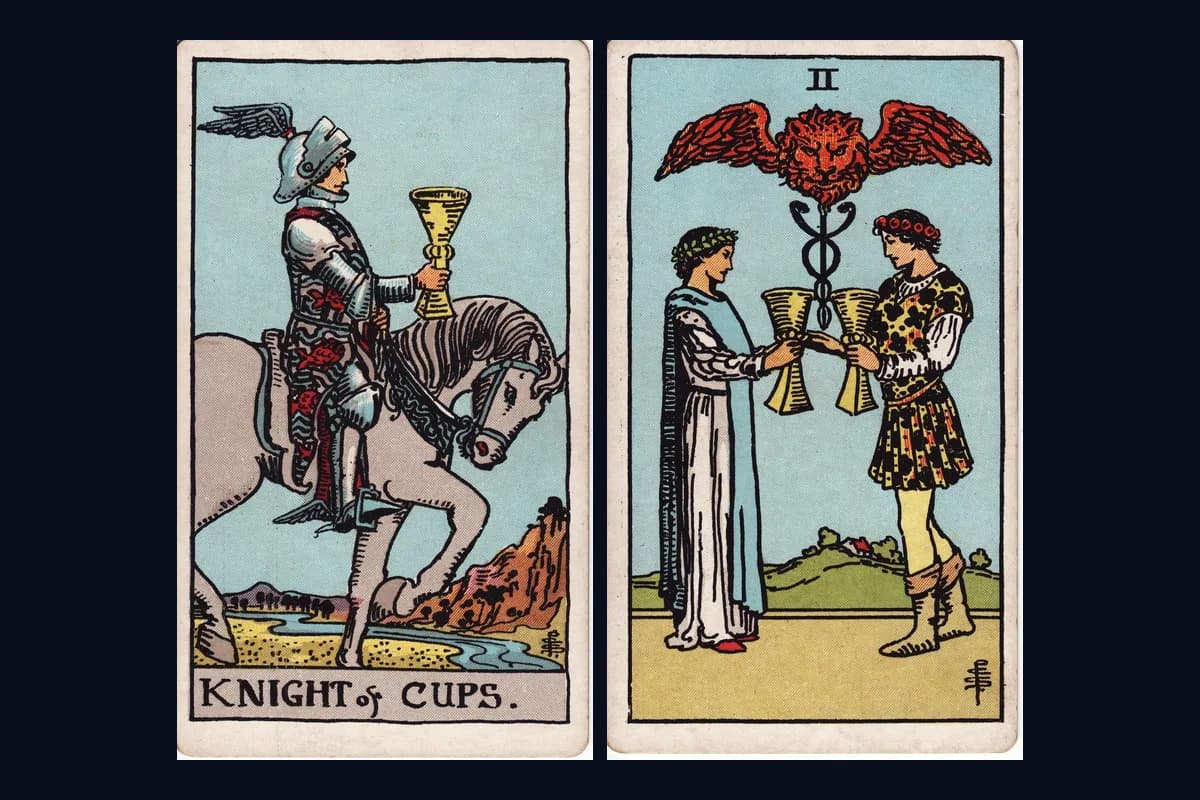
If no one has proposed yet, the Two is the part that's already here: a feeling that looks mutual. The Hierophant is the public part, declaring it in front of other people. Neither card says who asks. Waiting on the other person? The Knight of Cups and Two of Cups combination reads that wait. You're allowed to ask, too. But if your partner has told you they don't want to marry, believe them over any spread.
Already engaged? Then the Hierophant is the part with a guest list. Pollack writes in Seventy-Eight Degrees of Wisdom, "If we surrender ourselves to a Church the contradictions of life all become answered; but not resolved." A wedding can work the same way. It answers whether you're both committed. It doesn't resolve an old argument about money.
When families or faiths disagree, the Hierophant is a tradition, not a judge of whose love counts. Reversed here, it says the recognition may come from somewhere else: a courthouse, a friend officiating, vows you wrote yourselves.
And if you feel pushed toward a wedding, reread "captivity, servitude" in Waite's list. An upright Hierophant isn't telling you to go along. Talk to someone you trust who isn't part of that pressure, or contact a support service where you live.
In a Celtic Cross, say the Two of Cups lands in the first position (the heart of the question) and the Hierophant in the eighth, which Pollack calls the Environment, where other people's influence shows up. Upright there, the Hierophant says the people around you help more than they hold you back. Reversed, it can mean support from outside tradition.
Yes or no? Yes, if both cards are upright and both of you want the promise made public. The picture sets that condition: two cups, both raised. With only the Two reversed, it's no as things stand, because a wedding won't fix a bond that's out of step. With only the Hierophant reversed, it's yes to the commitment but maybe not to the traditional version. With both reversed, it's no for now.
Who would you want standing in the Hierophant's place if the two of you made it official? A priest, a judge, the friend who got ordained for the afternoon, or a grandmother whose nod counts for more than any license? What would your Hierophant look like with that face? That image belongs in your deck.
The Two of Cups first, or the Hierophant first
None of the authors quoted here sets a rule for this pair's order, though many readers take the first card as where things stand and the second as where they're heading.
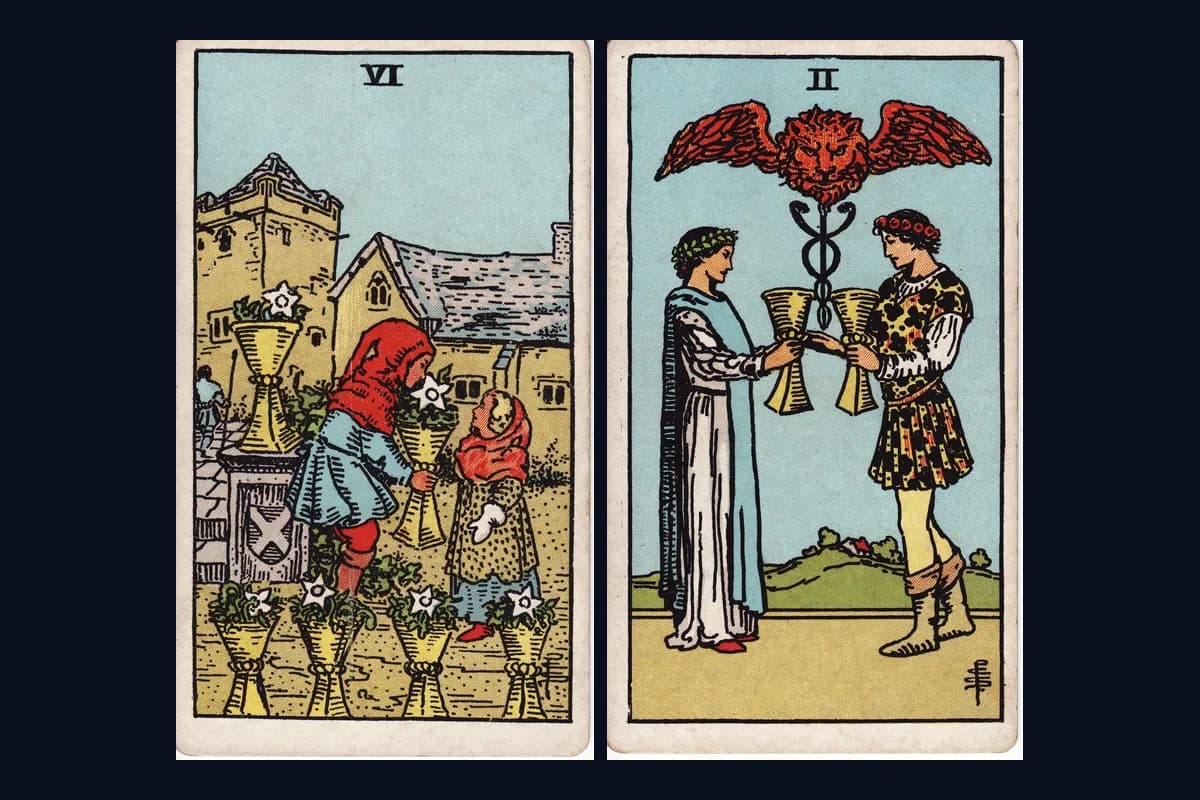
The Two of Cups first, then the Hierophant is the hopeful order. Feeling first, form second, if you both keep choosing each other. And if the feeling is an old one, for someone you've been with before, the Six of Cups and Two of Cups combination covers the return itself.
The Hierophant first, then the Two of Cups runs the other way. The form arrives before the feeling. Sometimes that's lovely: you met through a congregation, or an aunt who knew someone. But sometimes it's the plan picking the person, a deadline you set before you'd met anyone. This order can still reach a wedding if the feeling catches up. Would you choose this person with nobody watching?
In a three-card spread, try the relationship layout Tina Gong of Labyrinthos lists: what you want, what your partner wants, and where the relationship is heading. If the Hierophant lands in your place and the Two in your partner's, the spread has you wanting it official and them wanting closeness first. That isn't a no, and it isn't a yes. Ask them. If the cards land the other way around, the roles swap. The third card shows where those wants lead.
Orientation matters too. Read with reversals, and a single upside-down card shows which promise is out of line, the private one or the public one. Waite's Pictorial Key makes the reversed Hierophant gentler than you'd expect: "Society, good understanding, concord, overkindness, weakness." And concord is on his list for the upright Two as well, so a reversed Hierophant alone doesn't break the bond. Pollack reads the reversed Hierophant as unorthodoxy and says a reversed Two can mean "a relationship endangered by internal or external pressures." The table follows Pollack.
| Orientation | Reading |
|---|---|
| Both upright | Both promises line up; yes to making it official, if you both want that |
| Both reversed | The bond is out of step and the usual route isn't working either; talk before you plan anything |
| Hierophant upright, Two of Cups reversed | The form is ahead of the feeling; have the hard conversation before anyone books a ceremony |
| Hierophant reversed, Two of Cups upright | The bond is sound, but the usual route isn't working or isn't wanted; the yes may come from somewhere else |
Look at the order in your own spread. If the Hierophant came first, whose expectations arrived before you were both sure? If the Two came first, who still hasn't been told?
Where Venus lives in each card
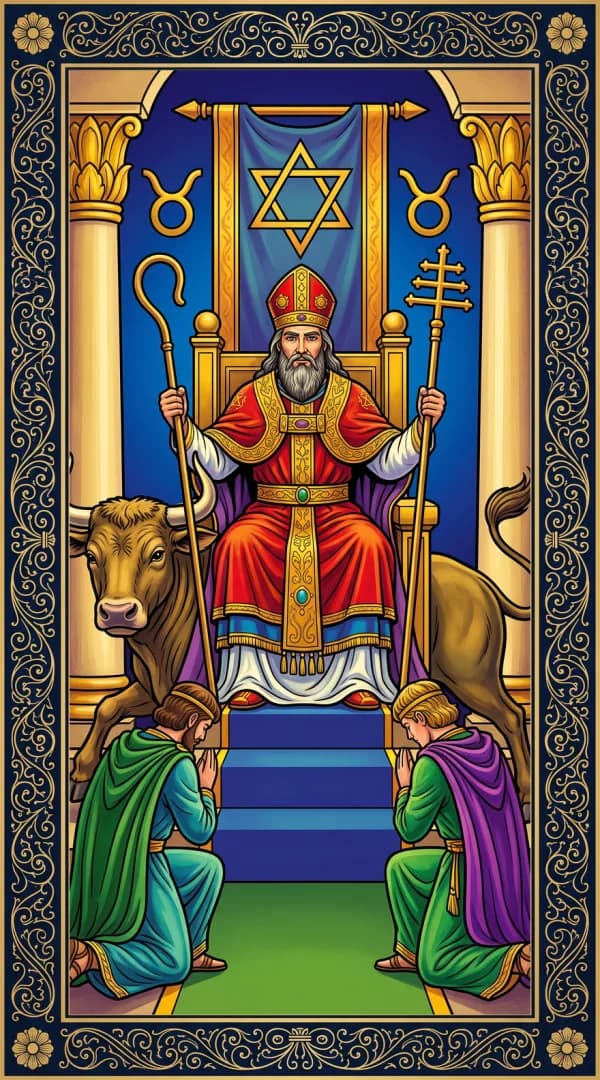
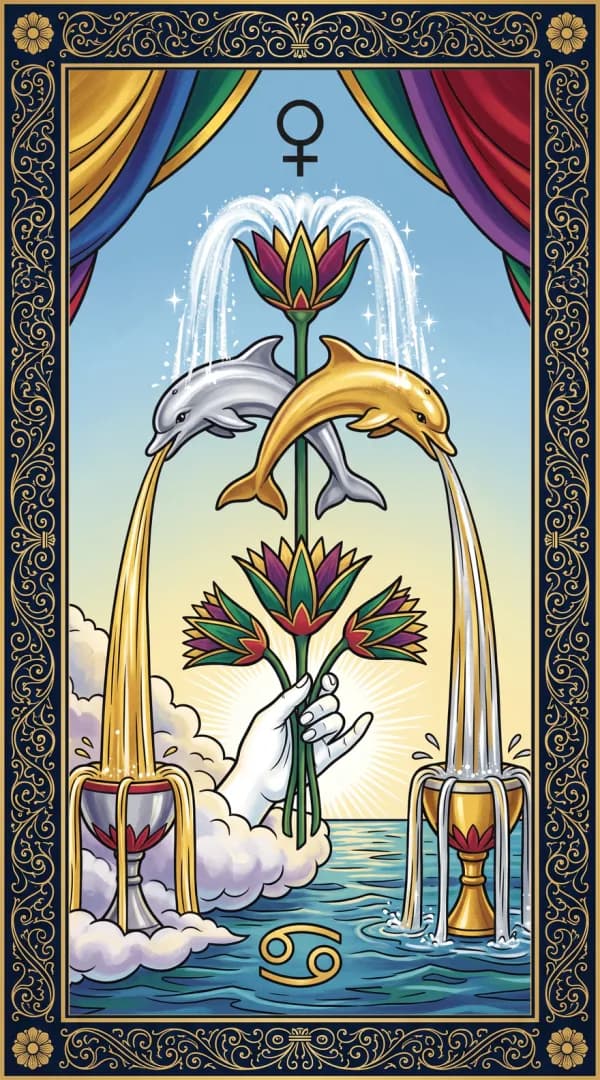
Both cards answer to Venus, and the Golden Dawn pair in section II shows it: two Taurus glyphs hang beside the Hierophant's banner, and the Two of Cups carries the glyph for Venus.
Taurus is a fixed Earth sign that Venus rules. The Two is Venus in the first ten degrees of Cancer, a cardinal Water sign that belongs to the Moon. In the old scheme of planetary dignities, those ten degrees are Venus's face, the smallest standing a planet can have in a sign. So the pledge card shows Venus as a guest, and the Hierophant's sign is Venus's own house.
The Moon runs the other way. It's exalted, or especially honored, in Taurus, and Cancer is its own sign. Cardinal signs open the seasons, and fixed signs hold them steady. Cancer starts things. Taurus keeps them.
In elemental dignities, the Golden Dawn's rules for how neighboring cards help or weaken each other, many readers count the Hierophant as Earth through Taurus. Book T names Fire with Water and Air with Earth as contraries, so Earth and Water aren't. The Golden Dawn's sample reading calls Earth "a friendly element to Water."
In 2027, Venus walks from the Hierophant's sign to the Two's (all dates Universal Time). It reaches Taurus on May 14, 2027, and moves on to Gemini on June 8, 2027. It enters Cancer on July 3, 2027 (the evening of July 2 in the Americas), and until July 11, 2027, it sits in the Two of Cups' ten degrees. No retrograde, no backward steps.
And on July 26, 2027, the Moon enters Taurus while Venus is still in Cancer. Each planet sits in the sign the other rules, which astrologers call mutual reception. It's a date in the sky, not a date for a proposal.
In these cards, Venus visits the pledge and lives in the vow. Is your love still a visitor? What would it take to move it in?
The card this promise adds up to
Add the Hierophant's 5 to the Two of Cups' 2 and you get 7. That's the Chariot.
One digit, nothing to reduce. Some readers add card numbers and some don't, but this sum doesn't stand alone. Book T gives the Chariot to Cancer, the Two of Cups' own sign, and titles it "Child of the Power of the Waters, Lord of the Triumph of Light."
Pollack noticed that the Hierophant's shape carries on: "The very next two cards after trump 5 repeat the motif, with the angel over the Lovers, and the charioteer of the Chariot over the black and white sphinxes." So your two cards and their sum all show one presence over two figures.
The Lovers, card 6, sits unseen between the Hierophant and the sum. Pollack says the Two can show "a long-term union or friendship, perhaps on a lighter level than the Lovers," though she reads it most often as a beginning. The Lovers is the choice of each other. The Two is where that choice starts, and the Hierophant witnesses it.
In Pollack's words, all three trumps are "attempts to mediate between the opposing poles of life and find some way, not to resolve them, but simply to hold them in balance." That's close to a working description of a marriage, whether or not a wedding ever happens. For a couple, the Chariot comes down to whether two different people can pull in one direction.
On the Tree of Life, the Qabalah's map of spheres and paths, the Hierophant and the Chariot sit across from each other at the top of its outer pillars. Robert Wang calls the Hierophant's path "the celestial road" the Chariot rides on. Vau, the Hierophant's letter, means nail, and Wang writes, "A nail binds together, it unifies." Cheth, the Chariot's letter, means fence. A promise fastens you together first. Then you put a fence around what you share. And a fence keeps things out as well as in.
The charioteer holds no reins. Without them, what keeps you both headed the same way?
Questions readers ask about this combination
Does the Hierophant and Two of Cups mean we'll get married?
Upright, the Hierophant and Two of Cups lean yes. Waite's meanings for the Hierophant begin with marriage, and the Golden Dawn's Book T opens its short list for the Two of Cups with the same word. The pair shows a private promise that could become a public one, as long as both of you want that. The public side can be a civil ceremony or a family's approval. No card gives a date or speaks for your partner.
How is the Hierophant and Two of Cups different from the Hierophant and the Lovers?
The Hierophant and the Lovers are both Major Arcana cards, so together they make choosing a partner a large-scale theme. The Two of Cups is the smaller-scale version, two people making a promise at eye level. Rachel Pollack says the Two can show "a long-term union or friendship, perhaps on a lighter level than the Lovers," though she reads it most often as a beginning. In this pair, the Hierophant is the witness such a promise may ask for.
What does it mean when the Hierophant and Two of Cups are both reversed?
With the Hierophant and Two of Cups both reversed, neither the traditional route nor the balance between you is working right now. It's no for now, not never, and it isn't a verdict on either of you. Talk before you plan anything. Waite's reversed Hierophant is gentle, with concord and good understanding on its list, and Pollack reads it as unorthodoxy. Not every reader uses reversals.
What planet connects the Hierophant and the Two of Cups?
Venus. The Hierophant's sign is Taurus, which Venus rules, and the Golden Dawn gave the Two of Cups to Venus in the first ten degrees of Cancer, the Moon's Water sign. So Venus is at home in one card and a guest in the other. Many readers count the Hierophant as Earth through Taurus, and the Golden Dawn's elemental dignities, its rules for neighboring cards, don't treat Earth and Water as contraries, so neither card weakens the other.
Is the Hierophant and Two of Cups a yes or no combination?
The Hierophant and Two of Cups give a yes when both cards are upright and you both want your promise made public. With only the Two of Cups reversed, it's no as things stand, because a wedding won't fix a bond that's out of step. With only the Hierophant reversed, it's yes to the commitment but maybe not to the traditional route. With both reversed, it's no for now. Neither card sets a date.