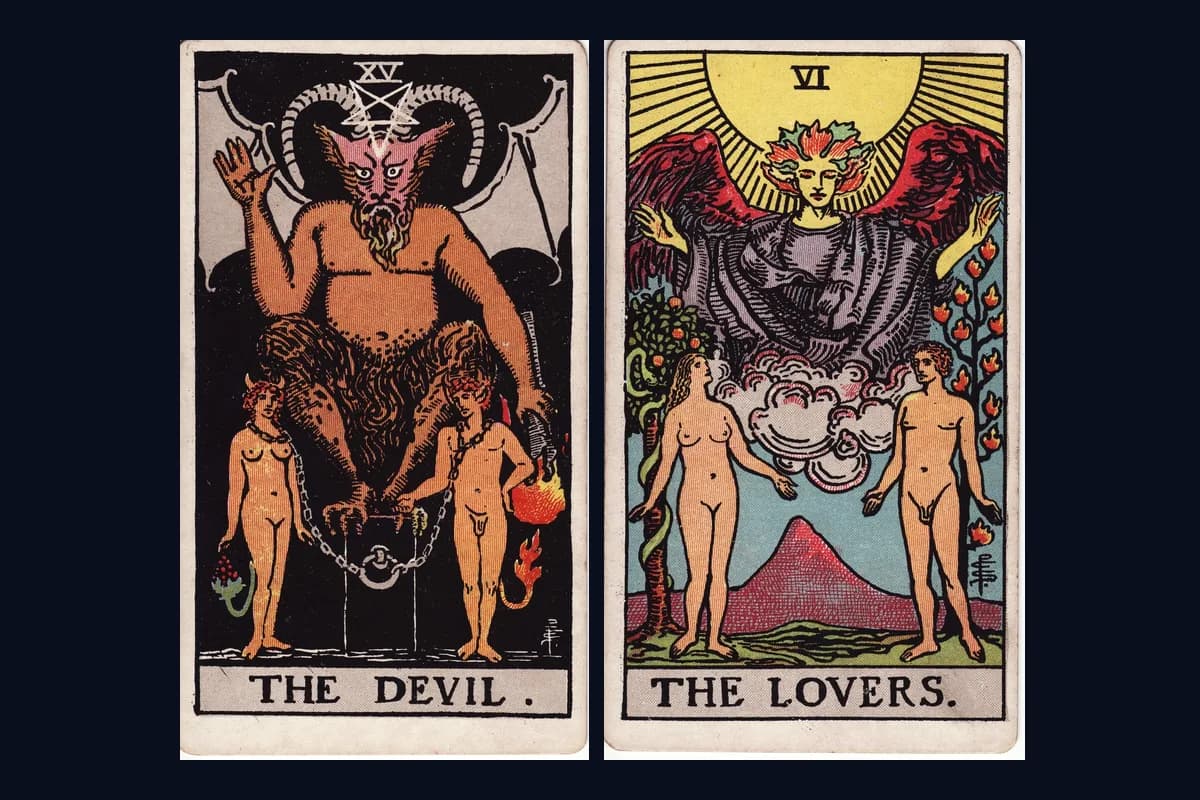
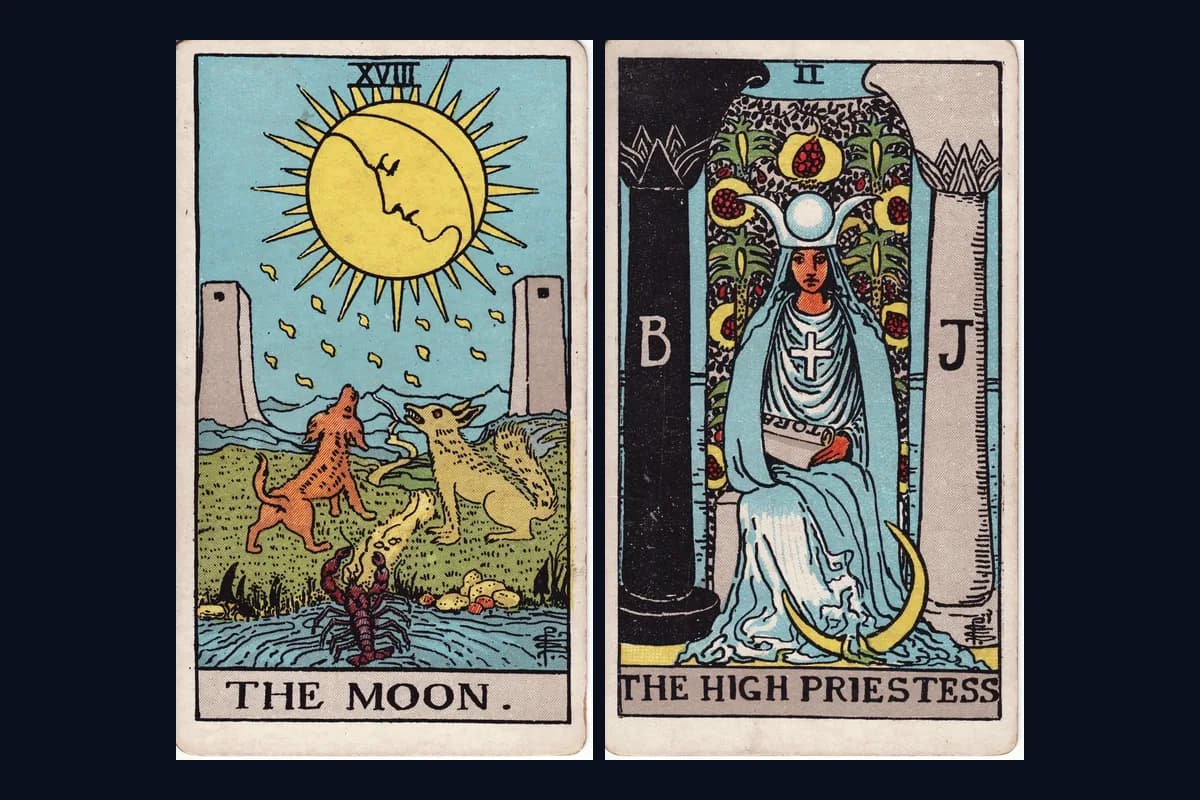
Tarot Card Combinations
Ten of Cups and Ten of Pentacles
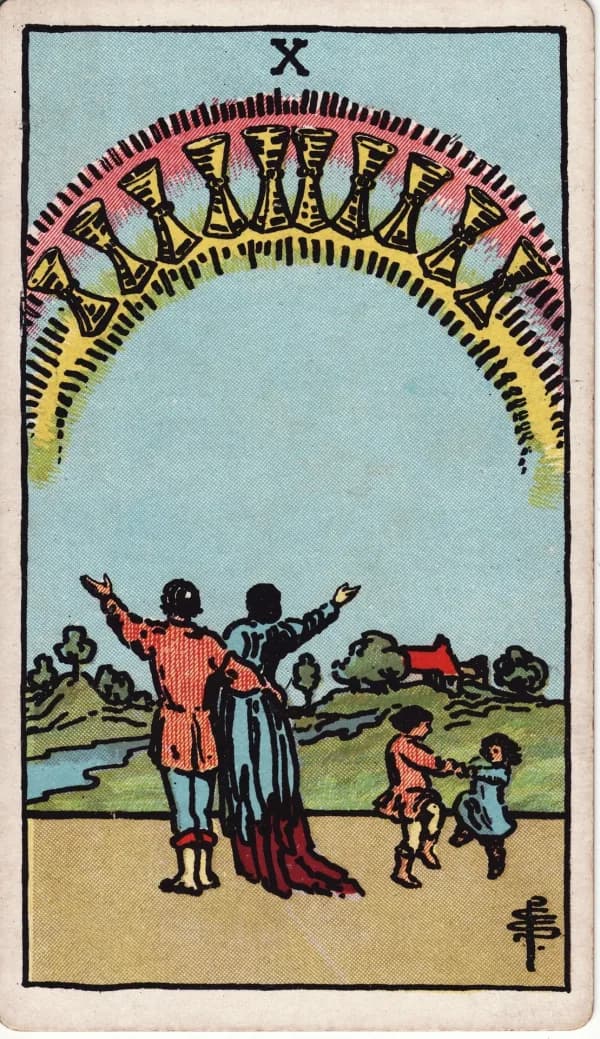
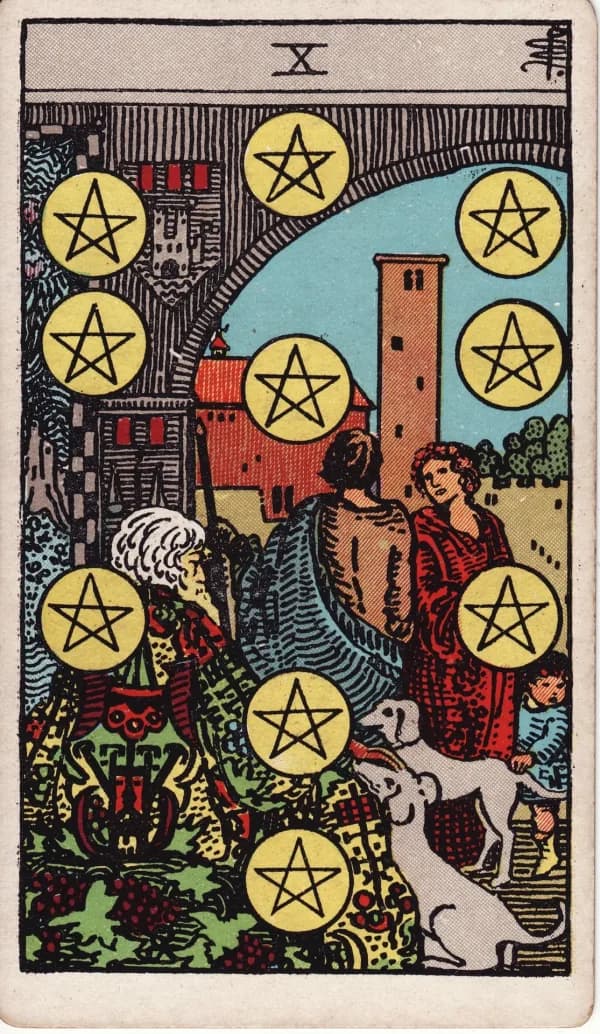
The Ten of Cups and Ten of Pentacles tarot combination signals a life built together: the love, and the home around it. A couple stand under a rainbow lined with ten gold cups, arms raised, while two children dance. On the other card, a family gathers under a stone archway, and an old man sits outside it with two dogs. Will you build a life together? It takes both.

Climate scientist, ashtanga practitioner, and advocate for human rights and LGBTQIA+ equality.
What each card means on its own
Look at the Rider-Waite-Smith Ten of Cups. Ten gold cups ride a rainbow across the sky. Below, a man and a woman stand with their backs to you, his arm around her waist, each with a free arm raised. Two children dance beside them, and a red-roofed cottage sits on a hill.
A.E. Waite, in The Pictorial Key to the Tarot, says the rainbow "is contemplated in wonder and ecstacy by a man and woman below, evidently husband and wife." (The spelling is his.) Your household may look nothing like the one he describes, and the card still fits it. Rachel Pollack, in Seventy-Eight Degrees of Wisdom, sees a split: "Arm in arm they look up and celebrate the rainbow. The children, however, dance without looking up."
It's a Ten, the suit's last number. The Golden Dawn, the magical order Waite belonged to, put every Ten in Malkuth, the Kingdom, the lowest sphere on the Tree of Life. Cups take the first Heh in God's four-letter name. Of that name's four letters, the order gave this one to Water. Heh means window. Book T, the order's tarot manual, titles this card "The Lord of Perfected Success" and gives it Mars in Pisces.
Aleister Crowley reads it darker. In The Book of Thoth the card is called Satiety, and its cups tilt and spill. His verdict: "The work proper to water is complete: and disturbance is due."
Now look at the Ten of Pentacles.
A heavy stone archway frames a bright town. Beneath it stand a man with his back turned and a woman in red, and a child has a hand on one of two white dogs. Outside the arch sits an old man in a patterned robe. Ten gold coins float over everything, laid out as the Tree of Life.
Pollack gives the card its due: "On the surface the card represents the established home, the good life, a secure and comfortable position in the world." But then she turns. "The people concerned, however, appear to take the comfort for granted; they find the security boring or stifling."
And it's a Ten in Malkuth too. Pentacles take the final Heh, the same letter a second time, given to Earth. Book T calls the card "Lord of Wealth," gives it Mercury in Virgo, and then sets a limit: "Completion of material gain and fortune, but nothing beyond."
In one card you stand behind a couple with their arms raised. In the other you stand outside an archway, looking in at a family whose members face different ways. Which spot is closer to where you stand today?
Why the Ten of Cups and Ten of Pentacles read as one household
Of the four Tens in the Rider-Waite-Smith deck, only these two show a family. The Ten of Wands has one man bent under his load. The Ten of Swords has one man face down. In these two, the ten emblems hang over a household and nobody holds one. And Waite gives each card a home: the Ten of Cups can be "the town, village or country inhabited by the Querent," and the Ten of Pentacles, "the abode of a family."
Pollack reads the pair as a contrast: "where the men and women in Cups celebrate the gift, the family here does not notice the magic all around them." The Cups couple stand arm in arm. Under the arch, she writes, "The man and woman face opposite ways, though the woman glances anxiously over her shoulder at the man."
Neither card is a Major, so this isn't one big event. Both are Tens, and when cards that share a number land together, the number gets louder. Each Ten is its suit at its fullest, so here two suits are full at once: the feeling and the practical life.
Together, the Ten of Cups and Ten of Pentacles point to a life with the love and the house in place, and it holds as long as you both keep facing the same way. Security is real ground to build on. But it doesn't do the noticing for you.
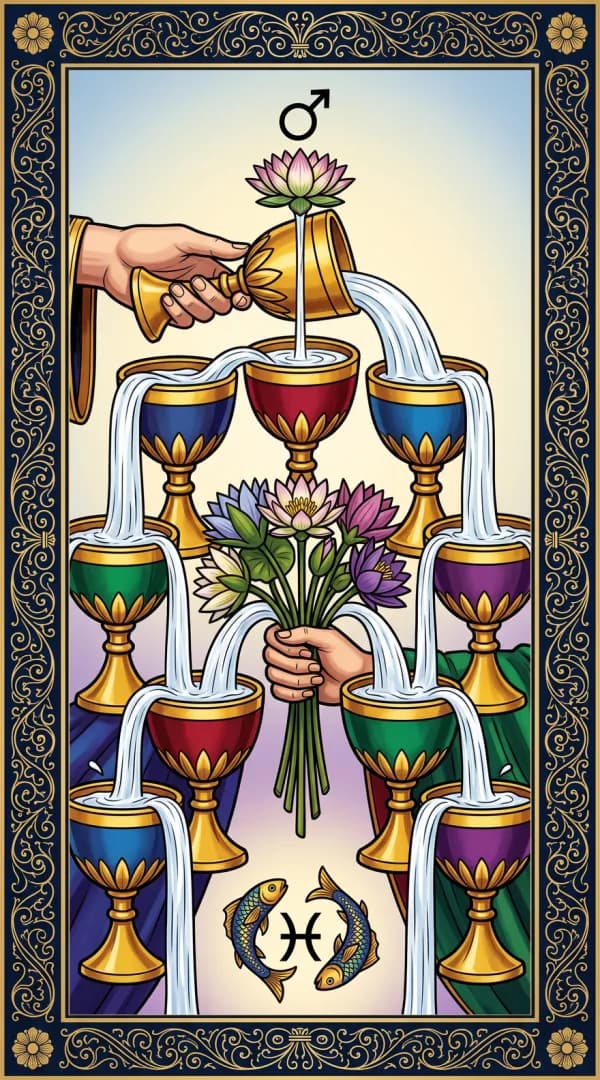
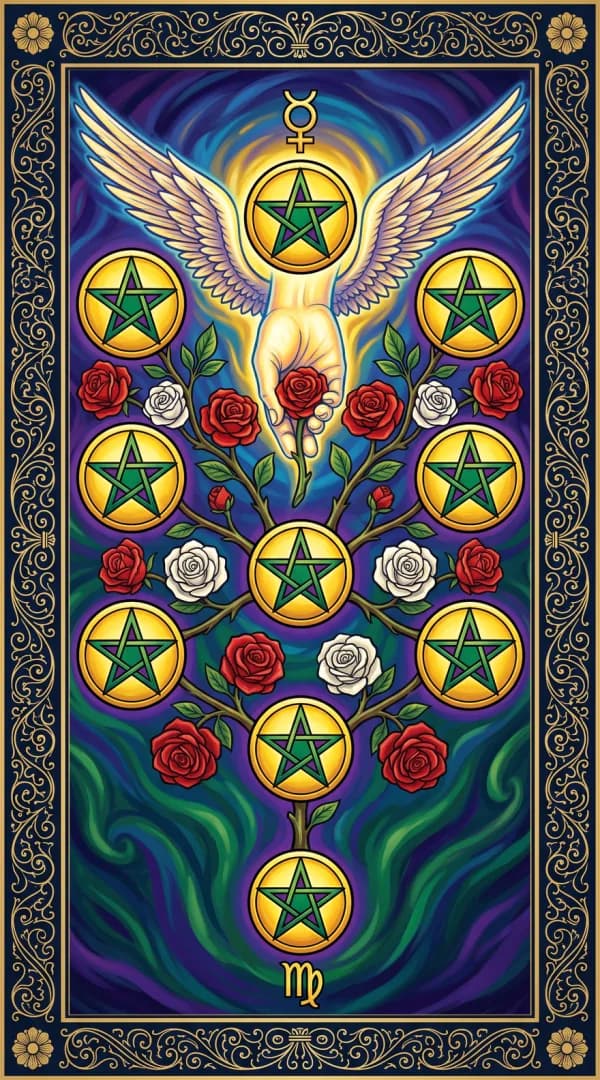
The Golden Dawn cards below make a related point without people. On the Ten of Cups, a hand tips the top cup, and in Book T's words, the cups "all run over." Love that has to keep being poured. On the Ten of Pentacles, a winged hand holds a rose branch that touches every coin. One living thing runs through the whole structure, and it needs tending.
When did the two of you last stop and look at what you've already built? If you had to hang one of these cards over your front door, which would it be?
What it means if you're asking about a life together
Will we build a life together? The pair answers both halves of that question.
The Ten of Cups is the together: the feeling, the people you love. The Ten of Pentacles is the life: the address, the money, the paperwork. With both cards upright, each half looks solid. But no card can make the other person's choice for them.
For existing partnerships weighing the next step, like moving in or getting engaged, the pair reads as ready. Does it mean marriage? It can. Waite's supplementary meanings, written for a man asking, give the Ten of Cups "a good marriage and one beyond his expectations." Marriage is one shape of this life, though, and the cards don't schedule a proposal.
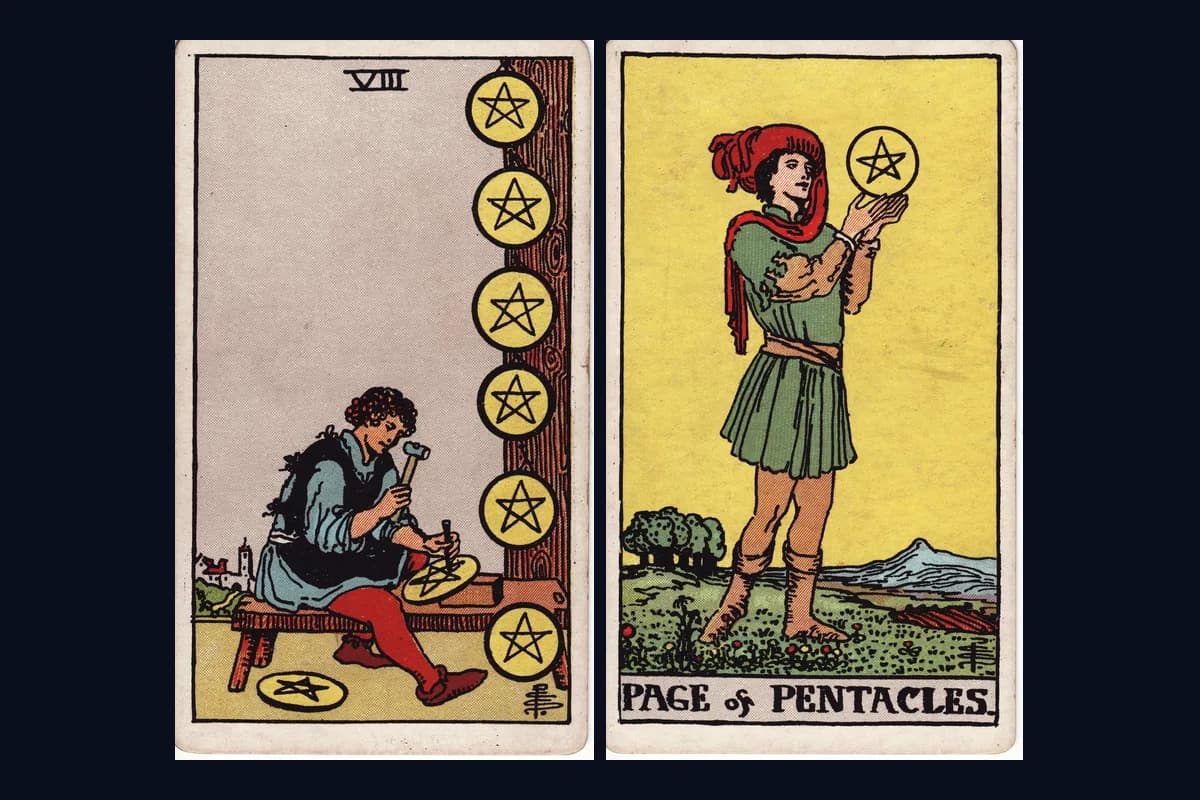
For money and a shared home, the upright Ten of Pentacles says the practical side can hold. It can't tell you what to sign or buy. Two people can want one house for different reasons, so say yours out loud. Asking about a job instead? The Eight of Pentacles and Page of Pentacles combination is the closer read.
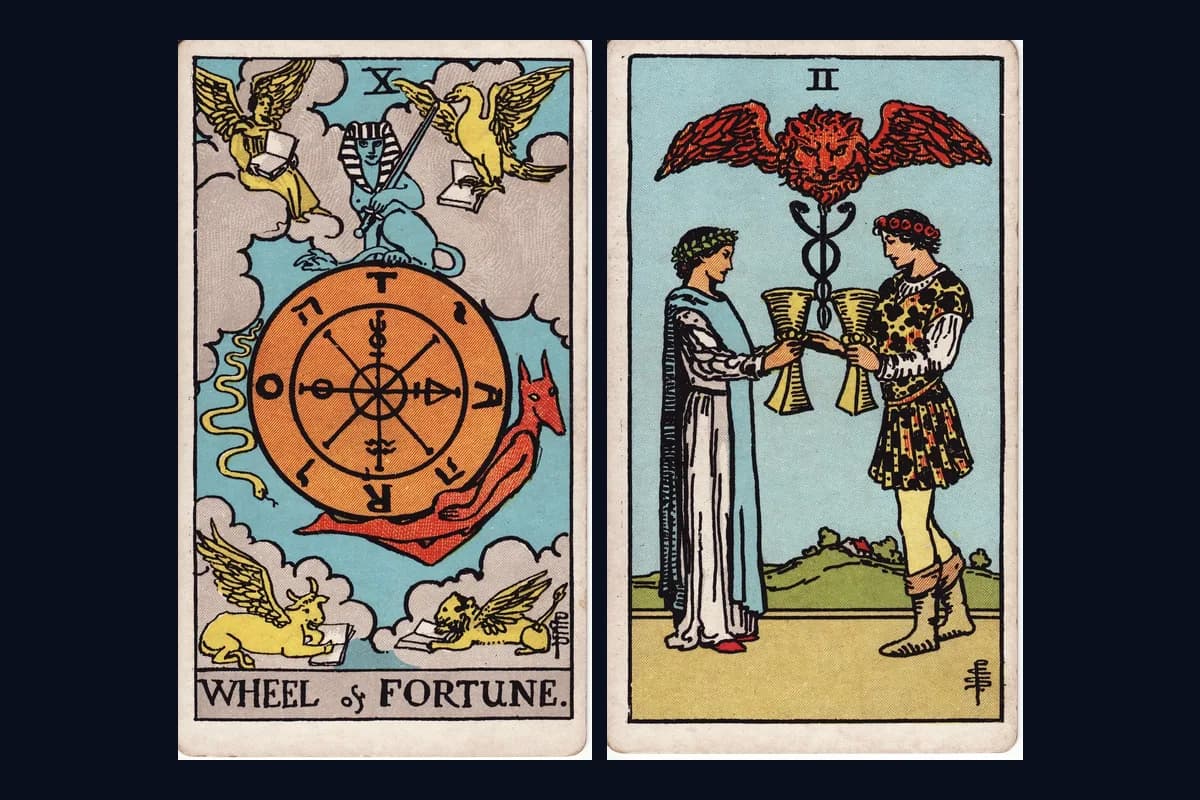
In a new relationship, two Tens can feel like a promise, but read them as a direction: nobody starts at the end of a suit's count. If you've just met and wonder whether this is the one, the Wheel of Fortune and Two of Cups combination reads that earlier moment.
For family, count the people. The Ten of Pentacles puts an old man, a couple and a child in one frame, and Waite's meanings include "family matters," so questions about in-laws live on the Pentacles side. Both cards have children in them. But neither card predicts children of your own.
Yes or no? Yes to building the life, as long as the love gets as much notice as the house. With one card reversed, it's not yet: fix the half that's upside down first. Both reversed, it's no as things stand.
Think about the life you're building, or hoping to build. Not the listing photo. The kitchen table on a Tuesday night. What would your Ten of Cups look like if its rainbow hung over that table? That image belongs in your deck.
How order, position and reversals change the reading
The Ten of Cups first, then the Ten of Pentacles is the hopeful order. The feeling comes first, and the life gets built on it. In the Ten of Cups, the house is small and far off on its hill, the way a shared future looks when you first picture it. By the Ten of Pentacles, you're at its door.
The Ten of Pentacles first, then the Ten of Cups holds the warning. The house came first, maybe for practical reasons, and the risk is that the structure starts carrying more weight than the feeling; the Ten of Cups arriving second is the correction. Pollack says it "especially refers to the recognition of the valuable qualities in a situation," and she ties that to readings where it appears "in contrast to the Ten of Pentacles."
In a Celtic Cross, the Ten of Cups as the crossing card is an odd kind of obstacle: the ideal you measure your real home against. Brigit Esselmont of Biddy Tarot says a good card there needs care, "as it will still represent a challenge." In hopes and fears (the ninth card), the Ten of Pentacles can mean you want the settled life and also dread it. As Esselmont puts it, "that which we hope for may also be that which we fear."
Esselmont also lists a three-card spread for couples: what brings you together, what pulls you apart, and what needs your attention. With the Ten of Cups first and the Ten of Pentacles third, love is what brings you together, and the practical plan is what needs your attention. A steady couple with homework. But with the Ten of Pentacles in the middle, the house and the money are what's pulling you apart, not the love.
Orientation matters too, if you read reversals. Pollack says the reversed Ten of Cups can mean someone who "does not recognize or appreciate the happiness life is offering him or her." In one of her own readings, for a woman who felt alone among her friends, the Ten of Cups sat under a reversed Ten of Pentacles. The Cups card spoke first of her friends' love, then said she "must not doubt the person she lived with."
| Orientation | Reading |
|---|---|
| Both upright | Love and a shared home hold each other up; the life can be built if you keep facing the same way |
| Both reversed | Feeling and finances strained at once; hold off on big moves and have the honest talk first |
| Cups upright, Pentacles reversed | The love is steady while money or housing wobbles; count on the bond, and look hard at any gamble, whoever proposes it |
| Cups reversed, Pentacles upright | The house and the plan are in place, but the feeling has gone quiet; security isn't the same as happiness, so make time for each other |
Which came first for the two of you, the feeling or the shared address? And if one card came up reversed, is it the half you've been assuming is fine?
Two cards on opposite sides of the sky
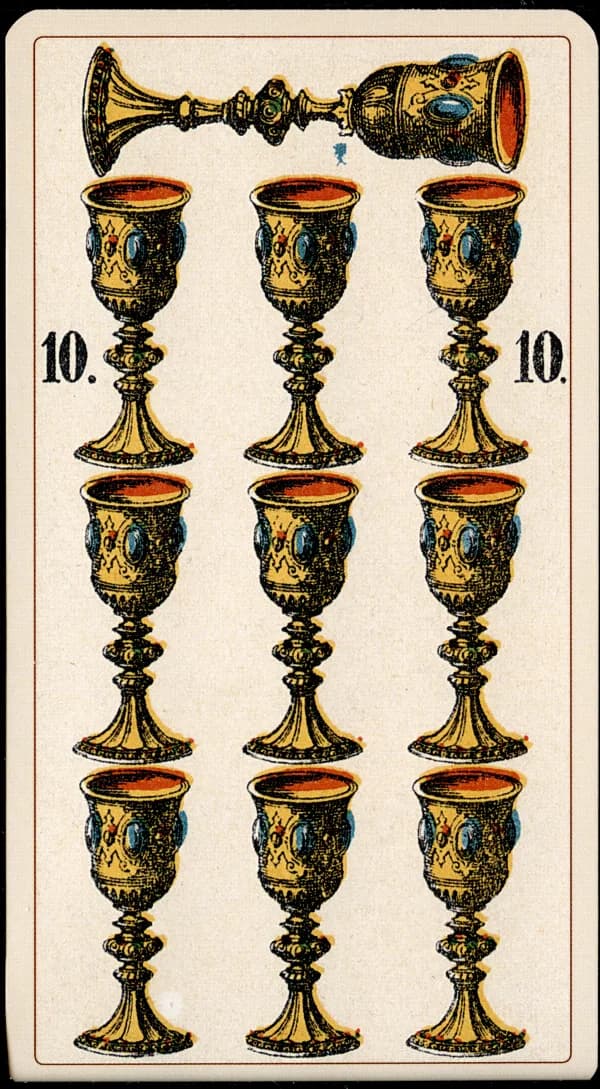
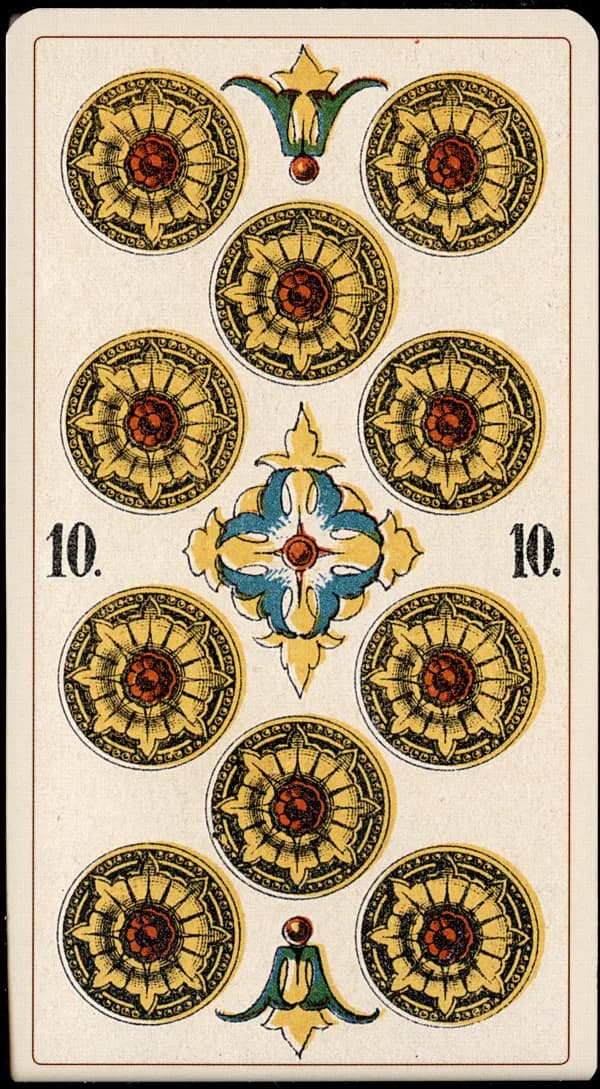
The Golden Dawn gave each numbered card from Two to Ten a decan, a ten-degree slice of the zodiac with a ruling planet. The Ten of Cups is Mars in the last ten degrees of Pisces. The Ten of Pentacles is Mercury in the last ten of Virgo. Pisces and Virgo are opposite signs, so the two slices face each other across the sky.
Mars looks like an odd guest on a card this happy, and Crowley thought it would spoil the calm. Book T gives Mars the end of Pisces "because the long cold of the winter requires a great energy to overcome it and initiate spring." It's the heat that gets a household through winter. Mercury has it easier: in traditional astrology, Virgo is its own sign and its exaltation, where a planet works best.
Do the two cards clash? Not in their elements. Book T names the hostile pairs: "Air and Earth are contraries as also are Fire and Water." Water and Earth aren't among them. Tarot author Mary K. Greer, explaining the order's rules, counts them as friendly, so each strengthens the other. There's a catch: "the term ‘friendly’ does not mean that the cards act nicely toward each other."
But the planets don't get along. William Lilly, the 17th-century astrologer, lists Mars and Mercury as enemies, and Venus as a friend to both. So love keeps them talking.
The sky lines the two cards up in 2027 (all dates Universal Time). Mercury crosses the Ten of Pentacles' ten degrees from August 28 to September 3, 2027. On September 15, 2027, the Moon is full at 22 degrees of Pisces, in the Ten of Cups' slice, with the Sun at 22 degrees of Virgo, in the Ten of Pentacles' slice. For one night the Cups side of the sky shines full, lit from the Pentacles side.
Who keeps things warm, and who keeps count? Have you thanked each other for the half you each carry?
What two Tens add up to
Add the Ten of Cups to the Ten of Pentacles and you get 20. That's Judgement.
Pollack makes the same jump from 10 to 20, starting from a different card: "The Wheel of Fortune, with its invisible laws of psychic cause and effect, was 10; Judgement is 20, 10 multiplied by 2." Each Ten shares the Wheel's number, so her doubling lands on the same card. But not every reader adds card numbers. Treat the sum as a lens.
On Judgement, a trumpet sounds over open coffins, and the people in them stand up. "Here we see a child between the two people," Pollack writes. That's a third family, after the two Tens. Waite even reuses his Ten of Cups words: that couple watch the rainbow "in wonder and ecstacy," and on Judgement, "all the figures are as one in the wonder, adoration and ecstacy expressed by their attitudes."
The Ten of Pentacles family shares a house but not a moment. On Judgement, everyone answers one call. She reads that call as a crossroads "where a decision is required on whether to make some great change." And building a life together is that kind of decision.
Both Tens live in Malkuth, but Robert Wang, in The Qabalistic Tarot, sets them in different worlds. The Ten of Cups is Malkuth "in the unconscious Mental World," the inner world he pairs with Water, and the Ten of Pentacles is Malkuth "in the material World." One kingdom, imagined and then built.
Reduce 20 and you get 2. Reduce each Ten first and 1 + 1 still makes 2. Two people, whichever way you count.
What part of your life together belongs to neither of you alone?
Questions readers ask about this combination
Does the Ten of Cups and Ten of Pentacles mean we'll build a life together?
Upright, the Ten of Cups and Ten of Pentacles point to a shared life with both halves in place: the feeling, and the home and money around it. The pair leans yes, with one condition. Rachel Pollack contrasts the families on the two cards: one celebrates what it has, and the other doesn't notice it. The life holds as long as you keep noticing each other. No card can make another person's choice for them.
What does the Ten of Cups and Ten of Pentacles mean in a love reading?
In a love reading, the Ten of Cups and Ten of Pentacles signal long-term commitment: moving in, a shared budget, maybe marriage, a family in whatever shape yours takes. The Cups card is the bond and the Pentacles card is the life built around it. The risk is comfort without closeness, a secure home where nobody is talking. Both cards show children, but neither is a pregnancy forecast.
What does it mean when the Ten of Cups and Ten of Pentacles are both reversed?
With the Ten of Cups and Ten of Pentacles both reversed, the feeling and the finances are strained at the same time. For a question about building a life together, that's no as things stand. Hold off on big moves, and have the honest conversation before the practical one.
What element connects the Ten of Cups and the Ten of Pentacles?
The Ten of Cups is Water and the Ten of Pentacles is Earth. In elemental dignities, the Golden Dawn's rules for how neighboring cards affect each other, Water and Earth aren't a hostile pair. As Mary K. Greer explains those rules, the two count as friendly, so each card strengthens the other, for good or ill. Both are also Tens, which puts them in Malkuth, the Kingdom, the tenth and lowest sphere on the Tree of Life.
Is the Ten of Cups and Ten of Pentacles a yes or no combination?
The Ten of Cups and Ten of Pentacles lean yes when both are upright: yes to building a life together, as long as you both want it and the love gets as much notice as the house. With one card reversed, it's not yet, so fix the half that's upside down first. Both reversed, it's no as things stand.