Tarot Card Combinations
Eight of Pentacles and Page of Pentacles
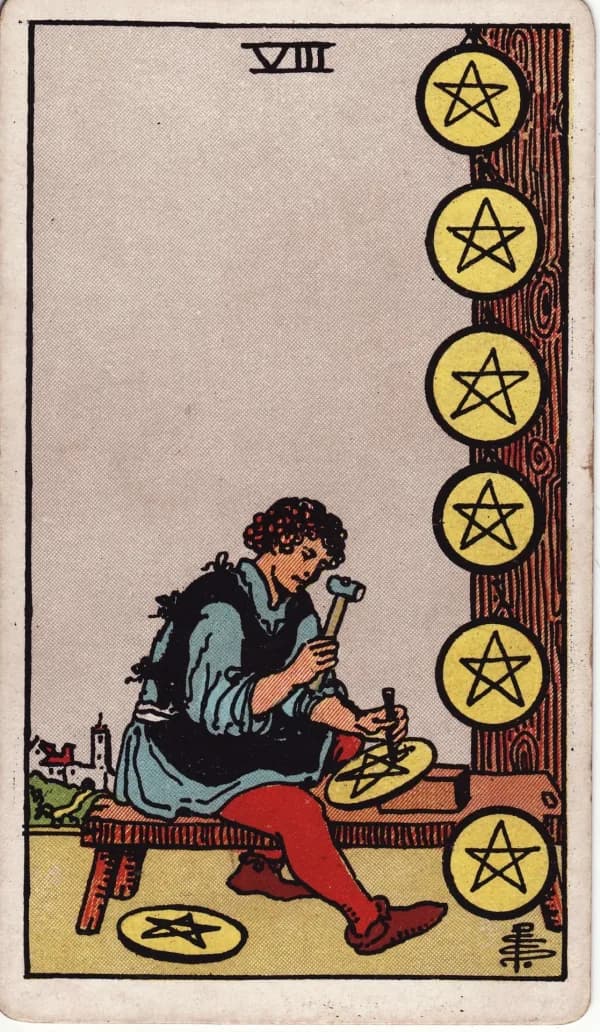
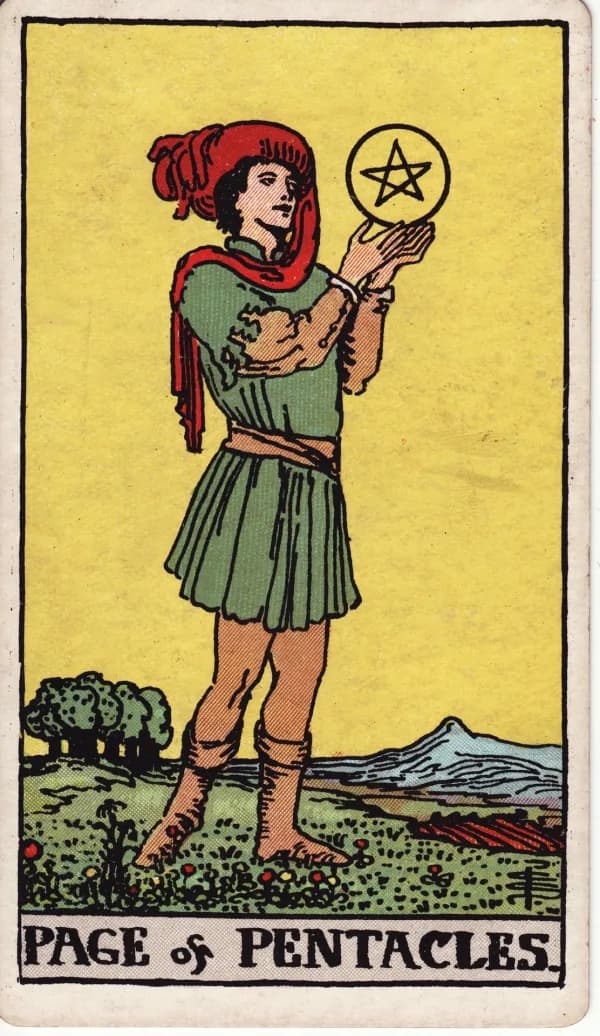
The Eight of Pentacles and Page of Pentacles tarot combination signals earned skill meeting a new opportunity. A young man bends over his work, chisel to a coin, six finished coins hanging beside him. In a flowering field, a youth raises both hands under a single coin. Before you ask will I get the job, count the finished coins. Then look at the one still in the air.

Climate scientist, ashtanga practitioner, and advocate for human rights and LGBTQIA+ equality.
The Eight and the Page, one at a time
Look at the Rider-Waite-Smith Eight of Pentacles. A curly-haired young man sits on a low bench, hammer raised in one hand, chisel in the other, its point set into a coin. Six finished coins hang down a wooden post beside him. Another lies on the ground under the bench. Far off to the left sits a small town. He isn't looking at it.
A.E. Waite gave the picture one sentence in The Pictorial Key to the Tarot: "An artist in stone at his work, which he exhibits in the form of trophies." His meanings are plainer: "Work, employment, commission, craftsmanship, skill in craft and business, perhaps in the preparatory stage." Hold on to those last five words. Rachel Pollack, in Seventy-Eight Degrees of Wisdom, is shorter still: "We have to care about the work itself."
Hod (splendor), the eighth sphere on the Kabbalistic Tree of Life, holds the Eights in the Golden Dawn system. Like the rest of its suit, this Eight takes the final Heh as its Hebrew letter: the last letter of God's four-letter name, which the Golden Dawn gives to Earth.
The order's manual, Book T, titles it Lord of Prudence and reads it more coolly than Waite. Robert Wang, in The Qabalistic Tarot, ties the two together: "Waite's craftsman illustrates the meaning of the card in divination, skill, prudence, and overcarefulness about small things, at the expense of the great." That's the person rewriting one cover letter for a fifth week.
Now look at the Page of Pentacles.
A young man in a green tunic and a red hat stands in a field of small flowers under a flat yellow sky, with trees, plowed furrows and one blue mountain behind him. Waite: "A youthful figure, looking intently at the pentacle which hovers over his raised hands."
Waite's meanings open with "Application, study, scholarship, reflection," then add a second reading: "news, messages and the bringer thereof." Pollack widens the first one: "the Page need not refer to someone actually in school." So anyone absorbed in learning something for its own sake can be this card.
In the Golden Dawn, the unnumbered Page turns into a woman. She's the Princess of Pentacles, Earth of Earth, the earthy rank of the earthy suit. So she carries the final Heh twice. Book T describes a "strong and beautiful Amazon figure." Aleister Crowley, in The Book of Thoth, puts his Princess "on the brink of transfiguration."
One figure has filled a post with finished work. The other can't take his eyes off a coin that hasn't landed in his hands. Which of them is closer to where you stand with this job?
What the Eight of Pentacles and Page of Pentacles mean together
Both cards show a learner, and the books say so. Waite's Eight has skill "perhaps in the preparatory stage," and his Page has "study, scholarship." Pollack describes both figures with the same phrase. The Eight is "the apprentice lost in his task." The Page is "the student, lost in his studies." One learns by doing, the other by looking. Neither is finished.
With no Major Arcana card here, this is an everyday career question: one job or one course. And whether a court card is a person or a piece of news is one of the first things to settle when you learn how to read tarot card combinations. Here the Page can be you, the email you're waiting for, or whoever sends it.
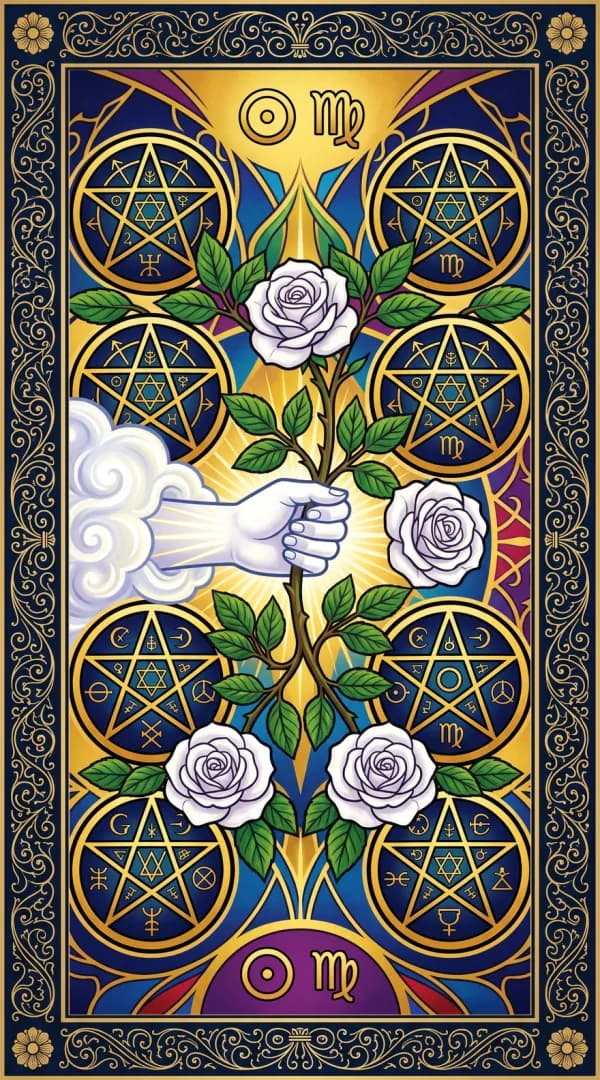
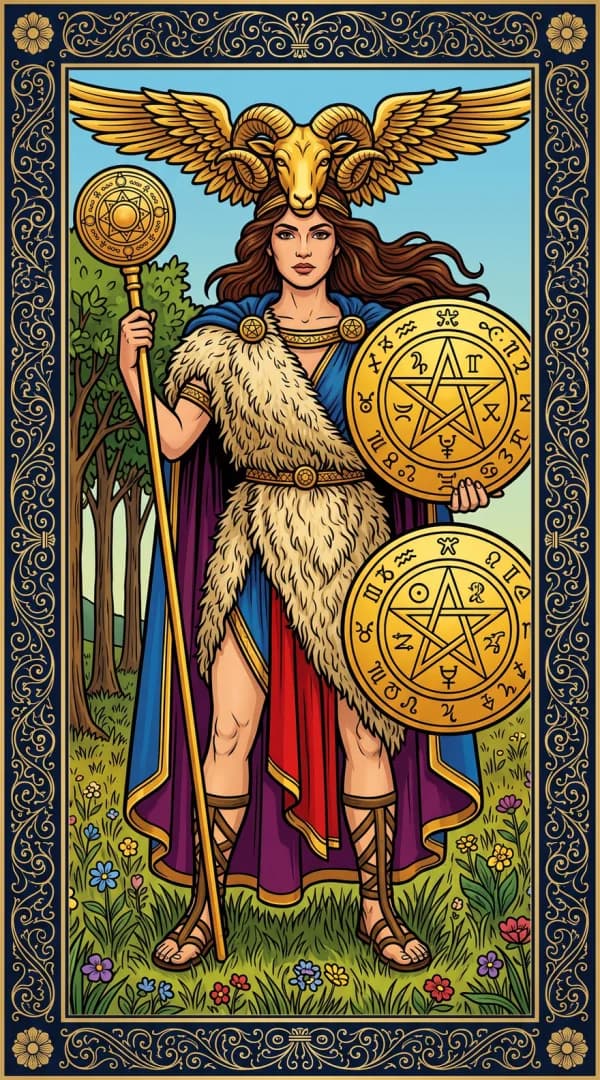
The Golden Dawn Eight below has no worker at all: a hand from a cloud holds a branch of white roses among eight pentacles, with the glyphs for the Sun and Virgo above and below. The Princess beside it wears a sheepskin mantle and a winged ram's head for a crest.
None of the books quoted here discusses this exact pair. Theresa Reed, The Tarot Lady, comes close one card at a time. She calls the Eight "the card of apprenticeship" and lists "a raise, promotion, or new job" among the Page's meanings. Side by side, that's the reading people hope for.
The work is real and news is in view, but the coin isn't in your hands yet. Waite's coin "hovers." And he puts the reward on a different card. Describing the Three of Pentacles, he looks back at the Eight: "The apprentice or amateur therein has received his reward and is now at work in earnest." Neither card in this pair shows that reward, or the person who decides.
Book T's note on the Eights goes further: "Generally show solitary success; i.e., success in the matter for the time being, but not leading to much result apart from the thing itself." On its own, the Eight is good work that goes no further than the bench. The Page is how it leaves the workshop.
What can you do now that you couldn't do a year ago? And has anyone who's hiring actually seen it?
Getting the job, and the other questions
If you came here asking will I get the job, the pair leans yes on your side of it. The Page is often read as the offer arriving. But look at who he is: someone starting out. So a yes from this pair tends to come as a beginning. The cards can't see the other candidates, the budget or the internal hire.
Interviewed and waiting? Look back at the Page. Waite says he "moves slowly, insensible of that which is about him." One opening can take all your attention like that. Send the follow-up. Then go back to the rest of your list.
Changing fields or going back to school puts the pair at its most literal. You're the Page again, even if you're good at something else. The offer may sit a step below your experience. That can still be the right door.
For a raise or a promotion, think wages, not windfall. Book T lists "gain of ready money in small sums" among the Eight's meanings. And the Page makes the promotion a start: new work before a new title.
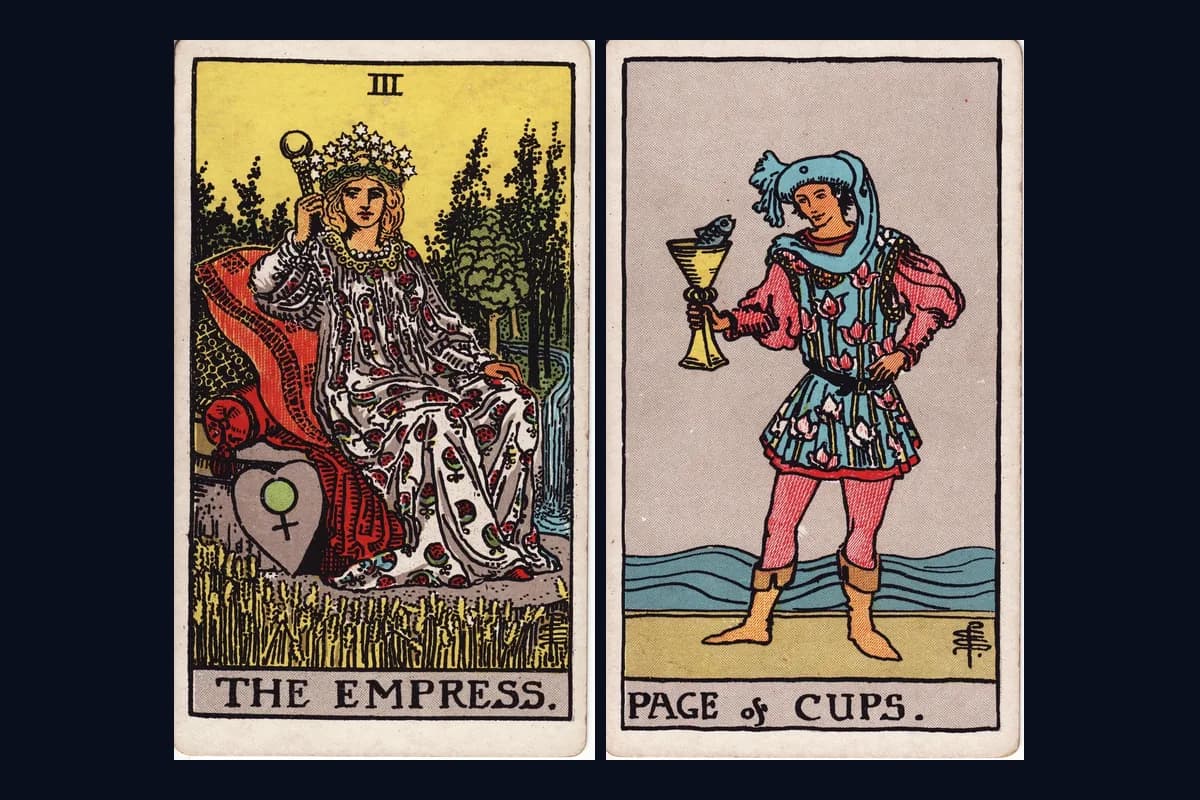
In love readings, each card holds one person, alone. Sometimes that's the answer: someone is so deep in work that love isn't what's on the workbench right now, and that someone might be you. Upright, the pair can also mean a bond built like a skill, through small, repeated care. For a first feeling rather than a first paycheck, the Empress and Page of Cups combination is the closer match.
In a Celtic Cross, Pollack's worked example puts the Eight of Pentacles in the Outcome (the tenth card): "The Eight indicates that the person will go through a period of hard work and learning." The Three of Pentacles sits in the Possible Outcome, above the center, and she reads it as the likely payoff.
Put the Page in the Three's place and the offer is where the work points, not a fact yet. For two outcome cards of one suit, Pollack also has a harder reading: "I read the Possible Outcome as something that might have happened but will not." If the cards around them pull against the offer, that's the reading to take.
Yes or no? Upright, it leans yes: your skill is real, and something new is in view. Pollack writes that the Eight of Pentacles can advise a person: "Keep working at what you are doing. It will take time, but it eventually will bring good results." Until an offer is in writing, keep your other applications moving. With the Eight reversed, it's not yet: how you work is what's off. With the Page reversed, this opening may stall or end in a no. With both reversed, it's no for now, and it doesn't measure your worth.
Swap the coins on the craftsman's post for work you've done yourself. What hangs there now? That image belongs in your deck.
The Eight first, or the Page first
The Eight of Pentacles first, then the Page of Pentacles is the hopeful order. The hours at the bench come first, and the news grows out of them. It still doesn't promise the job.
The Page of Pentacles first, then the Eight of Pentacles is the cautionary one. The news runs ahead of the skill. If the Page is the offer, a yes starts the apprenticeship instead of ending it. Before you accept, ask what the first six months look like. But if the Page is you, the Eight is the practice still between you and this job.
In a three-card spread of what you bring, what's arriving and what's asked of you, the Eight first and the Page second is the reading you want: your skill, then the news. If the Page lands first and the Eight last, you bring a beginner's eagerness, and the Eight is what a new job would ask of you.
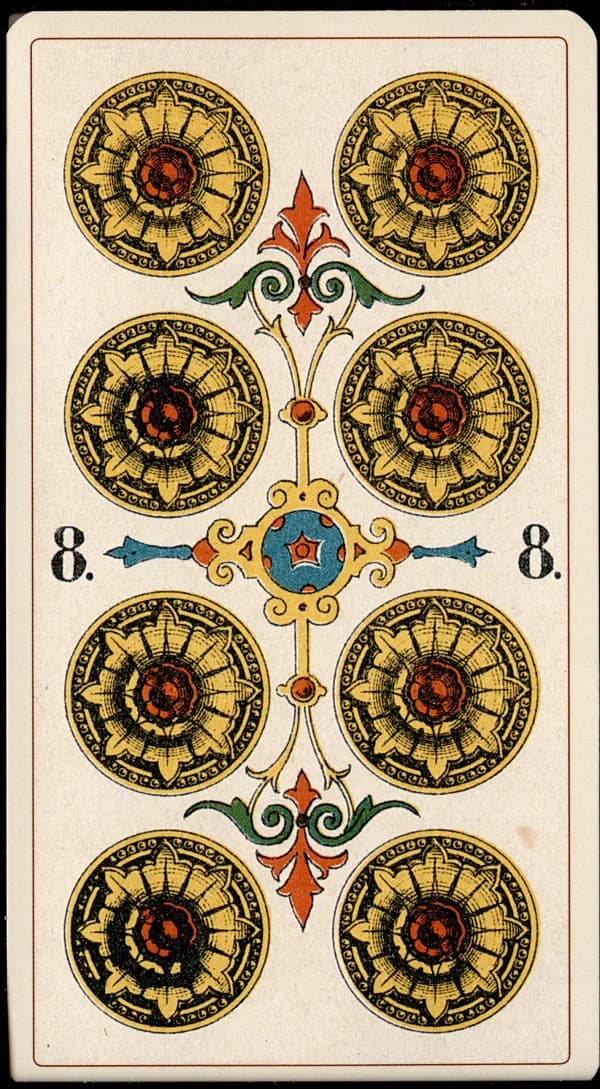
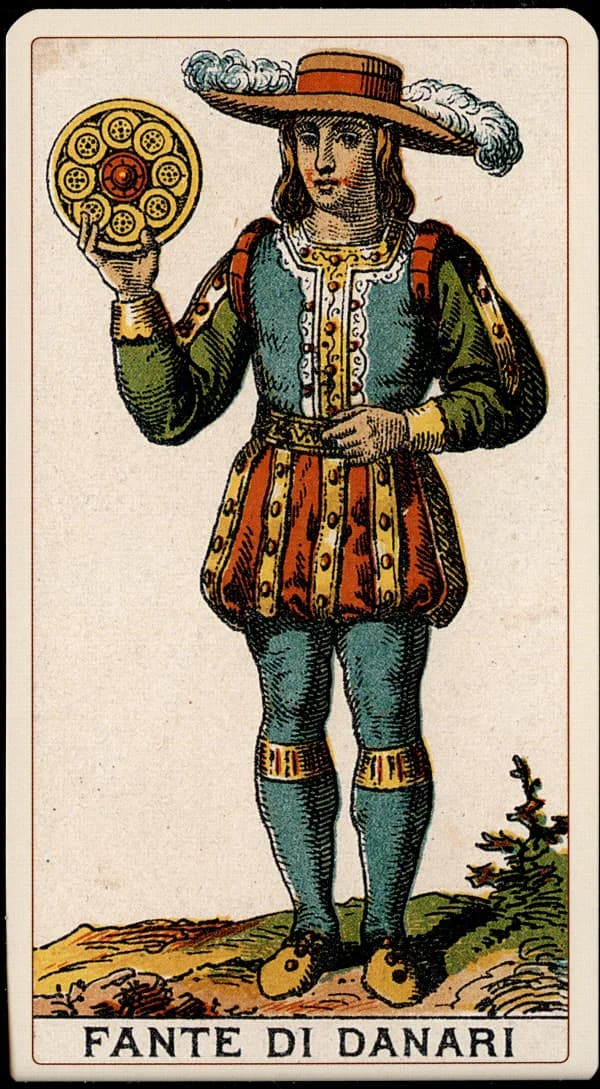
The Milanese Eight below has no worker either: eight coins in two columns, with an 8 printed on each side. The Milanese Page, the Fante di Danari, holds his coin up in one hand and looks out of the card, not at it.
Orientation matters too. Reversals, if you use them, tell you where to look: a reversed Page points at the opening, a reversed Eight at your work. Waite's reversed Page includes "unfavourable news," and that can mean a no. Pollack reads the reversed Eight as "primarily impatience." Theresa Reed names the opposite trap: "Getting hung up on details and getting nothing accomplished."
| Orientation | Reading |
|---|---|
| Both upright | Skill you've built meets a real opening; it leans yes, and what arrives is a start |
| Both reversed | Effort has drifted and the opening stalls; it's no for now, so reset the plan before the next try |
| Eight upright, Page reversed | Your work holds up, but the news is slow or disappointing; one no is about one opening, not your skill |
| Eight reversed, Page upright | A good opening is in view, but your effort is rushed or stuck on polish; if rushed, slow down, and if polishing, send it |
Which came first for you, the practice or the opening? And which one are you still waiting on?
What the sky can time, and what it can't
Both cards belong to Pentacles, the suit of Earth. In elemental dignities (the Golden Dawn habit of reading a card by its neighbors' elements), same-suit neighbors strengthen each other. On her tarot blog, Mary K. Greer spells out the catch: "They can greatly increase either the good or ill in each (depending on their individual meanings)." Doubled Earth isn't doubled luck. It makes both cards more of what they already are, careful study and fussing alike.
The Eight has an address in the sky. Book T puts it in the first decan of Virgo (the sign's first ten degrees), a decan ruled by the Sun. And Virgo, an Earth sign, belongs to Mercury, which is also Hod's planet. For Wang, the planetary aspect is "a very practical one which tends to cause concern with small details."
The Page has no address in the zodiac. Crowley is blunt: "The Princesses have no Zodiacal attribution." Book T gives the Princess a quarter of the sky instead, around the north pole of the ecliptic (the Sun's yearly path). The Sun never crosses that quarter. So one card has a season, and the other has none. You can time the work. You can't time the offer.
On the Tree of Life, every Eight sits in Hod and every Princess in Malkuth (the Kingdom), the sphere of the physical world. One path joins them. It carries Shin (the Hebrew letter for tooth) and the card Judgement, where an angel's trumpet calls the dead up from their coffins. Read it as the call you're hoping for, if you like.
Crowley reads the coins on his Eight as Populus, a figure from geomancy (the old art of reading marks made in earth). He ties it to the Moon moving into conjunction with the Sun, and a new moon is that conjunction. The Sun enters Virgo on August 23, 2027, and the new moon falls at 8 degrees Virgo on August 31, 2027 (both dates Universal Time), inside the Eight's decan. Use the days between those dates to finish the part that's yours.
What's one careful step you could take on this application this week, one that doesn't depend on anyone else's answer?
Adding up the Eight and the Page
Count the Page as 11 and add the Eight. You get 19. That's the Sun.
Nothing on the card says 11. The site Tarot Elements gets it by counting straight on past the Ten. Biddy Tarot leaves court cards out: "Court Cards do not typically have a numerological association." If that's you, keep reading anyway, because the Sun doesn't need the sum.
The Sun is already inside the Eight. That first decan of Virgo belongs to the Sun, the planet of card XIX. And on the Tree of Life, the Sun card's own path (the letter Resh, meaning head) starts at Hod, the sphere of every Eight, and runs to Yesod, the Foundation. Two roads to the Sun, and neither needs a number for the Page.
The Eight's craftsman works far from town. Nobody is watching. On the Rider-Waite-Smith Sun, a child rides a white horse out into full daylight. The Sun is your work out where people can see it.
Reduce 19 and you get 10, the Wheel of Fortune, then 1, the Magician. The Golden Dawn gives the Magician to Mercury, the planet of Hod and of Virgo. So the sum and its reduction both lead back to the Eight.
The Sun puts everything in plain view. If the people deciding on this job could see all your work at once, what would you want them to notice first?
Questions readers ask about this combination
Does the Eight of Pentacles and Page of Pentacles mean I'll get the job?
On the part you control, the Eight of Pentacles and Page of Pentacles point toward yes: the Eight shows skill you've built. Beyond that, the Page is often read as the offer arriving, though what arrives tends to be a beginning. No card can see the other candidates or make a hiring decision, so keep your other applications moving until an offer is in writing.
What does the Eight of Pentacles and Page of Pentacles mean in a love reading?
In a love reading, the Eight of Pentacles and Page of Pentacles each show one person, alone. Sometimes that's the answer: someone is too deep in work to make room for love right now, and that someone might be you. Upright, the pair can also mean a bond built like a skill, through small, repeated care.
What does it mean when the Eight of Pentacles and Page of Pentacles are both reversed?
When the Eight of Pentacles and Page of Pentacles are both reversed, effort has drifted and the job opening stalls. It reads as no for now, and it doesn't measure your worth. Rachel Pollack reads the reversed Eight mainly as impatience. Reset the plan before the next try.
What element connects the Eight of Pentacles and the Page of Pentacles?
Earth. Both cards are Pentacles, the suit of Earth. The Golden Dawn places the Eight in the first ten degrees of Virgo, an Earth sign, and gives the Page, as its Princess of Pentacles, the title Earth of Earth. Under elemental dignities (the practice of reading a card by its neighbors' elements), same-suit cards strengthen each other, so each becomes more of what it already is, for good or ill.
Is the Eight of Pentacles and Page of Pentacles a yes or no combination?
Upright, on a job or career question, the Eight of Pentacles and Page of Pentacles lean yes: your skill is real, and something new is in view. With the Eight reversed, it's not yet: how you work is what's off. With the Page reversed, the opening may stall or end in a no, and one no says nothing about your skill. With both reversed, it's no for now. Neither card can answer for the people making the hiring decision.