Tarot Card Combinations
Queen of Cups and King of Cups
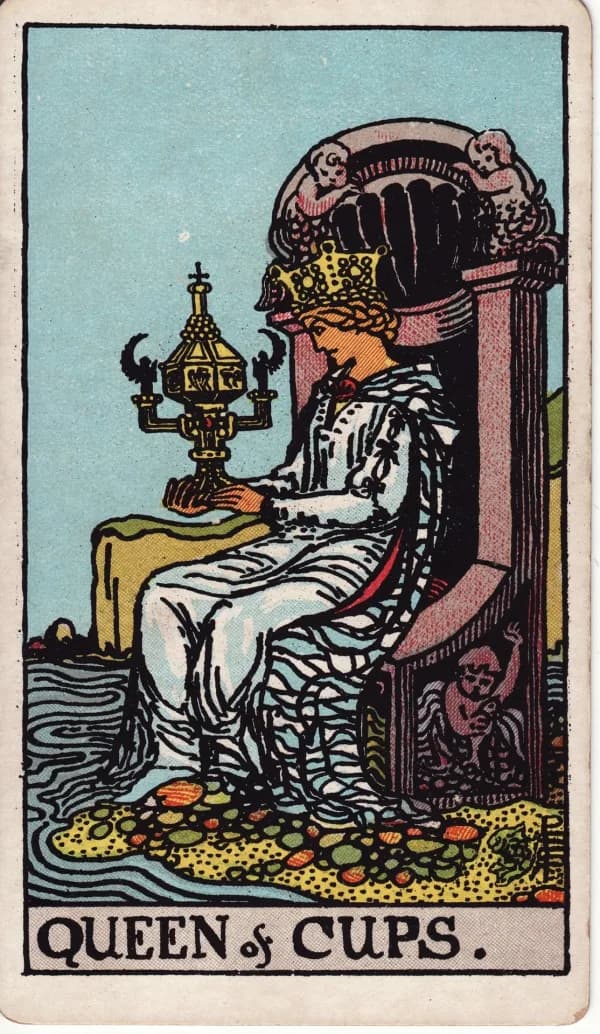
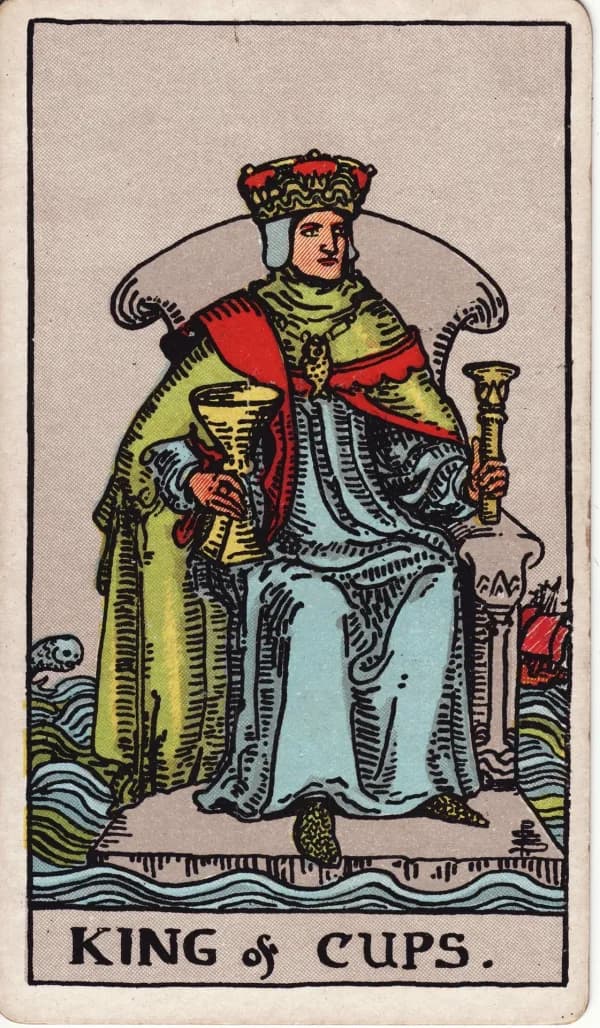
The Queen of Cups and King of Cups tarot combination signals two people who both feel deeply and show it in opposite ways. A queen sits at the sea's edge, eyes on a closed gold cup with angel handles. A king, enthroned out at sea, holds an open cup. Two thrones, one sea. Asking whether you're meant to be? Watch what each does with their cup.

Climate scientist, ashtanga practitioner, and advocate for human rights and LGBTQIA+ equality.
What each card means on its own
Start with the Rider-Waite-Smith Queen. She sits in profile on a carved throne, facing left, staring at the cup in her hands. It's the fanciest cup in the suit: gold, shaped like a small church, an angel on each handle, a cross on the lid. And it's shut. Bright pebbles lie under her feet, and her white gown is drawn in the same wavy lines as the water, so the hem seems to run into the sea.
A.E. Waite wrote that "she sees, but she also acts, and her activity feeds her dream." His meanings for her include "loving intelligence, and hence the gift of vision." Rachel Pollack, in Seventy-Eight Degrees of Wisdom, sums her up: "What is most important is that she joins consciousness to feeling."
In the Golden Dawn, the magical order Waite belonged to, she's Water of Water, the suit's element doubled. Her Hebrew letter is Heh, meaning window. On the Tree of Life, the Qabalah's map of ten linked spheres, her place is Binah (Understanding), the third. The lid itself is older than Waite's deck. Robert M. Place, author of The Tarot: History, Symbolism, and Divination, notes that the Marseille Queen's cup is "the only one in the suit, other than the Ace, that has a lid." He adds that "she cannot see what is inside." She's holding a vision she hasn't opened.
Now look at the King.
His heavy stone throne sits on a square slab in open sea. A fish leaps on your left (Waite calls it a dolphin), and a red-sailed ship rides the swell on your right. He holds a plain open cup in his right hand and a short sceptre in his left. Pollack noticed that his throne "floats on the lively sea, yet he himself does not touch the water," and that to succeed "he has had to discipline and even suppress his dreams."
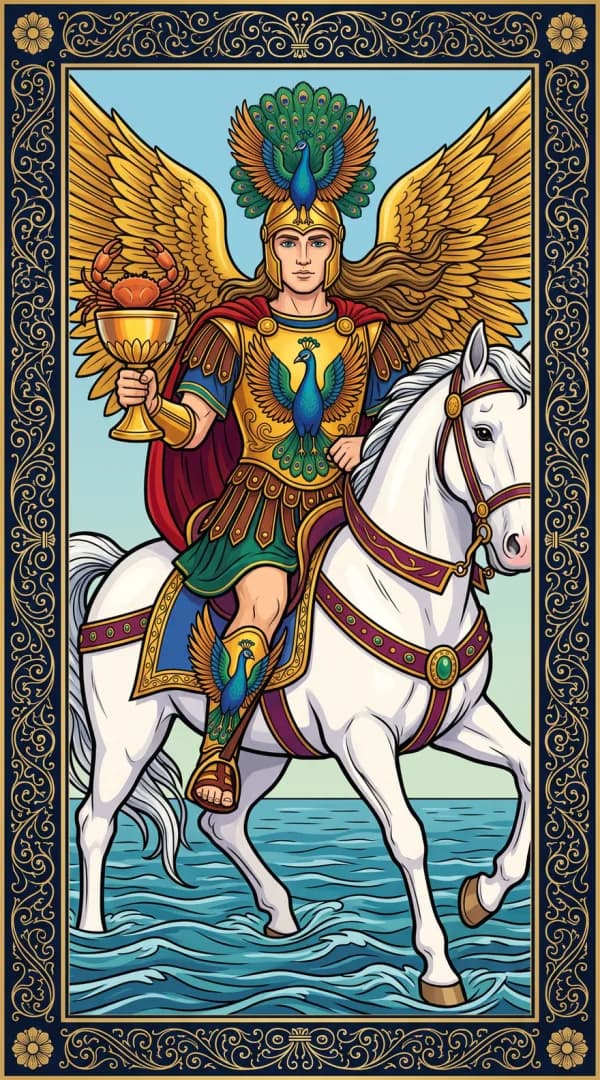
In the Golden Dawn he's Fire of Water, the spark inside the element. His letter is Yod, meaning hand, and his sphere is Chokmah (Wisdom), the second. But the Golden Dawn gives him no throne. Its King, the figure Aleister Crowley's Thoth deck renamed the Knight, rides a white horse through the waves, and Crowley found him quick to warm but "not very enduring."
Set them side by side. Her sky is blue and her water gray. His sky is gray and his water blue and green. One cup sealed and studied. The other open, held at his side.
Which cup are you holding: the sealed one you keep studying, or the open one you carry without looking in? Which one is the other person holding?
Why the Queen and King of Cups read as a couple
These two are already a couple: one suit, the top two ranks of its court, each enthroned at the same sea. When Pollack needed an example of a court card standing for a partner, she picked exactly these two. "Suppose a married woman chooses the Queen of Cups to represent herself; if the King of Cups comes up in the reading it may represent her husband."
But Mary K. Greer, co-author of Understanding the Tarot Court, writes that "a King can be most like a person's mother and a Queen like the father, so don't get too fixated on gender roles matching sex." Either card can be you.
Neither belongs to the Major Arcana, the part of the deck most readers save for life-shaping themes. Two court cards are two people, or two sides of one person. They answer how the two of you love. Suited, not fated.
In elemental dignities, the Golden Dawn's rules for how neighboring cards strengthen or weaken each other, Greer finds that "Court Cards in the same suit tend to support each other." Whatever these two mean in your spread, good or bad, they turn it up.
Together, the Queen and King of Cups describe two people who can both hold what they feel, so neither one has to carry the feeling for both. That's this pair's version of soulmates. It's also a condition, and it's the first thing to go when either card comes up reversed.
But a soulmate can be a mirror. Crowley warns that the Queen "reflects the nature of the observer in great perfection." If she mirrors whoever looks at her, part of what you see in this relationship may be you.
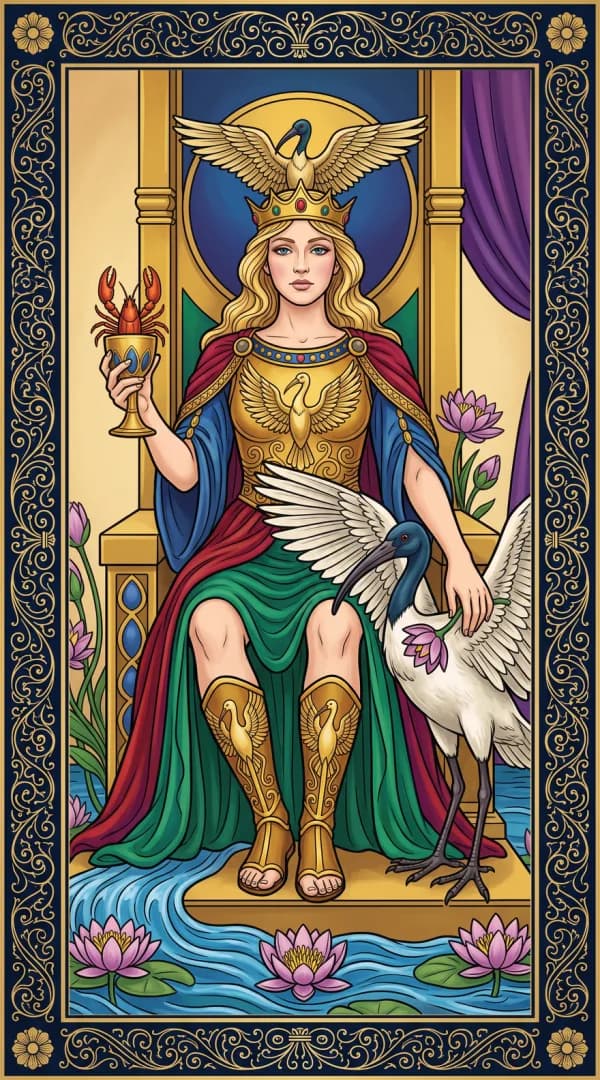
On the Golden Dawn pair below, both cups are open and something alive climbs out of each. A crayfish rises from hers. From his comes a crab, which Robert Wang, author of The Qabalistic Tarot, calls the "symbol of the Sign Cancer," her sign.
What do you love most in this person? How much of it might be you, reflected back?
What it says about soulmates, twin flames and marriage
So, are you meant to be? Two well-known readers each call one card marriage material. Waite's Queen is "a perfect spouse." Theresa Reed, The Tarot Lady, calls the King "the type of guy who makes great husband and father material." But neither wrote about the two together. Upright, the pair describes love that's grown up on both sides, though it can't vouch for yours, or tell you what either of you will do with that love.
If you think in twin flame terms, no tarot tradition gives these cards that meaning. It's a modern overlay. The lore pictures one soul split in half; this pair shows two whole people who hold the same feeling differently, and neither is chasing the other. If one of you keeps running off and coming back, these cards show what staying looks like.
On marriage, Pollack splits the work: "while the King symbolizes society, the Queen symbolizes the family," and that holds "for men as well as women." Upright, that's a marriage sharing the load, with either of you in either seat. If you're already talking rings and leases, the Four of Wands and Two of Cups combination reads the engagement itself. This pair reads the two people making the promise.
Wondering how they feel about you? No card reads a mind, but upright, neither of these is cold: the Queen feels deeply and keeps the lid on; the King feels deeply too and holds his cup steady without looking in. In Pollack's example, the King can also mean "her husband's influence on her," so notice how this person affects you. Do you feel steadier around them, or just quieter?
In a Celtic Cross, say the Queen lands in the center and the King crosses her. Pollack reads the crossing card "right side up, despite how it comes off the deck," and calls the two positions "simply 'being' and 'doing'." The Queen is what you feel. The King is how it gets done. If either lands in the fifth spot, which Pollack calls the Possible Outcome, she says: "It simply means the person is heading in this direction."
Yes or no? Yes, if both cards are upright and both of you keep saying what you feel. It's a yes to two people, not a promise from fate. With one card reversed, the answer is not like this. With both reversed, it's not yet.
Think of something you feel for this person but haven't said, and something you've told them a hundred times. What would your two cups look like, the closed one and the open one? That image belongs in your deck.
What changes when the King comes first
Few books set rules for this pair's order, so borrow an older rule: Wang records the Golden Dawn teaching that Kings can mark a matter's "arrival or departure, according to the way in which the cards face."
Queen first, then King: on the Rider-Waite-Smith cards she faces the left edge, away from him, and on the Golden Dawn pair above, his horse heads for the right edge, away from her. Feeling comes first, and each tends their own cup. Call it the cautionary order: make sure you're having the same conversation.
Or if the King comes first, they turn toward each other on the same cards. She faces him. His horse heads her way. That's the hopeful order: steadiness meets the feeling instead of managing it.
For a three-card spread, Brigit Esselmont of Biddy Tarot has a favorite: "It's the Situation, Problem, Action spread." If the Queen falls in Situation and the King in Action, whatever lands between them is the thing in the way.
Orientation matters too. Greer's rule of thumb: "Reversed Court Cards are not evil people; their characteristics can be weakened or excessive." That goes for Waite's darker entries for both cards: "distinguished woman but one not to be trusted" and "Dishonest, double-dealing man." Take either as a question to ask, not evidence about anyone. Fear is different. If you're afraid of how your partner will react, that's more than a card can read. Tell someone you trust.
The mixed rows below are where one of you carries the load. Pollack ties maturity to rank: if a partner is immature or leans too hard on the other, "the Knight may appear instead of the King." So an upright King describes a grown-up partner without proving yours is one. Reversed, the King can leave both cups with the Queen's side. Carrying more for a season is normal. Carrying all of it for years needs saying out loud.
| Orientation | Reading |
|---|---|
| Both upright | Both of you feel it and both can carry it; the clearest yes this pair gives |
| Both reversed | Two people running low at once; tired and guarded, so rest and talk before deciding anything |
| Queen upright, King reversed | The Queen's side carries the feeling for both while the King's calm cracks or goes cold; ask directly, then watch what gets done |
| Queen reversed, King upright | A drained Queen beside a steady King; the Queen's side has given more than it got back; let the King's side pick up its share without taking over |
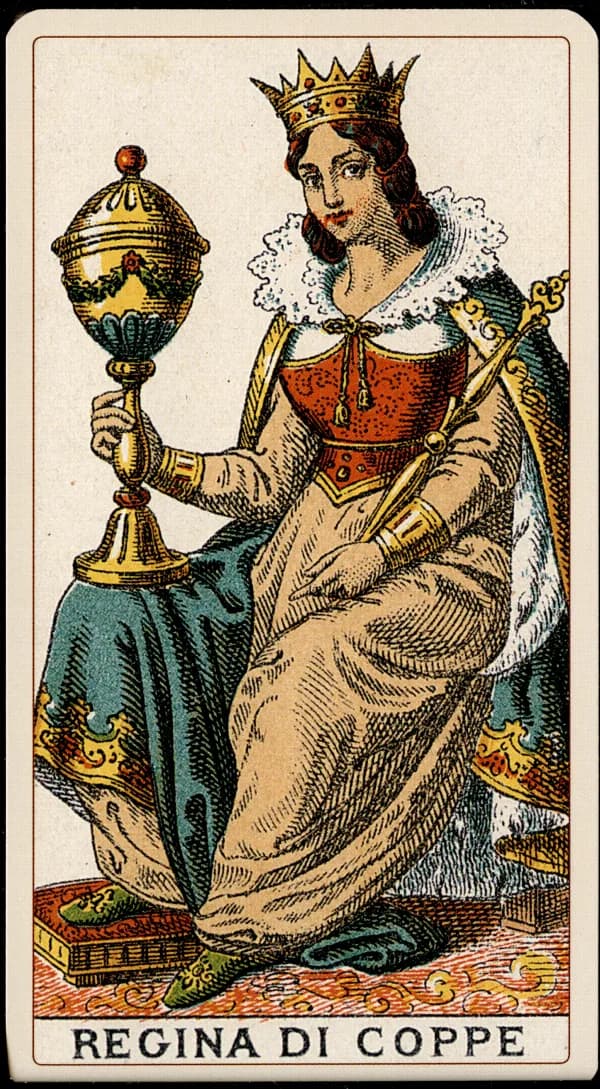
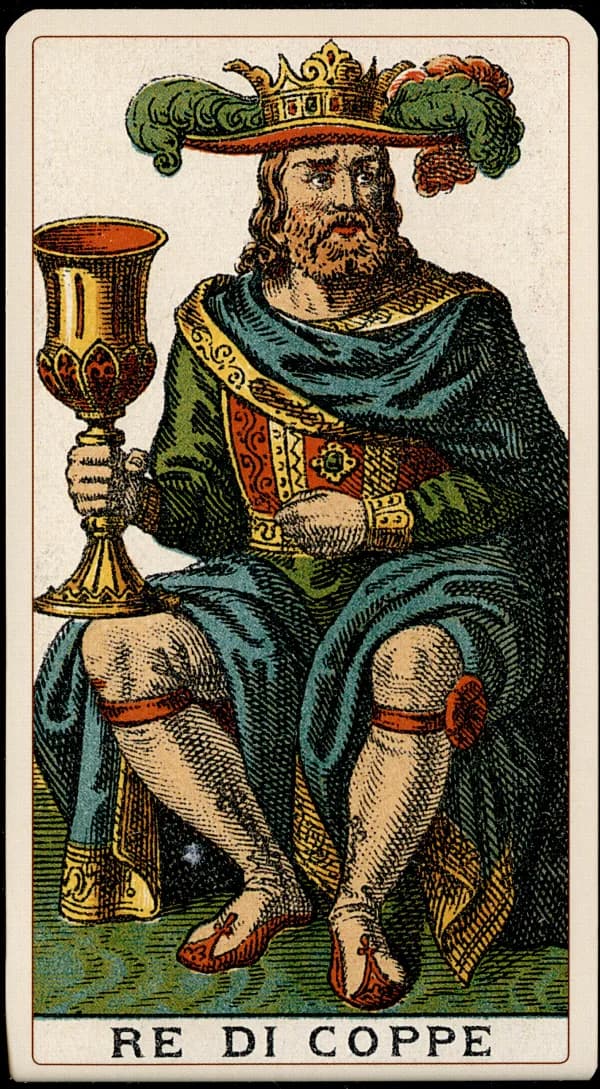
The Milanese pair below has no sea, but the lid survives: her tall cup is capped, and his is open.
Which row of that table sounds most like the two of you right now? If one of you has been carrying more of the feeling, how long has that been true?
What the sky adds to a soulmate reading
The Golden Dawn gave every court card except the Pages its own stretch of the zodiac: the Queen runs from 20 degrees of Gemini to 20 degrees of Cancer, the Moon's sign. The King, the rider in the Golden Dawn pair above, runs from 20 degrees of Aquarius to 20 degrees of Pisces, Jupiter's sign.
Under the shared Water, friction. She's Water of Water, and he's Fire of Water. Crowley gives the King's card (the Thoth Knight, again) the I Ching hexagram Kwei Mei, often translated as the Marrying Maiden. He says its commentary deals with "the difficulties of rightly mating such opposites as fire and water." Fire flares fast. Water holds steady.
Each stretch holds three decans, the ten-degree slices the Golden Dawn gave the Twos through Tens. The Queen's holds the Ten of Swords, the Two of Cups and the Three of Cups; the King's holds the Seven of Swords, the Eight of Cups and the Nine of Cups. But neither stretch is all sweetness: each opens on a Swords card. On the Tree of Life, the one path joining their spheres belongs to the Empress, Venus's card.
Mercury, the planet of speech, turns retrograde in Pisces on February 9, 2027, and direct on March 3, 2027, without leaving the King's degrees. It turns retrograde in Cancer on June 10, 2027, and direct on July 4, 2027, without leaving the Queen's (all dates Universal Time). Two Water cards feel more than they say. Astrologers read a retrograde Mercury as a time to go back over things. And if you've carried the feeling for both and still haven't said so, speak up in those weeks, or sooner.
He carries a little Fire under his Water; she's Water all the way through. When things go wrong between you, who runs hot, and who goes quiet?
The card the King and Queen make together
Neither card is numbered, which sends you to the Golden Dawn: Wang files the Kings under Chokmah, the second sphere of the Tree of Life, and the Queens under Binah, the third. He also notes that Mathers, a founder of the order, set court cards beside the spheres rather than on them. So hold this lightly.
Add 2 and 3 and you get 5. As a Major Arcana number, that's the Hierophant.
William Wynn Westcott, another founder, records the Pythagorean view that 5 "unites in friendship the two forms of number even and odd; the 2 and 3." One of its old names: "Gamelia, that is referring to marriage." The Pythagoreans he quotes called 3 male and 2 female, while the Golden Dawn makes Chokmah the Supernal Father and Binah the Supernal Mother. The roles swap. The sum stays 5.
Or count past the Ten, as some modern readers do, and the Queen is 13 and the King 14. That's 27, which reduces to 9, the Hermit. The Hierophant teaches in public and the Hermit turns inward, the way the two cups split.
Book T, the Golden Dawn's tarot manual, also points to a card for the couple itself: it reads every Two as the powers of the King and Queen just beginning to unite. In Cups, the card this King and Queen make together is the Two. Wang puts the Two of Cups in Chokmah, the King's sphere. Its decan, Venus in the first ten degrees of Cancer, sits inside the Queen's stretch of sky. On Waite's card, two people stand face to face, each holding out a cup.
The sum needs both numbers. Where are the two of you different in a way that holds you together?
Questions readers ask about this combination
Does the Queen of Cups and King of Cups mean we're meant to be?
Upright, the Queen of Cups and King of Cups describe two people who can both hold what they feel, which is what most people mean by a good match. Neither belongs to the Major Arcana, where readers usually look for life-shaping themes, so the pair reads how you love and leaves fate out of it. Whether the relationship lasts depends on both of you choosing it and saying what you feel.
Is the Queen of Cups and King of Cups a soulmate or twin flame sign?
Partly. Rachel Pollack's own example casts the Queen of Cups and King of Cups as a wife and husband, and A.E. Waite and Theresa Reed each call one of them marriage material. That supports a soulmate reading in the sense of a well-matched couple. Twin flame is a modern idea no tarot tradition attaches to these cards, and they show two whole people, not one soul split in half.
What does it mean when only one of the Queen and King of Cups is reversed?
When only one of the Queen and King of Cups is reversed, one of you is usually carrying more of the feeling. A reversed Queen beside an upright King points to the Queen's side giving more than it gets back. An upright Queen beside a reversed King means the Queen's side carries the feeling while the King's calm cracks or goes cold. Either card can be you. Talk before you decide anything about the other person.
What element connects the Queen of Cups and the King of Cups?
Water. The Queen of Cups and King of Cups are both Cups, and in elemental dignities, the Golden Dawn's rules for how neighboring cards affect one another, two court cards of one suit tend to support each other. Underneath, the Golden Dawn makes the Queen Water of Water and the King Fire of Water, so there's a small spark of friction inside the shared element.
Is the Queen of Cups and King of Cups a yes or no combination?
Yes, with a condition. If the Queen of Cups and King of Cups are both upright, it's a yes as long as both of you keep saying what you feel. With one card reversed, the answer is no, not like this: someone is carrying too much. With both reversed, the answer is not yet: rest, and talk honestly before deciding anything.