Tarot Card Combinations
Six of Swords and The Star
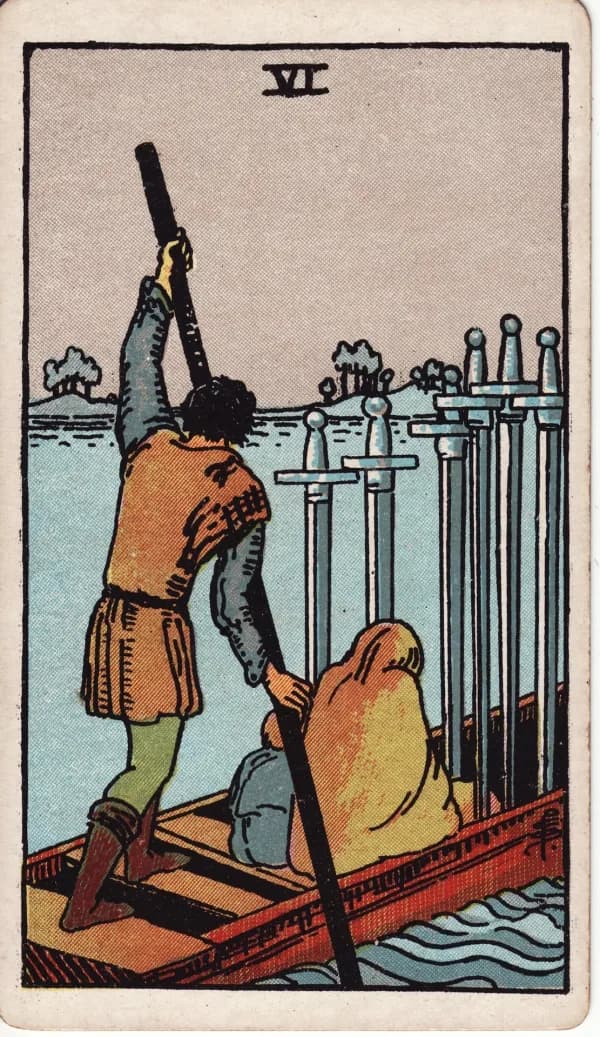
The Six of Swords and the Star tarot combination signals moving on toward calmer water. A ferryman poles a punt. A hooded woman and a child sit in front of him, behind six upright swords. The water's choppy by the boat and smooth ahead. On the next card, a woman kneels at a pool, pouring from two jugs. If you're asking whether to go, watch the water.

Climate scientist, ashtanga practitioner, and advocate for human rights and LGBTQIA+ equality.
What each card shows on its own
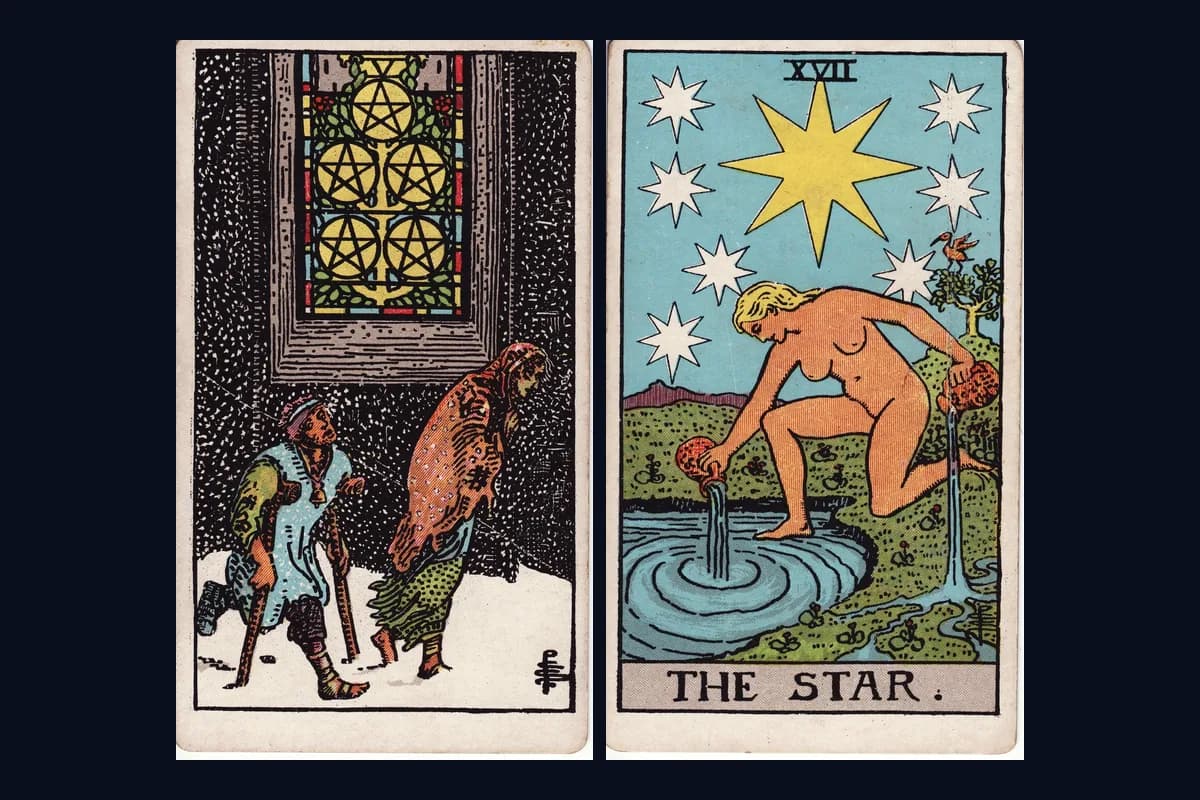
Look at the water on both Rider-Waite-Smith cards before you look at anyone in them. On the Six of Swords, it's smooth almost everywhere. Only one patch, low on the right beside the boat, breaks into waves.
The Six is all backs. A ferryman at the stern pushes a long black pole into the water. In front of him, a hooded woman sits with her head bowed and a smaller figure leaning into her. Six swords stand upright in the bow. A.E. Waite, who planned the deck Pamela Colman Smith drew, wrote, "The course is smooth." Smith drew the waves anyway.
It's the 6 of Swords, the Air suit, and, like every Minor card, it has no Hebrew letter of its own. The Golden Dawn, the magical order behind this deck's symbols, titled it the Lord of Earned Success. Rachel Pollack, author of Seventy-Eight Degrees of Wisdom, says it usually doesn't mean death, though it can mean mourning. "Rather it depicts a quiet passage through a difficult time."
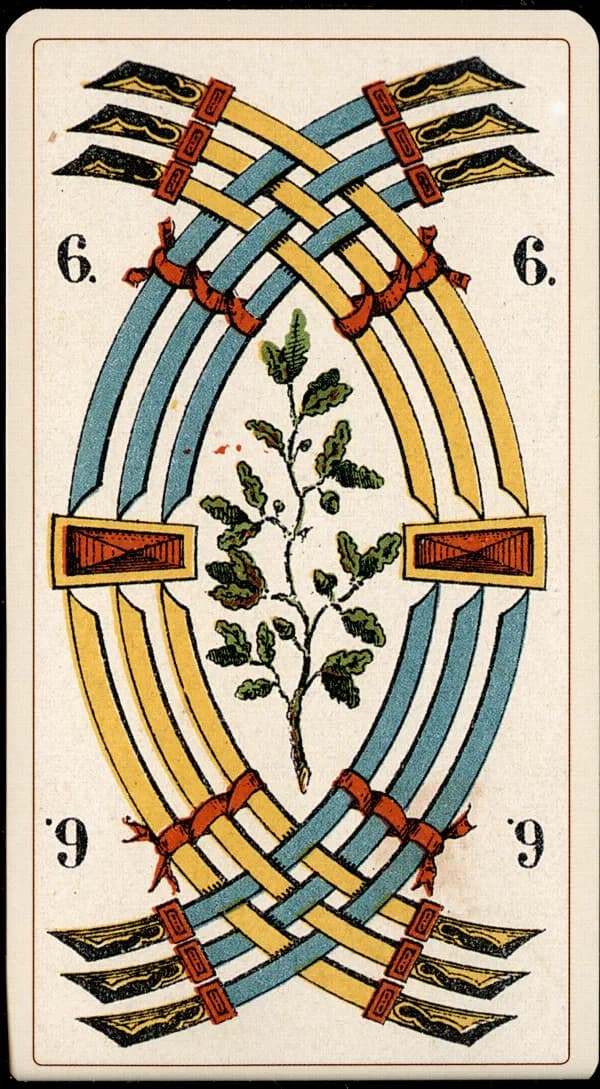
Older decks put nobody in a boat: Marseille-pattern Sixes, like the Milanese card further down, are curved blades around a sprig. But the meaning came first. Tarot author Mary K. Greer notes that as far back as Etteilla, the eighteenth-century French card reader, the card was "a path, passage, or voyage," and Waite's list of meanings opens with "journey by water." Smith just gave it a boat.
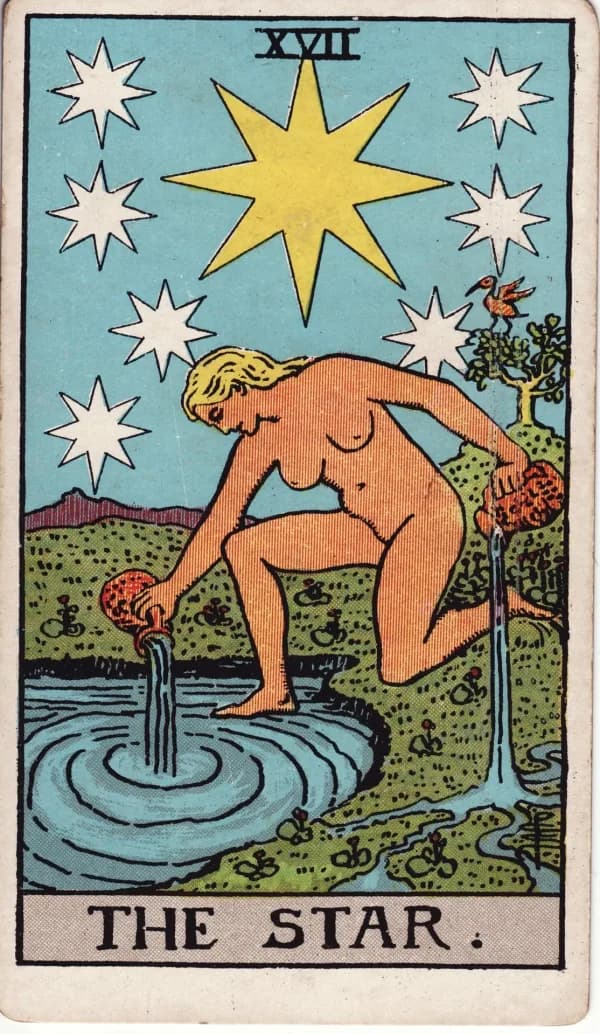
Now look at the Star (XVII).
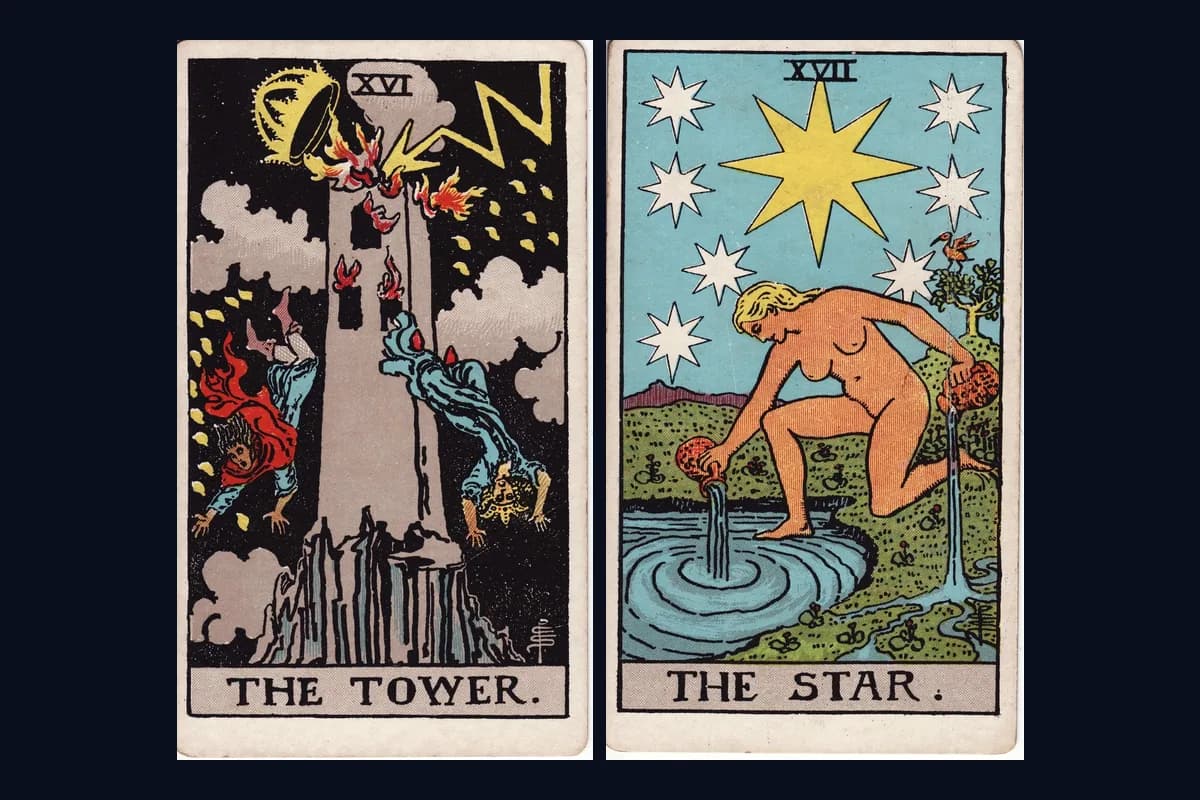
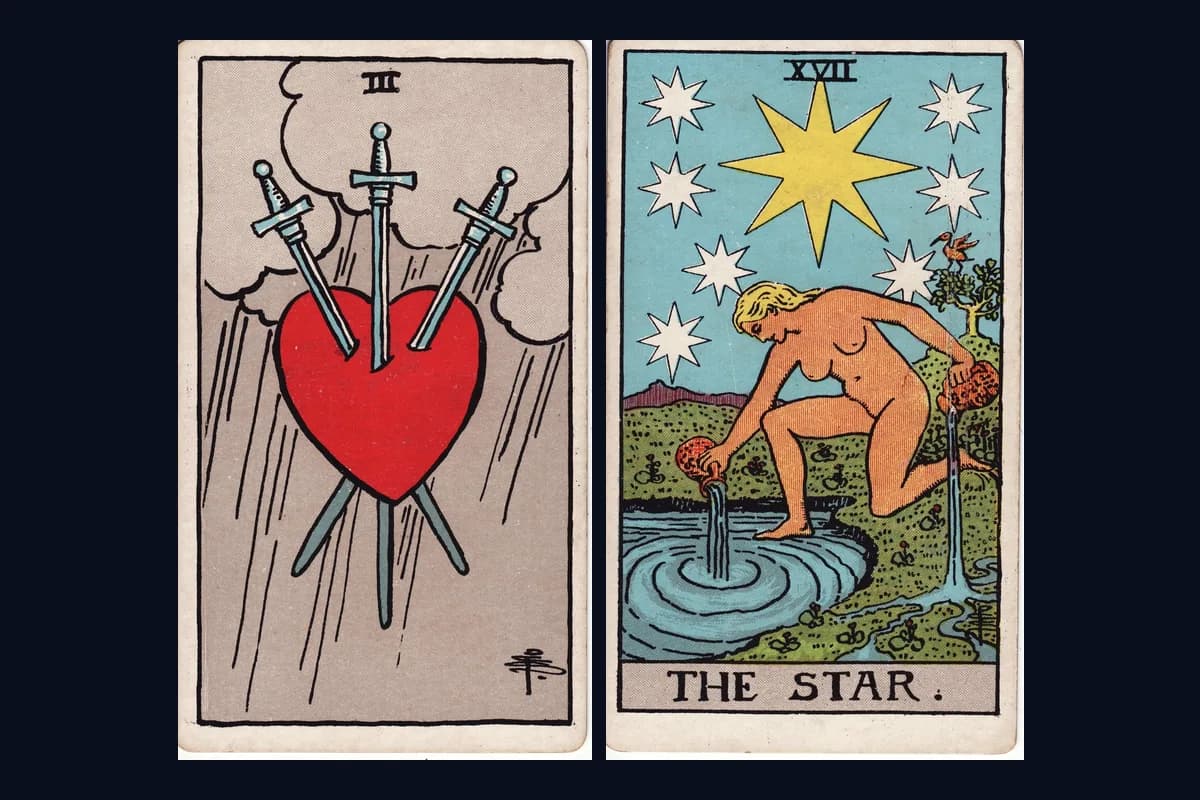
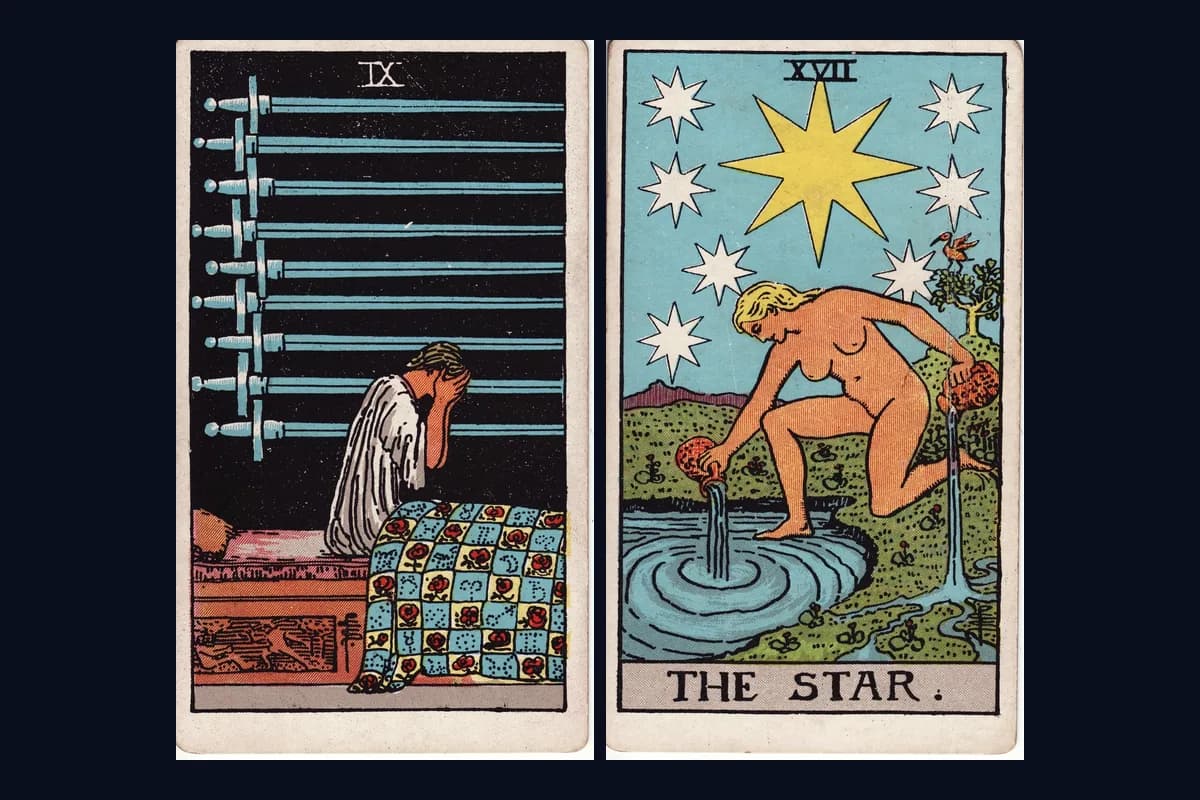
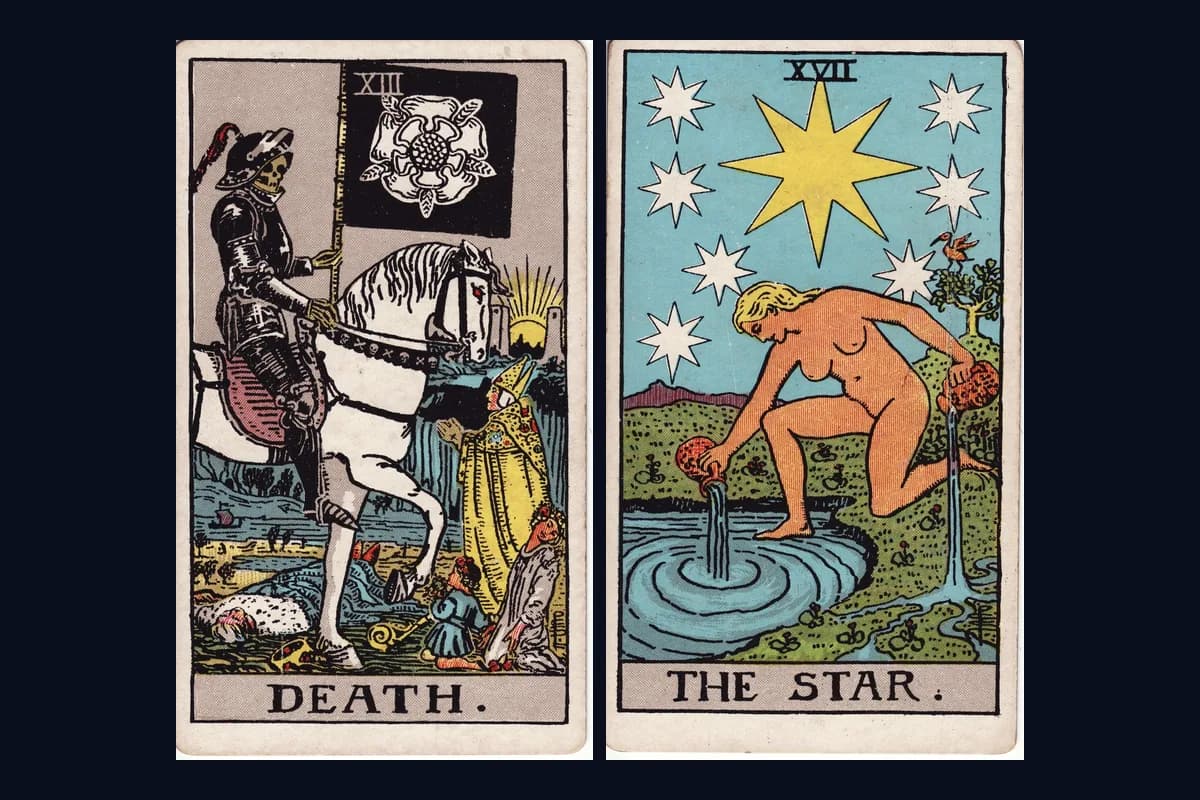
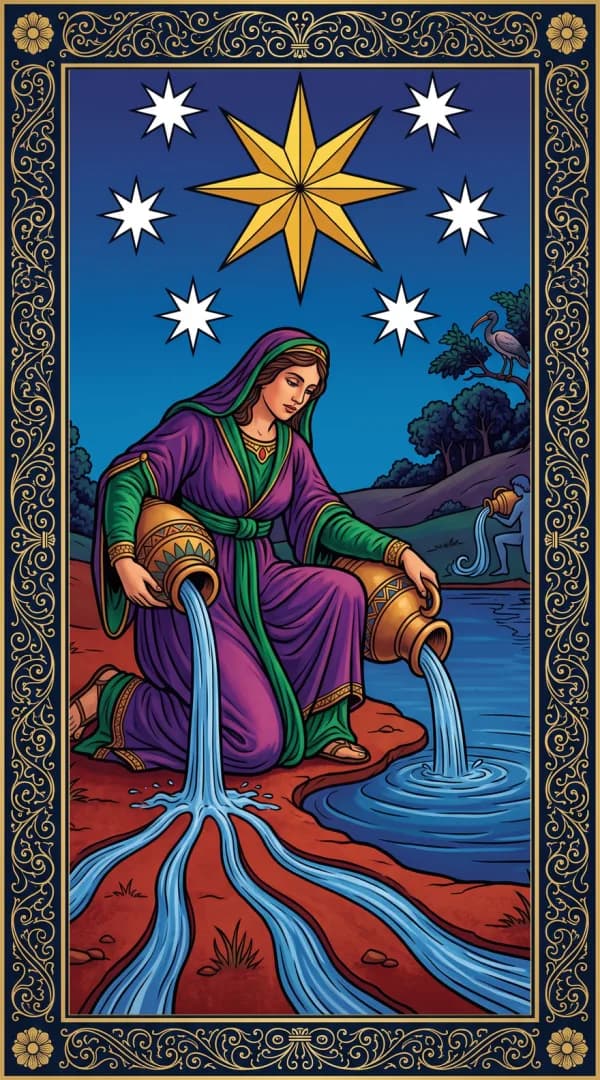
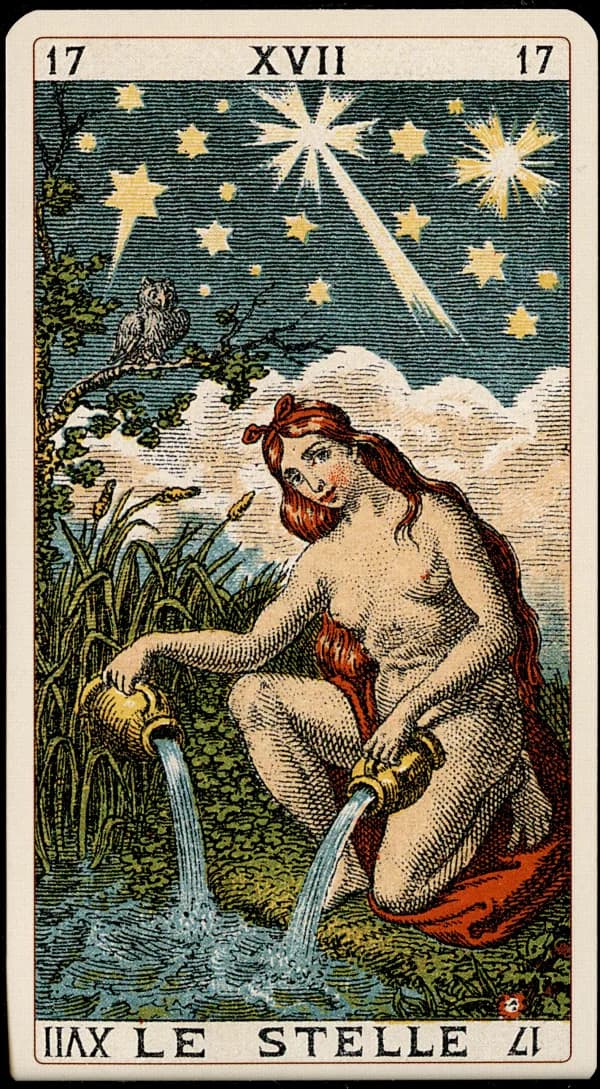
The sky is pale and clear. One big yellow star sits among seven small white ones. A naked woman kneels by a pool, one foot on the water, and pours from two red jugs: one into the pool, where rings spread out, and one onto the grass. Pollack spots the foot: "The maiden's foot does not penetrate the water." So the pool ripples only where the jug pours.
Behind her, Waite writes, is "a shrub or tree, whereon a bird alights," and Pollack takes it for an ibis. In readings, she says, the card "expresses hope, a sense of healing and wholeness, especially after emotional storms." The Golden Dawn gave the Star to Aquarius and to the Hebrew letter Tzaddi, meaning fish hook. Book T, the order's tarot manual, titles the card "Daughter of the Firmament, Dweller between the Waters." That's where the Six's passengers sit right now.
Six swords stand between the passengers and the shore. If you were the one under the hood, would you be watching the blades, or the land past them?
What the Six of Swords and the Star mean together
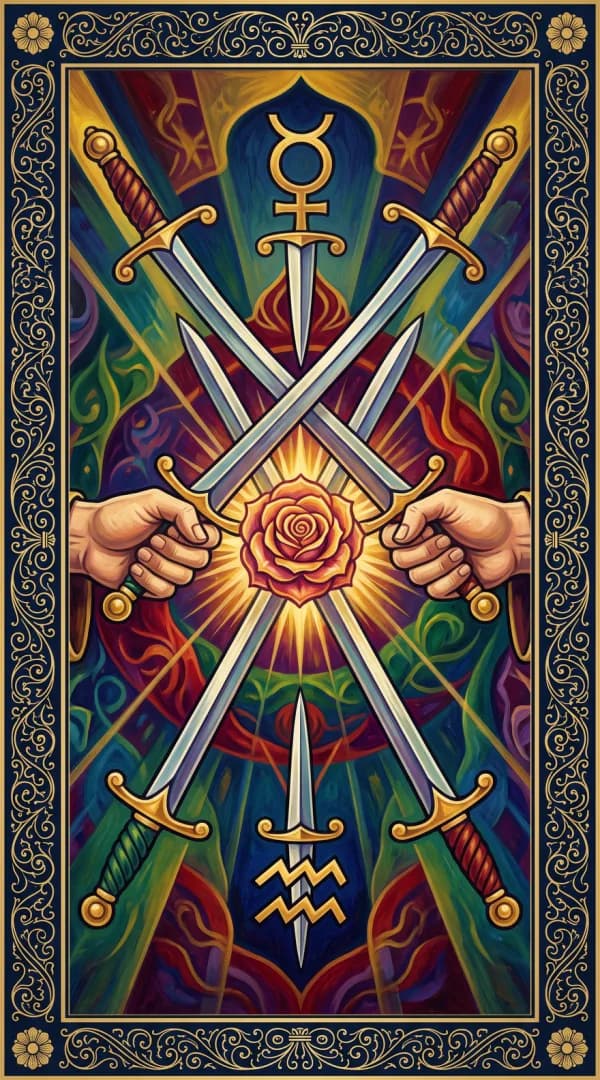
One sign holds both cards. In the Golden Dawn system, the Star is Aquarius and the Six of Swords is Mercury in Aquarius, the sign's middle ten degrees. So the Six, one of three Swords cards that split Aquarius, sits inside the Star's sign. The Golden Dawn Six below prints both glyphs: Book T asks for "Mercury and Aquarius above and below," and the two wavy lines at the card's foot are the Star's sign.
Both are Air cards too. Odd, for two pictures this full of water. T. Susan Chang, who writes on the decans, calls Aquarius "the air sign mistaken for a water sign." Across the pair, the water is choppy, smooth, still, poured.
This is a Major beside a Minor, so read it from above. The Star is the wide view, a stretch of your life turning toward recovery. The Six is the ground: the boxes, the notice period, the last drive past the old place. The bigger card sets the terms, so the move serves the recovery.
Little is written on this exact pair, but Chang, writing on the Six's decan, has the ferryman steer by the Star.
Put the two together and you get this: the crossing points toward calmer water, and some of the weight rides across with you. In the Tower and Star combination, the disaster comes to you. Here, you go.
So will it feel better on the other side? The cards picture it calmer. That isn't the same as fixed, and nobody in the boat is cheering. But neither card goes under. Pollack says the Six's troubles "will not sink us," and the Star's foot never breaks the water.
The Golden Dawn pair below has no boat. Its Six is two hands holding crossed swords around a rose, which Book T calls re-established. Robert Wang, author of The Qabalistic Tarot, reads it as the rose the Five of Swords tore apart, made whole. What the Five broke, the Six mends, and the Star waters.
The swords don't stay on the near bank. They make the crossing too. What are you carrying over that you hope to put down on the other side?
How the pair reads when you're deciding whether to go
In a Celtic Cross, Waite lets you pick the Significator, the card the spread is about, as the one "which has a meaning corresponding to the matter." For a move, that's the Six. Then watch what covers it. Waite's first card gives "the atmosphere of it in which the other currents work." With the Star there, the air around the whole move is recovery.
For relocation, the Six can be the move itself, and the Star says how the new place may feel, not what it costs. Tarot author Benebell Wen's rule for the Marseille Six is that Earth cards nearby point to "a physical change, such as a geographic relocation." With no Earth card here, the pair is as much the decision as the address. Not every move is chosen, and the Six doesn't blame you for needing this one. If the rent is pushing you out, the Five of Pentacles and Star combination reads that harder stretch.
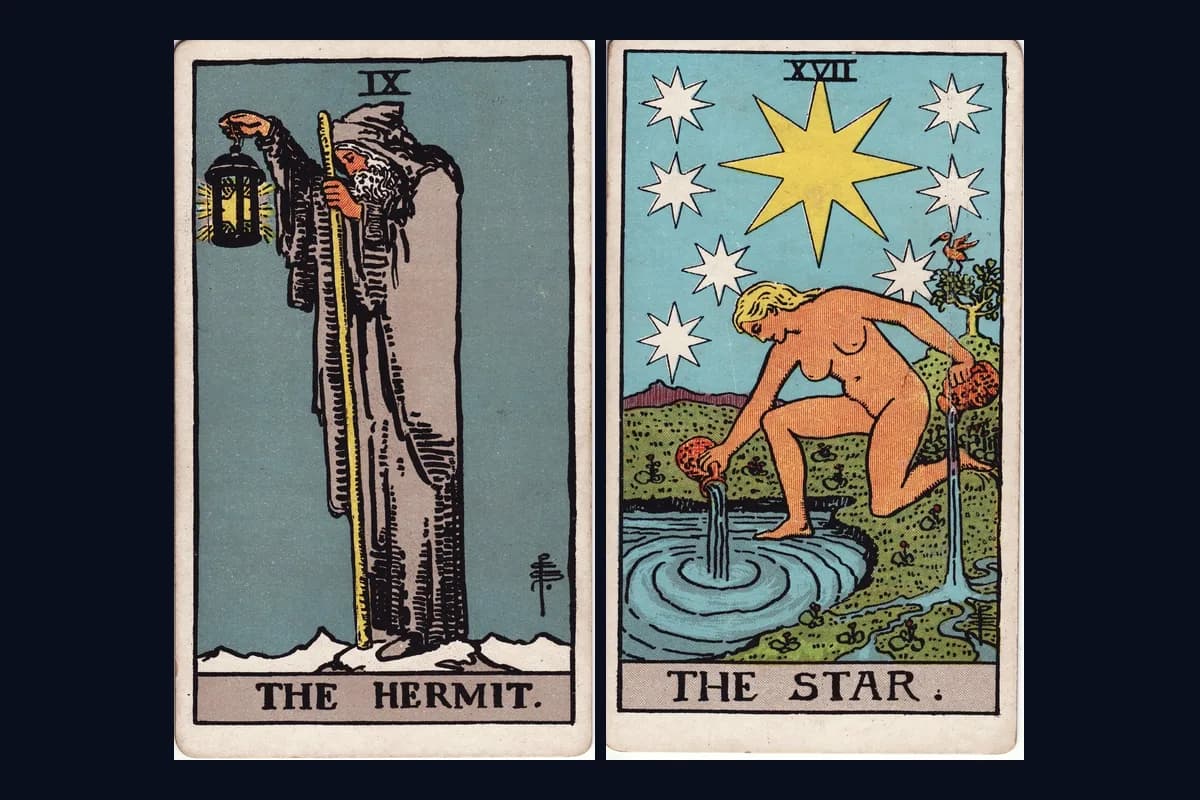
For travel, the Six is the trip and the Star is what it's for: rest. The pair favors going away to recover, but it doesn't forecast how the trip goes. The Hermit and Star combination is the retreat without the trip.
In love readings, the Six can mean leaving a relationship, or two people moving somewhere together. Tina Gong of Labyrinthos says the card "can signal a struggle is reaching its end." The Star is the open heart on the far side, and neither card says whether anyone returns. A heartbreak that's still sharp gets its own reading in the Three of Swords and Star combination.
Whether to leave someone is your decision. If you're afraid of the person you'd be leaving, that's a safety question before it's a tarot one, and a domestic violence hotline can help you plan a safe way out.
For career questions, the Six is the notice you hand in or the transfer to another city, and with the Star, your reason to work can come back. But the new boss is outside the frame. When leaving the job means losing who you were there, the Death and Star combination covers that slower recovery.
For health questions, the pair can turn up around a trip for care, or weeks of getting better somewhere new. Dreading the night before? See the Nine of Swords and Star combination. If you're traveling for treatment, a yes here is about your readiness to go, not whether the treatment is right. The cards are not a medical opinion, and if your question is about your body, talk to someone who went to school for it.
If you're asking yes or no: yes to the crossing, with the Six upright. Add an upright Star and it'll feel like relief more than a win. With the Six reversed, it's not yet, though the cards' timing doesn't apply if staying isn't safe or a doctor has set the date. Neither card names a date or promises how the new place turns out. And if you're crossing away from a person, the yes describes a direction. It's no verdict on them, and no order to you.
You know the shore you're leaving by heart. The one you're heading for is harder to picture. What do you see on your far bank? That image belongs in your deck.
The Six of Swords then the Star, or the Star then the Six
Six of Swords first, then the Star is the hopeful order: the crossing, then the shore. The reading stops where the boat does, and Pollack's Star pauses too: "For the moment, the journey can wait." Arrived, not finished.
The Star first, then the Six of Swords is the cautionary order. The pause came first, and now the boat is leaving. Maybe you've rested enough to go. Or a move is pulling you from a place that was just starting to feel like home. Wen sees the Six's passengers "trying desperately to grasp at the still point, without success." In this order, you've already found it. It's still a yes; now you carry it.
In a three-card spread of past, present and future, the seats are the shore you left, the water and the shore ahead. Six in the middle, Star last: you're mid-crossing, quiet ahead. Six first, Star in the middle: you've docked, and this is your first easy stretch over there. Star first, Six second: a rest is over and the trip has started.
Orientation matters too. Not every reader uses reversals. For those who do, a reversed Six is a crossing that stalls, and a reversed Star is hope that's hard to find. Theresa Reed of The Tarot Lady reads the reversed Six as a wait: "It may not be time to leave…yet." But that wait never means staying somewhere unsafe or putting off care.
| Orientation | Reading |
|---|---|
| Both upright | A crossing under way toward a calmer shore; expect relief more than triumph, with some weight riding along |
| Both reversed | The crossing stalls and you're running low; get help with what's holding you here, and rest when you can |
| Six upright, Star reversed | Moving out of necessity before you feel ready; the move counts, so plan the recovery too |
| Six reversed, Star upright | Hope is ready but the boat isn't; give the crossing time, unless staying isn't safe or care can't wait |
And if you've already left, no reversed card means go back; if you left someone you fear, a domestic violence hotline can help you stay safe. When the reversed Star sounds like the last few weeks, tell a doctor or someone you trust. If you ever feel you can't keep going, call or text 988 in the US.
In your spread, which came first, the boat or the pool? Are you crossing to find some rest, or rested enough to cross?
What the sky adds to this crossing
Aquarius is fixed Air, ruled by Saturn in traditional astrology. The Six's ten degrees of it, a decan, belong to Mercury, the planet of roads and messages. In Greek dress, Mercury is Hermes, guide of travelers, and Wen sees him in the Rider-Waite-Smith boat: "the archetype of Hermes with his staff, shapeshifting into that ferryman."
So the Six is the Minor Arcana child of two Major Arcana parents, the Magician (Mercury) and the Star (Aquarius). One parent sits beside it here; the Magician is the one missing from this pair. Chang adds a detail you can check: "It is the only minor card where airy Mercury rules an airy decan."
This is Air beside Air in elemental dignities, the Golden Dawn's rules for how neighboring cards strengthen or weaken each other. Greer puts it plainly: "two swords cards are like-minded and egg each other on." Readers extend that suit rule to a Major through its sign. Upright, both meanings are quiet ones, so what gets louder is relief.
Mercury enters Aquarius on January 13, 2027, and crosses the Six's own ten degrees from January 19 to January 25, 2027 (all in Universal Time). Draw this pair that week and the sky is running the same ferry.
And don't wait for a planet before you leave somewhere unsafe or travel for care. The sky can echo a crossing. It can't tell you when yours is safe to make.
Mercury carries messages as well as travelers. Before this crossing, who do you trust to know where you're going?
The card hidden in these numbers
Add the Six of Swords to the Star, 6 + 17, and you get 23. That's past the last Major Arcana card, so add the digits: 2 + 3 = 5, the Hierophant, the card of teachers and tradition. Every far shore has its own rules to learn.
Reduce the Star first and a different card turns up on the way. Wang and Pollack both fold the Star's 17 into 8, and 6 + 8 = 14. Temperance. Then 1 + 4 brings you back to the same 5. Adding two cards isn't a Golden Dawn rule; it's a habit of modern readers, so keep it only if it helps.
On Temperance, an angel stands with one foot on land and one in a pool, "pouring the essences of life from chalice to chalice," in Waite's words. So two water pictures add up to a third.
Behind the angel, a path climbs toward two mountains. Pollack notices what the Star lacks: it "shows no road leading back from the pool to the mountains of outer reality." But Temperance has one. "The road especially signifies return," she writes. In this reading, the three cards are the crossing, the rest and the walk back into ordinary life.
Every Six sits in Tiphareth, called Beauty, on the Golden Dawn's Tree of Life, a Kabbalistic map of ten spheres joined by twenty-two paths, one for each Major Arcana card. The Star's path runs down to Yesod, the Foundation, and Temperance's climbs from Yesod up to Tiphareth. The card hidden in these numbers is the road between them.
Are you still in the boat, resting at the pool, or already on the road back?
Questions readers ask about this combination
Does the Six of Swords and the Star mean it's time to move on?
Yes, when the Six of Swords and the Star are both upright. The Six is a crossing already under way, and the Star is the calmer shore on the far side. Expect relief rather than celebration, since the swords ride across too. The cards don't set a date or make the decision for you. If the partner or home you're leaving isn't safe, a domestic violence hotline can help you plan a safe way out.
Does the Six of Swords and the Star mean relocation or travel?
Often, yes. Waite's meanings for the Six of Swords open with "journey by water," and tarot author Mary K. Greer notes that Etteilla, an eighteenth-century French card reader, called it a path, passage or voyage. Beside the Star, it reads as a move or a trip toward somewhere you can rest, including travel for care. The cards are not a medical opinion, so plan that travel with your doctor. The cards can't pick the place or the date, either.
What does the Six of Swords reversed with the Star mean?
With the Six reversed and the Star upright, the hope is there, but the crossing hasn't started or has stalled. For Theresa Reed of The Tarot Lady, the reversed Six can mean it's too soon to leave. That's a wait, never a reason to stay somewhere unsafe, put off care or go back. Both reversed, the wait is heavier and hope feels far off, so get help, then rest. Not every reader uses reversals.
What element connects the Six of Swords and the Star?
Air, though both picture water. Swords are the Air suit, and the Golden Dawn gave the Six of Swords to Mercury in Aquarius, the sign's middle ten degrees. The Star is Aquarius, the fixed Air sign. Matching elements strengthen each other in elemental dignities, the Golden Dawn's rules for how neighboring cards affect one another. Those rules cover suits, but readers extend them to a Major through its sign, so when both are upright, the pair's relief grows stronger.
Is the Six of Swords and the Star a yes or no combination?
Upright, in either order, the Six of Swords and the Star say yes to the move, and the yes lands as relief more than triumph. With the Star reversed, it's still yes, but plan how you'll recover, since a new address won't bring hope back by itself. A reversed Six means not yet, though if staying isn't safe or care can't wait, the cards' timing doesn't apply. The answer comes with no date and no promised outcome.