Tarot Card Combinations
Death and The Star
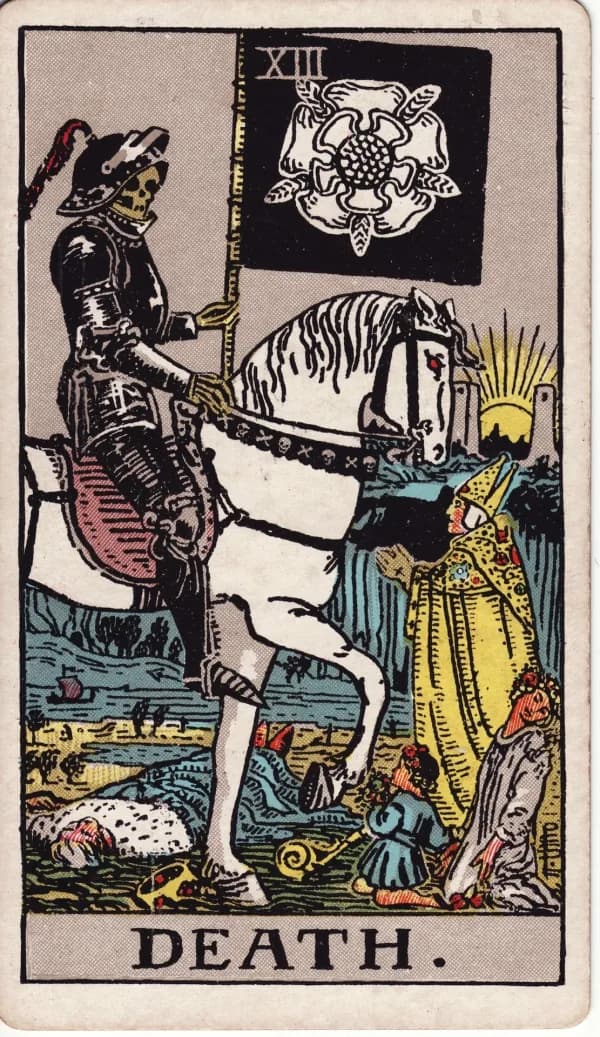
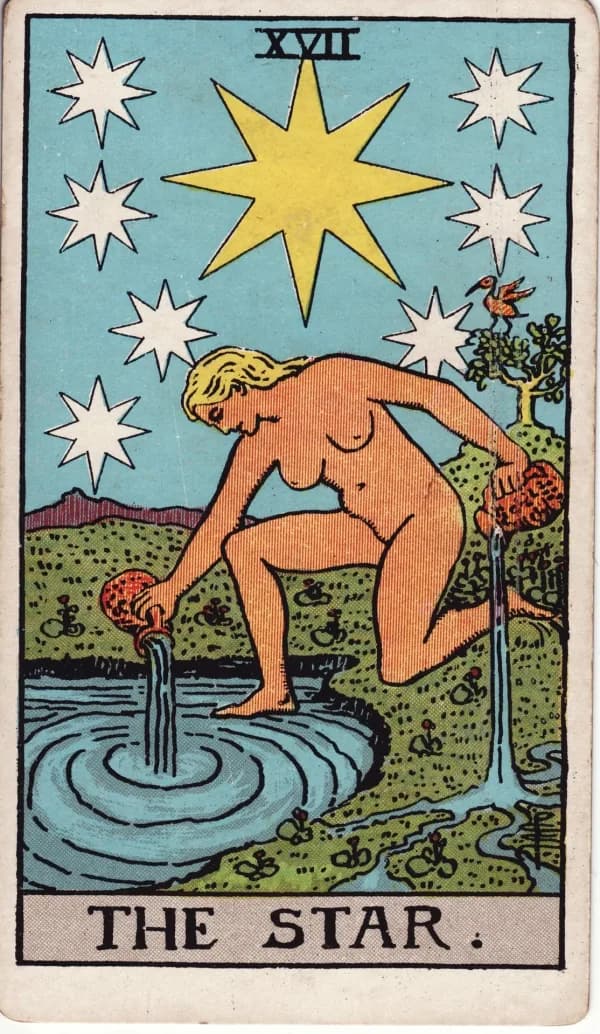
The Death and the Star tarot combination signals healing after an ending. Under a gray sky, a skeleton in black armor carries a black banner with one white rose. On the other card, the color comes back: a great yellow star in a blue sky, and a woman pouring water onto green grass. If Death made your stomach drop, that's the name doing it. The card isn't predicting anyone's death.

Climate scientist, ashtanga practitioner, and advocate for human rights and LGBTQIA+ equality.
What each card shows on its own
Look at the Rider-Waite-Smith Death card from the top down. The sky is flat gray. A skeleton in black armor, a red plume on his helmet, rides a white horse and holds up a black banner with one five-petaled white rose on it. There's almost no color up here.
The color sits low. A king lies fallen, his gold crown on the ground. A bishop in yellow robes faces the rider, a young woman turns away, and a child holds out flowers. Behind them a river with a small boat on it runs toward a sun between two towers. Rachel Pollack, author of Seventy-Eight Degrees of Wisdom, says the boat "symbolizes the true self carried through Death to a new life."
If the card made you think of a real death, notice where Pollack puts the danger. She reads Death as "a time of change," and its darkest side as this: "In its most negative aspect it indicates a crippling fear of physical death." The fear, not the event. And Aleister Crowley's note in The Book of Thoth is blunter: "Apparent death or destruction, but such interpretation is illusion."
Death is card XIII. The Golden Dawn, the magical order behind this deck's symbols, gave it Scorpio and the Hebrew letter Nun, which means fish. Hold on to the fish.
Older decks show this card another way. The Tarot de Marseille traditionally leaves XIII without a name, and its skeleton mows with a scythe. But A.E. Waite, who planned the deck Pamela Colman Smith drew, took the weapon away. His horseman, he wrote, "carries no visible weapon."
Now look at the Star (XVII).
The sky here is pale blue. One big yellow star shines over seven small white ones, all eight-pointed. A naked woman kneels with one knee on the grass and one foot on the water, pouring from two red jugs: one into a pool, one onto the land, where it runs off in thin streams.
Pollack sets her beside Temperance, the card right after Death. "Both cards come after a crisis," she writes, "but where Temperance is controlled the Star is free." The Star's woman "pours it out freely, confident that life will continually supply her with new energy." The Golden Dawn gave her Aquarius and Tzaddi, the Hebrew letter for a fish hook. Crowley's Thoth deck swapped in the letter He, so his Star doesn't carry a hook.
Pollack's little boat is still out on Death's river. The Star's woman is already kneeling at the water. Where are you right now: still on the river, or at the pool?
What Death and the Star mean together
Most pairs share a theme. These two share a hidden picture. Death is the fish and the Star is the hook. Robert Wang, author of The Qabalistic Tarot, puts them in one sentence, where the hook "is put into the waters" to "catch the fish" that stands for Death. What Death starts happens underwater, out of sight. The Star brings it up. In this picture, hope is the tool that gets you through the ending.
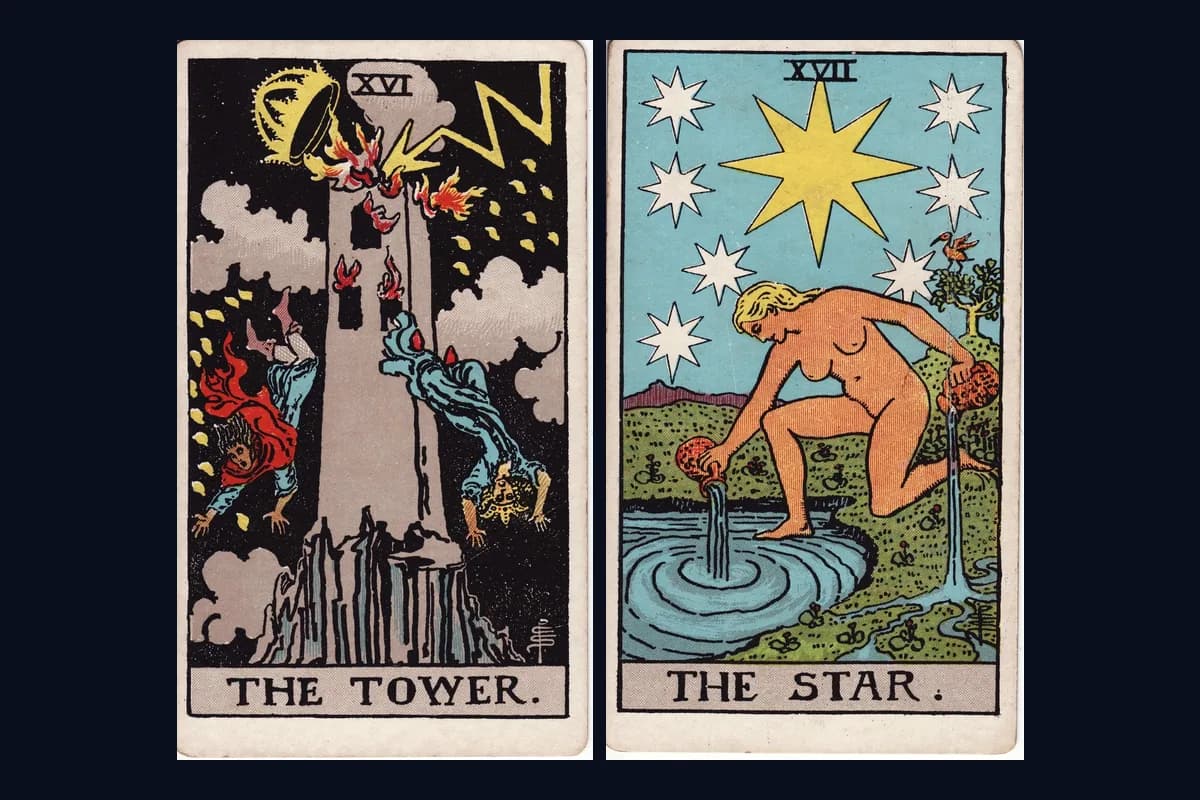
Both cards are Major Arcana, so this is a chapter of your life, not a bad week. In the Tower and Star combination, the cards are neighbors and nothing stands between the fall and the first light. Here the deck sets Temperance, the Devil and the Tower in between. But that doesn't mean more trouble is coming. Recovery from this kind of ending takes a stretch of road.
Brigit Esselmont of Biddy Tarot starts her list of tarot cards for healing with Death, then the Star. Her reason for Death: "One of the first steps of healing is to acknowledge that something has come to an end."
The ending stays an ending, and healing starts anyway. The Star doesn't undo what Death closed. She pours water on the ground it left.
There's a catch in the Star's own meanings. Book T, the Golden Dawn's tarot manual, lists "deceived hope" as her other side. Hope pointed at what comes next belongs to the Star. Hope that the ending can be undone is the deceived kind. But wishing it hadn't ended is human, even if it isn't what she's pouring.
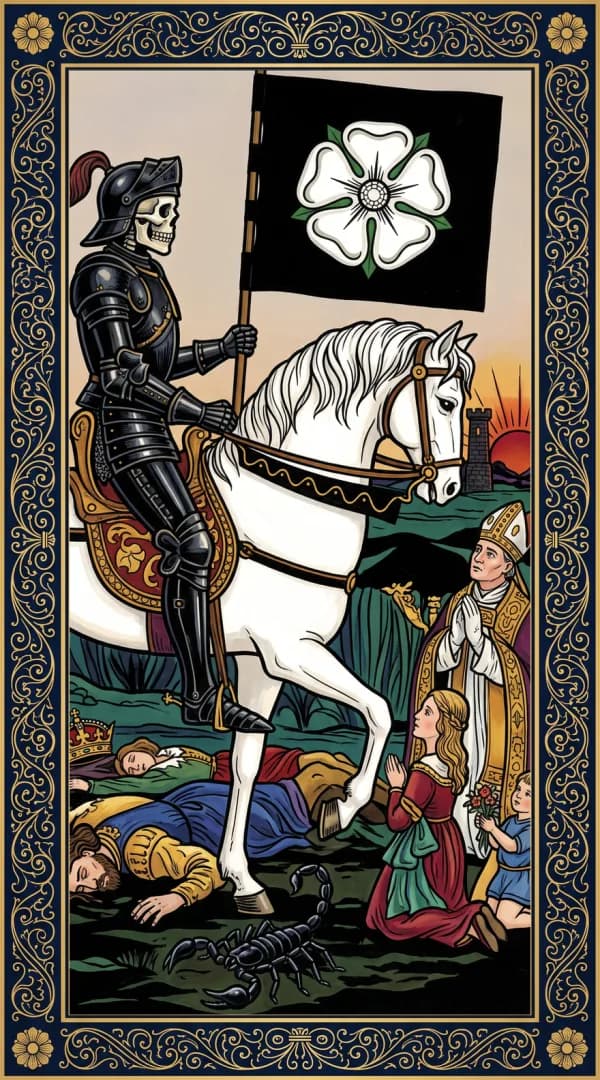
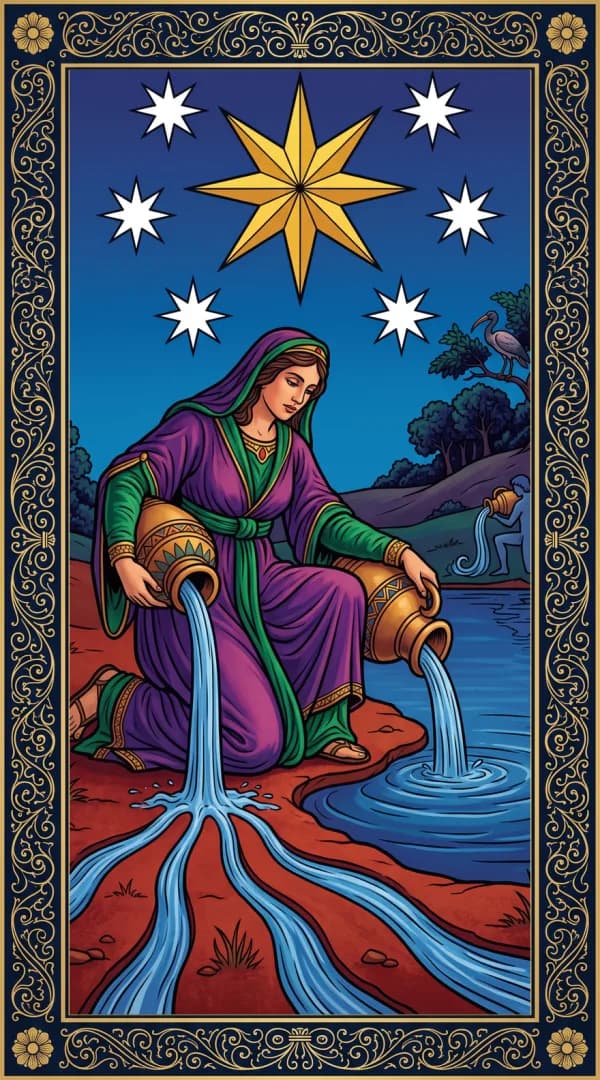
On the Golden Dawn Death below, the sun sits low beside a dark tower, and a black scorpion, Scorpio's creature, crawls under the fallen men. On the Star beside it, the sky has gone a deep night blue, and a gold eight-pointed star hangs right over her head. The light that sat on Death's horizon is now above her.
How far has the light climbed for you since the ending?
How this pair reads in your own situation
In a Celtic Cross, read the near-future card and the outcome together. Pollack describes the near future as "some situation that the person will soon have to face." Death there, Star as outcome: a hard ending is close, not final. Such a reading, she writes, can help someone "come through a difficult time by reassuring him or her that it will not last." If that ending means moving away, the Six of Swords and Star combination reads the move itself.
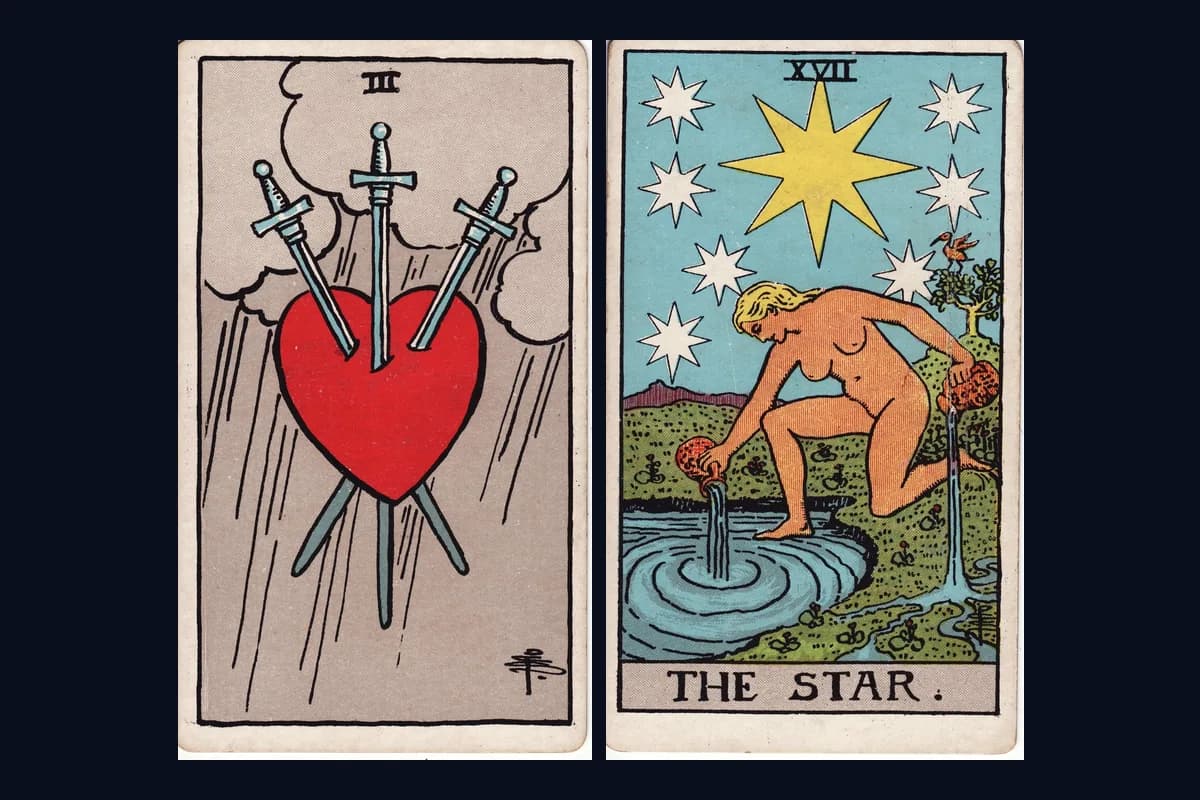
In a love reading after a breakup, Death is the ending, whoever chose it. The Star is the first evening you make plans that are only yours. Look how crowded Death's card is. The Rider-Waite-Smith Star has room for one. The pair doesn't say whether you'll reunite, and if you did, it wouldn't be the relationship Death closed. If the hurt is still sharp, the Three of Swords and Star combination stays closer to the heartbreak.
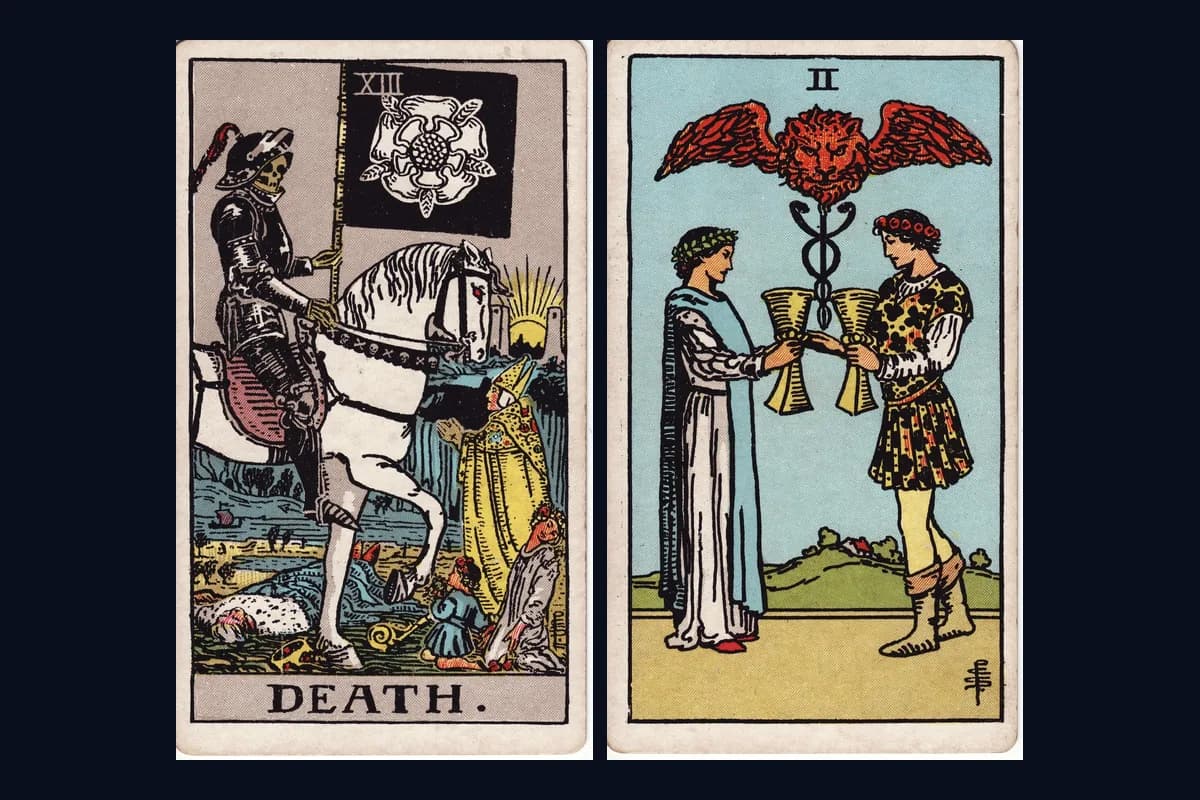
If you're still together, Death can end an old pattern, not the relationship, and the Star is you two steadying afterward. Asking whether it's ending or deepening? Read the Death and Two of Cups combination.
Drawn as feelings, the pair shows someone who sees a chapter as finished and feels calmer. But whether that calm includes you, the cards don't say.
For grief after a death, or the fear that this card foretells one: Death in a reading doesn't predict anyone dying. If the loss has already happened, the card can stand for it, but the pair isn't saying it was meant to happen, and it isn't putting a date on your grief. The Star doesn't replace anyone. She kneels by the water and keeps pouring.
For career reinvention, Death is the layoff, resignation or outgrown field, title and all. The Star won't pay your rent. She gives direction before there's a plan. If the layoff has put the rent itself in doubt, the Five of Pentacles and Star combination stays with that harder stretch.
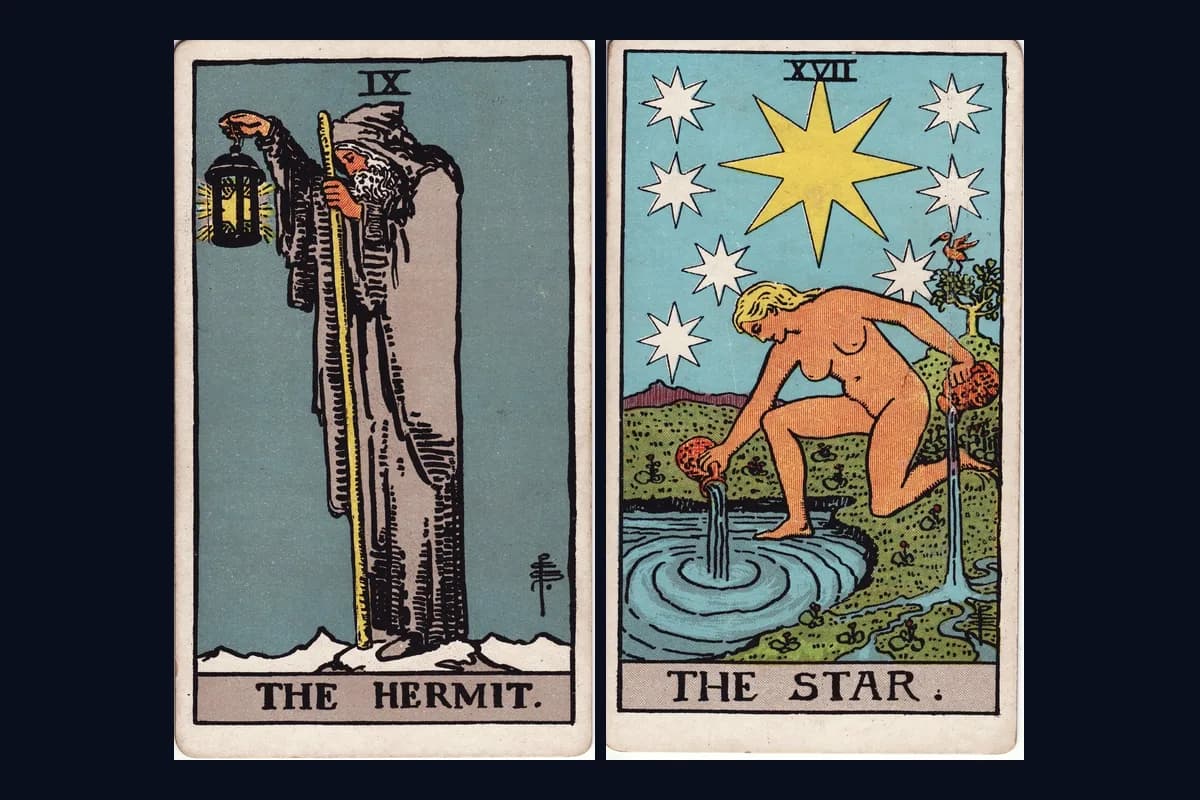
Spiritual rebirth shows in what the figures wear: black armor, then nothing. Whatever you've been guarding comes off. If you'd rather set it down alone, read the Hermit and Star combination.
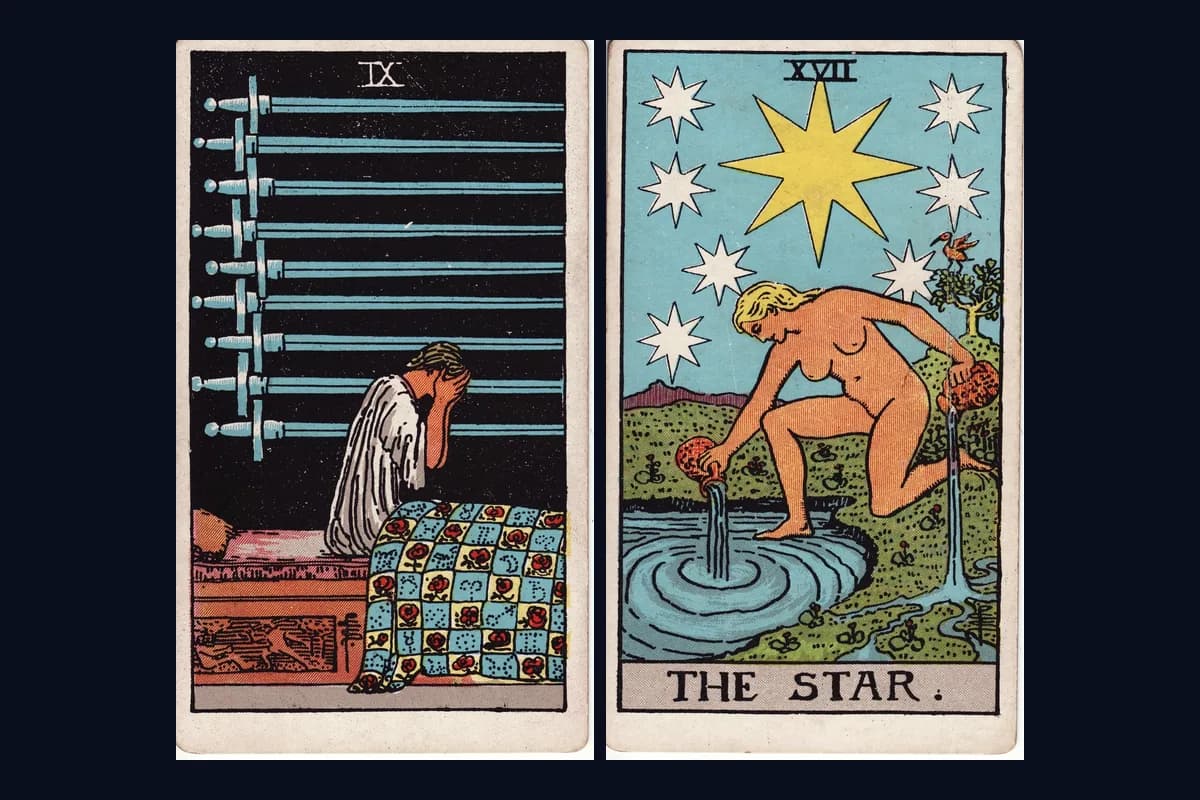
For health questions, the Star doesn't promise a cure, and Death isn't a diagnosis. Read the pair as the fear around an illness and the hope that keeps you going. Fear that costs you sleep has its own pair: the Nine of Swords and Star combination. The cards are not a medical opinion, and if your question is about your body or someone else's, talk to someone who went to school for it.
If you're asking yes or no, it depends on the question. Will this get easier? The pair leans yes, on its own schedule. Will things go back to how they were? Death says no, and the Star doesn't argue. With the Star first, that yes is closer to not yet, which isn't no.
Death's banner carries one white rose. If yours held the one thing you'd keep from this ending, what would it be, and what's the first color you'd want back? That image belongs in your deck.
How card order and reversals change the reading
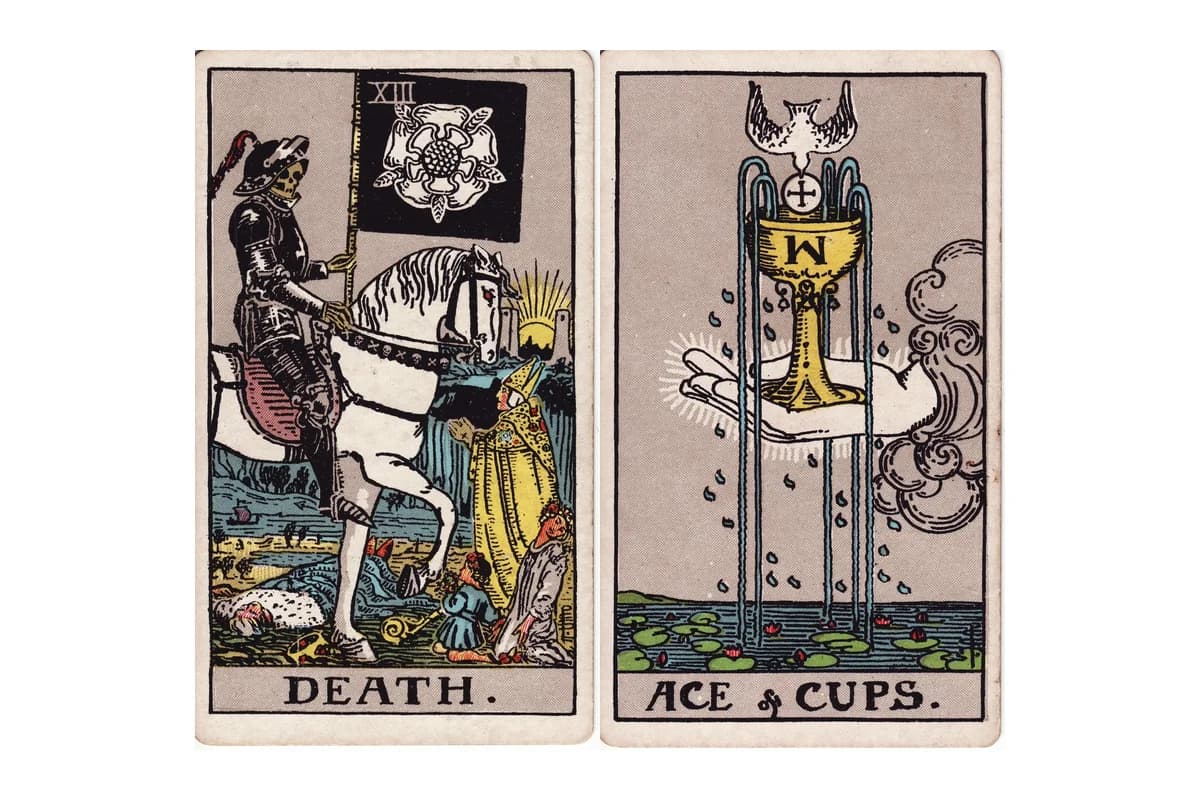
Death first, then the Star: the deck's own order, XIII toward XVII, and the hopeful one. You face the ending, and hope comes after it rather than in its place. If a rush of new feeling follows your ending, the Death and Ace of Cups combination reads that version.
The Star first, then Death: the cautionary order. A hope comes before an ending, and sometimes it means exactly that. But on the Tree of Life, the Kabbalistic map of ten spheres whose paths the Golden Dawn gave to the Major Arcana, the deck's order flips. Climb from the bottom and you reach the Star's path before Death's.
Wang writes that "on the Path of Tzaddi we begin to develop the tools of Creative Imagination which are required to tread the difficult Path of Nun." That's Death's path. In this order, the Star is the tool you pack for it.
In a three-card spread of past, present and future, Death in the past with the Star in the present puts the worst of the ending behind you. With Death now and the Star ahead, stay with what's ending and don't rush it. With Death in the past and the Star in the future, the middle card is the stretch you're in. If it's one the deck sets between them, Temperance means a slow middle, the Devil a habit still tying you to what ended, the Tower something else coming down before the calm.
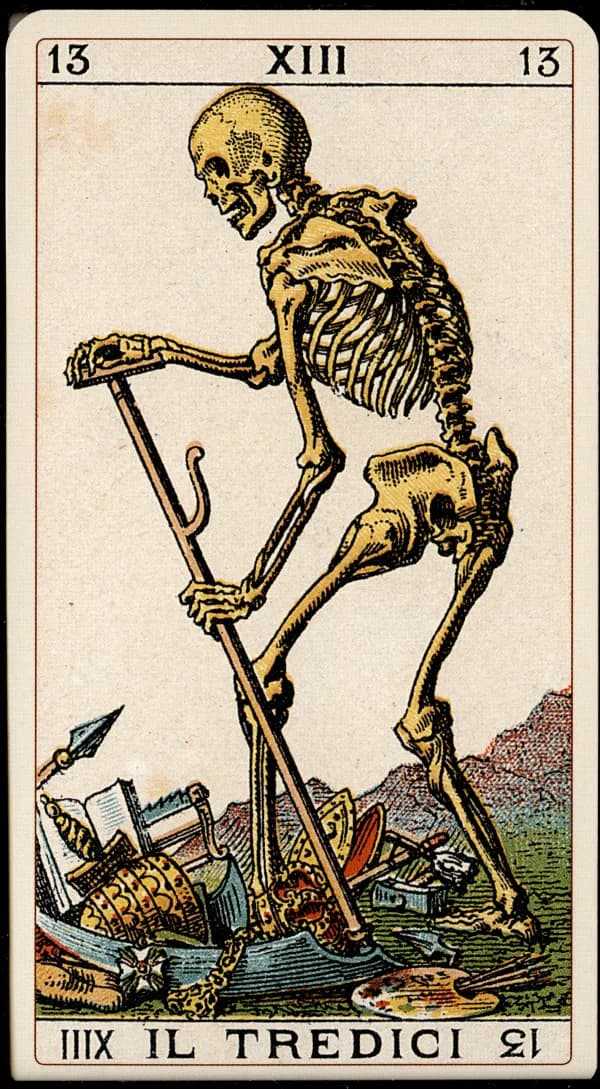
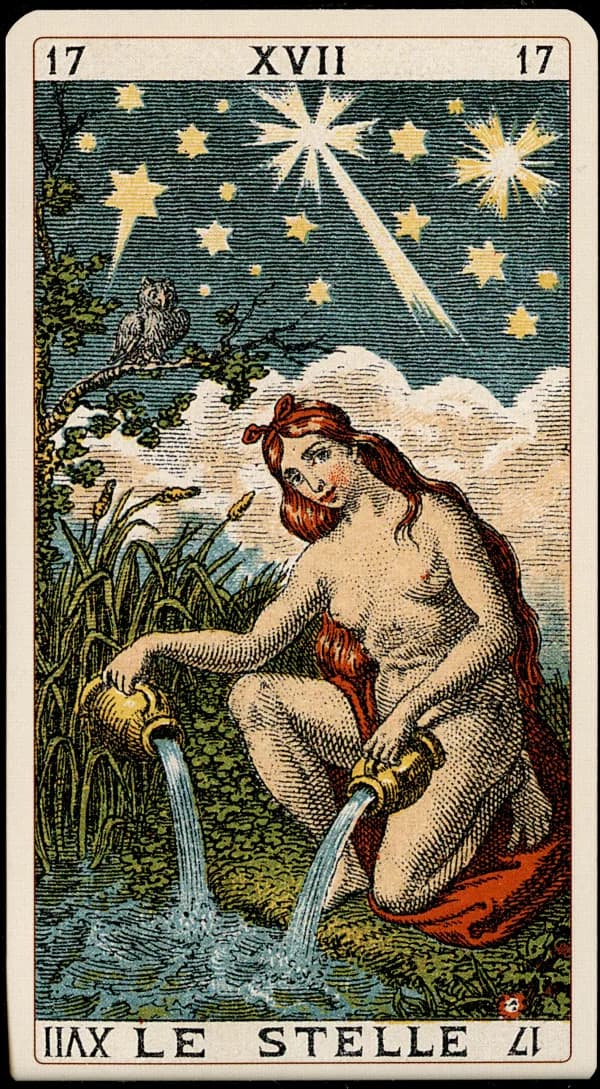
The Milanese Death below goes by its number, Il Tredici, the Thirteen. Its skeleton leans on a scythe over a heap of things people build lives around: a crown, a book, a saw, a painter's palette. The pile holds roles, not people.
Orientation matters too. Not every reader uses reversals. For those who do, a reversed Death is an ending slow to finish or hard to let go of, and a reversed Star is hope that's hard to feel:
| Orientation | Reading |
|---|---|
| Both upright | An ending that's real and a calm that follows; recovery is under way, with no date attached |
| Both reversed | Not ready to let go of what ended, with hope far off; you're stuck for now, and it's a time to lean on people |
| Death upright, Star reversed | The ending has happened, but you can't picture anything after it; that's grief talking, not the future |
| Death reversed, Star upright | Hope is already here while the ending finishes, or while part of you still holds on to what ended; point the hope at what comes next |
If hope has stayed out of reach for weeks, tell a doctor or a counselor. And if this ending ever leaves you not wanting to be here, call a crisis line or your local emergency number now.
Whichever card came first, what hope are you carrying, and is it pointed forward or back?
What the sky adds to this recovery
Death belongs to Scorpio and the Star to Aquarius. Scorpio is fixed Water, ruled in traditional astrology by Mars, and Aquarius is fixed Air, ruled by Saturn. Mars cuts. Saturn builds, slowly.
Fixed signs hold their shape, and these two sit three signs apart: a square, the angle astrologers read as friction.
But in elemental dignities, the Golden Dawn's rules for how neighboring cards strengthen or weaken each other, this is Water beside Air. Book T says, "Air is friendly with Water and Fire." Mary K. Greer, laying out the same rules on her blog, puts Water with Air one step below full friends, where neither card turns the other up or down by much. The grief doesn't cancel the hope. And the hope doesn't rush the grief.
The Golden Dawn gave Scorpio's three decans (ten-degree slices) to the Five, Six and Seven of Cups. The first, the Five, is Mars in Scorpio: the Lord of Loss in Pleasure. The second, the Six, is the Lord of Pleasure, and Book T's meaning for it starts with "Commencement of steady increase, gain and pleasure, but commencement only." That's early healing, described honestly.
The Moon is full in Scorpio on April 20, 2027, and again on May 20, 2027 (both in Universal Time). Mars, Death's own planet, enters Scorpio on September 2, 2027 (Universal Time), starting in that Five of Cups decan. If you pull this pair on one of those dates, the sky is keeping you company. It isn't setting the date you heal.
What do you still need to feel before you can think it through?
What grows out of these numbers
Add Death's 13 to the Star's 17 and you get 30. No Major Arcana card carries that number. So keep going: 3 + 0 = 3. The Empress.
In the Rider-Waite-Smith deck she wears a crown of twelve stars, with ripe wheat at her feet, falling water behind her and the sign of Venus on a heart-shaped shield. She's the card of things that grow. Pollack points Death her way: "Since 13 is a higher form of 3 the card also recalls the Empress." And when Pollack lays out the numbered Major Arcana in three rows of seven, the Star lands in the Empress's column: "The Star appears below the Empress and the Wheel." Some readers put weight on patterns like these; others don't.
Reduce each card first and you get there another way. Death's 13 becomes 4, the Emperor. The Star's 17 becomes 8, Strength in the Rider-Waite-Smith deck. Add them: 12, the Hanged Man. Keep reducing and 1 + 2 is 3 again. At one digit, the two routes always meet, so look at the stop on the way.
The Hanged Man is the card right before Death. He hangs upside down from a living tree, going nowhere, and Waite says his face shows "deep entrancement, not suffering." The figure, Waite adds, suggests "life in suspension, but life and not death." His Hebrew letter is Mem, water: the same water where Wang's hook goes to catch Death's fish. The numbers reach the Empress, but only by way of the pause.
What would you want growing in the ground Death cleared?
Questions readers ask about this combination
Does Death and the Star mean things will be okay?
Death and the Star lean toward yes, with a condition. With Death first, the pair reads as an ending, then healing, with no date attached. It doesn't say that what ended comes back. With the Star first, a hope you hold now meets an ending still to come, and that hope is what you carry through it.
Does Death and the Star mean someone is going to die?
No. In a reading, Death points to the end of something in your life, such as a relationship or the way you've seen yourself. Rachel Pollack puts the card's darkest meaning in the fear of death, not the event. The Star beside it is recovery. The cards are not a medical opinion, so if you're worried about an illness, talk to someone who went to school for it.
What does Death and the Star mean in a love reading?
In a love reading, Death and the Star describe an ending and the recovery after it. After a breakup, Death is the ending, whoever chose it, and the Star is the first stretch of feeling like yourself again. The pair doesn't forecast a reunion. If you're still together, Death can end an old pattern rather than the relationship, and the Star is the two of you steadying afterward.
What does it mean when Death and the Star are both reversed?
With Death and the Star both reversed, you may not be ready to let go of what ended, and hope feels far off. You're stuck for now, not for good, and it's a time to lean on people. Not every reader uses reversals. If hope has stayed out of reach for weeks, tell a doctor or a counselor, and if you ever find yourself not wanting to be here, call a crisis line or your local emergency number.
Is Death and the Star a yes or no combination?
With Death and the Star, the answer depends on the question you bring. Will this get easier? The pair leans yes, on its own schedule. Will things go back to how they were? No: what Death ends stays ended, and the Star doesn't argue. If the Star comes first in your spread, that yes is closer to not yet, which still isn't no.