Tarot Card Combinations
Three of Swords and The Star
The Three of Swords and the Star tarot combination signals heartbreak with hope already in the same reading. Gray rain slants past a red heart. Three swords run through it, and nobody holds them. Then the sky clears. Under a yellow star, a woman kneels at the water's edge and pours from two jugs. Will it always hurt like this? Your cards show which way it's moving. Not when.

Climate scientist, ashtanga practitioner, and advocate for human rights and LGBTQIA+ equality.
Each card on its own
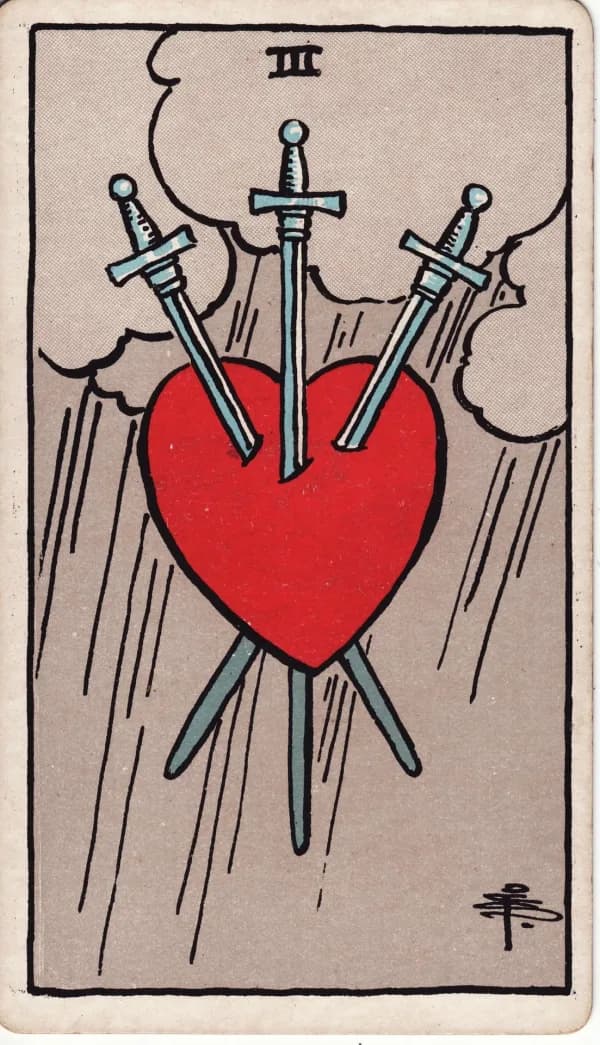
Look at the Rider-Waite-Smith Three of Swords. There's nobody on it. A red heart hangs in a gray sky with three swords through it. Clouds bulge in from the top and sides, and thin rain falls.
A.E. Waite, who planned the deck Pamela Colman Smith drew, described the card in nine words: "Three swords piercing a heart; cloud and rain behind." His divinatory meanings stop after six words, "Removal, absence, delay, division, rupture, dispersion," the rest being "too simple and obvious to call for specific enumeration." Notice one word on that list. Delay. It's a word about time.
Rachel Pollack, author of Seventy-Eight Degrees of Wisdom, finds something gentler in the image: "Yet, for all its gloom, the picture brings a certain calm in the symmetry of its swords." The Golden Dawn, the magical order whose system shaped this deck, titled the card the Lord of Sorrow.
The Sola Busca deck, engraved in Italy in 1491, already runs three swords through a heart much like the one on Smith's card, under a clear sky. But she added the clouds and rain. If you're asking whether this hurt lasts, notice that the part she added is the part that can clear.
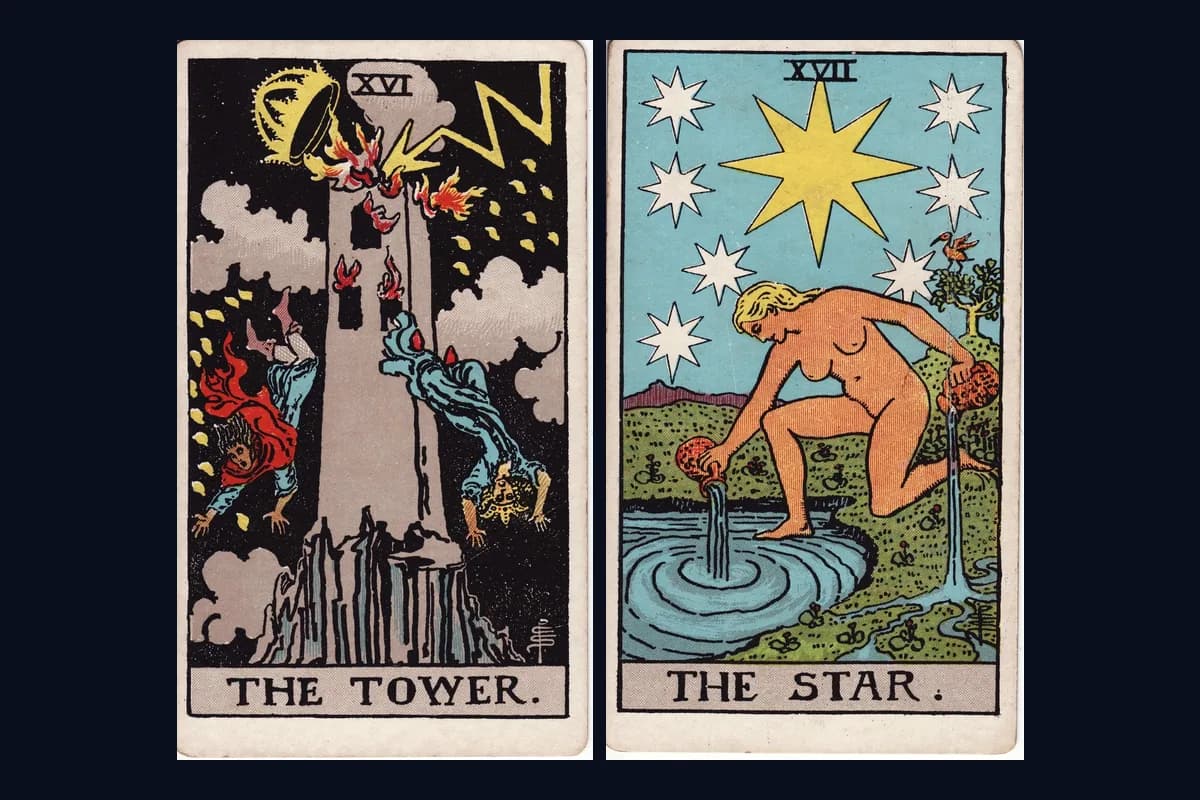
Now look at the Star (XVII).
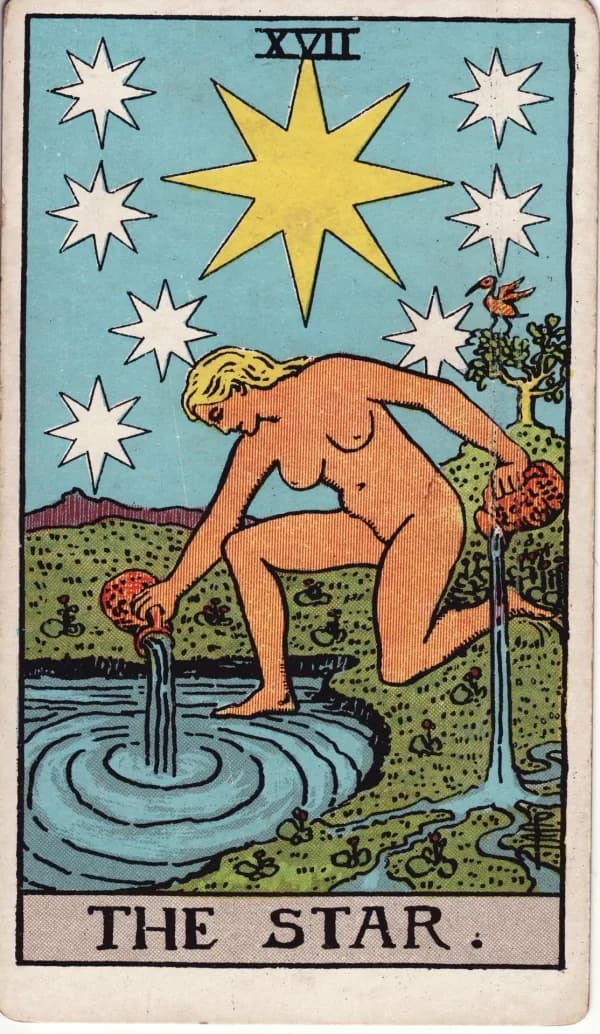
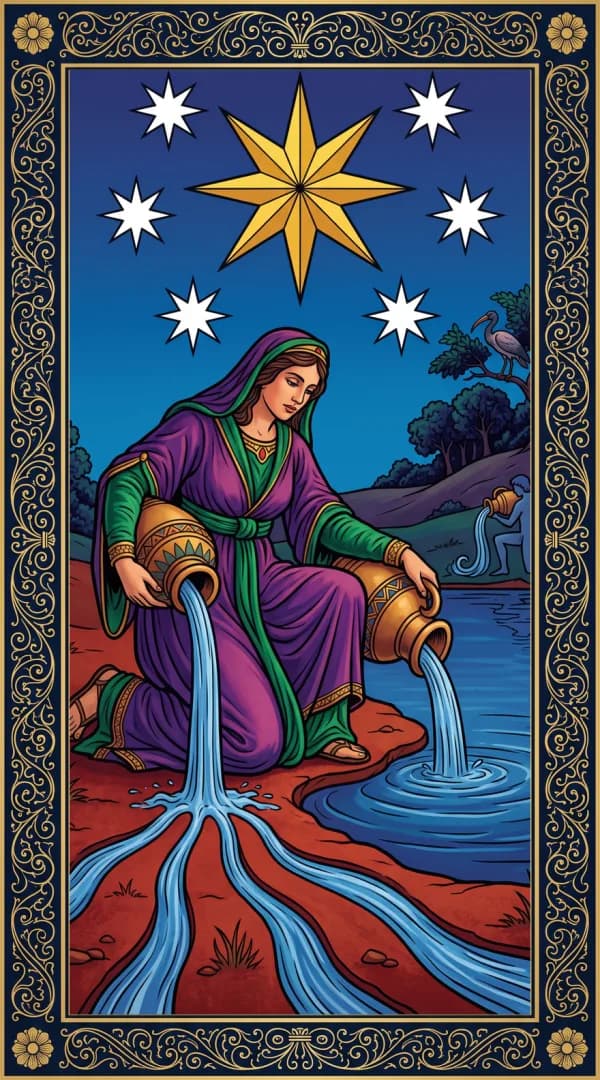
A big yellow star hangs in a clear sky, with seven small white ones around it. Below, a naked woman kneels at a pool, one knee on the grass and one foot on the water, tipping one jug into the pool and the other over the bank.
The Golden Dawn gave the Star to Aquarius, the water bearer, and to the Hebrew letter Tzaddi, a fish hook. Waite sounds tired of the obvious reading: "The summary of several tawdry explanations says that it is a card of hope." Pollack is warmer: the card "expresses hope, a sense of healing and wholeness, especially after emotional storms." Emotional storms. And the other card in this pair is one.
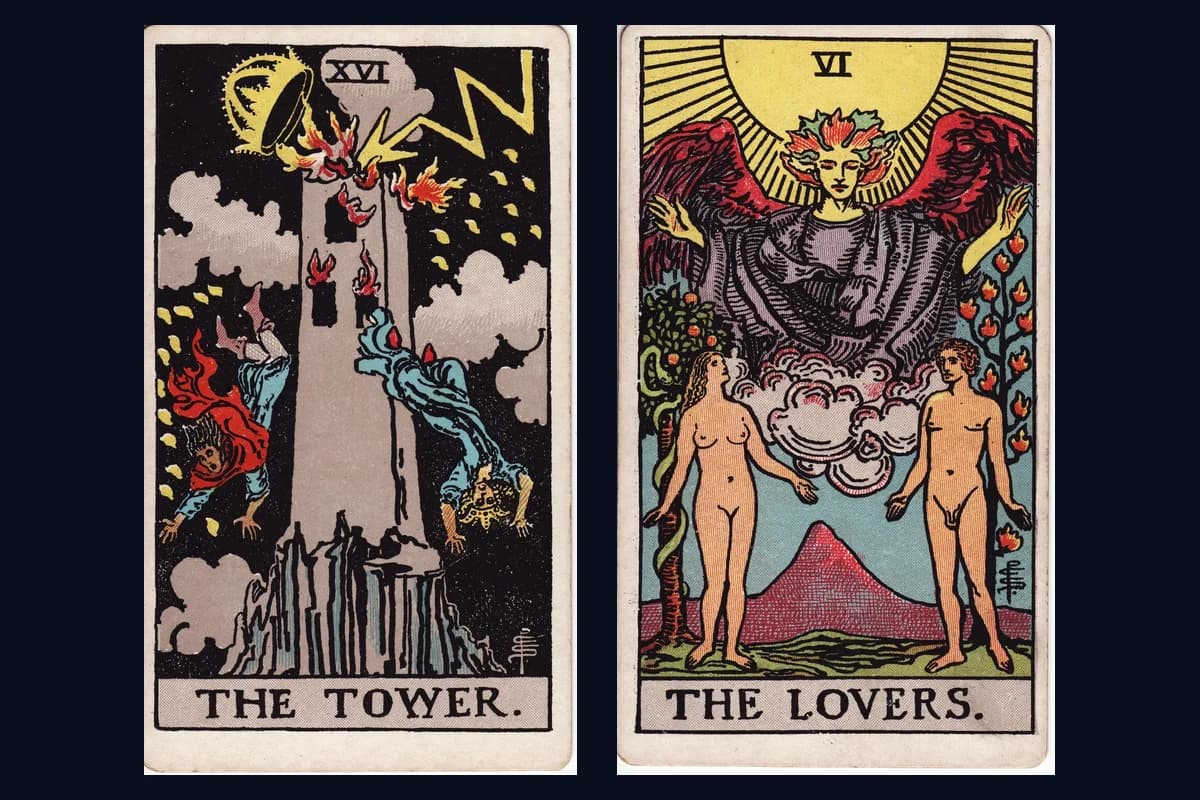
In the Major Arcana the Star follows the Tower, and the Tower and Star combination tells this story with everything falling at once. This pair tells it through one wounded heart.
Look at the rain behind the heart, then at the water in the woman's hands. Which is closer to you now: the rain, or the water you could pour?
What the Three of Swords and the Star mean together
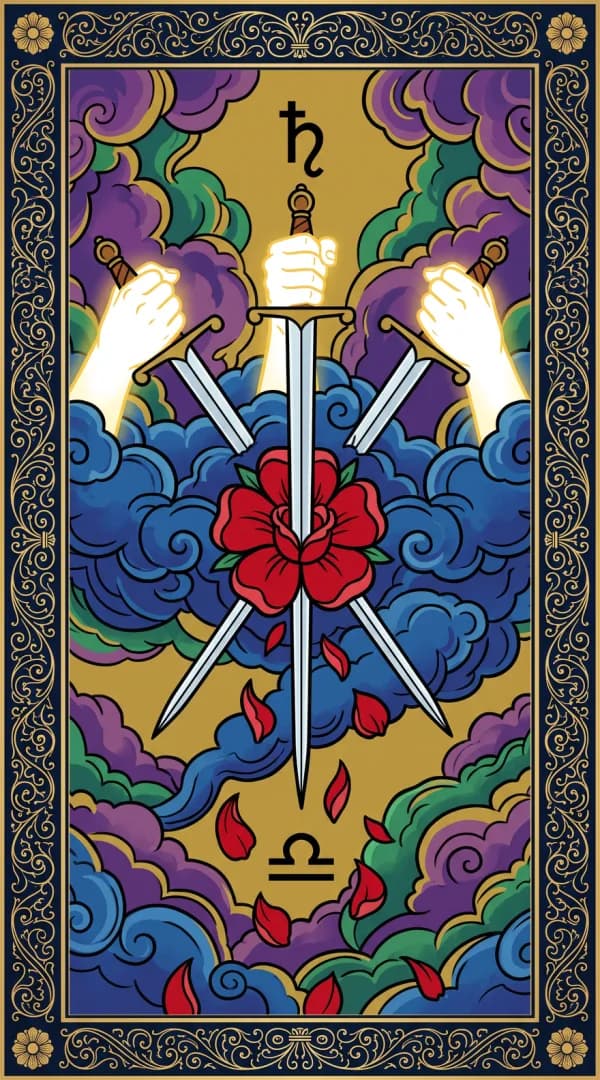
These two cards look like opposites, but the same planet stands behind both. The Golden Dawn put the Three of Swords under Saturn in Libra, and its card below prints both glyphs. The Star belongs to Aquarius, which traditional astrology also gives to Saturn (modern astrologers pick Uranus). "In the ancient world, Saturn was said to govern Aquarius," Robert Wang writes in The Qabalistic Tarot. Saturn is the planet of time, limits and slow work.
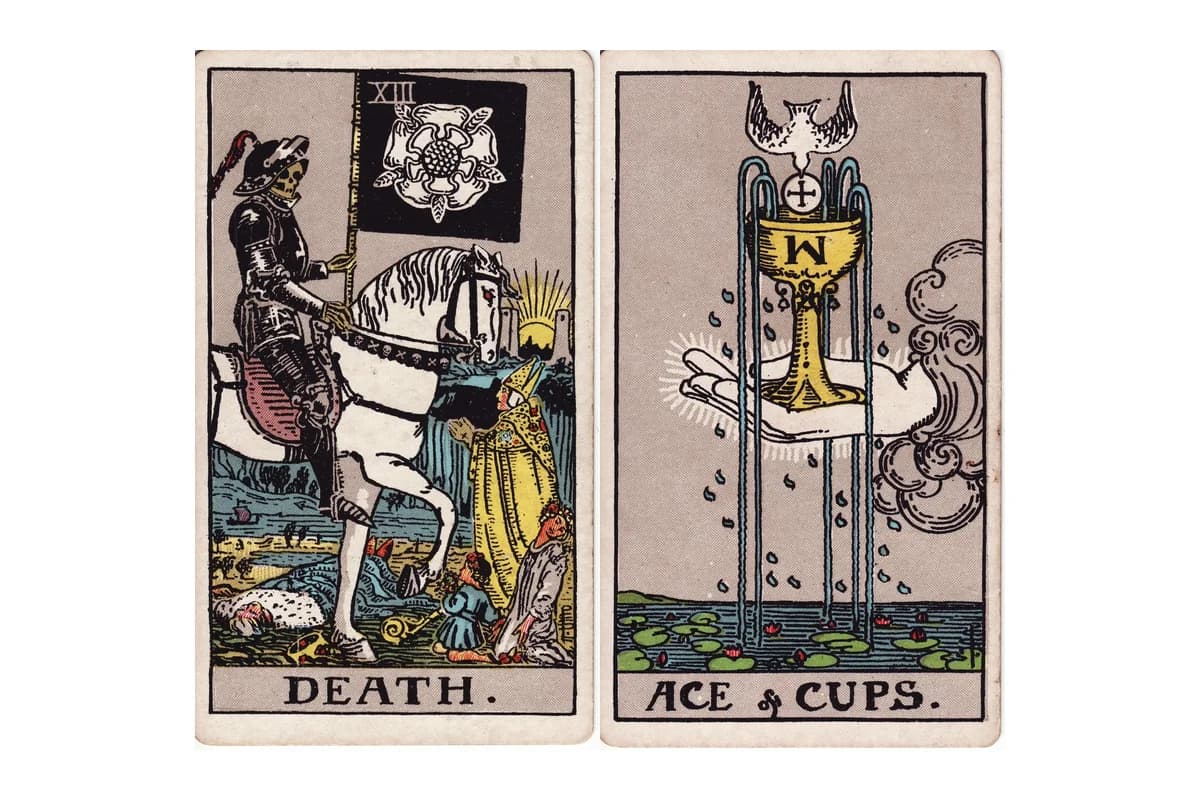
This is also a Major beside a Minor. In what readers call the helicopter view, the Major is the aerial picture and the Minor the detail on the ground. Here the big picture is hope, and the Three of Swords is what happened inside it. That doesn't make the pain small, only specific. The Death and Ace of Cups combination runs the other way, with the ending as the big picture.
Little has been written about this exact pair. The closest comes from Pollack, who uses both cards to explain the Celtic Cross position of hopes and fears. With the Three of Swords there, she reads a fear of heartbreak that "has prevented the necessary emotional commitment." A hopeful card there, "such as the Star or the Six of Wands (both cards that mean hope)," shows that "the person's attitude can create success." This pair holds both halves: the fear of being hurt again, and the hope that keeps you open.
The Star doesn't wait for the Three of Swords to finish: hope turns up while it still hurts. You can cry on the way to work and still notice the light on the way home.
So is the pain temporary? The pair leans yes, but it can't tell you when. The Three of Swords is real hurt, and nothing on the Star takes that back. If your heartbreak is grief for someone who died, the pain may soften without ever fully leaving. The Star doesn't ask it to.
The Golden Dawn Three of Swords below is harsher: three hands reach out of storm clouds, and their blades cut a red rose whose petals fall. On the Rider-Waite-Smith pair, nobody holds the swords and the Star's woman kneels alone, so neither card shows a couple. The pair names the hurt. But no card can say who caused it or who comes back.
Where are you hurting and hoping at the same time?
What this pair says in each kind of reading
In a Celtic Cross, Waite's second position lies across the first and shows "the nature of the obstacles in the matter." A good card there gets two readings: "the opposing forces will not be serious," or "something good in itself will not be productive of good in the particular connexion." So with the Star crossing the Three of Swords, either little stands in your way or hope is the complication. If it's hope, maybe you want one ending (an apology, a reunion) so badly that it keeps the wound open. Point that hope at what you can change.
In a three-card spread of past, present and future, the Three of Swords in the past with the Star in the present puts the sharpest part behind you, even on days it doesn't feel that way. The Three in the present with the Star ahead means you're in the middle of it. The Star before the Three reads harder: the hurt lands in a hopeful stretch, and the hope is still real.
In love readings after a breakup, the Three of Swords is the night it ended. The Star is the morning you notice you didn't wake up thinking about them, even in a week that still hurts. Neither card promises they'll come back. Tina Gong of Labyrinthos advises that you "give yourself time before you attempt to find love again."
If you're still together, the Three can be a fight, or words that landed harder than anyone meant. The Star is the hope of getting through it, if you both want to. Gong notes that in the worst case, "since this card is a three, it can also point to a third party creating trouble in your relationship." Treat that as a question, not a verdict: the cards can't tell you whether anyone cheated, and if you suspect something, talk about it. When the hurt comes from a truth surfacing, the Tower and Lovers combination looks at that moment of discovery.
For grief after a death, go gently. Pollack once read for herself after losing a family member, and the Three of Swords came up crossed by the Three of Cups: "Looking deeper into the reading, I saw the two as connected, not opposed." The Star can sit beside your Three the same way. Nothing in this pair sets a pace.
For career questions, the Three is often something said: a rejection, a review that stung. The Star is the nerve to put yourself forward again.
For health questions, the pierced heart is a symbol, not a diagnosis. The cards are not a medical opinion, and if your question is about your body, talk to someone who went to school for it. If the hurt has kept you from sleeping, eating or getting through the day, tell a doctor or a counselor. And if it ever turns into not wanting to be here, call a crisis line now.
If you're asking yes or no, it depends on the question. Will the hurt ease? With the Three first, the pair leans yes. With the Star first, it's not yet, which isn't no. Will someone come back? It doesn't say, in either order.
If you designed your own Star for this stretch of your life, what would she hold instead of two jugs? That image belongs in your deck.
The order you drew them in changes the story
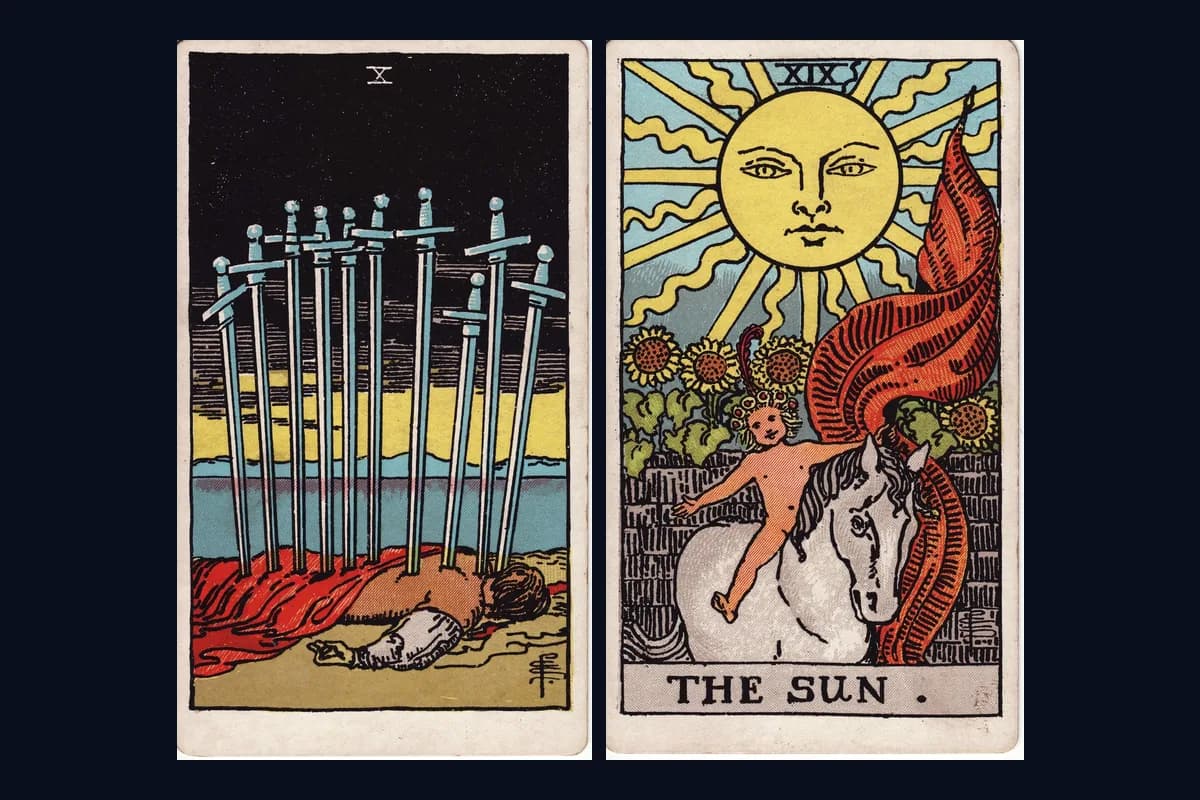
Three of Swords first, then the Star is the hopeful order: the storm, then the clear sky. Pollack's advice is to let the pain all the way in, and some people hear that as a test to pass before they can feel better. It isn't. In this order the Star can show up on a bad day. Hit rock bottom? Read the Ten of Swords and Sun combination.
The Star first, then the Three of Swords is the cautionary order. A hope meets a hurt. That can be a hope about to be tested. Or it can be one running ahead of a loss you haven't had room to feel yet. But neither reading predicts a betrayal, and neither makes the hope foolish.
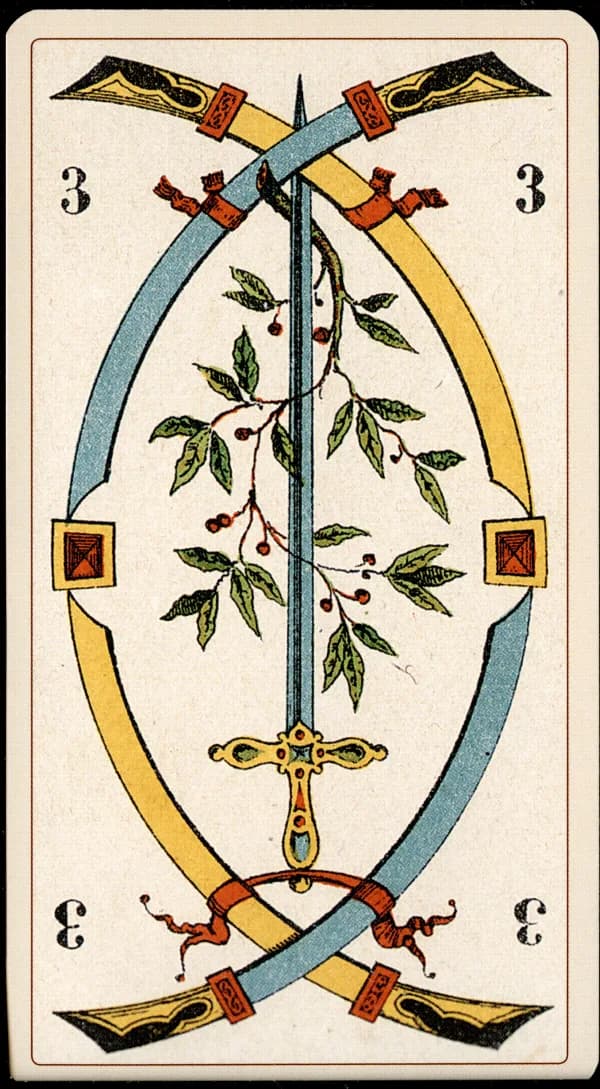
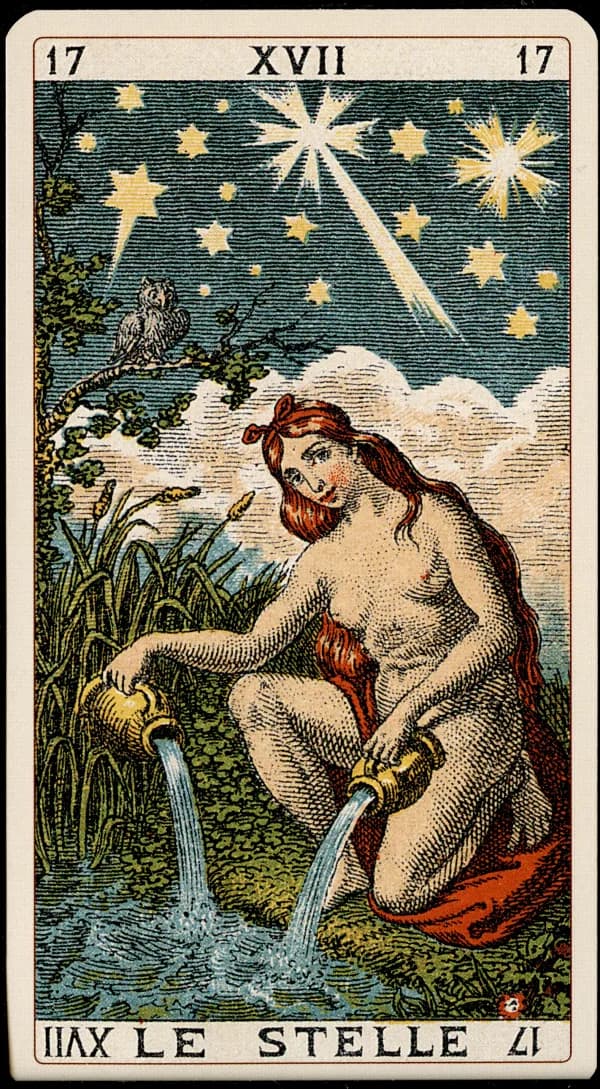
The Milanese pair below shows no pain at all. Its Star is labeled Le Stelle, the Stars. Its Three of Swords is a pip card: two curved blades around a straight one, with a leafy branch growing through the gap. You can read that branch as something still alive inside the blades.
Orientation matters too. Not every reader uses reversals. Those who do mostly read a reversed card as blocked, delayed or turned inward rather than canceled. The reversed Three splits them, though. Some see pain loosening its hold. Pollack sees pain pushed away: "The healing process becomes blocked when we fight acceptance." The Star beside the Three usually decides which, as the rows show.
| Orientation | Reading |
|---|---|
| Both upright | A fresh hurt felt in full, with hope already beside it; card order shows which is louder now |
| Both reversed | Grief pushed away and hope hard to reach; slower, not stuck for good, and a time to lean on people |
| Three upright, Star reversed | A new hurt while the Star's water feels far off; the hardest row, and a reason to let people help |
| Three reversed, Star upright | Older pain loosening its hold and hope easier to feel; the most hopeful of the four, though loosening isn't the same as gone |
Whichever card came first, what has felt even a little lighter since this started?
The planet and element both cards share
Saturn is strong in both cards' signs. Libra, the Three's sign, is where Saturn is exalted, meaning honored and working well. And Aquarius, the Star's sign, is one of Saturn's two traditional homes. Both cards are Air, too. Swords are the Air suit, and Aquarius is an Air sign even though its figure carries water. Aleister Crowley swapped the Star's Hebrew letter in his Thoth deck but kept the card in Aquarius, so his Star stays Air.
Book T, the Golden Dawn's tarot manual, sets out elemental dignities, its rules for how neighboring cards affect each other. Cards of the same suit on either side of a card "strengthen it greatly," for good or evil. Readers extend that rule from the suits to a Major through its sign, so here it's Air beside Air. The Star doesn't dilute the hurt, and the hurt doesn't dim the Star.
A decan is a third of a sign, ten degrees wide. The Golden Dawn gave Libra's three decans to the Two, Three and Four of Swords, titled in order the Lord of Peace Restored, the Lord of Sorrow and the Lord of Rest from Strife. Sorrow sits between a peace and a rest.
Wang reads Saturn here as a correction: "Saturn throws the scales of Libra off balance in order that they may be rebalanced in a better way." He's describing a planet. Why you lost what you lost is a different question.
Saturn turns direct on December 10, 2026 (Universal Time), after months of apparent backward drift. Astrologers read it as slow work moving forward again. On August 17, 2027, the Full Moon in Aquarius, the Star's sign, brings a penumbral lunar eclipse so faint that, by NASA's figures, most people won't notice any shading. A shadow crosses Aquarius and the light holds. But your grief keeps its own calendar.
What has stayed steady for you through this?
Three plus seventeen
Add the Three of Swords to the Star and you get 20. That's Judgement.
Count it out. From the Star, three steps take you past the Moon (18) and the Sun (19) to Judgement (20). Pollack reads the Star, Moon and Sun as one stretch: "In between, filled with strangeness, lies the Moon." So the numbers don't let hope skip the strange part.
On Judgement, an angel sounds a trumpet and the figures below rise to answer it. Waite's meanings are short: "Change of position, renewal, outcome." Adding a Minor card's number to a Major's is a modern reader's habit, not Golden Dawn doctrine, so hold it loosely.
Reduce 20 and you get 2, the High Priestess, the quiet card hidden inside loud Judgement. Pollack ties her to the Star: its pool, she writes, is "that same water we saw concealed behind the pillars of the High Priestess." The Star's woman kneels at the water the High Priestess kept hidden and pours her own into it.
Behind all of it sits Binah, Understanding, the third of the ten spheres on the Kabbalistic Tree of Life. The Golden Dawn placed every Three there, and it's also Saturn's sphere. Crowley's Three of Swords shows Binah at her darkest, "the darkness of the Great Sea." His Star pours her liquor where the land meets "the water of the great Sea of Binah." And Waite called the Star's woman "the Great Mother in the Kabalistic Sephira Binah," though the Golden Dawn's own Tree puts the Star far below Binah. Still, the storm and the water come from one sea.
Judgement is three cards past the Star, and you don't have to be there yet. When you get there, what will be calling you?
Questions readers ask about this combination
Does the Three of Swords and the Star mean the pain is temporary?
The Three of Swords and the Star lean toward yes, especially with the Three first: the hurt is real, and hope is already in the same reading. The pair can't give you a date, and it doesn't promise that anyone comes back. Grief after a death may soften without ever fully leaving. If the pain is stopping you from sleeping, eating or getting through the day, talk to a doctor or a counselor.
What does the Three of Swords and the Star mean in a love reading?
In a love reading, the Three of Swords and the Star describe a real heartbreak and the hope of healing from it. In the Rider-Waite-Smith deck, neither card shows a couple: the Three has no people at all, and the Star has one. The pair is about how you heal. No card can tell you whether someone comes back or whether anyone was unfaithful.
What does it mean when the Three of Swords and the Star are both reversed?
With the Three of Swords and the Star both reversed, grief is pushed away and hope feels hard to reach. Readers who use reversals mostly take a reversed card as blocked or delayed, so the pair reads as slower, not stuck for good. It's a time to lean on other people. Not every reader uses reversals.
What element connects the Three of Swords and the Star?
Air connects the Three of Swords and the Star. Swords are the Air suit, and the Golden Dawn gave the Star to Aquarius, an Air sign, even though its figure pours water. Crowley kept Aquarius on his Star too, so the pair stays Air in both systems. The Three's decan, the middle third of Libra, belongs to Saturn, and Saturn is Aquarius's traditional ruler, so one planet stands behind both cards.
Is the Three of Swords and the Star a yes or no combination?
The answer from the Three of Swords and the Star turns on two things: what you asked and which card came first. On whether the hurt will ease, the pair leans yes with the Three first, and says not yet with the Star first. On whether someone will come back, the pair is silent in both orders, and no card can answer for another person.