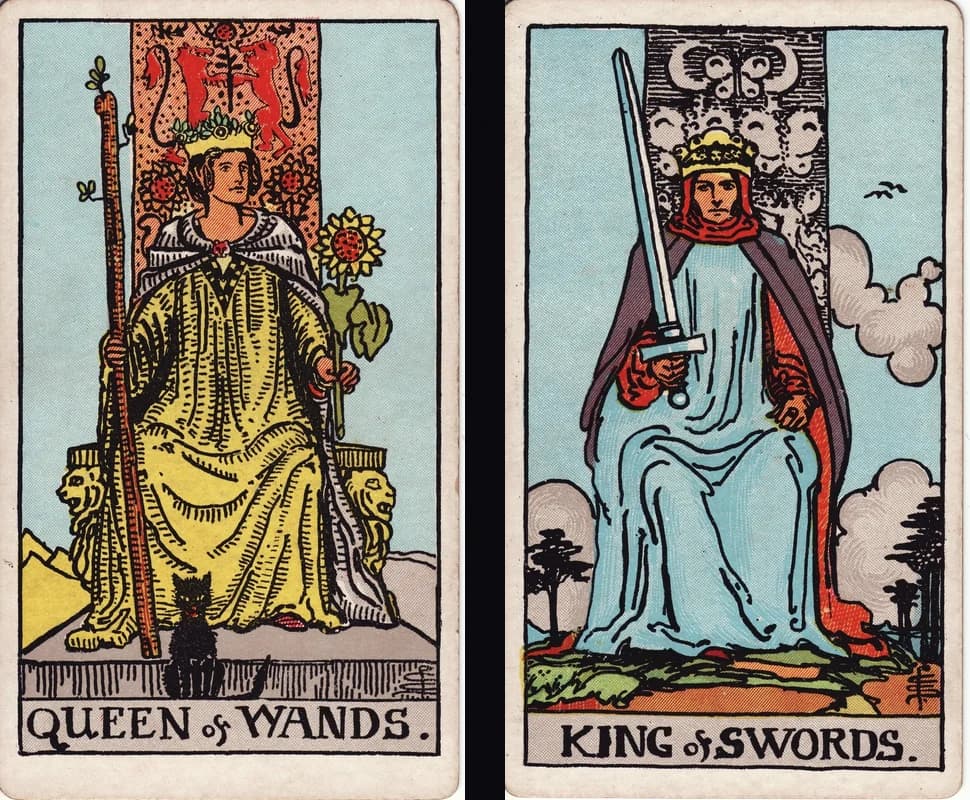
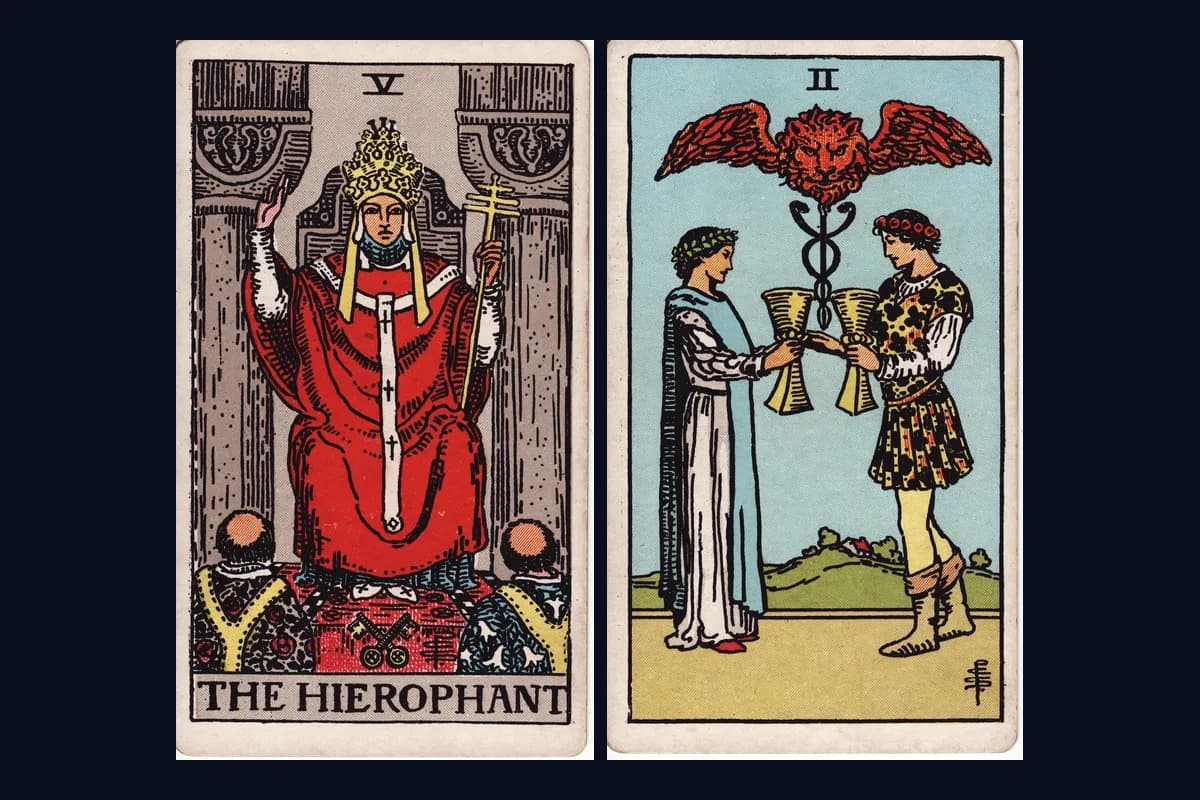
Tarot Card Combinations
Ten of Swords and The Sun
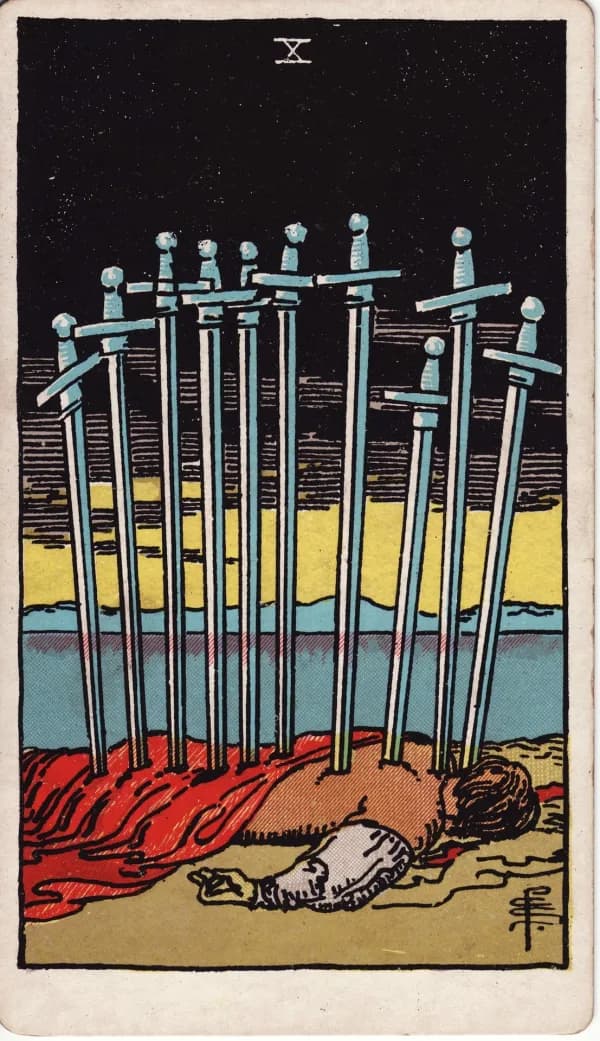
The Ten of Swords and the Sun tarot combination signals rock bottom with the light already in view. A man lies face down under a black sky, ten swords in his back. Only the horizon is yellow. On the next card, that yellow is a huge sun over a naked child on horseback, arms open. If you're asking whether this is the bottom, look where the light starts.

Climate scientist, ashtanga practitioner, and advocate for human rights and LGBTQIA+ equality.
What each card shows before you pair them
Start with the Rider-Waite-Smith Ten of Swords. The top half of the sky is solid black. A man lies face down with a red cloth over him and ten swords standing in a line down his back. You can't see his face. Look lower. Under the black, a band of yellow light runs along the horizon, over water lying flat and calm.
A.E. Waite's Pictorial Key to the Tarot, his illustrated guide to the deck, gives the card a hard list: "pain, affliction, tears, sadness, desolation." Then comes a line that's easy to miss. "It is not especially a card of violent death." Rachel Pollack, author of Seventy-Eight Degrees of Wisdom, looked past the swords to the horizon, where "the sky clears in the distance, the black clouds give way to sunshine."
The Golden Dawn, the magical order behind the deck's symbolism, titled the card the Lord of Ruin. As a Minor card, it has no Hebrew letter of its own. But the order gave it a planet. You'll meet it next.
Now look at the Sun (XIX).
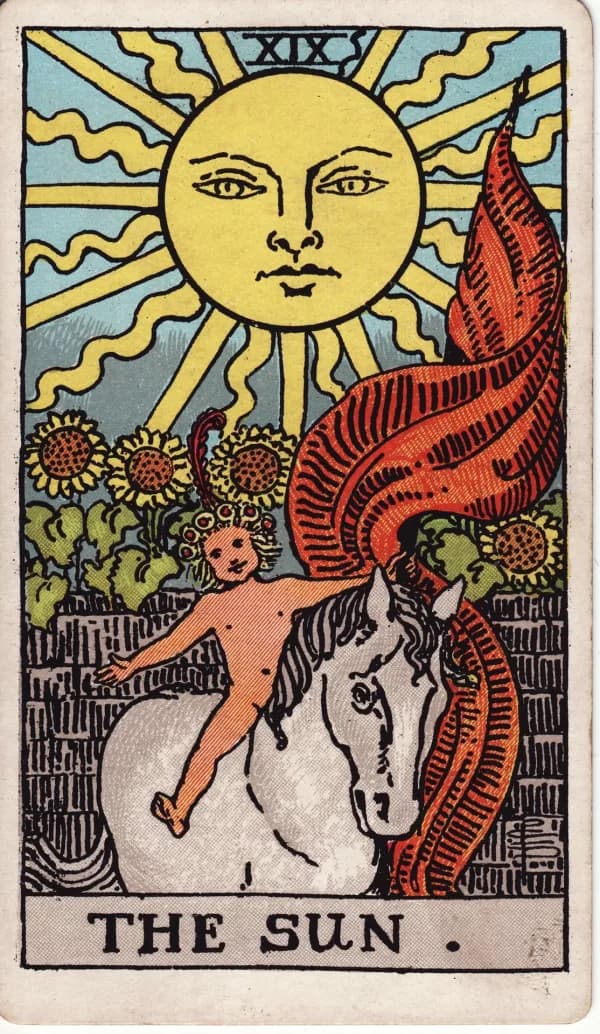
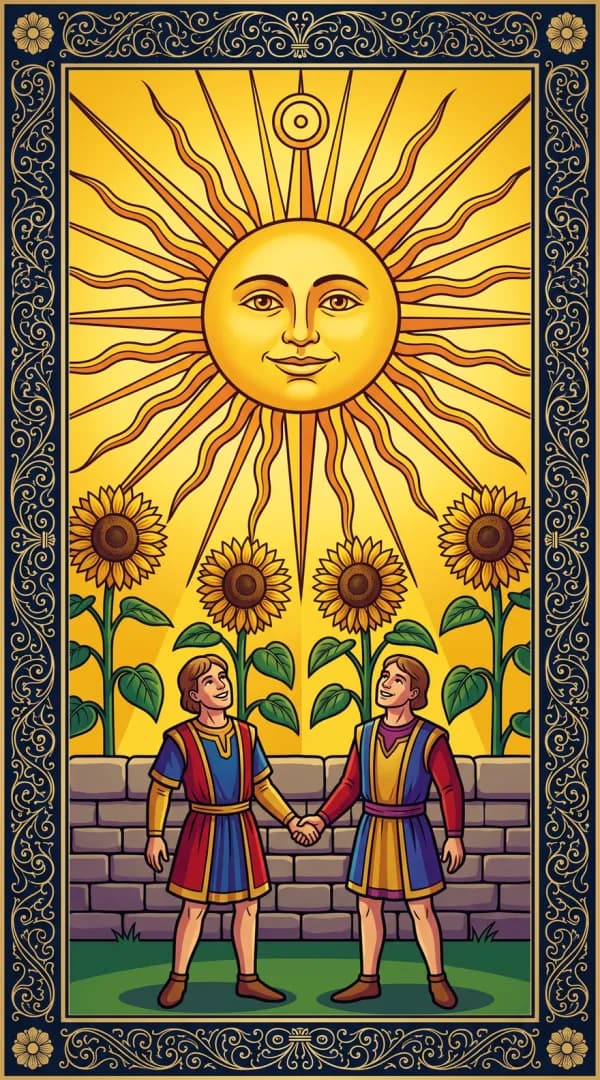
A huge sun with a calm face fills the top of a pale blue sky. Four sunflowers lean over a gray stone wall. In front of it, a naked child in a flower wreath rides a white horse with no saddle, one arm flung wide, a long red banner streaming beside him. He's looking straight at you.
The Golden Dawn called this card the Lord of the Fire of the World and gave it the Sun itself, with Resh, the Hebrew letter meaning "head." For Pollack, this joy comes after the dark: the sunstruck person "has gone beyond the child's fear of darkness by travelling through it."
The Tarot de Marseille put two children in front of that wall. Waite preferred one naked rider, which he called "the better symbolism connected with this card."
Put the two cards side by side. The red cloth over the fallen man turns up again as the child's red banner. And that thin yellow band on the Ten's horizon has become the sun itself.
Look from the Ten's black sky down to its strip of yellow, then across to the Sun. Which part looks most like your sky today?
What the Ten of Swords and the Sun mean together
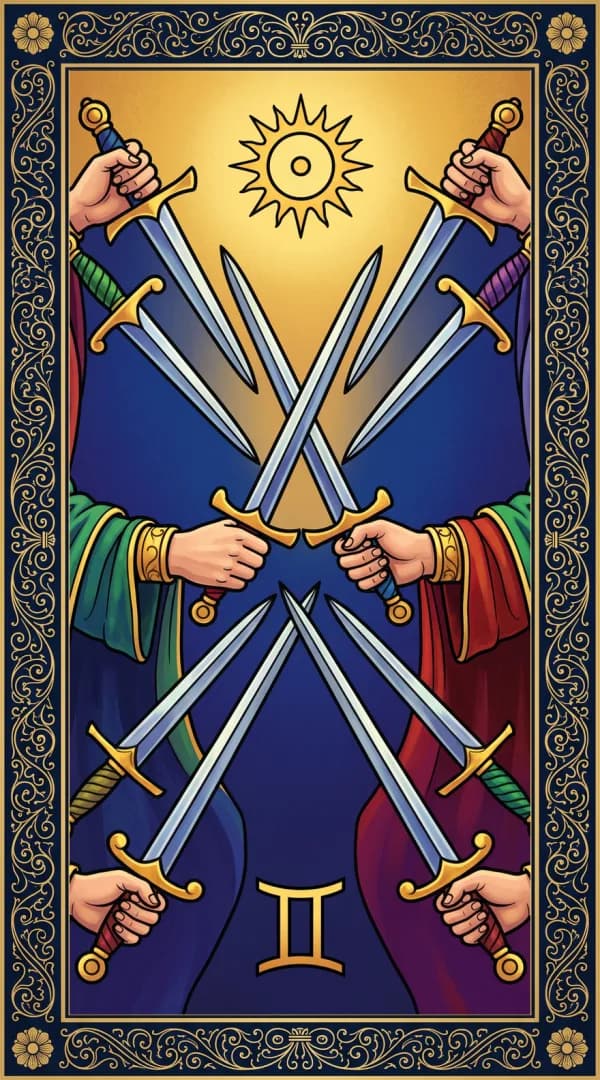
Look at the top of the Golden Dawn Ten of Swords below: the small rayed disc is the Sun's symbol, and the mark at the bottom is Gemini. The Golden Dawn gave each numbered Minor card from two to ten a decan, a ten-degree slice of the zodiac with its own ruling planet. The Ten of Swords got the last ten degrees of Gemini. Its ruler is the Sun.
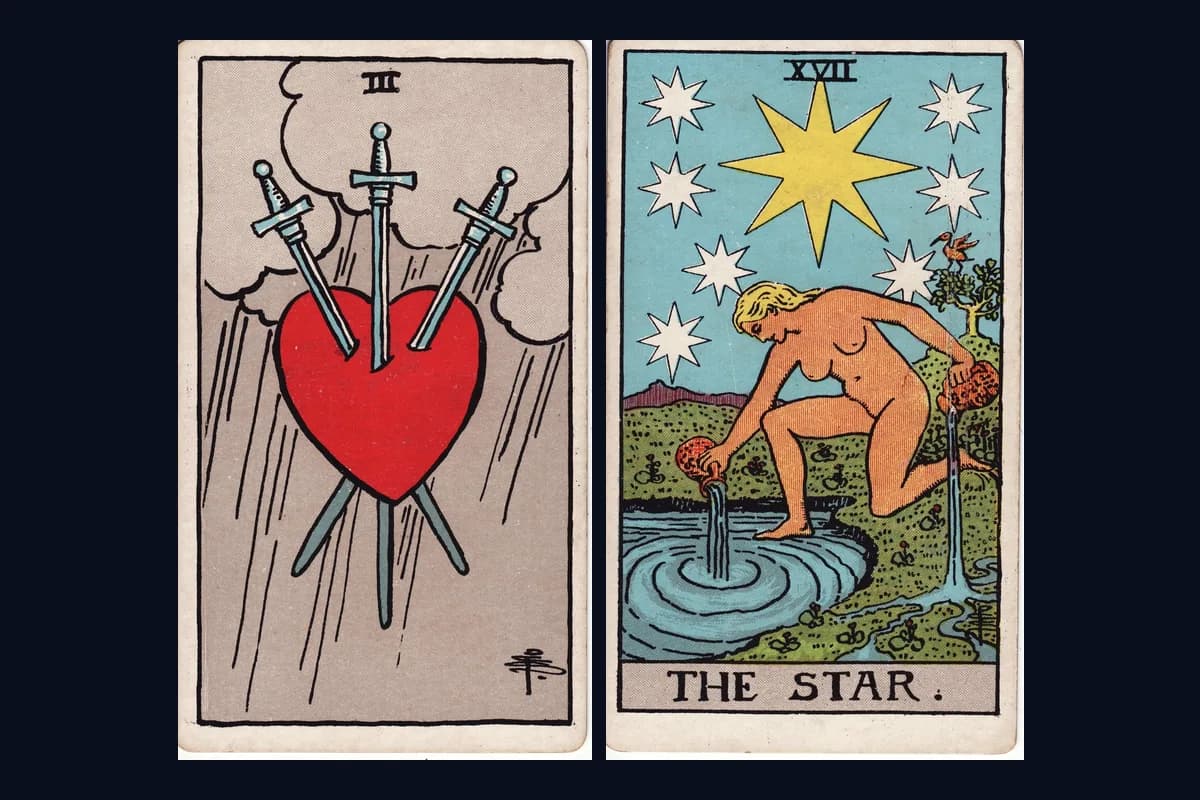
In the Golden Dawn's system, the Sun card stands for that same planet. So the card beside the Ten in your reading already rules it. The Three of Swords and Star combination shares a planet one step removed, through the Star's sign. Here the Major is the planet itself.
None of the classic authors reads this exact pair, but Aleister Crowley pinned the Ten's one hope on its Sun. "Yet this card is not entirely without hope," he wrote in The Book of Thoth. "The Solar influence rules; ruin can never be complete, because disaster is a sthenic disease." Sthenic is an old medical word for an illness of too much strength, so for Crowley, disaster burns itself out.
His next line: "As soon as things are bad enough, one begins to build up again." That's Crowley reading a card. You don't have to wait for things to get bad enough before you ask for help.
A Major beside a Minor gets read from two heights. From the air, the Major sets the picture: a map mostly in daylight, with the Ten as one dark field. On the ground, the Ten fills the whole view. And you're down on the ground, where it hurts.
With the Ten of Swords behind you, the Sun says rock bottom was a floor, not a place you have to live. The fall was real. Nothing on the Sun takes it back. But the ground you hit is also the ground you stand up on.
Where was the light in your worst week, even if it was only one person or one easier morning?
How the pair reads, question by question
In a Celtic Cross, Brigit Esselmont of Biddy Tarot reads the card laid across the center as the challenge, even when it's a good card. A Sun across the Ten can be light arriving before you're ready. Or it's the pressure to look fine while you're still hurting. The last card is the outcome, "where the situation is headed" if you stay on your current course. With the Ten earlier, a Sun there is as close to a plain yes as the spread comes. A Ten there is a warning you can still act on.
In a three-card spread of past, present and future, the Ten in the past with the Sun in the future is the pair at its clearest. The middle card is the bridge between them. The Ten in the present with the Sun ahead means you're in it now, and the spread points up.
In love readings, the Ten is often an ending you didn't choose: a breakup, a betrayal, sometimes infidelity. The cards can show how a betrayal feels, but not whether one happened or who's to blame. Still together? Then the pair can be a rupture you've both come through. Apart? The Rider-Waite-Smith child rides alone, and the warmth that comes back is your own. But if someone is still hurting you, the Sun isn't a reason to wait it out.
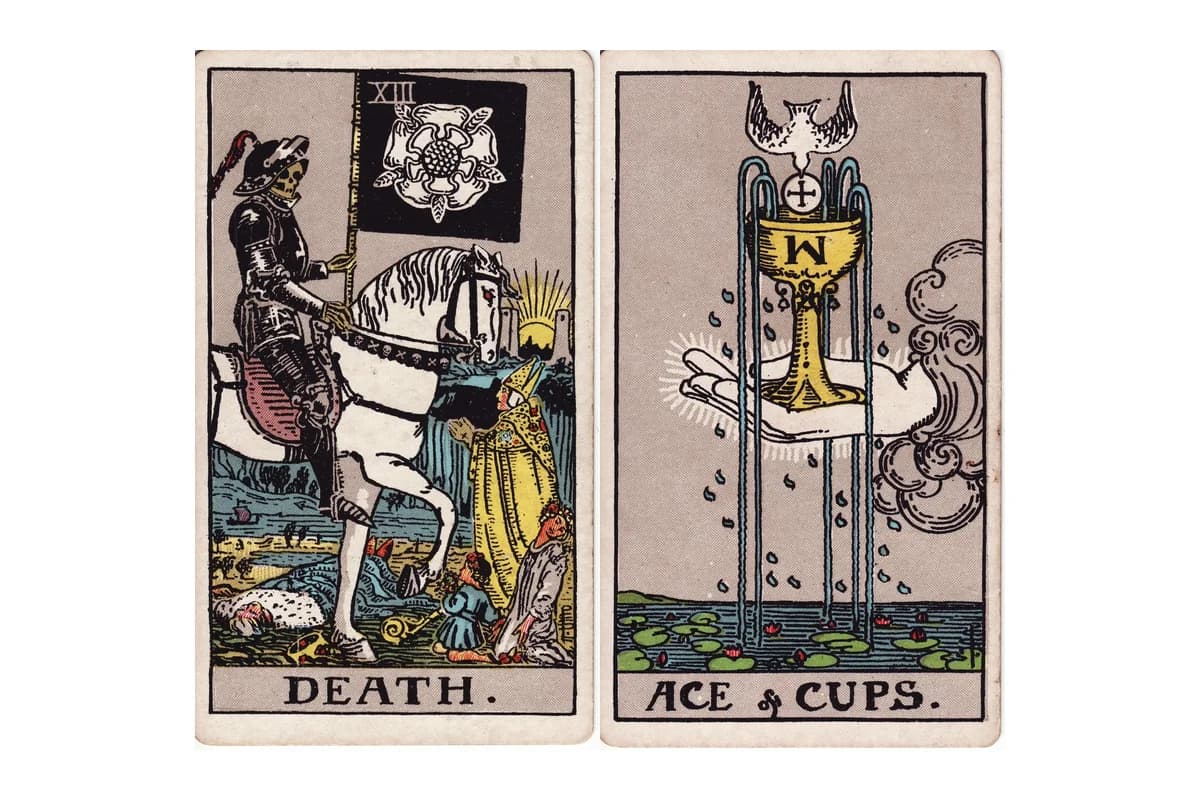
Career questions bring the job that ended, or the one that wore you down. Tina Gong of Labyrinthos lists "loss of job, office politics, breakdown from stress, burnout." For burnout, notice that the child on the Sun is off the clock. He's riding with his arms out. So read the card as rest before it's a push to shine. When you're ready, the Death and Ace of Cups combination turns to work that would feed you.
For health questions, the Sun isn't a prognosis, and the cards are not a medical opinion. Take questions about your body to someone who went to school for it. With a chronic illness, read the Sun as good days inside it, not a cure. A low that stops you from sleeping, eating or getting through the day is a reason to see a doctor or counselor, not to draw again. If it has started to mean not wanting to be here, call a crisis line or your local emergency number now.
Asking yes or no? You're asking two things. Is this the bottom? With the Ten first, the pair leans yes: ten is as far as a suit counts, though no card rules out another setback. Does it get better? Esselmont calls the Sun alone "a pretty safe Yes." After the Ten, it's yes to things getting lighter, not to the old life coming back. If you've lost someone, better doesn't mean over it. Neither card gives a date. With the Sun first, the pair ends on the Ten, so it can't yet promise either yes.
What would one good, ordinary day look like after your own Ten of Swords? If it were a card, what would the sun be shining on? That image belongs in your deck.
Which card came first, and which way they face
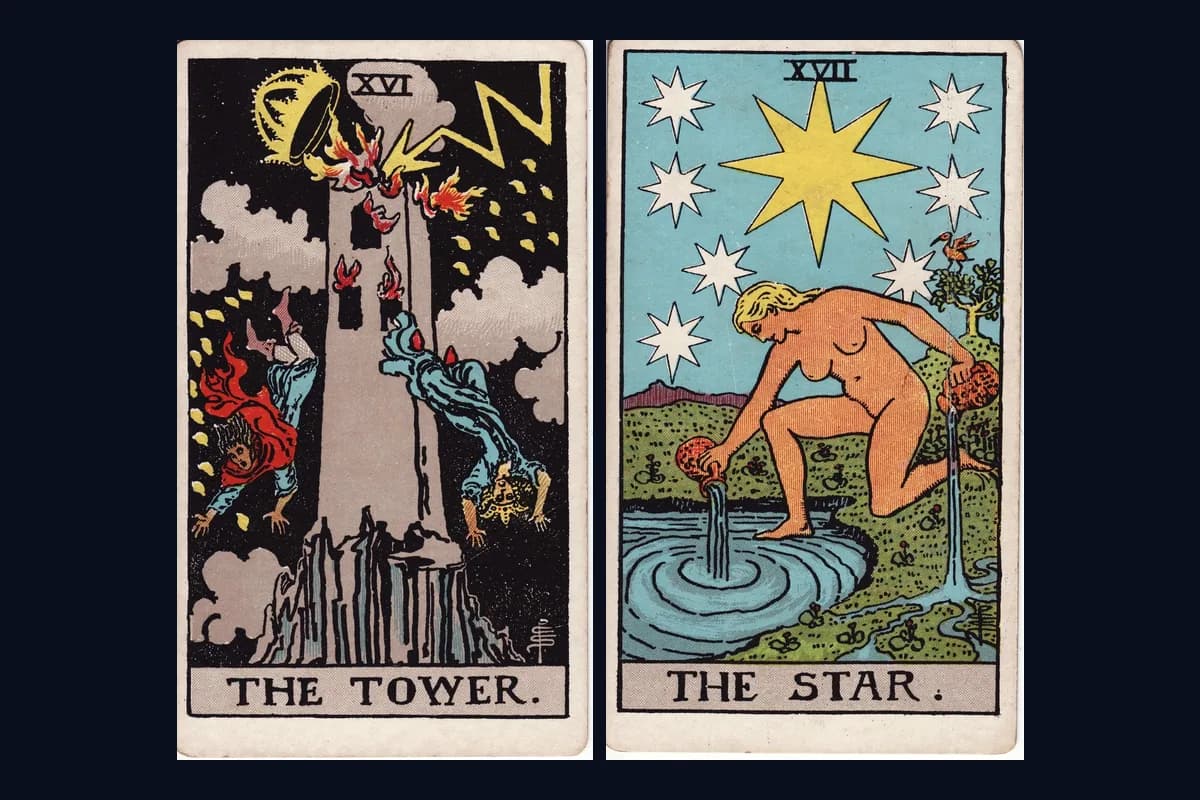
Ten of Swords first, then the Sun is the hopeful order. Nothing on the Sun card is lying down. The Major Arcana runs the same way, only slower: the Tower falls at XVI and the Star brings hope at XVII, but the Moon brings doubt back at XVIII. Only then comes the Sun. The Tower and Star combination reads the first two steps of that run.
The Sun first, then the Ten of Swords is the cautionary order. A good stretch has a hard ending folded into it, like the promotion that turned into burnout. If you're already in the loss, this may just be the order it happened in. A hard ending isn't a punishment for being happy. And a Ten still ahead of you can change.
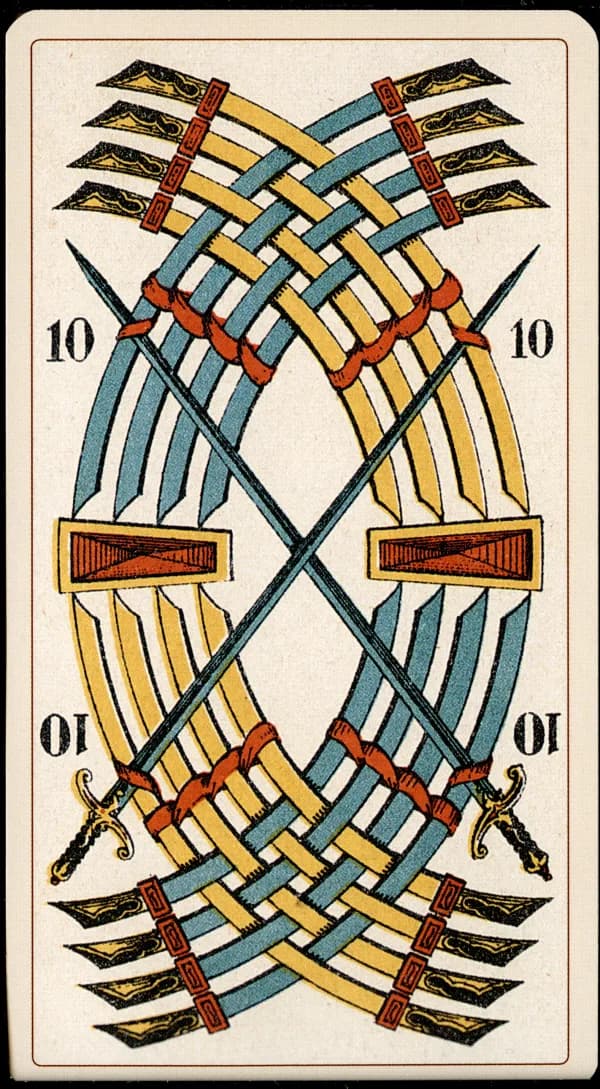
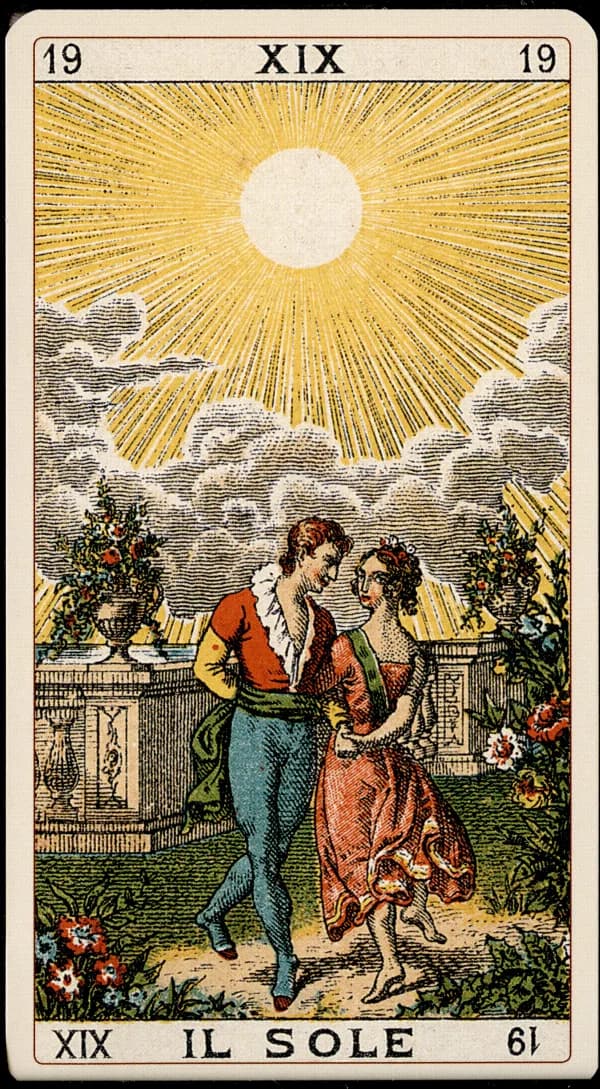
The Milanese Ten below has no body at all, just curved blades woven into an oval with two straight swords crossed through it. Older decks drew the Ten this way. But Pamela Colman Smith drew the man under the black sky for the 1909 deck. The Milanese Sun puts a young couple arm in arm in a garden: tradition, like the Marseille's two children, not a sign that anyone is coming back.
Orientation matters too. Not every reader uses reversals. Those who do are split on the Ten. Waite reversed it into "Advantage, profit, success, favour, but none of these are permanent," a small sun beside this pair's full-size one. Pollack pictures "the swords falling out of his back," and Biddy Tarot and Labyrinthos mostly read it as recovery. Both also list a darker strand: resisting the end, or relapse. Pollack's reversed Sun is a sun "clouded over," where the good things "do not become lost but confused." The rows follow the recovery reading.
| Orientation | Reading |
|---|---|
| Both upright | A real ending and real daylight side by side; whichever came first tells you where you stand |
| Both reversed | Recovery under way but quiet, and joy behind cloud; you may be further along than you feel |
| Ten upright, Sun reversed | A raw ending with the light dimmed; lean on people, and remember a clouded sun hasn't set |
| Ten reversed, Sun upright | The swords coming out and the light at full strength; most of the way up, with part of the ending still to let go of |
Where did the Ten of Swords land in your spread: behind you, under you or still ahead?
How one Sun can rule both cards
Why would the brightest planet rule the bleakest card? Crowley gives half the answer: in Gemini, "the mercurial airy quality of the Sign serves to disperse his rays."
A Golden Dawn manuscript that Mary K. Greer, author of Women of the Golden Dawn, credits to J.W. Brodie-Innes gives the other half. The Sun is "very fiery energy, destructive unless it acts on very solid material & is modified," and Gemini is "the tenuous or most Airy Air." Light with nothing solid to land on thins out. And it burns. On the Sun card, it has a garden wall and a row of sunflowers to land on.
Traditional astrology scores a planet's strength by where it stands. In the Ten's slice of Gemini, the Sun holds only the dignity called face: a claim on that one decan, and the weakest kind. But in Leo, its own sign, it holds domicile, the strongest.
Swords are Air, and the Sun card counts as Fire. In elemental dignities, the Golden Dawn's rules for how neighboring cards affect each other, Fire and Air are friendly. Each strengthens the other. So the Sun doesn't soften the Ten, and the Ten doesn't dim the Sun.
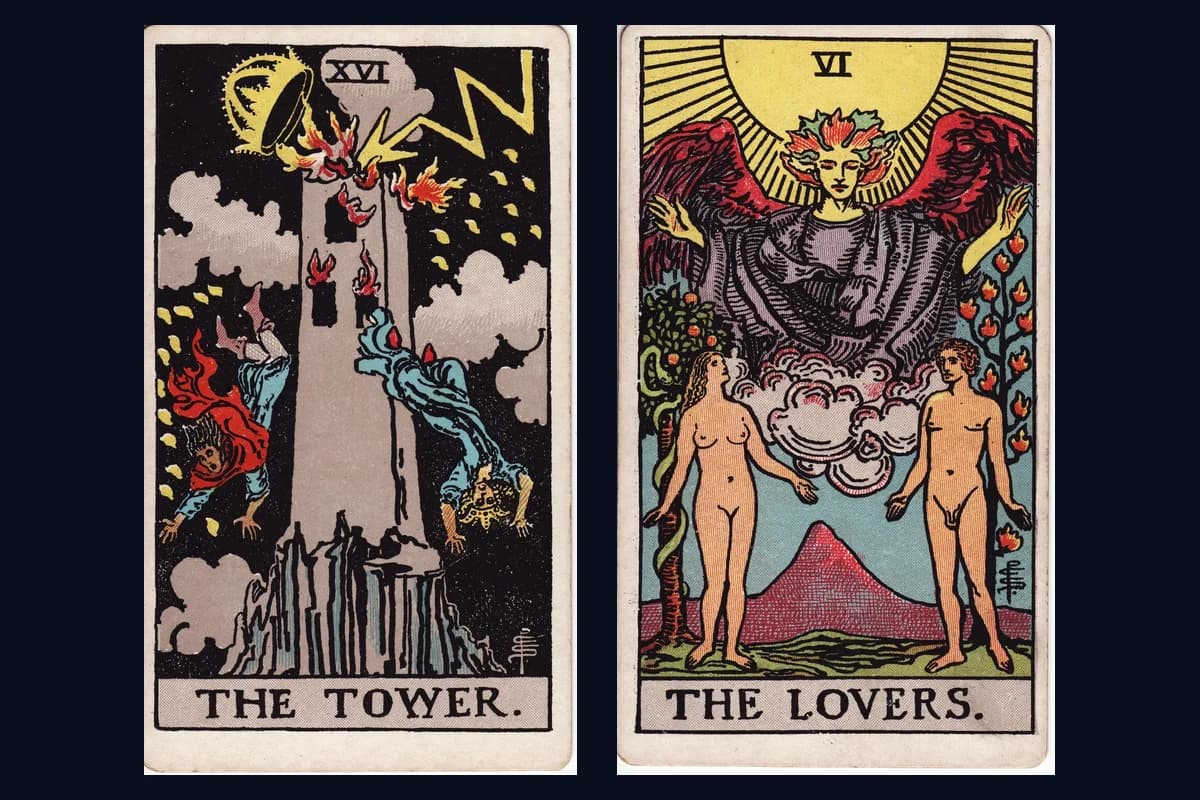
Gemini is also the Lovers' sign. The Tower and Lovers combination calls the Nine of Swords, Mars in Gemini, the child of those two Majors. By the same logic, the Ten of Swords is the child of the Sun and the Lovers.
The Sun enters the Ten of Swords' decan on June 11, 2027, and leaves it at the June solstice on June 21, 2027 (both Universal Time). North of the equator, the bleakest card in the suit climbs right up to the longest day of the year. On July 23, 2027 (Universal Time), the Sun enters Leo, the sign it rules. Robert Wang, writing on the Ten in The Qabalistic Tarot, borrows an old maxim: "The stars impel, they do not compel."
What could the light in your life land on right now: more sleep, or someone you can call?
Why both cards come back to ten
The Ten of Swords is a 10. Add the digits of the Sun's 19 and you get 10 again. In the Major Arcana, 10 is the Wheel of Fortune.
Pollack makes the Sun's half of that move herself: "1 plus 9 equals 10, the Wheel of Fortune." She doesn't tie that 10 to the Ten of Swords. So the rest is arithmetic, and some readers don't count reductions at all.
On the Rider-Waite-Smith Wheel, a snake slides down the left side while a red, jackal-headed figure rides up the right. The bottom and the top sit on one rim. The Wheel says your position changes. But it doesn't say it only goes up. It never says when.
Keep counting and 10 becomes 1, the Magician. No Major Arcana number but 19 takes two steps to reduce, and the Ten of Swords' number is the middle step of the Sun's.
The sum takes a different road: 10 + 19 = 29, a number no Major Arcana card carries, and 2 + 9 = 11, which numerologists call a master number and leave unreduced. That's Justice in the Rider-Waite-Smith deck and Strength in the Milanese. No author quoted here makes this sum, so give it less weight than the Wheel.
On the Tree of Life, the Kabbalistic map of ten spheres joined by twenty-two paths, the Golden Dawn put every Ten in Malkuth, the Kingdom, the lowest sphere. The Sun is a path instead, the one marked by Resh, between Hod, the sphere of reason, and Yesod, the Foundation. With Malkuth, those two spheres make a small triangle at the foot of the Tree. The Sun is the only side of it that doesn't touch the bottom.
If rock bottom and the Sun sit on one turning wheel, where are you on it right now? Still at the bottom counts as an answer.
Questions readers ask about this combination
Does the Ten of Swords and the Sun mean things will get better?
Usually yes: with the Ten first, the Ten of Swords and the Sun mean a fall behind you and daylight ahead, though better isn't the same as back. With the Sun first, the Ten may be the fall you're in or one ahead. Neither card gives a date. If feeling low stops you from sleeping, eating or getting through the day, see a doctor or counselor. If it means not wanting to be here, call a crisis line now.
What does the Ten of Swords and the Sun mean in a love reading?
In love, the Ten of Swords is often an ending you didn't choose, such as a breakup or a betrayal, and the Sun is your own warmth coming back. The cards can show how a betrayal feels, but they can't prove anyone was unfaithful or promise a reunion. If you're still together, the pair can be a rupture you've both come through. If someone is still hurting you, the Sun isn't a reason to wait.
What does it mean when the Ten of Swords and the Sun are both reversed?
With the Ten of Swords and the Sun both reversed, the usual reading is quiet progress. Rachel Pollack pictures the reversed Ten with the swords falling out of the man's back. Among readers who use reversals, many see it as recovery under way and the reversed Sun as a sun behind cloud, not one that has set. Others read the Ten as holding on to the ending. You may be further along than you feel.
What element connects the Ten of Swords and the Sun?
The Ten of Swords is Air, and the Sun card counts as Fire. In elemental dignities, the Golden Dawn's rules for how neighboring cards affect each other, the two are friendly, so the Ten keeps its full weight and the Sun its full light. The closer link is a planet. The Golden Dawn gave the Ten of Swords to the Sun in Gemini, and the Sun card stands for that same planet.
Is the Ten of Swords and the Sun a yes or no combination?
The Ten of Swords and the Sun give a yes with a condition. With the Ten first, the pair leans yes to having hit rock bottom. Brigit Esselmont of Biddy Tarot calls the Sun on its own "a pretty safe Yes." After the Ten of Swords, the yes means things getting lighter, not the old situation coming back, and neither card gives a date. With the Sun first, the pair can't yet promise either yes.