Tarot Card Combinations
Nine of Swords and The Star
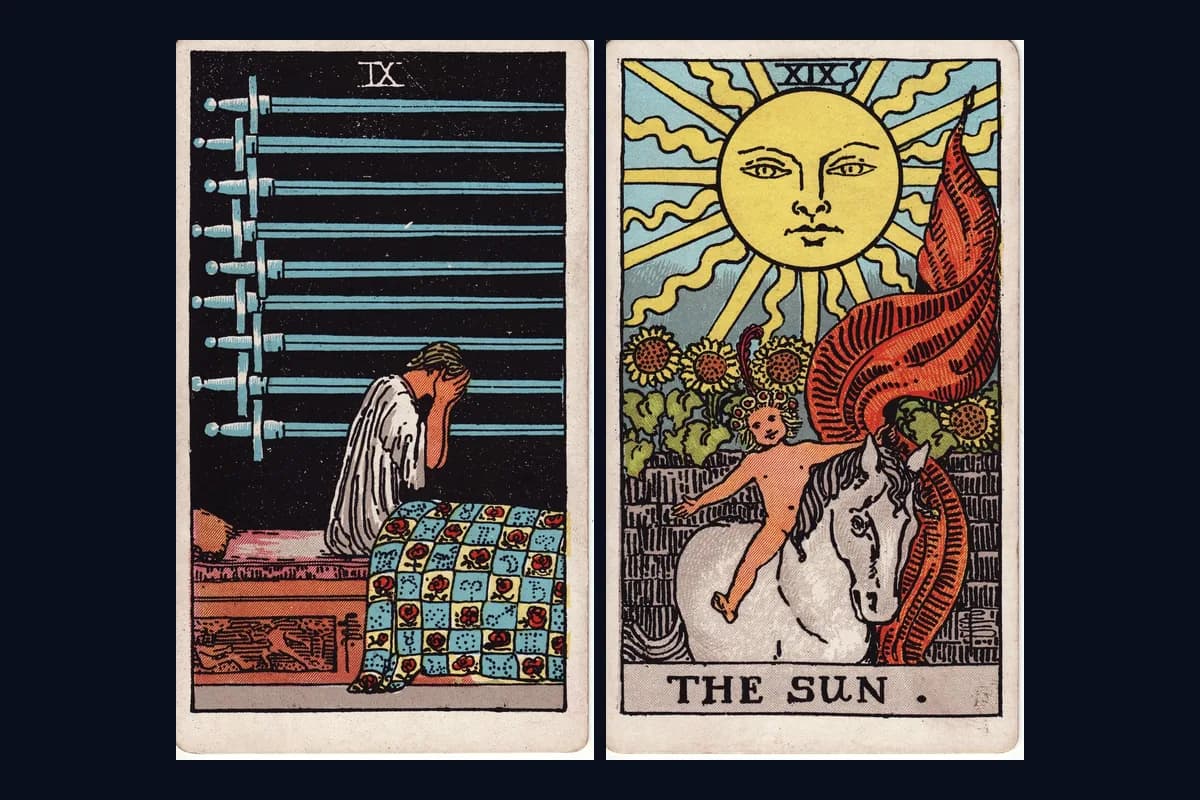
The Nine of Swords and the Star tarot combination signals sleepless worry with a calmer mind in view. A woman sits up in bed, face in her hands, and doesn't see the nine swords hanging in the dark behind her. On the next card, eight stars shine over a second woman. She's kneeling at a pool, a jug in each hand. Nine blades, eight lights. Which have you been counting?

Climate scientist, ashtanga practitioner, and advocate for human rights and LGBTQIA+ equality.
The two cards, one at a time
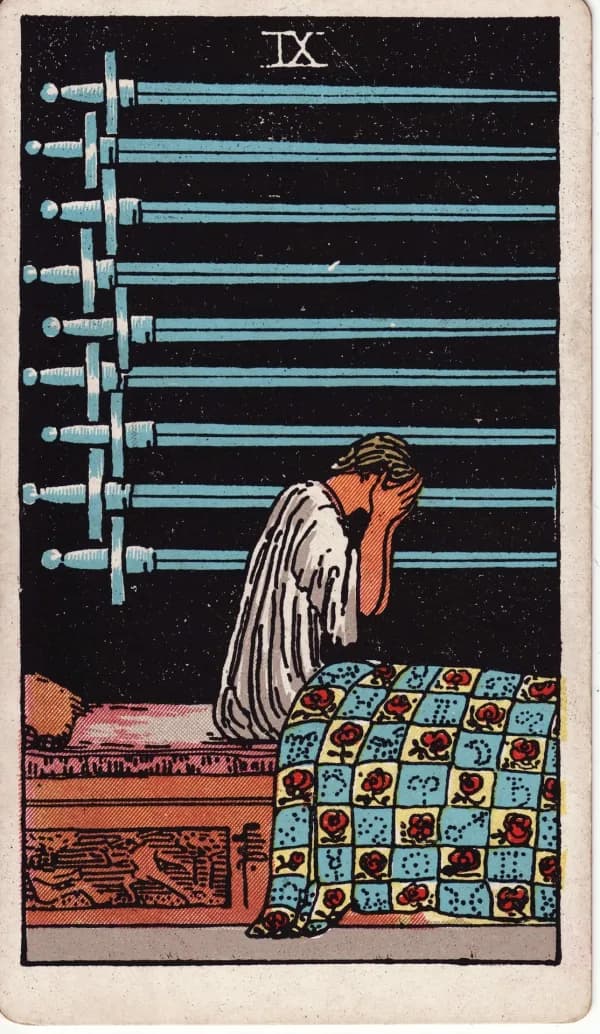
Look at the top half of each Rider-Waite-Smith card. The Nine of Swords keeps nine blades up there, the Star eight stars, and neither woman is looking up. On the Nine, the blades hang in level rows against a flat black background. Below them, a woman in a white nightgown sits up in bed with both hands over her face. None of the blades touches her. Her quilt is a patchwork of red roses and small astrological signs.
A.E. Waite gives the image one plain line in The Pictorial Key to the Tarot: "One seated on her couch in lamentation, with the swords over her." Rachel Pollack, author of Seventy-Eight Degrees of Wisdom, finds a surprise: "Love, in fact, fills the card and gives it its meaning." Then she points to the bed: "The blanket design shows roses, symbol of passion, alternating with the signs of the zodiac."
So the woman in bed has the sky stitched into her lap. The Golden Dawn, the order behind this deck's symbols, titled the card the Lord of Despair and Cruelty and gave it to Mars in Gemini. Robert Wang describes the order's own design in The Qabalistic Tarot: "In the Golden Dawn card the rose has been completely destroyed." Pamela Colman Smith, who drew this deck, put roses all over the quilt.
Now look at the Star (XVII).
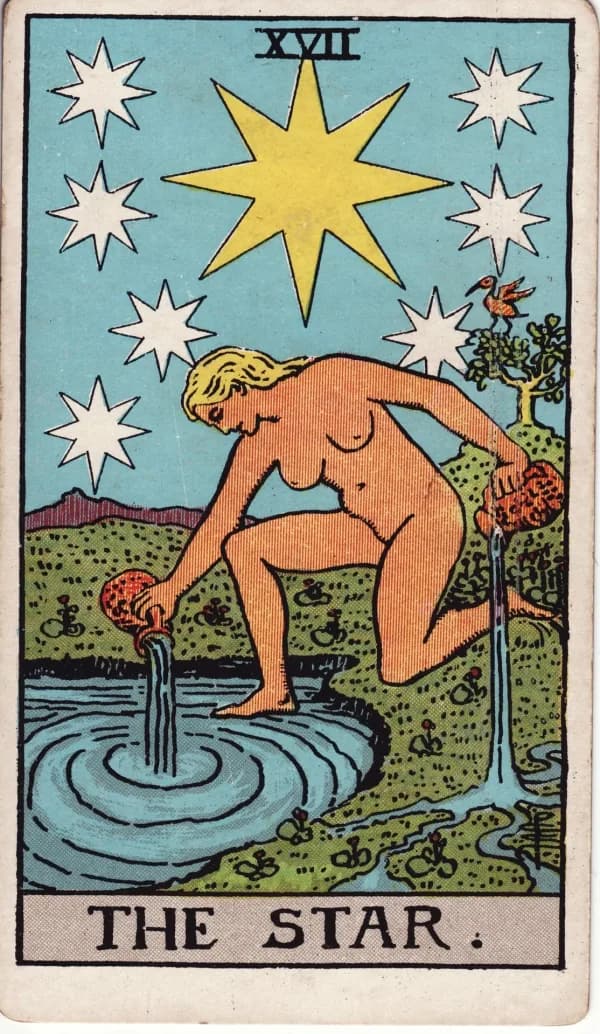
The sky is light, close to the blue of the Nine's blades. Count the stars: a large yellow one and seven small white ones, each with eight points. A naked woman kneels at the edge of a pool, one foot resting on the surface, and each hand tips a red jug: the pool gets one, the land the other. She's watching the water.
Waite records the card's first motto: "Waters of Life freely." And nobody here is earning the water. The Golden Dawn gave the Star to Aquarius, a fixed Air sign, and to Tzaddi, the Hebrew letter for a fish hook. Wang reads that hook as reaching down "to pull the Personality up from its depths of self-enclosure," the Personality being his word for the everyday self. Depths of self-enclosure? That's a fair name for the other card in this pair.
The woman in bed can't see the sky on her own quilt. The woman at the pool has both hands full. Which pair of hands looks more like yours this week?
Why the Nine of Swords and the Star belong together
These two cards share an address. On the Tree of Life, the Kabbalistic map the Golden Dawn laid the cards on, all four Nines live in Yesod, the ninth sphere, whose name means foundation. Wang calls it the home of the mind's images: "the dreams and fears of humanity." And that's the Nine's bedroom. The Star's path, Tzaddi, runs down into Yesod from Netzach, the sphere of feeling. It's one of only four paths that reach Yesod, and it ends in the room where the Nine can't sleep.
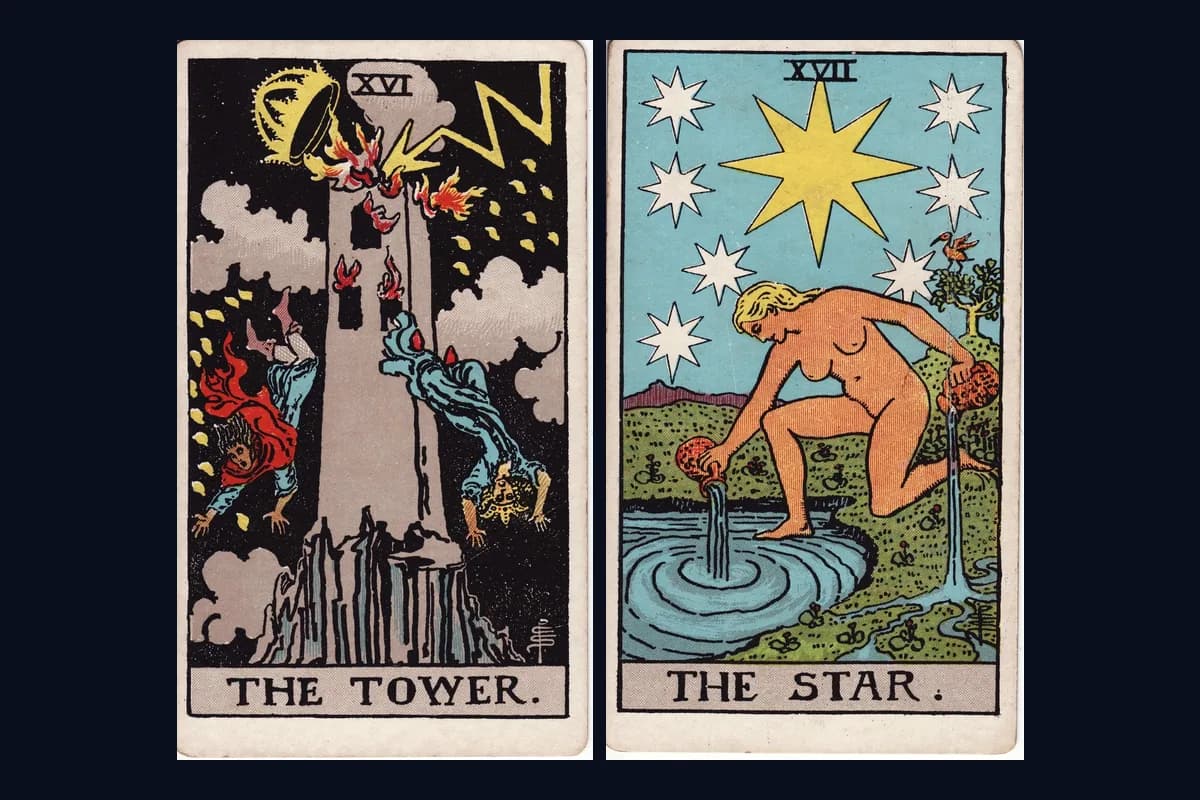
This is also a Major card beside a Minor. Readers take the Major as the theme and the Minor as one situation inside it. Here, the situation is the worry. The Tower and Star combination runs a similar arc with two Majors: a whole life coming down, then the first calm. This pair is that arc, shrunk to the size of one bedroom.
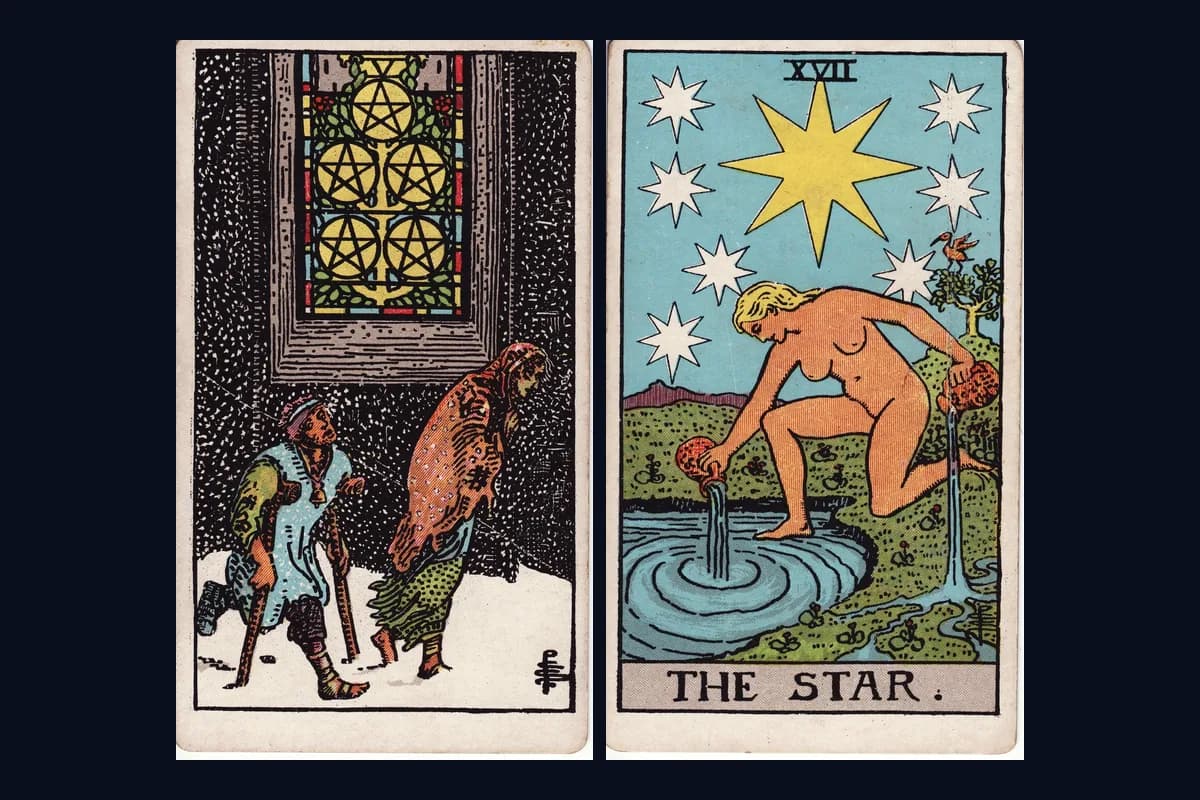
Joan Bunning, author of Learning the Tarot, lists each card as the other's opposite. On her Nine of Swords page, the Star heads the opposing cards with the gloss "serenity, peace of mind." But opposites can share an hour. You're awake with the worry, and still hoping. When the worry is money, the Five of Pentacles and Star combination reads it from the snow, outside a lit window.
The worry gets the louder card, but hope gets the bigger one. Bigger means the worry sits inside something larger than tonight. Nothing here sets a date.
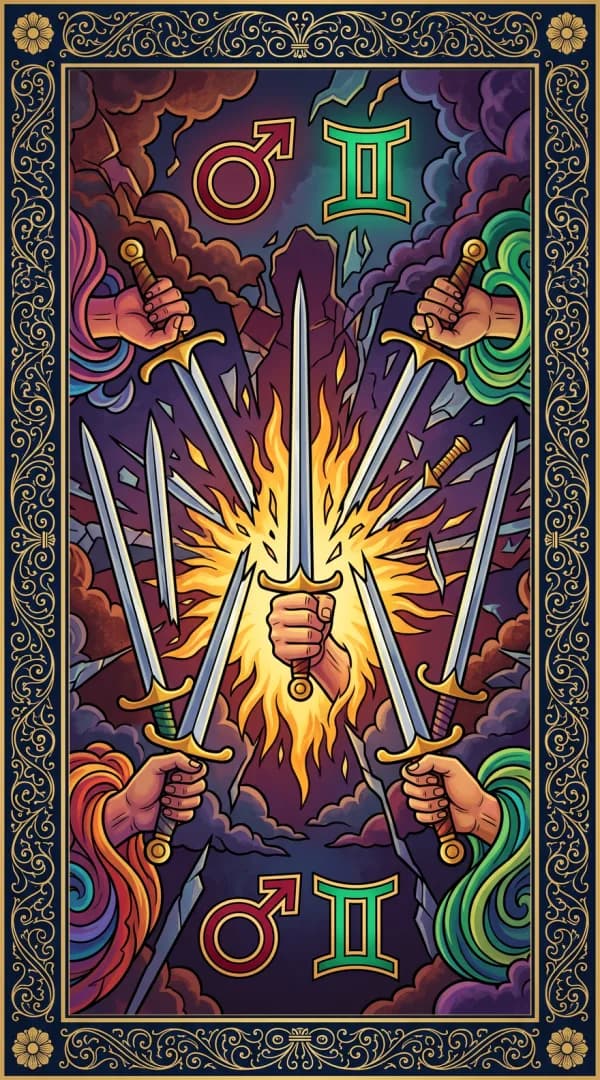
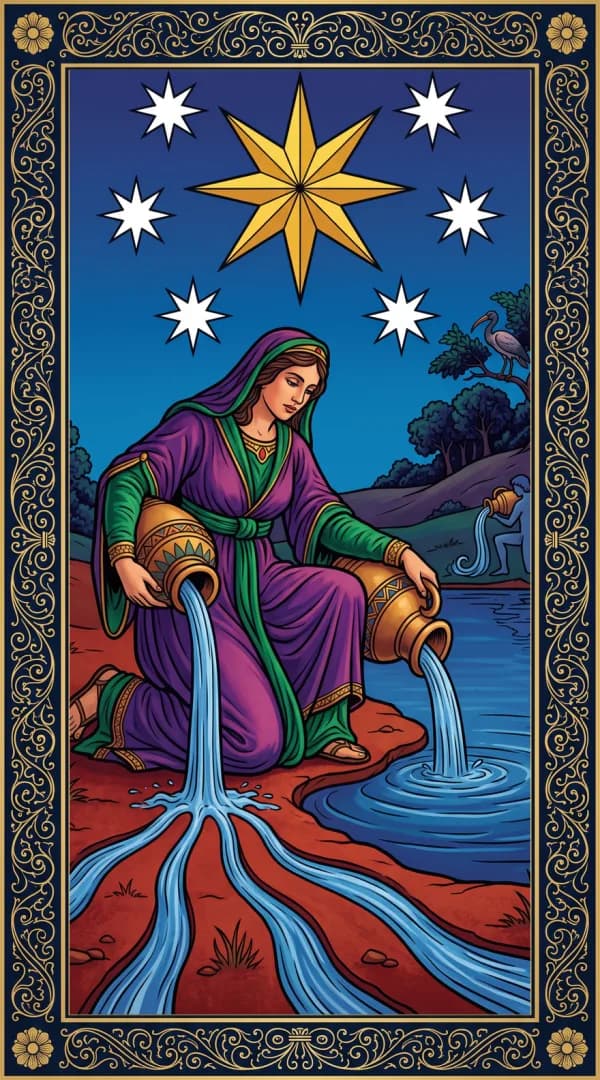
The Golden Dawn deck below puts both cards against the dark. On its Nine, hands reach out of purple storm clouds and grip blades around a burst of fire. On its Star, the dark is a navy night sky, and what it holds is light: one gold star and six white ones over a robed woman pouring water. Same dark. One card fills it with blades, the other with lights.
If the Nine of Swords is one night and the Star is the wider view, which one has felt like the whole picture lately?
Reading the pair for love, work and sleep
In a Celtic Cross, Pollack works through this exact pair. She imagines the Star in the Possible Outcome, the card just above the center, for someone who "might emerge feeling very free, full of hope, open to life." Then she puts the Devil in the final Outcome and asks what went wrong. Her answer is the Nine of Swords reversed in the Basis, just below the center: "the 'imprisonment' symbolized in the Nine prevents the person from realizing the potential of the Star." In her example, the hope was real but blocked. So start with what's underneath.
In a three-card spread of past, present and future, the plainest layout puts the Nine in the present and the Star in the future: you're in it, and hope is one card over. With the Nine behind you and the Star in the present, the nights have started to ease. With the Star in the past and the Nine now, read it kindly. You've felt calmer before, and what helped then is worth trying again.
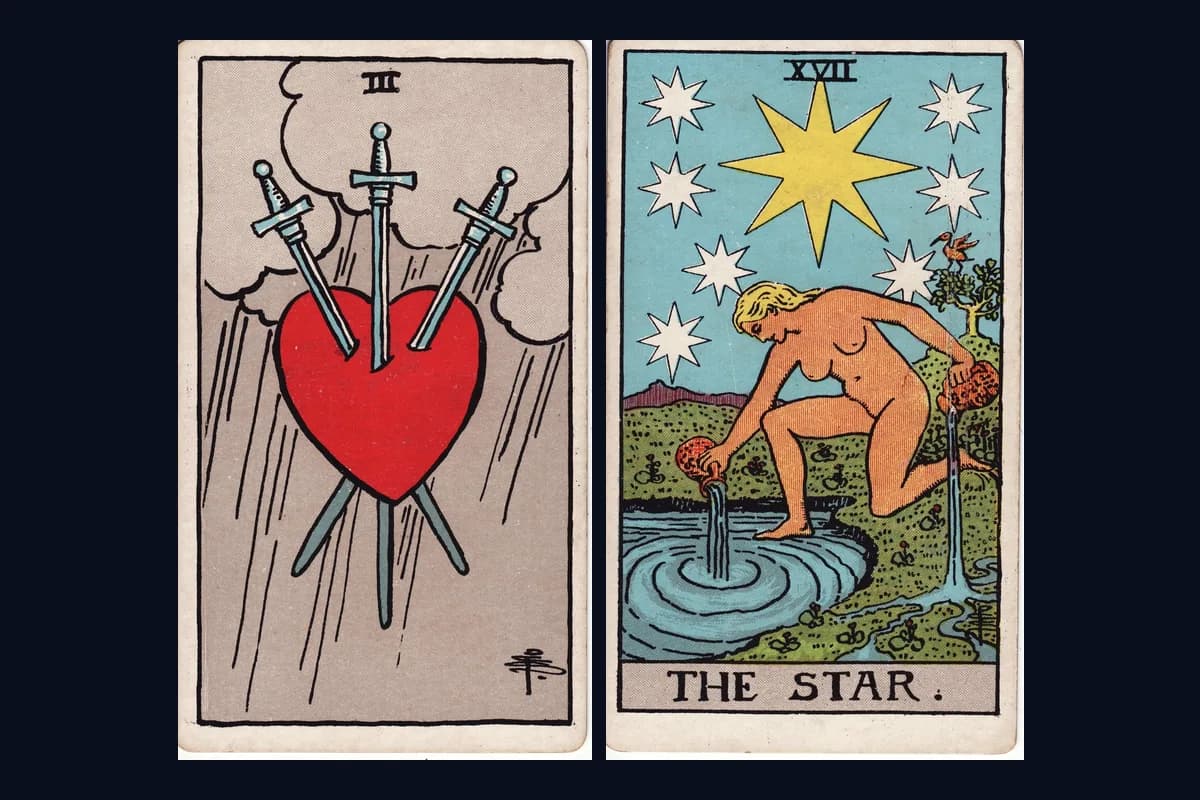
In love readings, the Nine is the fear and the Star is what you're afraid to lose. When you're single, it's often the dread of being hurt again; in a relationship, a suspicion that only shows up at night. The Nine shows how loud the worry is, not whether it's right. For a heart that's already broken, read the Three of Swords and Star combination. If what keeps you up is fear of your partner, that's a safety question, not a tarot one: call a domestic violence helpline.
As feelings, the pair shows someone worried and hopeful at once. Pollack adds: "Very often the Nine refers not to something happening directly to us, but rather to someone we love." That's the love she says fills the card.
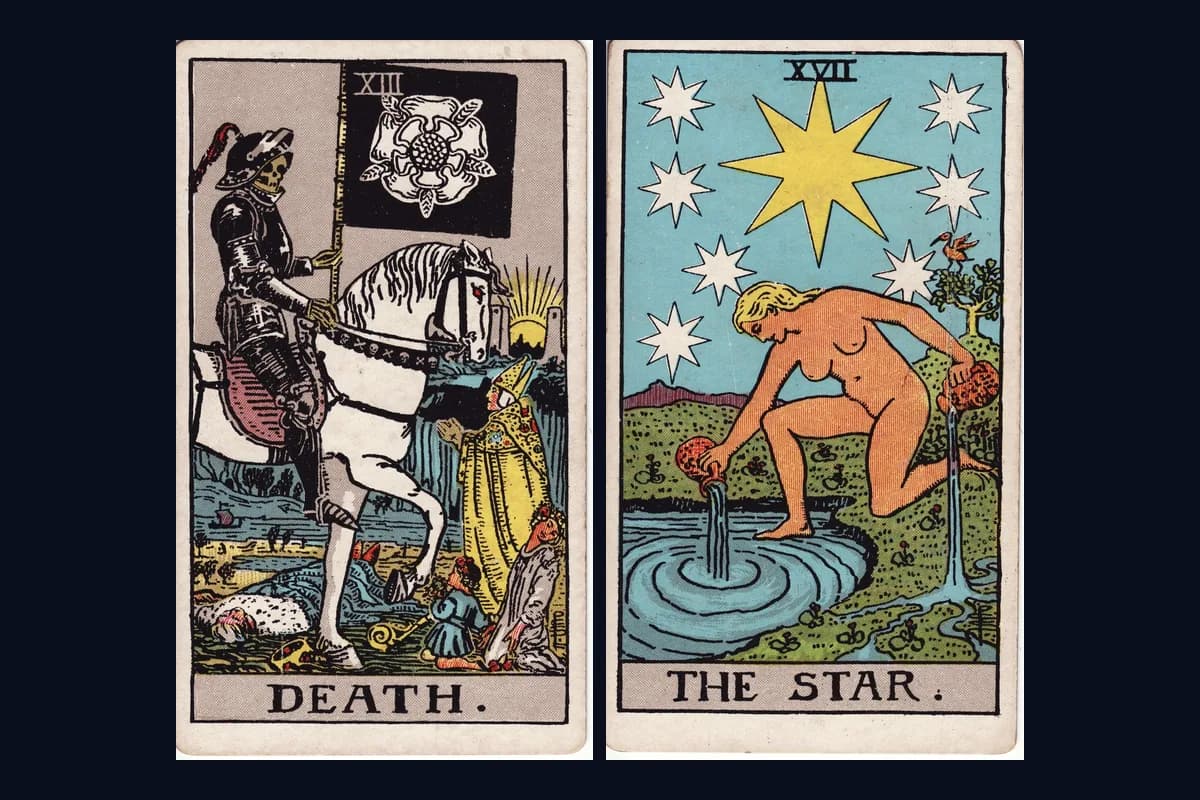
For career questions, the Nine is the email you reread at 2 a.m. Read it in daylight, with the facts in hand. With the Star beside the Nine, the next step is easier to see. Neither card can tell you how the job turns out. When an ending is what keeps you awake, the Death and Star combination looks at what grows after it.
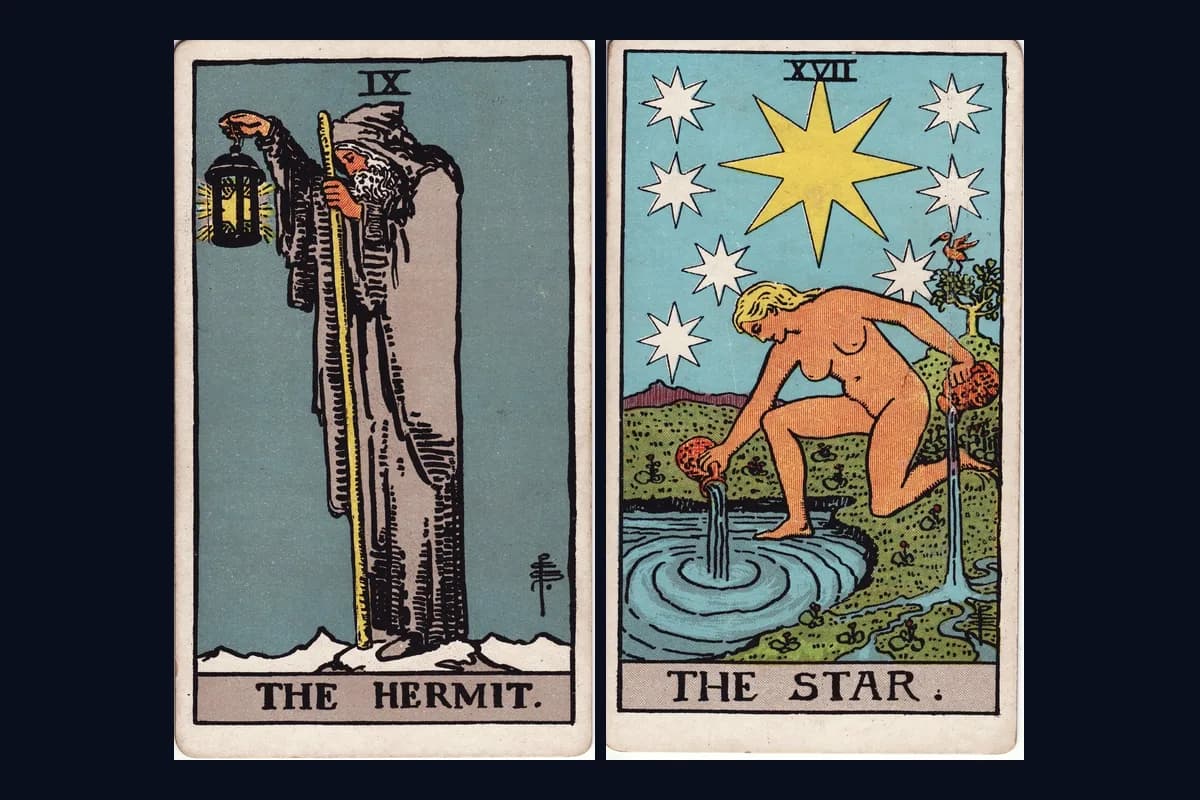
For mental health and sleep, the pair reflects heavy nights and the wish to feel steadier. A reading can't diagnose or treat anxiety or insomnia, and it doesn't stand in for a doctor, a therapist or a crisis line. If you already have that help, nothing in this pair is a reason to stop. Burnout has its own pair, the Hermit and Star combination.
The Star can sound like a guarantee, so take the pair as a nudge to ask for help, not a reason to wait. The cards are not a medical opinion. If the worry has lasted for weeks or feels hard to control, talk to someone who went to school for it. If you're in crisis, contact your local emergency services; in the US, you can call or text 988.
Yes or no? Your question is probably the one Bunning gives the Nine: "Will everything work out OK?" Both upright with the Nine first, the pair leans yes: a direction, not a date. Reverse just the Nine and it still leans yes, unless you're holding the fear in. With the Star first, or the Star reversed, it's closer to not yet. Whichever you get, there's a condition: do something with the hope, even if that's telling one person how bad the nights have been. And if you've asked the cards more than once tonight, they've answered.
The Nine's quilt is stitched with red roses and the signs of the zodiac. If you stitched your own, what would you want over you on the bad nights? That image belongs in your deck.
The order you drew them in, and which way up
Nine of Swords first, then the Star: the hopeful order. The worry is where you are, and the Star is where the reading points. It won't name the last bad night. It tells you there's something to see by while you're still in it. Lying awake over whether to leave? The Six of Swords and Star combination reads that question.
The Star first, then the Nine of Swords: the cautionary order. A good stretch, then worry creeping back. Sometimes it means just that. But anxious people know a second version: you lie awake over the thing you want most. Then the Star is what you're protecting, and it was there first. If the good news has already come, read the Nine of Swords and Sun combination.
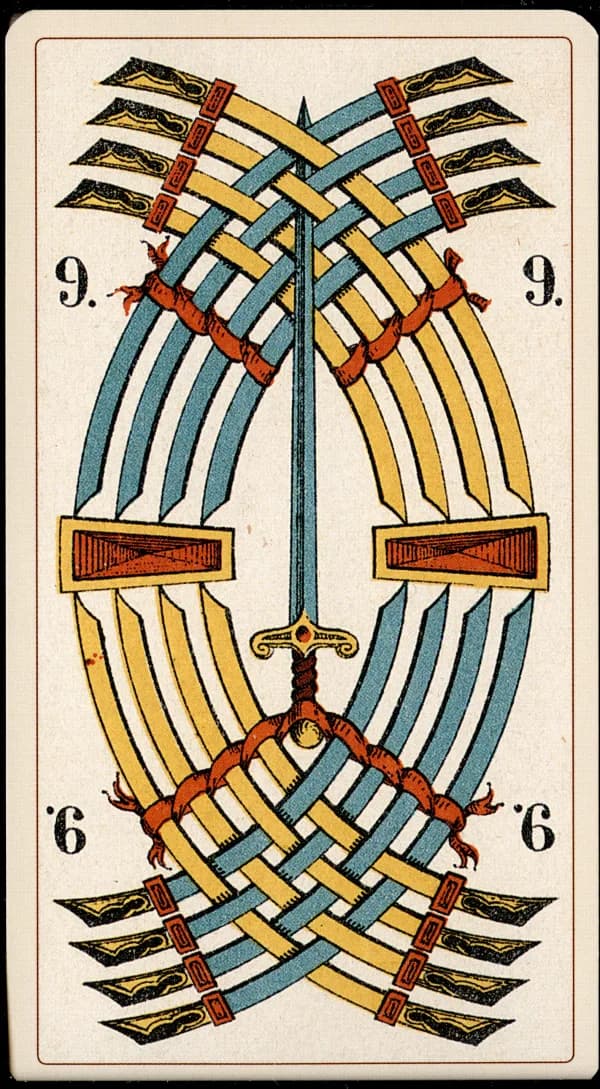
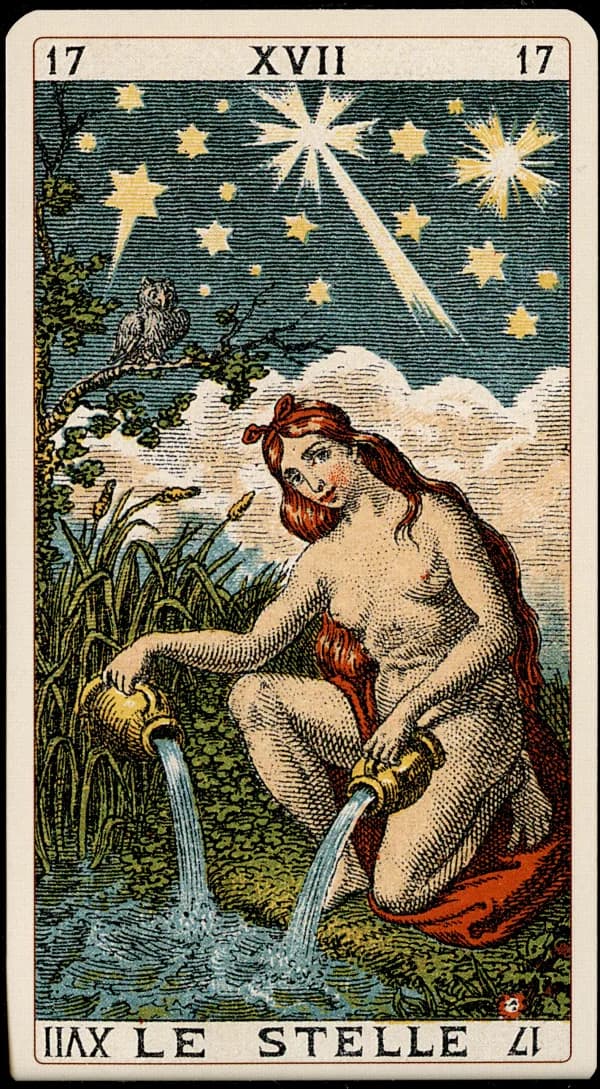
The Milanese pair below moves the dark. Its Nine has no bed, no woman and no night, just curved blades woven around one straight sword. The bedroom is Smith's. Here, the Star is the dark card: a night sky full of small stars and a comet, an owl awake on a branch, and a woman pouring from two gold jugs.
Orientation matters too. Not every reader uses reversals, and those who do split over the reversed Nine. Theresa Reed of The Tarot Lady calls it "Stress relief at last." Waite's list runs darker: "Imprisonment, suspicion, doubt, reasonable fear, shame." That's fear held in, not fear gone.
| Orientation | Reading |
|---|---|
| Both upright | Loud worry and real hope side by side; calm can come back, slowly |
| Both reversed | Worry gone quiet without going away, and hope gone flat; answers matter less than rest, small routines and someone to talk to |
| Nine upright, Star reversed | Fear at full volume and hope out of reach; this one isn't for waiting out alone, so name the fear to someone you trust |
| Nine reversed, Star upright | The nights may be easing, or the fear may be held in; hope is close either way, so notice which one it is |
If the Star came first in your spread, what's the worry protecting?
What the sky says about a mind that won't settle
The Nine's Golden Dawn decan, a ten-degree slice of a sign, is Mars in Gemini. Mars is the planet of force. Gemini, the Twins, is Mercury's sign of thought and talk. Wang is blunt: "the fiery Mars energy could do no good in the sign of dualities." A fighter in the house of thought. You know the argument at 3 a.m. You're on both sides of it.
A Golden Dawn manuscript that tarot author Mary K. Greer credits to J.W. Brodie-Innes explains: "Mars has his full unmodified sway in the Airy Air of Gemini." And nothing slows him down. For Aquarius, the Star's sign, the same manuscript speaks of "the soft nature of Watery air." One element, two kinds of weather, and only the Star's has water in it.
Both cards are Air, so they match under elemental dignities, the Golden Dawn's rules for how neighboring cards affect each other. Greer, summarizing Golden Dawn co-founder MacGregor Mathers, calls same-element cards "very strong for either good or evil, according to their nature." So sharing Air strengthens what each card holds. Here, that's the worry along with the hope. Even Book T, the order's tarot manual, ends the Nine's list of meanings on a softer note: "Yet also obedience, faithfulness, patience, unselfishness."
The Sun crosses the Nine's decan, 10 to 20 degrees of Gemini, from May 31 to June 11, 2027 (Universal Time). Inside that stretch, on June 4, 2027, at 19:40 Universal Time, the Moon is new at nearly 14 degrees of Gemini. Around a new Moon, the nights are the month's darkest, when the most stars show. Those dates belong to the sky. Your recovery keeps its own time.
The last time you argued with yourself at 3 a.m., what slowed the argument down, even a little?
What the numbers leave standing
Add the Nine of Swords to the Star and you get 26. No Major Arcana card carries that number. So add the digits: 2 + 6 = 8. That's Strength.
Now reduce the Star by itself: 1 + 7 is 8 again, so the Nine didn't move the total at all. That isn't special to this pair. Adding 9 never changes what a number reduces to. Reduce first and it's plainer still: 17 becomes 8, and 9 + 8 brings you straight back to 17. Whichever way you add them, the 9 drops out and the Star keeps its number. It's arithmetic, not a forecast. Some readers put weight on sums like this; others don't.
You can see both numbers on Smith's cards. The Nine hangs nine blades in the dark. The Star answers with eight stars, and Pollack points out: "The stars on the card are all eight pointed which is another reference to Strength." For her, "the Star is Strength raised to a higher level."
On Strength, a woman in white bends over a lion with her hands at its jaws. No weapon anywhere on the card. Set that beside the Nine of Swords: Strength meets the animal with patience and her bare hands. That's the card hiding in this pair.
Which card is 8 depends on your deck. In the Tarocchino Milanese, as in the Marseille decks, 8 is Justice. That fits too. The mind at 3 a.m. argues both sides and still rules against you. But Justice holds the scales for a fair hearing.
What would it look like to meet tonight's worry the way Strength meets the lion?
Questions readers ask about this combination
Does the Nine of Swords and the Star mean my worry will end?
When both are upright and the Nine comes first, the Nine of Swords and the Star lean toward easing, as a direction rather than a date. Drawn in the other order, or with the Star reversed, it's more like not yet, though the hope is still yours to use. Neither card says easing happens on its own. If the worry has lasted for weeks or feels hard to control, talk to a doctor or therapist.
What does the Nine of Swords and the Star mean in a health reading?
In a health reading, the Nine of Swords and the Star describe the worry and lost sleep around a hard stretch, and the hope of feeling steadier. They can't diagnose or treat anxiety or insomnia. The cards are not a medical opinion, so if worry or poor sleep is wearing you down, see a doctor or therapist. If you're in crisis, contact local emergency services; in the US, call or text 988.
What does the Nine of Swords and the Star mean in a love reading?
In a love reading, the Nine of Swords and the Star point to worry about the relationship, not a verdict on it. The Nine shows how loud the fear of heartbreak has become, and the Star shows the hope that's still underneath it. Read as feelings, it's anxiety and hope at once. No card can tell you whether a partner is faithful, or whether the worry is right. If you're afraid of your partner, call a domestic violence helpline.
What does it mean when the Nine of Swords and the Star are both reversed?
When the Nine of Swords and the Star are both reversed, the worry may be quieter without going away, and hope may feel flat rather than close. Not every reader uses reversals. For those who do, it's a time for rest, small routines and someone to talk to. If the flatness hangs on for weeks, bring it to a doctor or therapist.
Is the Nine of Swords and the Star a yes or no combination?
Asked whether things will work out, the Nine of Swords and the Star give a conditional answer. Both upright with the Nine first, it leans yes, with no date attached. If only the Nine is reversed, it still leans that way, unless you're holding the fear in. With the Star first or reversed, it's closer to not yet, so tell someone you trust how the nights have been. In every case, do something with the hope.