Tarot Card Combinations
Nine of Swords and The Sun
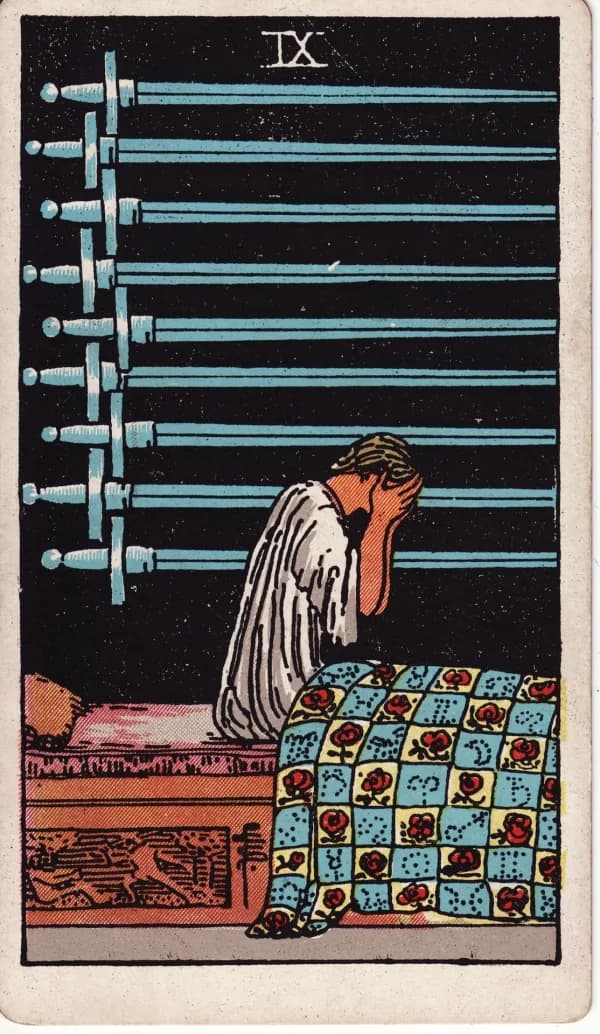
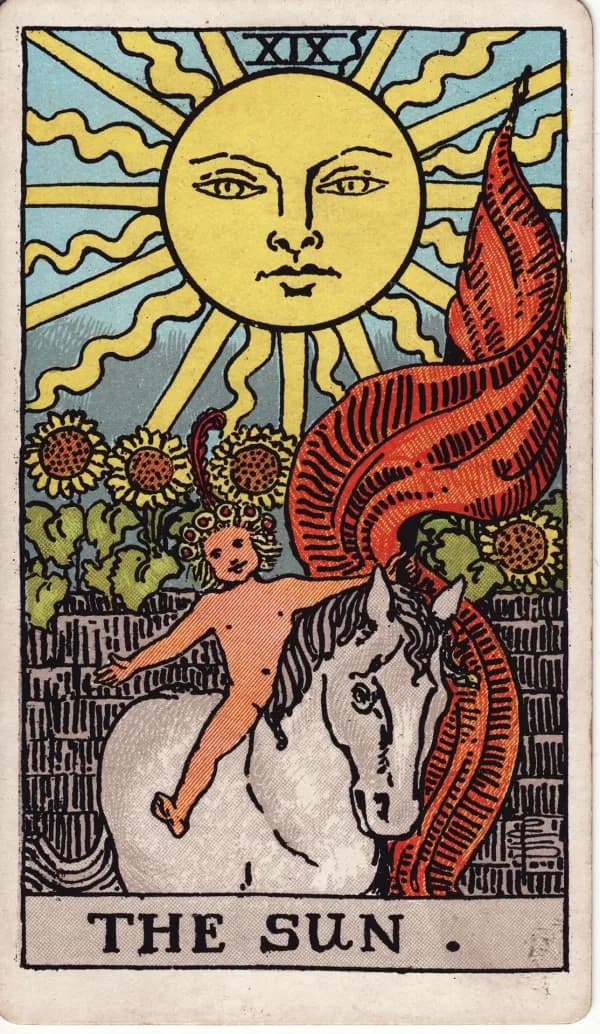
The Nine of Swords and the Sun tarot combination signals worry that won't switch off while your life is going well. One card is a black room: nine pale blades hung over someone sitting up in bed. The other is noon. A sun with open eyes fills the sky over a child on a white horse. Your life may look like the second card. Your mind's still drawing the first.

Climate scientist, ashtanga practitioner, and advocate for human rights and LGBTQIA+ equality.
What each card shows on its own
Every value flips between these two Rider-Waite-Smith cards, starting with the background.
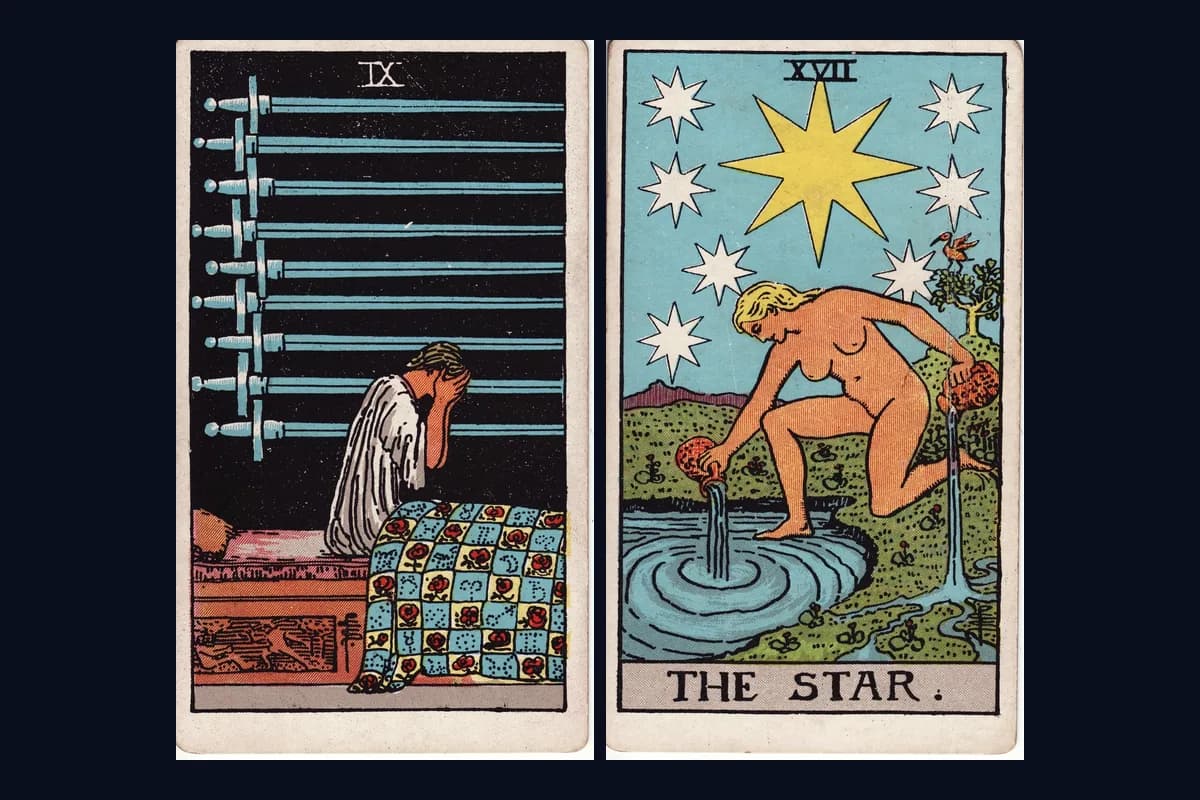
On Pamela Colman Smith's Nine, there's no window and no moon, only black from edge to edge. Nine pale blue swords cross it like the slats of a shut blind. A woman has pushed herself upright in bed, palms pressed to her eyes. Over her knees lies a checked quilt of pale blue and yellow, scattered with red roses. Biddy Tarot points out the carving on the side of the bed: one figure beating another down.
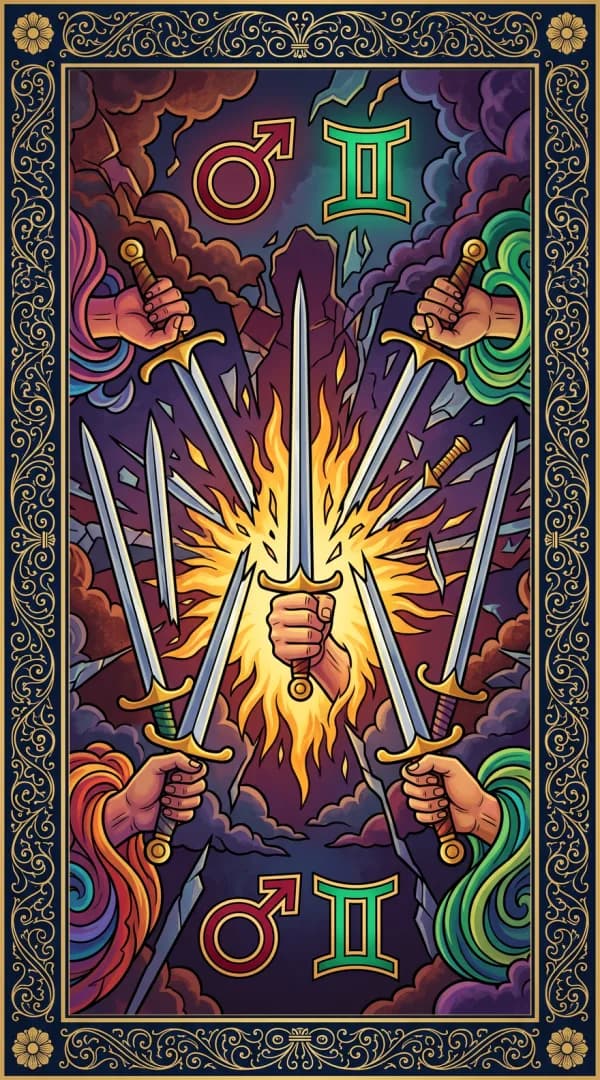
To the Golden Dawn, a Victorian magical order, the card is the Lord of Despair and Cruelty, under Mars in Gemini. Aleister Crowley's The Book of Thoth spells out the despair: "The Ruach consumes itself in this card; thought has gone through every possible stage, and the conclusion is despair." In Qabalah, the Ruach is the conscious, reasoning self.
Crowley's own deck drops the bedroom. His Nine, titled Cruelty, shows nine jagged, rusty blades of uneven length, all striking downward. He gives its mood a job title: "the temper of the inquisitor." That's the inner critic with no body attached.
Now the Sun (XIX).
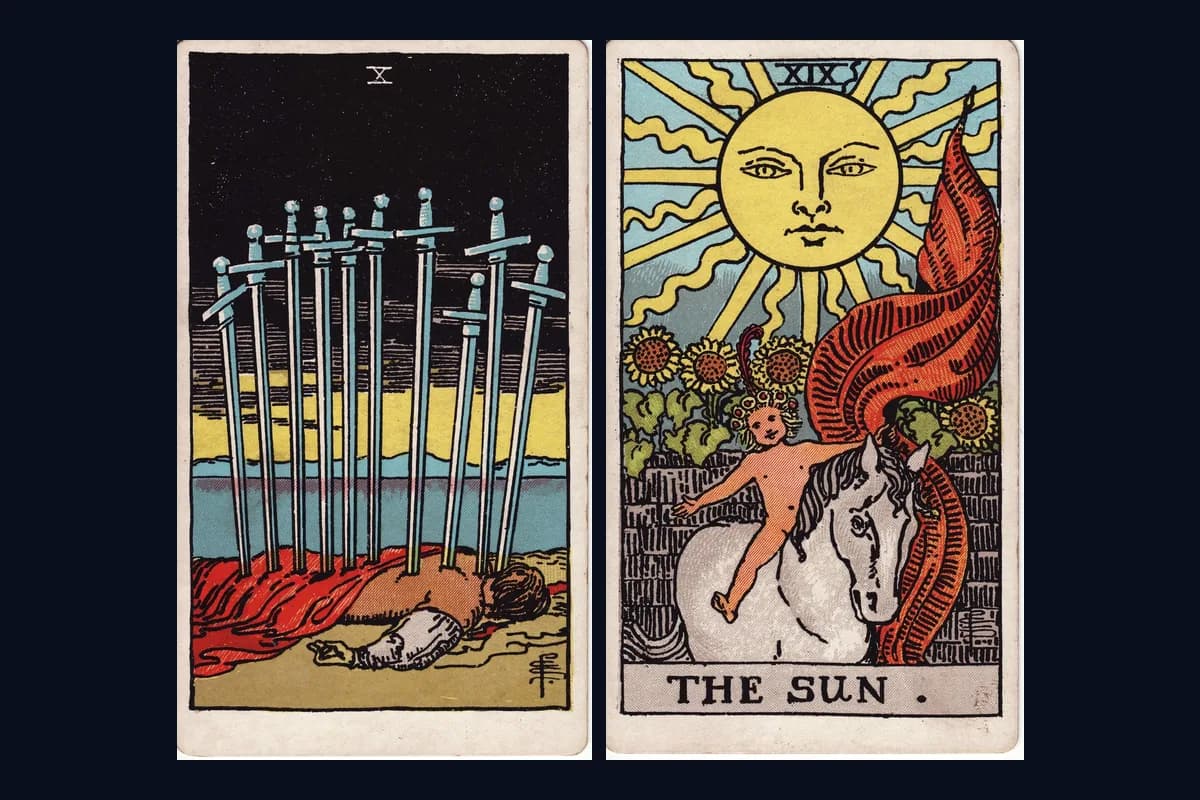
The top third of the card is a yellow disc with a calm human face, set in a pale blue sky. The eyes are open and level with yours. In front of a low gray wall, a naked child with a red feather in his wreath rides bareback, a huge red banner rising beside him. Nothing on this card is hidden.
Its Golden Dawn planet is the Sun itself, and its Hebrew letter is Resh, meaning head. For Rachel Pollack, author of Seventy-Eight Degrees of Wisdom, the person under this card is lucid, "a word which means clear and direct, but which literally means 'filled with light'."
But one of the oldest Suns was quieter. On the so-called Charles VI card, painted in fifteenth-century Italy, a woman holds a distaff and spindle, and Tarot Heritage reads the turning spindle as the sun's daily round. That Sun is an ordinary working day. And the light comes around whether you're ready or not.
If a friend painted your week, would it be the noon or the black room? Which one would you paint?
What the Nine of Swords and the Sun mean together
Both cards are about the mind. Robert Wang, author of The Qabalistic Tarot, gives each Major card a path on the Tree of Life, the Qabalists' diagram of ten spheres. He writes that "the Path of THE SUN is the highest level of the human intellect, as THE STAR is the highest level of the emotions."
The Star meets the Nine through feeling, which is where the Nine of Swords and Star combination takes it: worry easing toward calm. The Sun meets it through thought. The Nine's one face hides behind two hands, and both of the Sun's faces meet your eyes.
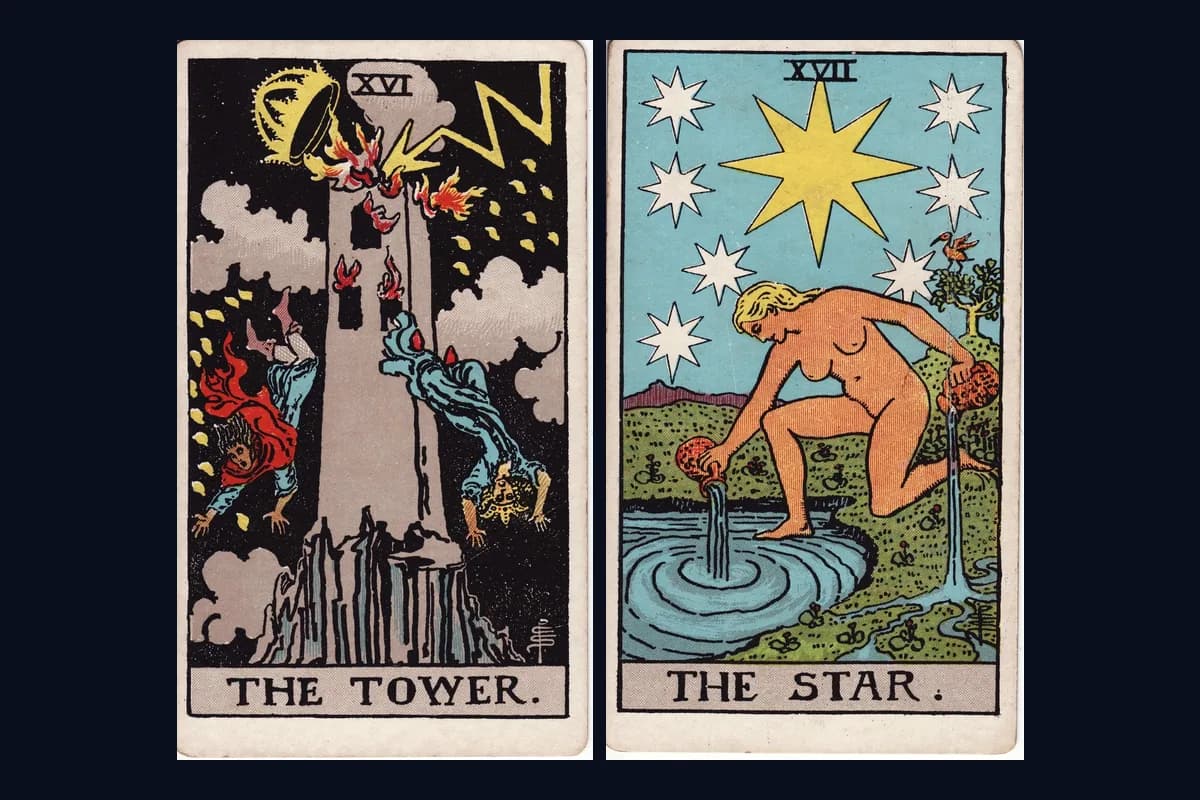
Brigit Esselmont of Biddy Tarot reads a Major card beside a Minor with a simple split: "the Major Arcana card tells you 'what' or 'why' and the Minor Arcana card tells you 'how'." Here, the Sun is the what: the reading says this part of your life is going well. The Nine is the how: you're living it at night, going over what could still go wrong. The Tower and Star combination starts with lightning and a collapse. But no tower falls in this pair.
Where does that thinking come from? Joan Bunning, author of Learning the Tarot, puts it inside you: "What tortures we put ourselves through when our fears and doubts overwhelm us." Tarot author Benebell Wen sees "someone clearly and visibly still shaken by a past injury or disappointment." Both can be true. Dread after good news often has a history. The mind learned to brace.
The Nine of Swords and the Sun say the good news is real, and your mind hasn't caught up with it yet.
The worry is real too. But what it predicts may not be.
Then there's guilt, often about the good itself. Bunning's action lists for the two cards nearly answer each other. The Nine's include "refusing to forgive yourself" and "forgetting joy." The Sun's include "forgiving yourself" and "experiencing joy." The Sun offers the joy, and part of you may still feel you haven't earned it.
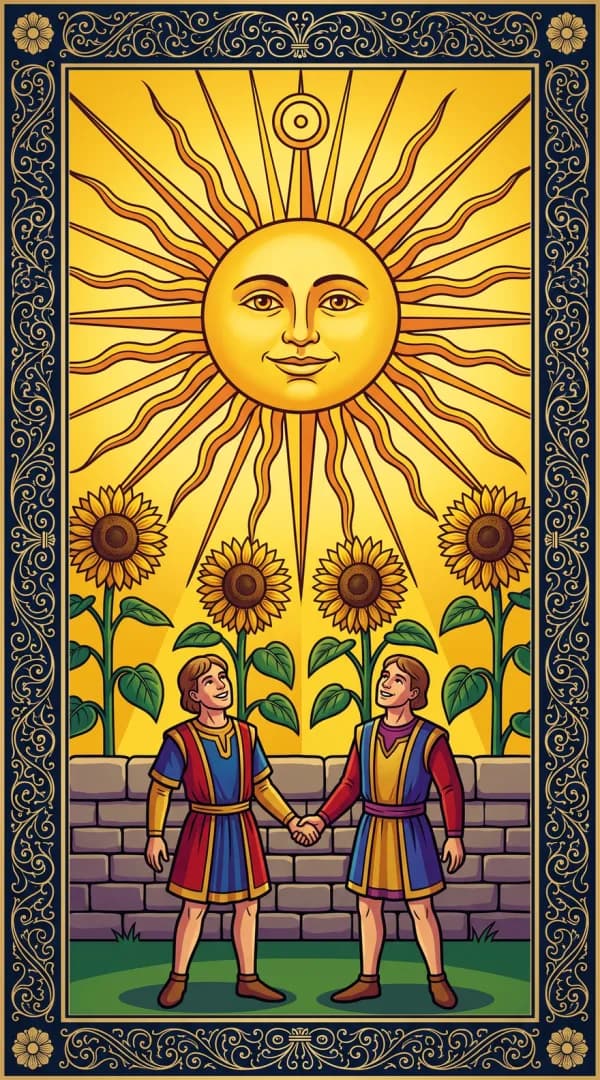
Count the hands on the Golden Dawn pair below. The Nine has five, each a fist around a hilt. The Sun has four, on two boys in tunics, and two of those hands are clasped. One grip won't let go of a blade. The other holds on to someone.
The only fight on either Rider-Waite-Smith card is the one carved into the side of the bed. When your mind argues with good news, whose voice does the arguing sound like?
Readings for love, work, sleep and self-doubt
In a Celtic Cross, A.E. Waite's second card, laid across the first, "shews the nature of the obstacles in the matter." With the Sun underneath and the Nine across it, the matter looks good and the obstacle is the worry about it. Put the Nine in the ninth place, Waite's card for "hopes or fears," with the Sun at the center, and it reads as fear of losing what's going well.
In love readings, the Sun is the relationship as others see it: warm and out in the open. The Nine is what you do with it after dark. You rehearse a breakup that hasn't happened. Their feelings for you? Happy, and scared it won't last.
Not every doubt is anxiety, though. Waite's extra note for the reversed Nine is blunt: "Good ground for suspicion against a doubtful person." If your worry rests on something you saw rather than something you pictured at night, take it seriously. And if a partner frightens you, put your safety first.
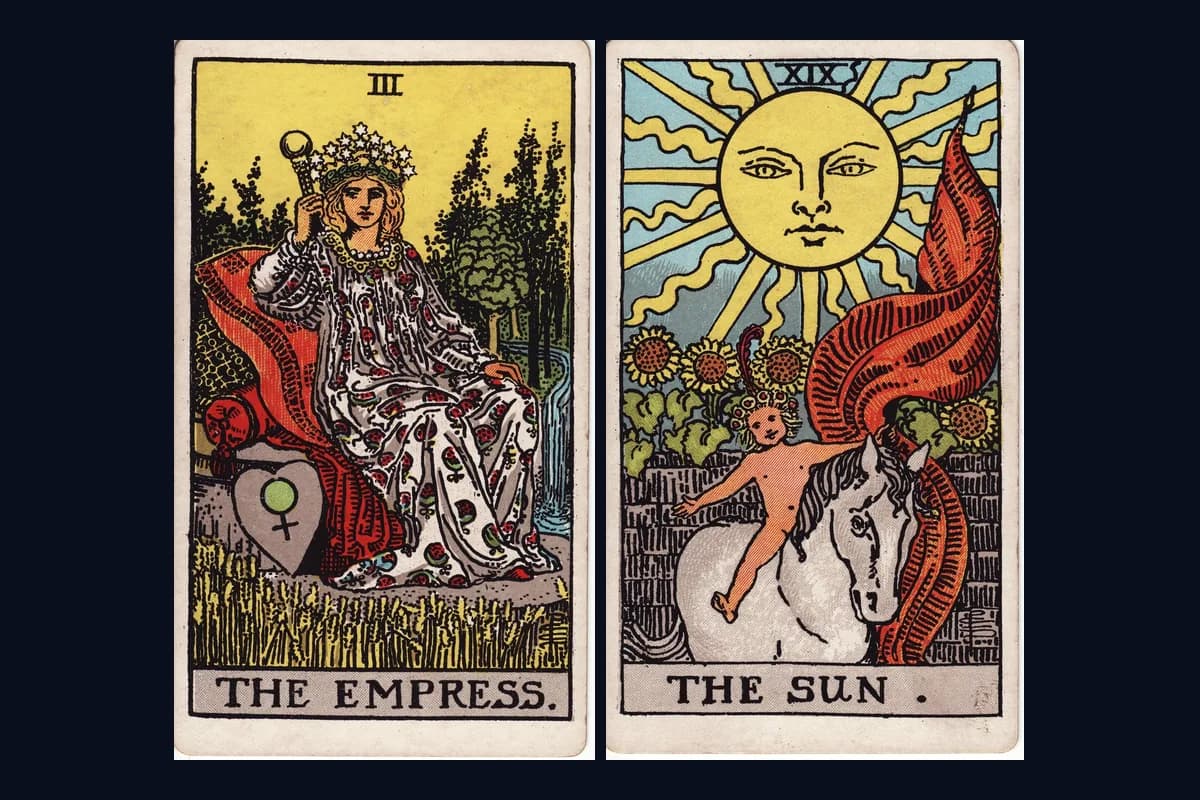
For career questions, it's the good review you can't stop picking apart, the one where the work plainly went well and a voice in your head keeps saying you only got lucky. When the bright thing is work you've made and are about to show, the Empress and Sun combination reads that launch.
When the question is about you, the Nine speaks as the inner critic. Bunning's notes on the card ask, "Have I done enough?" The Sun leans yes here, and the critic won't take it. Try two columns on a page: the critic's charge, then only what you can check.
For health questions, sleep and mood included, the pair reflects bad nights in a good season. It can't diagnose or treat anxiety, insomnia or depression. The cards are not a medical opinion, and a Sun in your spread isn't proof you ought to feel fine. Get anything physical checked. If the worry or the lost sleep has gone on for weeks, or feels hard to control, take it to a doctor or a therapist. If you're in crisis or thinking about harming yourself, call your local emergency number now; in the US, call or text 988.
Yes or no? Yes to the situation, not yet to the calm. Barbara Moore of Llewellyn says the Sun and the aces are "usually read as clear yeses." The Nine leans no, but its no is mostly about your nights, not the thing you asked. So the pair leans yes on the situation, as far as the facts you can check agree. Calm is another matter: not yet, and neither card names a date. With the Sun reversed, it's not yet on both counts, so turn to people now.
Somewhere in your life there's a noon your mind won't let you stand in. Picture it as a card. What's in the sky, and who's riding out under it? That image belongs in your deck.
What changes when the order flips
Nine of Swords first, then the Sun: the hopeful order. Read the second card as the case against the worry, not a forecast: the Sun reads the situation more kindly, and the evidence decides between them.
The Sun first, then the Nine of Swords: the order of dread after good news. The news lands, then your mind turns on it, and a job offer becomes the fear of being found out. This order shows where the worry came in. It doesn't say where things go from here. So the risk is acting on the dread: turning the offer down, or pushing away someone who makes you happy. If something broke after a good stretch, you're closer to the Ten of Swords and Sun combination.
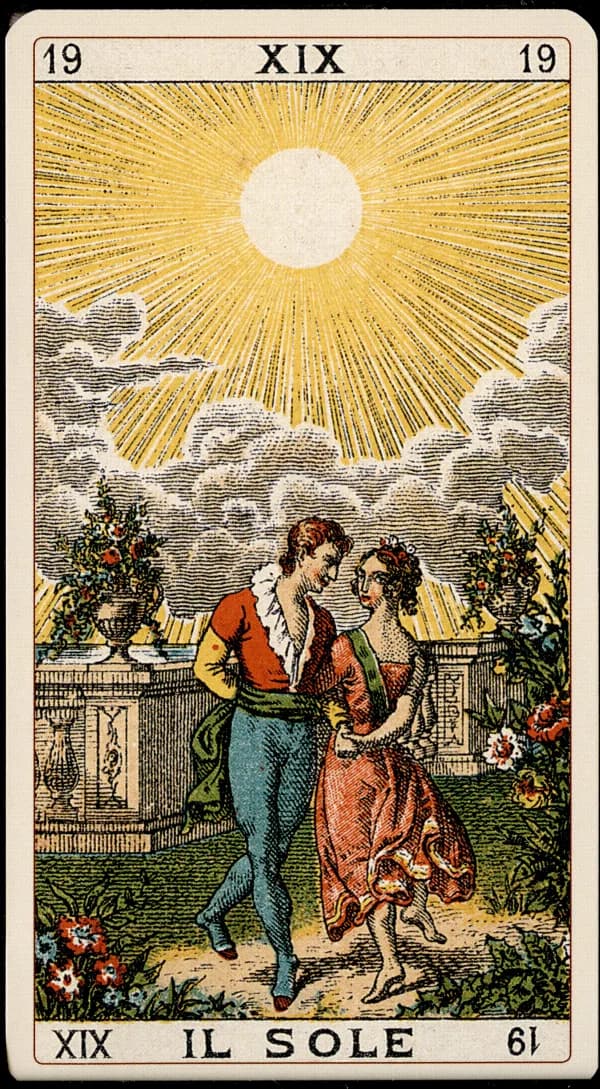
In a three-card spread of past, present and future, the Sun behind you and the Nine now tell that same story. But swap them, Nine behind and Sun now, and the hard stretch may be over while your mind is still keeping watch. With the Nine in the future slot, read it as worry you might carry forward, and work on it now. In every layout, worrying doesn't undo the Sun. On the Milanese Sun below, a bank of gray cloud sits beneath a pale disc, and the rays come through anyway.
Orientation matters too. Not every reader uses reversals. Wen's keyword for the reversed Nine is "Overcoming Fears."
| Orientation | Reading |
|---|---|
| Both upright | Good circumstances and a mind that can't feel them; yes to the situation, not yet to the calm |
| Both reversed | The good dims to meet your mood instead of your mind catching up; flatness can pass for calm, so if it lasts weeks, tell someone and see a doctor |
| Nine upright, Sun reversed | Worry fills the room and hides the good; the hardest of the four, so talk to a friend or a doctor |
| Nine reversed, Sun upright | Worry loosening while the good gets through; the nearest this pair comes to a plain yes, unless a lasting fear points at something real |
In your life, does the worry tend to arrive before good news, or right behind it?
How the planets split night from noon
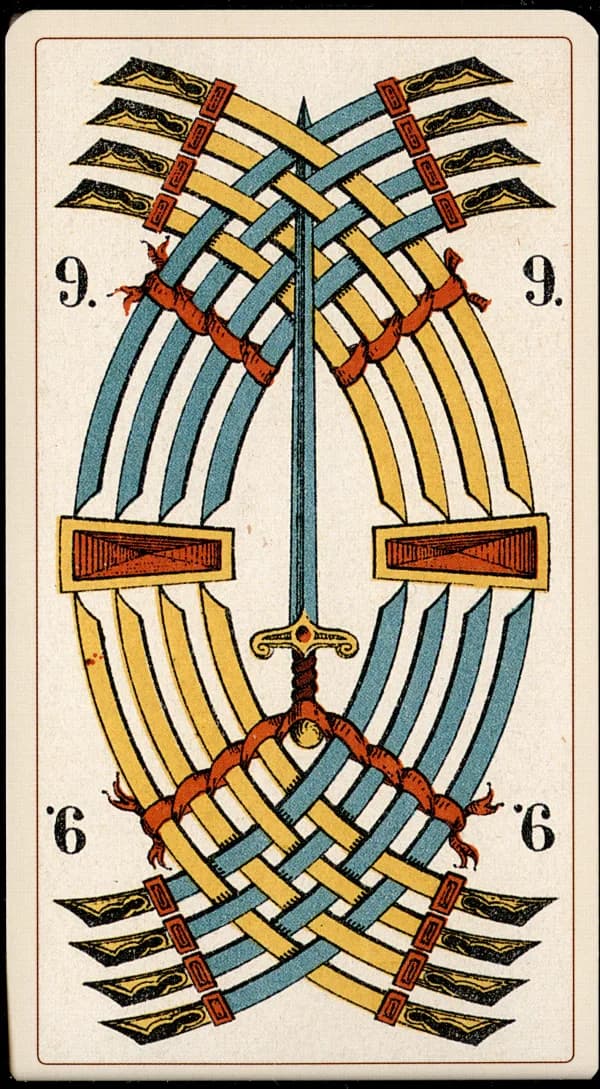
The Nine's Mars in Gemini is a planet that fights, in a sign that thinks out loud. Crowley sums it up: "The card is ruled by Mars in Gemini; it is agony of mind."
Ancient astrology had already put the Sun and Mars on different shifts. It divided the planets into two sects, a day team and a night team. Ptolemy, the second-century astronomer, puts the Sun on the day team. Mars he gives to the night. In the Robbins translation of his Tetrabiblos, the ancients assigned "Mars, which is dry, to the moisture of the night," so the damp dark would temper him. But on the Nine of Swords, the night doesn't temper him at all: the blades still hang in the dark, and the sleeper is still awake.
The Nine's suit is Air; Golden Dawn practice and Wen's table of elements both place the Sun card under Fire. If you read with elemental dignities, the Golden Dawn's rules for how neighboring cards affect each other, Air and Fire are friends, and Wen says the two strengthen one another. That holds for hard cards too. In one of her worked examples, a Two of Swords beside a Nine of Wands, that dignity "results in further aggravation." So here, the good can grow stronger, and the worry can feed on it.
On February 19, 2027 (Universal Time), Mars stands directly opposite the Sun. Astronomers call it an opposition, and the night planet is up all night. It doesn't forecast your nights or your calm.
When things go well for you, does the good news settle your thinking, or give it more to chew on?
The card hiding in the numbers
Add the Nine of Swords to the Sun and you get 28. No Major Arcana card carries that number, so add the digits: 2 + 8 = 10, the Wheel of Fortune, then 1 + 0 = 1, the Magician. But the Sun's 19 reaches that same 1 by itself, so the sum tells you more about the Sun than about the pair. Not every reader adds cards at all.
The nine that matters is the one printed on both cards, IX inside XIX. Pollack reads the 9 in 19 too. "The number 19 suggests a higher level of 9," she writes, and her 9 is the Major Arcana's own, the Hermit. Then: "Here the truth has emerged and the robed stiff Hermit is transformed into a gloriously open child."
The Hermit is the hidden third card. Pollack's passage stays with the Sun, so the step to the Nine of Swords, through the 9 both cards carry, is one you're free to take or leave. And Wen's sample Celtic Cross happens to lay the Hermit across the Nine of Swords.
Picture the Rider-Waite-Smith Hermit: an old man in a gray robe stands on a snowy peak, holding up a lantern under a flat gray-blue sky. Between the Nine's black room and the Sun's open noon, his sky is the halfway shade, and he stands in it with a light of his own.
What's one thing you can see clearly enough to do, even with the Nine still talking?
Questions readers ask about this combination
Does the Nine of Swords and the Sun mean anxiety when life is going well?
Yes, often: beside the Sun, the Nine of Swords reads as anxiety while life goes well, such as dread after good news or guilt about being happy. The cards can describe that gap, but they can't diagnose or treat anxiety. If the worry or lost sleep has gone on for weeks, or you can't rein it in, see a doctor or therapist. In a crisis, contact local emergency services; in the US, call or text 988.
Does the Nine of Swords and the Sun mean I'm too hard on myself?
Paired with the Sun, the Nine of Swords can point to an inner critic that won't accept the evidence: the Sun says things are going well, and you're awake at night arguing with it. Try writing the critic's charge on one side of a page and only what you can check on the other. A worry isn't always wrong: if it keeps pointing at something you actually saw, take it seriously.
What does the Nine of Swords and the Sun mean in a love reading?
In love, the Nine of Swords and the Sun usually read as a good relationship you're living anxiously, not a bad one. The Sun is how it looks from outside; the Nine is what you do with it after dark. Their feelings for you? Happy, and scared it won't last. Not every doubt is anxiety, so trust what you've seen over what you imagine. If a partner frightens you, put your safety first.
What does it mean when the Nine of Swords and the Sun are both reversed?
With the Nine of Swords and the Sun both reversed, the good news can dim to match your mood instead of your mind catching up with it, while the worry eases or just goes quiet. That can pass for calm. If that muted feeling lasts for weeks, tell someone close and see a doctor, because a reading can't tell low mood from a quiet patch.
Is the Nine of Swords and the Sun a yes or no combination?
The Nine of Swords and the Sun say yes to the situation, not yet to the calm. Asked whether things are going well, the pair leans yes, because the Sun is usually read as a clear yes, but let the facts you can check decide. Asked whether you'll feel at ease, the pair says not yet, and neither card names a date. With the Sun reversed, it's not yet on both counts, so turn to people you trust.