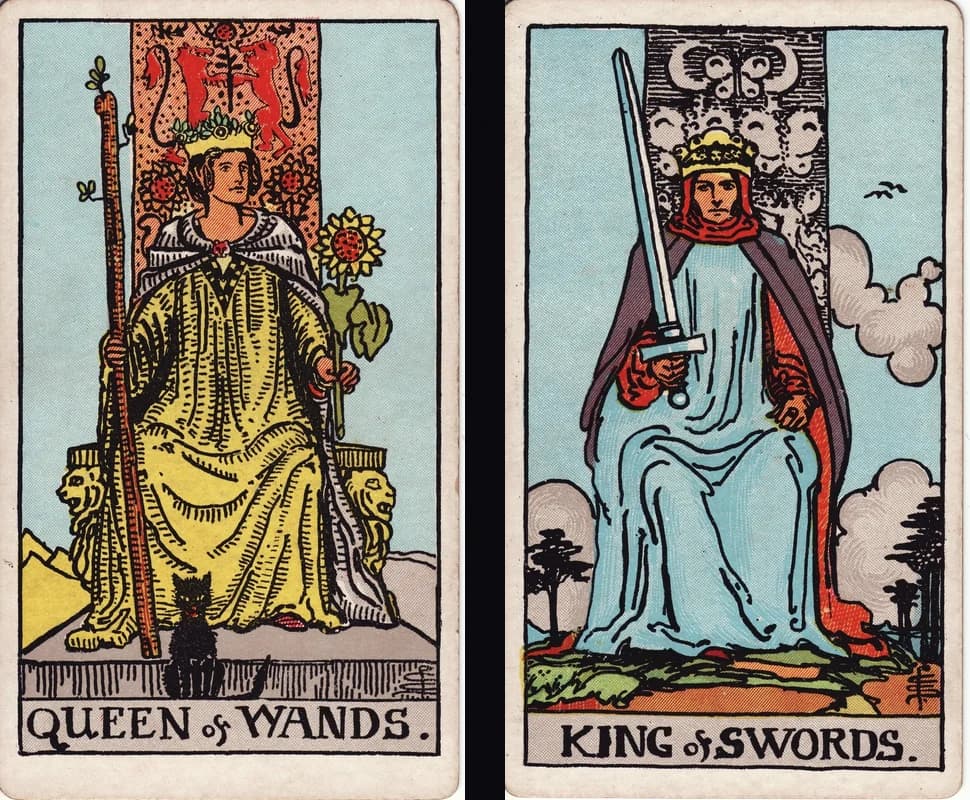
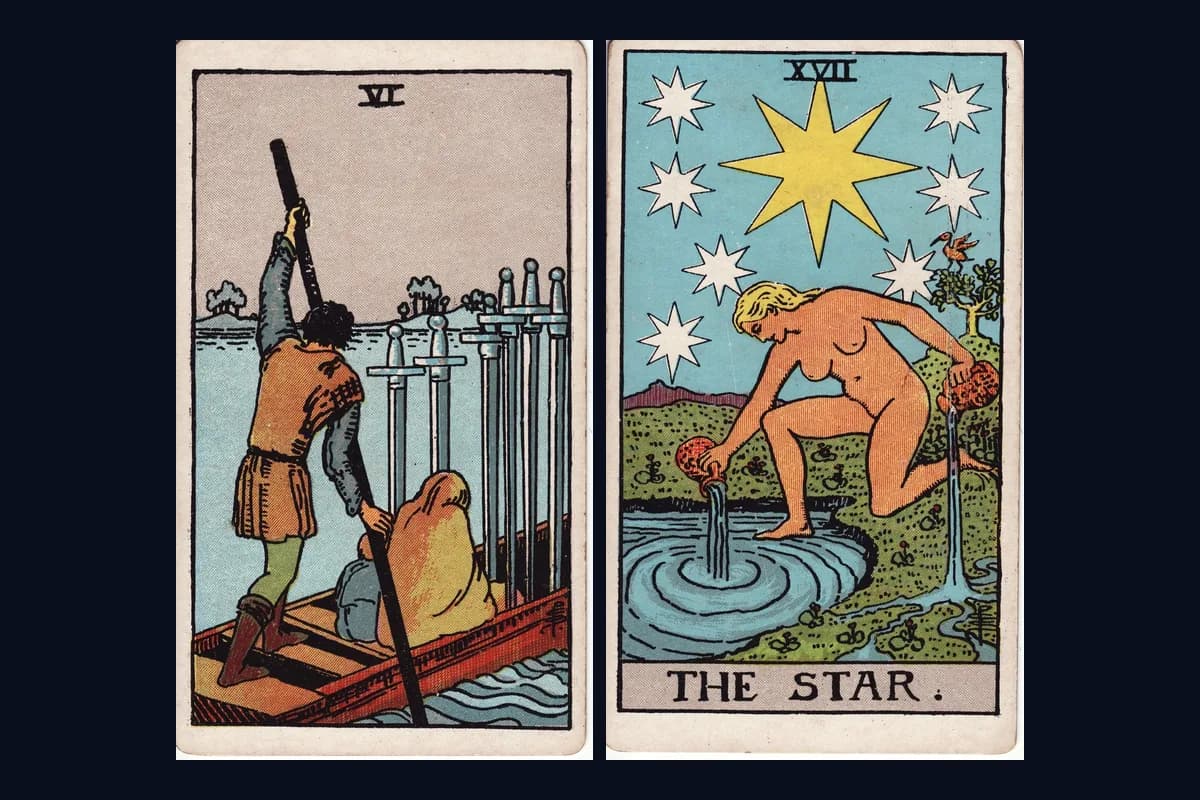
Tarot Card Combinations
The Empress and The Sun
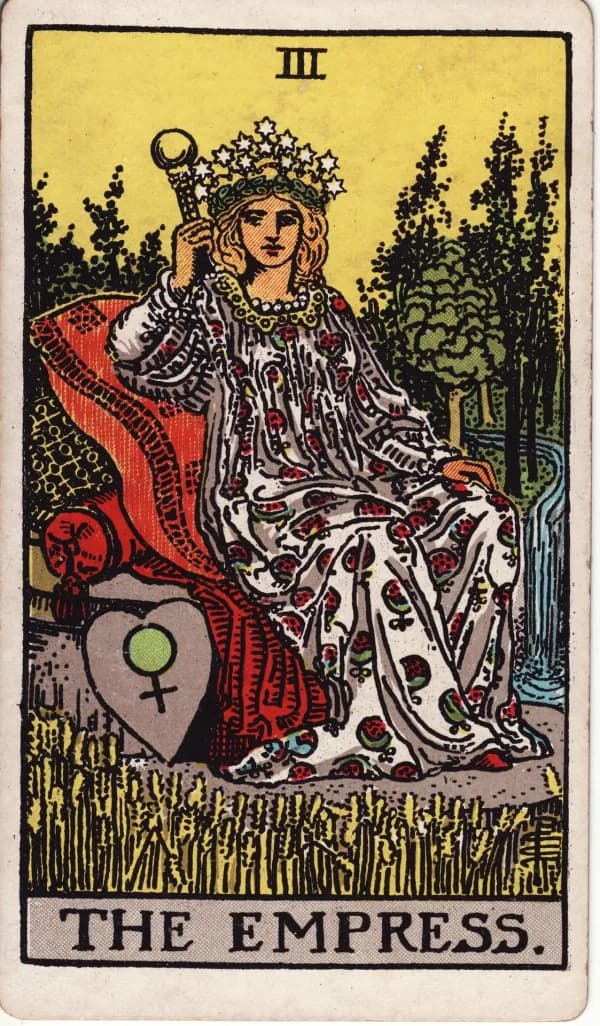
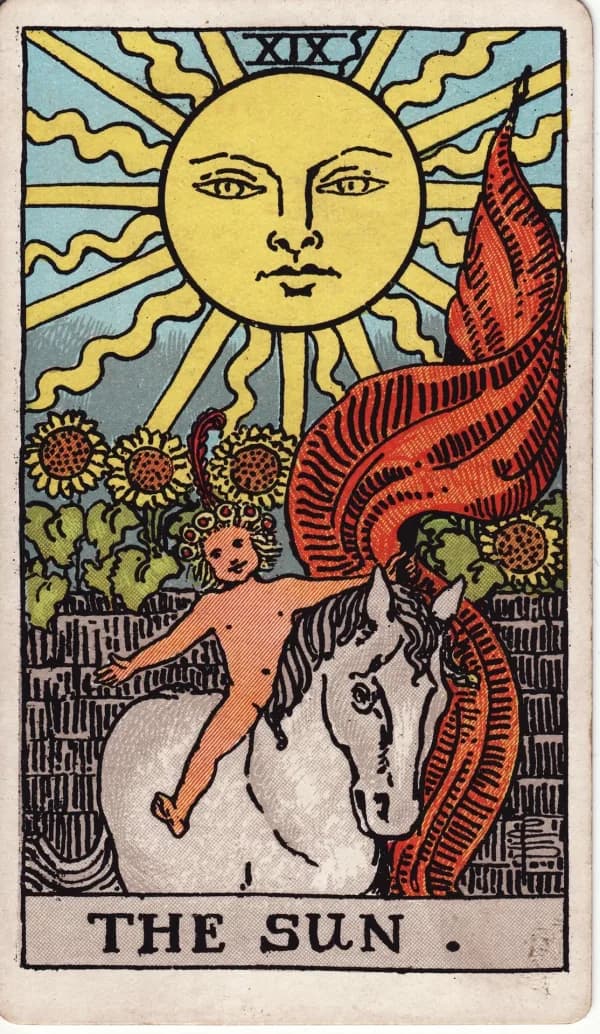
The Empress and Sun tarot combination signals abundance in full bloom. A woman crowned with twelve stars sits under a yellow sky, wheat ripening at her feet. Opposite her, a naked child rides a white horse below the sunflowers. Two warm golds. Nothing clashes. Asking about a pregnancy? That's for a test or a midwife, not a card. What have you been tending, and who gets to see it?

Climate scientist, ashtanga practitioner, and advocate for human rights and LGBTQIA+ equality.
Each card on its own, in the same warm light
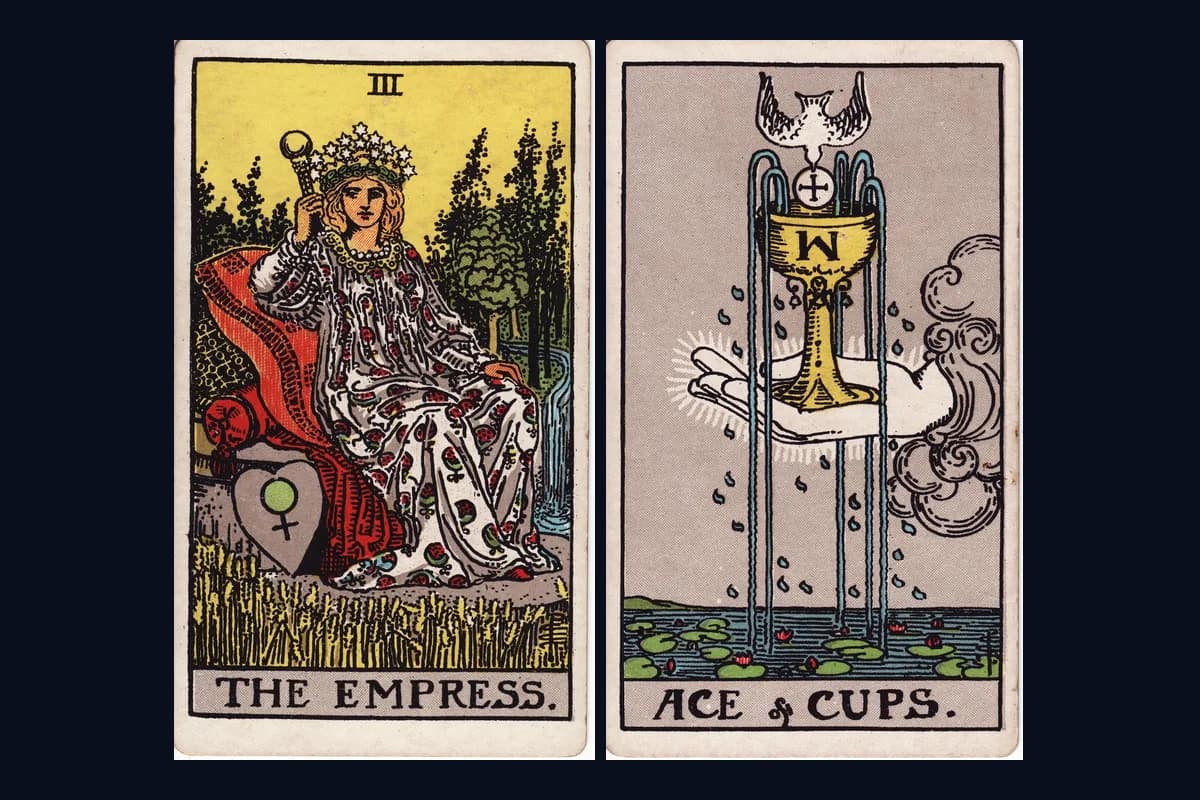
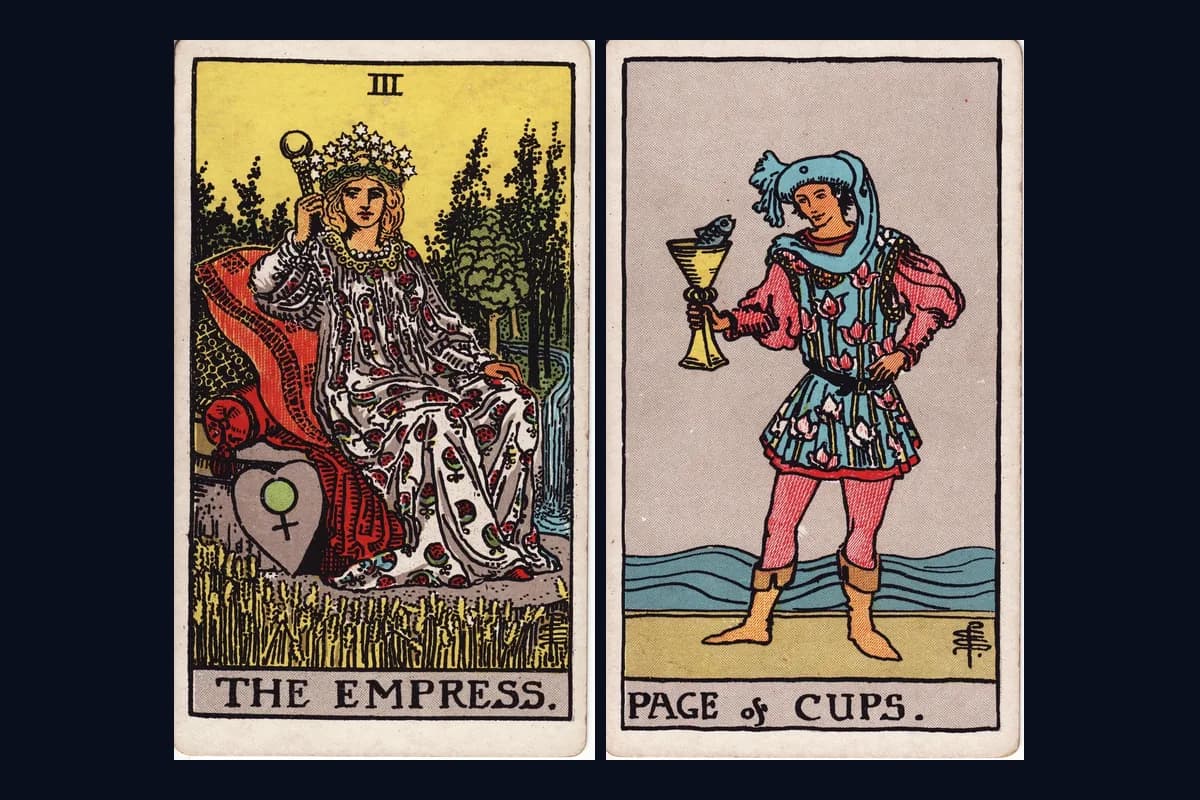
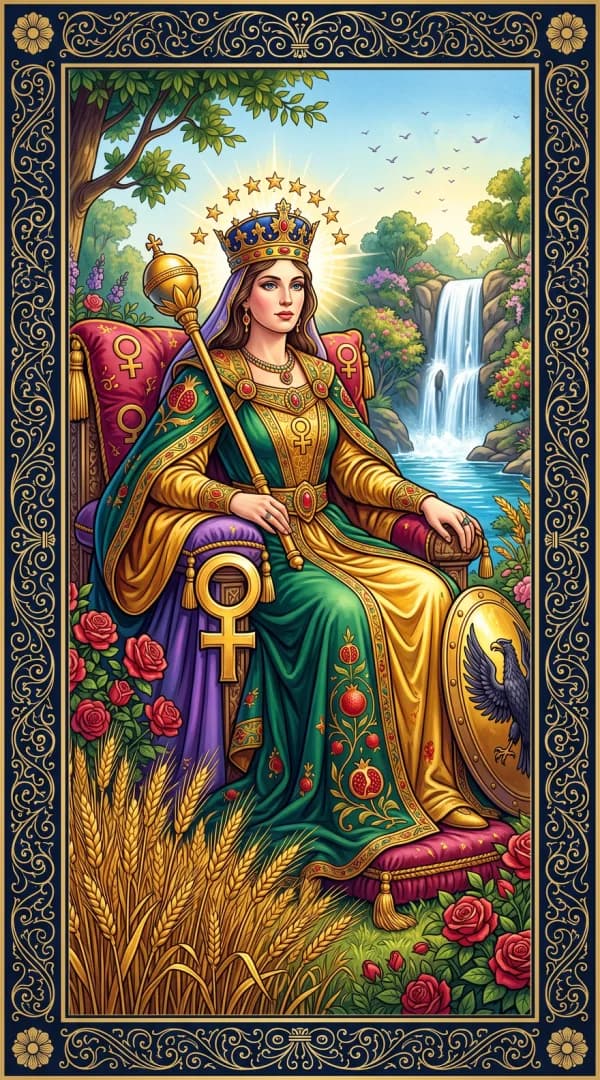
Look at the Rider-Waite-Smith Empress, and let the color reach you first. Her whole sky is a flat, warm yellow. The wheat across the bottom of the card is the same gold. Then come the reds: the cushions she leans on, the pomegranates printed on her white gown. A.E. Waite, who wrote the guide to this deck, gave her a diadem of twelve stars. Count them. They'll matter later.
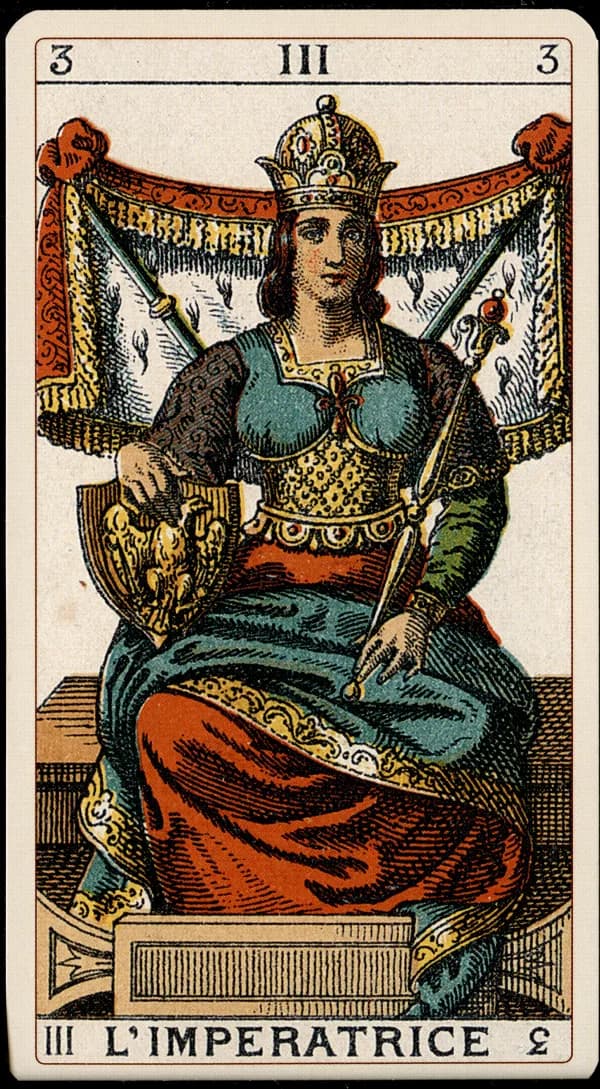
Rachel Pollack, in Seventy-Eight Degrees of Wisdom, traces the wheat to a goddess who "ruled agriculture, and in North-Western Europe was called the 'Corn Goddess'." The Empress is card III. The Golden Dawn, the magical order whose symbols shaped the deck, gave her Venus and the Hebrew letter Daleth, the door.
But the order's own Empress was sterner. Robert Wang, in The Qabalistic Tarot, describes a version where "she holds an orb of the Sun, meaning that she dominates the Heavens," a queen who "can destroy as well as create." The modern Golden Dawn card in section II carries an orb and cross instead, the Marseille emblem that Wang reads as rule over the Earth.
Now turn to the Sun.
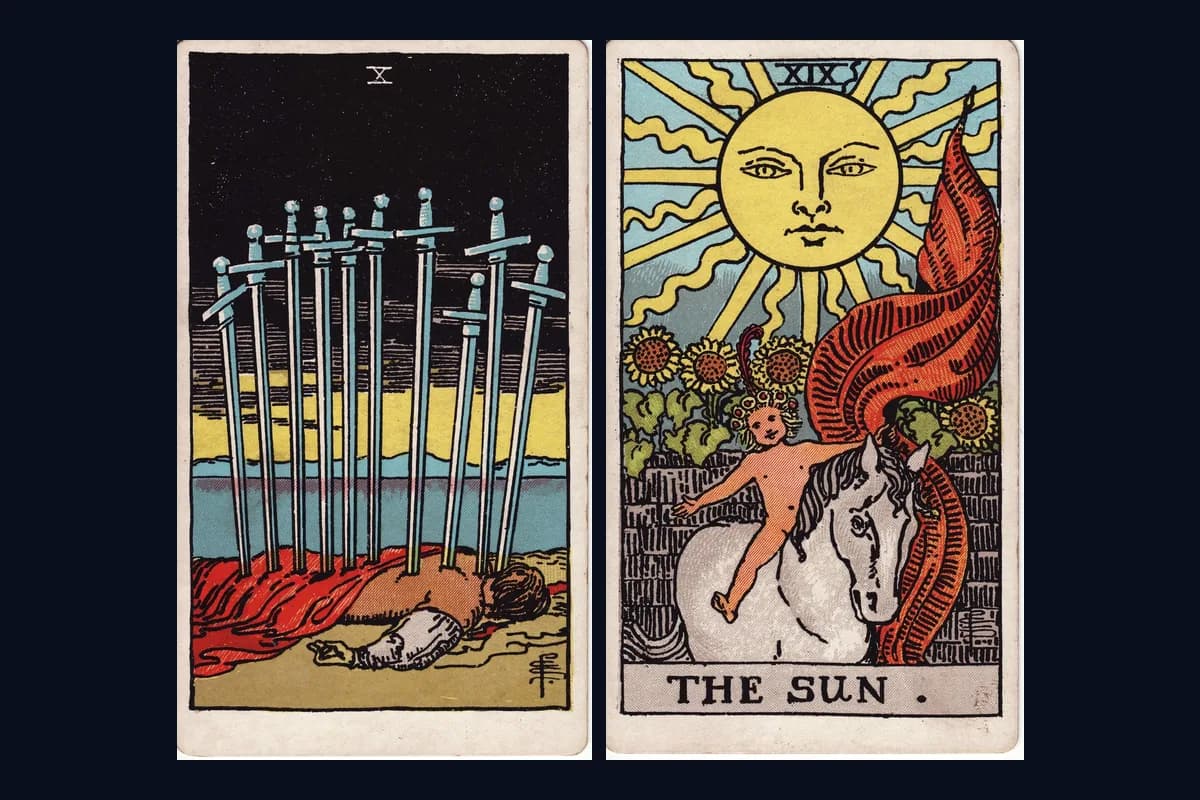
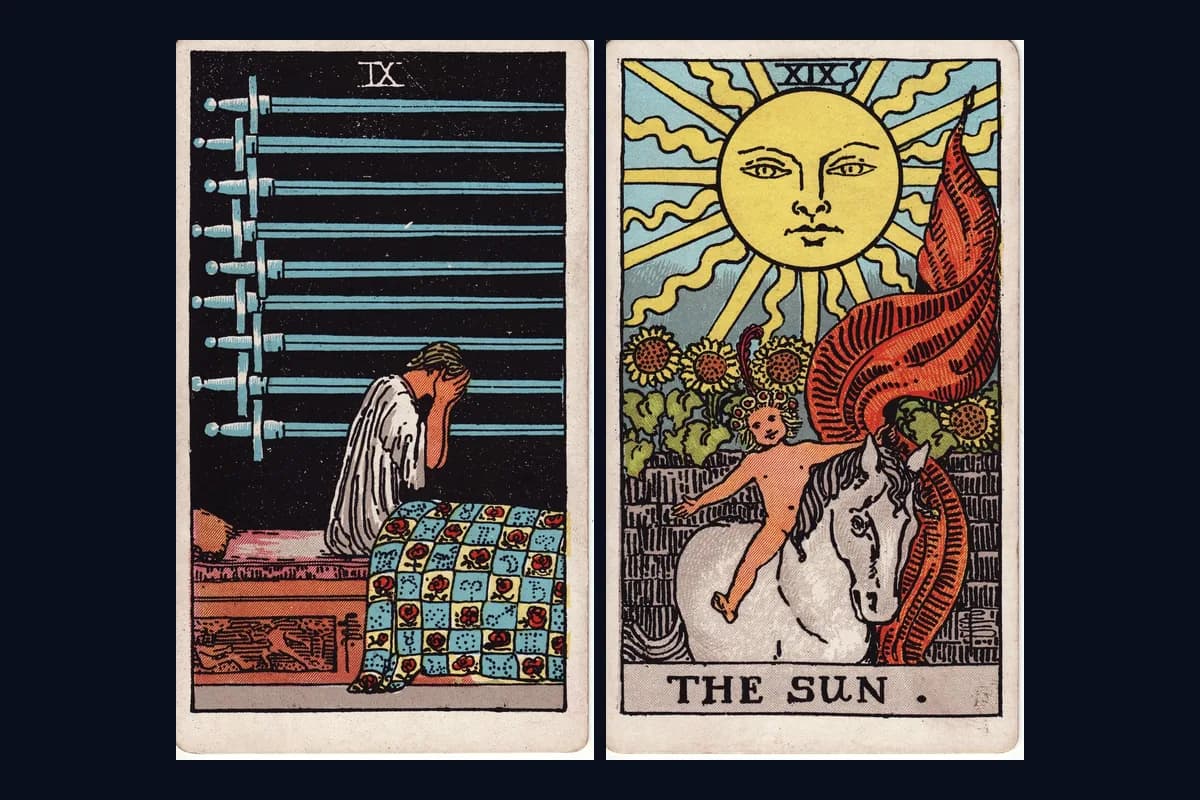
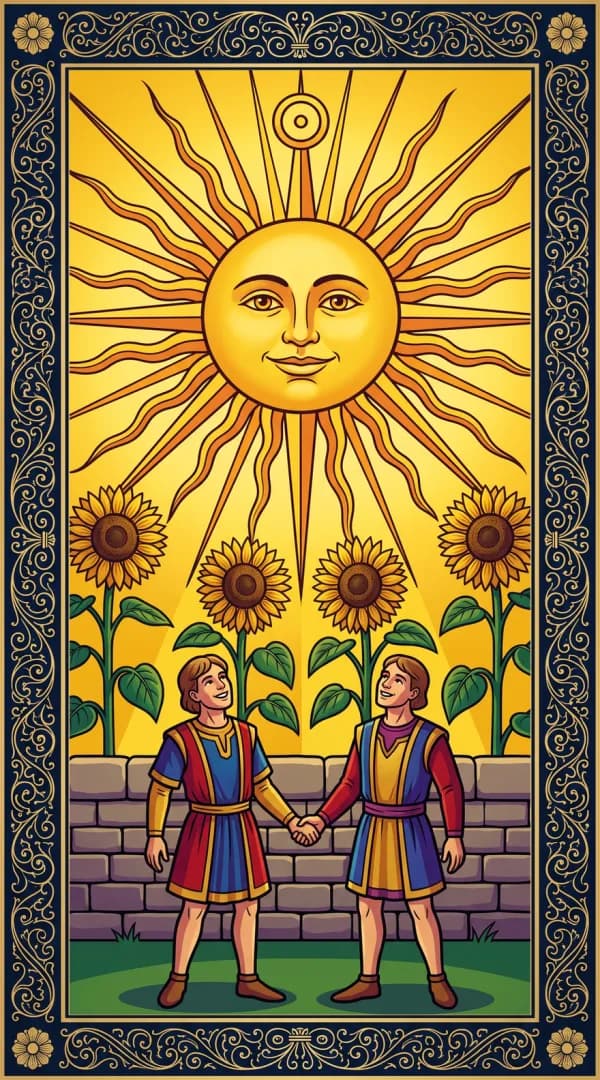
Here the gold gathers in two places. The sky is pale blue, and the yellow sits in the sun itself, a round face ringed with straight and wavy rays, and in four sunflowers over a gray wall. In front of the wall, a naked child rides a white horse bareback, flowers and a single red feather in his hair. A red banner rolls out beside him, the same red as the Empress's cushions.
It's card XIX. The Golden Dawn gave it the Sun itself and Resh, the head. Waite reads the card as a passage from the sun of this world to a light that "is typified by the heart of a child." Pollack keeps it plain: "The card signifies joy, happiness, and a great sense of the beauty of life."
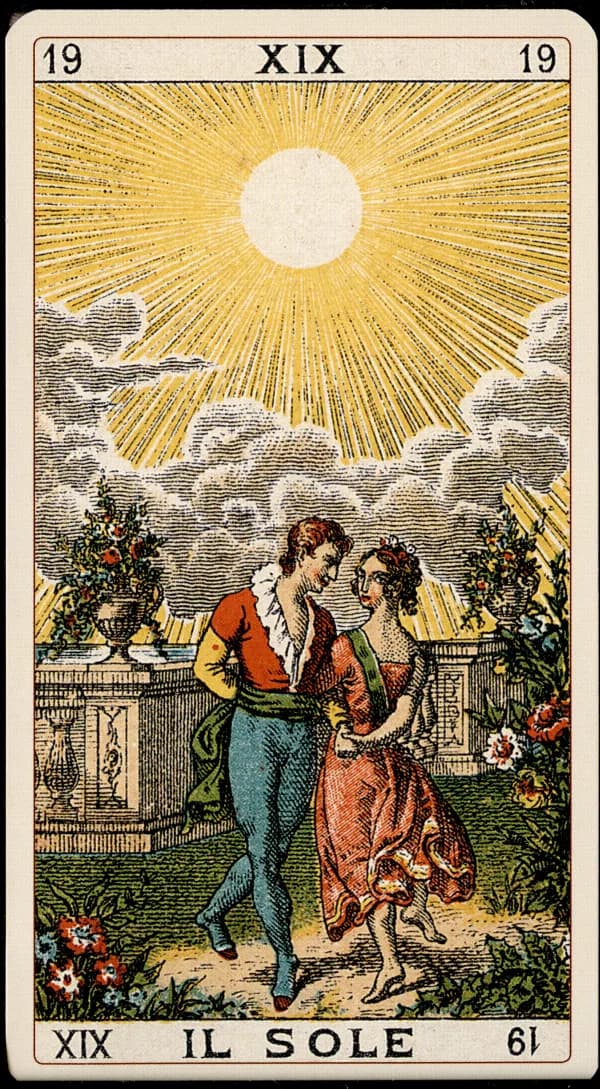
But the child wasn't always alone. Older Suns put two children in front of that wall, and the Milanese Sun in section IV shows a young couple in a garden instead. Sherryl E. Smith of Tarot Heritage traces that couple to Carlo Della Rocca's 1835 Soprafino deck. In that line of cards, the joy belongs to two adults. Waite's 1909 deck picked the lone rider.
Put yourself on one of these two cards. Are you on her red cushions while the wheat comes in at its own pace, or bareback on the white horse, where anyone can see you?
Why the Empress and the Sun belong together
These two share something most pairs don't: one card is written into the other. Waite says that in certain aspects the Empress has been "correctly described" as "the woman clothed with the sun." The phrase comes from the Book of Revelation, where that woman wears a crown of twelve stars: the Empress's diadem. Wang calls her "the Mother of the Sun."
And both cards are gardens. Waite calls the Empress "the inferior Garden of Eden, the Earthly Paradise." On the Sun, he sees a light "coming out from the walled garden of the sensitive life." The mother is the garden. The child is what rides out of it, into full view.
Two Major Arcana cards make a life theme, not a passing mood: what you're raising, whether that's a child, a household or a body of work. Kerykeion's Learn Tarot guide sums up the pair in one line: "One tends the garden; the other lights it with full, generous warmth."
What you've been tending is ready to be seen. The Empress did the slow part, out of sight. The Sun is when other people see it: a child's first good year at school, a book with your name on the spine. For a pregnancy question, read the pair for the life around you: the help you have and the room you're making in your days. Only a test, a doctor or a midwife can tell you how your body is doing.
Tarot usually teaches by contrast. This pair doesn't. Wheat gold on one card, sunflower yellow on the other, and the two don't fight. So the risk here is too much heat. Wang warns about the Sun card: "it is a sun at which one cannot look directly without suffering damage." In a family, that's the calendar with no empty evenings. In creative work, it's the burnout after the launch. When the launch goes well and you still can't enjoy it, the Nine of Swords and Sun combination reads that.
Think of something you've looked after for a long time, a child or a piece of work. What would it take to let it ride out of the walled garden?
What the pair says about family, pregnancy and creative work
In a Celtic Cross, the Empress beneath you and the Sun crowning you put wheat underfoot and sun overhead. Waite's card beneath is "that which has already passed into actuality," and his crown is "the best that can be achieved under the circumstances, but that which has not yet been made actual." The care is real. The bright part is what you're reaching for. And if the Sun is your outcome card, an Empress pulled as a clarifier (an extra card drawn to explain another) names what feeds that light: steady care, given and received. None of this forecasts a pregnancy.
When the question is about children and family, this is the pair at home, a good season for the people under your roof: a child finding their feet, a house that's louder and happier. Theresa Reed, The Tarot Lady, says that, depending on the question, the Sun may be advising you to "put children first." Family here includes children adopted or placed with you, stepkids and the friends who became family. If the news is still small and new, the Empress and Page of Cups combination reads that earlier stage.
For pregnancy and health questions, the cards are not a medical opinion, and if your question is about your body, talk to someone who went to school for it. No reading stands in for a doctor, a midwife or a test. Angelorum, a tarot site, files this pair under "A Healthy Pregnancy" and warns on the same page that "you should never use the cards in place of a medical health care professional." Start with the Empress and Ace of Cups combination if you're hoping to conceive.
After a loss, or after years of trying, a pair this sunny can be hard to look at. A bright draw doesn't promise a baby, and a dim one wouldn't mean you'd failed. If you're pregnant and something feels wrong, call your midwife or doctor right away, whatever the cards showed. The same goes for a low mood that won't lift after a birth. If it ever includes not wanting to be here, contact a crisis line or emergency services now.
For creative work and career, the light is easier to read. Call this the launch pair: the drafts and the tenth version nobody saw, then the day the work goes public. Aleister Crowley saw in the Empress and her consort, the Emperor, "both the initial perfection of Nature and the final perfection of Art." The pair marks work that's ready to go out, not a sales forecast.
In love readings, it's a bond that feels like home and starts to look like one from outside. Waite's list for the Sun includes "fortunate marriage." Single? Interest that doesn't hide.
If you're asking yes or no, this is about as warm as two cards get, with one limit: the pair answers questions about readiness, not about what a body will do. Ready to grow the family, or finally show the work? Upright, yes, as long as you keep up the care that got you here. With a card reversed, give the dimmer side some attention first. On pregnancy itself, no draw can answer yes or no.
Picture your own Sun card. What is it shining on: a crowded table, or something you made? And who's standing in that light with you? That image belongs in your deck.
How order and orientation change the pair
The Empress first, then the Sun is the hopeful order, and it's the deck's own order: III before XIX. Care first, light after. In a three-card spread of past, present and future, the Empress behind you and the Sun in the present mean something you started a while ago is in full sun now. With the Empress now and the Sun ahead, keep tending. Did your Sun come after a hard fall instead of a season of care? That's the daylight in the Ten of Swords and Sun combination.
The Sun first, then the Empress is the cautionary order. The joy arrives before the groundwork. A sweet, fast relationship starts talking about a family. A bright idea gets announced before the year of slow work it needs. Nothing's wrong with the happiness. But the Empress asks what will keep it fed once the excitement wears off.
Orientation matters too. Not every reader uses reversals. Waite's whole entry for the reversed Sun, in The Pictorial Key to the Tarot, reads: "The same in a lesser sense." Every row below describes care and mood, never a body.
| Orientation | Reading |
|---|---|
| Both upright | Care and light at full strength; what you've tended is ready to be seen, so enjoy it and keep tending |
| Both reversed | The warmth is still there, turned down low; rest, take the help on offer and come back to the question later |
| Empress upright, Sun reversed | The care is steady, but the light is dim; worry or tiredness is muting the joy, so look after your mood as closely as everything else |
| Empress reversed, Sun upright | The joy is real, but the care is worn thin or wound too tight; rest the one doing the caring, and give the people you tend more room |
Which came first for you, the care or the joy? And if one card turned up reversed, is it the field or the sky that needs you now?
Why Venus and the Sun never pull apart
You've met the two planets already: Venus for the Empress and the Sun for the Sun card, both from Book T, the Golden Dawn's tarot manual. The Sun rules Leo, a Fire sign, so the Sun card is Fire. Modern readers file the Empress under Earth because Venus rules Taurus, an Earth sign.
Do Fire and Earth get along? In elemental dignities, the Golden Dawn's rules for how neighboring cards strengthen or weaken each other, Book T calls them friends. The sky goes further.
Seen from Earth, Venus never strays more than about 48 degrees from the Sun. So these two can never square off at 90 degrees or face each other across the sky. Of the major aspects, the angles astrologers read between planets, the only one they can make is the conjunction: side by side. It's the two golds again: an analogous palette, colors that sit next to each other on the color wheel.
On January 3, 2027, Venus stands about 47 degrees from the Sun in the morning sky, close to the widest they ever get. Then the gap closes. From July 27 to August 20, 2027 (Universal Time), Venus and the Sun share Leo, the Sun's own sign. On August 12, 2027 (August 11 in the Americas), Venus passes beyond the Sun at 19 degrees of Leo.
There's one catch. For weeks around that meeting, Venus is lost in the Sun's glare. And then she comes back as the evening star. In a happy house or a project that's going well, the steady tending can disappear into all that light the same way. Those weeks set no date for anything, and no sky can time a pregnancy.
Who does the unglamorous jobs where you live or work, and when did anyone last thank them for it?
What the mother and the child add up to
Add the Empress's 3 to the Sun's 19 and you get 22. No card in the Rider-Waite-Smith deck carries that number. The Fool is printed with a 0, but some readers count him last instead of first. Mary K. Greer describes a way of adding cards that never reduces a total of 22 or below. And 22 is the Fool.
Put him next to the pair. The Rider-Waite-Smith Fool steps out under a yellow sky like the Empress's, with a white sun behind him and a red feather in his cap, like the Sun's child. Waite says that sun "knows whence he came, whither he is going." So a mother card and a child card add up to a first step, and that card already has a sun in it.
Card sums are a reader's habit, not a law. Read this one as readiness. If your question is about a family or something you're making, 22 points at your willingness to begin. It doesn't say when, and it can't tell you how things turn out.
There's a second 22 on the Sun card itself. Wang counts "twenty-two rays in Waite's card," one for each path on the Tree of Life, the Kabbalists' map of ten spheres.
Reduce 22 to one digit instead and you get 4, the Emperor, the card of walls and rules. Crowley wrote of his own Sun card in The Book of Thoth: "The limitation of mundane law, which is always associated with the number Four, has disappeared." Both Suns keep a wall, and on Waite's, the child is already out in front of it. You build the 4 so that what you're raising has room to outgrow it.
The Fool doesn't wait for a map. What in your life feels ready to begin, even before you can see all of it?
Questions readers ask about this combination
Does the Empress and the Sun mean a healthy pregnancy?
No card can confirm a pregnancy or see how one is going, and that includes the Empress and the Sun. Angelorum, a tarot site, lists this pair as a sign of a healthy pregnancy. What the pair describes is the life around the question: care already given, and room for joy. The cards are not a medical opinion. A test tells you whether you're pregnant, and a doctor or midwife can tell you how it's going.
What does the Empress and the Sun mean for family and children?
For family questions, the Empress and the Sun are the pair at home: a good season for the people under your roof, and care that other people can now see, like a child's first good year at school. Family here includes children adopted or placed with you, stepkids and the friends who became family. The main risk is too much heat, a calendar with no empty evenings. The pair describes the household, not what a body will do.
What does it mean when the Empress and the Sun are both reversed?
With the Empress and the Sun both reversed, the warmth is turned down low rather than gone. The care feels worn thin and the joy is muted. Rest and take the help on offer, then come back to the question later. If you asked about a pregnancy, the reversal says nothing about your body, so don't let it delay a test or a call to your doctor or midwife. Not every reader uses reversals.
What element connects the Empress and the Sun?
No single element: the Sun card is Fire because the Sun rules Leo, and modern readers file the Empress under Earth because Venus rules Taurus. The Golden Dawn gave her the planet Venus rather than an element. In elemental dignities, the Golden Dawn's rules for how neighboring cards affect each other, Fire and Earth are friendly. In the sky, Venus never strays far from the Sun.
Is the Empress and the Sun a yes or no combination?
Upright, the Empress and the Sun lean yes when you're asking whether you're ready for something new, like a family plan or a creative project you've been tending. The condition is that you keep up the care that got you here. With one card reversed, give the dimmer side some attention first. On pregnancy, the cards can't say yes or no; that's a question for a test, a doctor or a midwife.