Tarot Card Combinations
The Empress and Ace of Cups
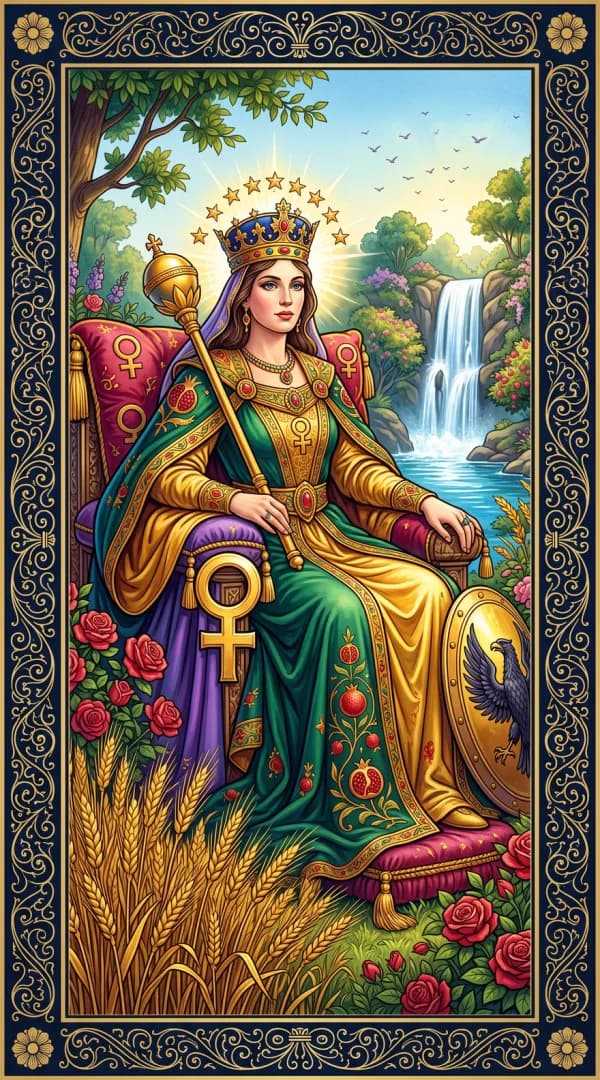
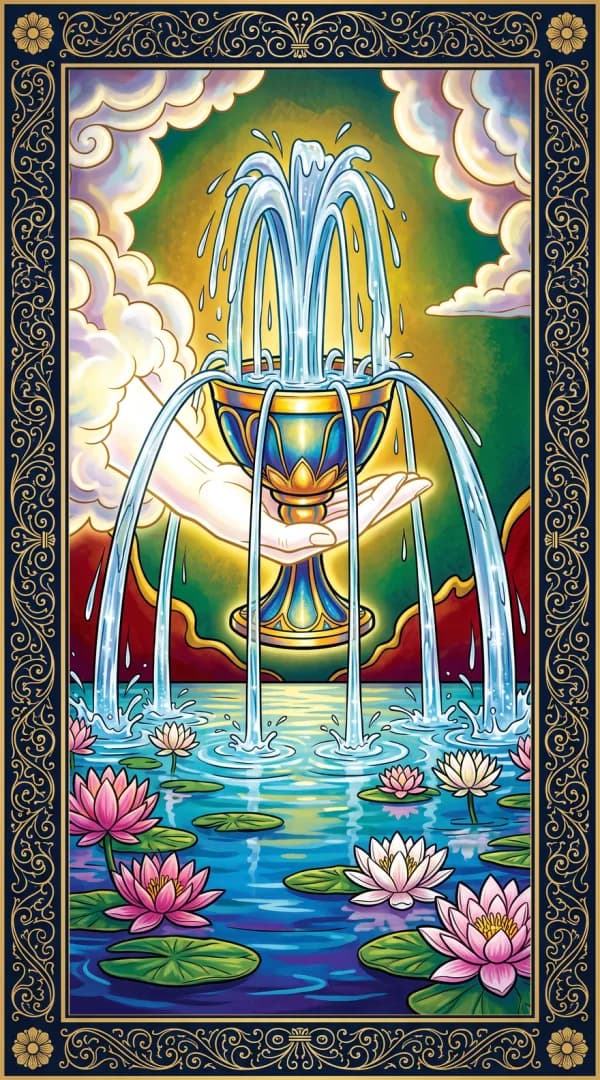
The Empress and Ace of Cups tarot combination asks what's ready to be born. Five streams spill from a gold cup into a lily pond, and across from it, the Empress sits in a pomegranate-print gown behind a thick stand of wheat. Teal water, ochre ground. If you're asking about a pregnancy, these cards can't confirm or deny one. So where is the water landing for you?

Climate scientist, ashtanga practitioner, and advocate for human rights and LGBTQIA+ equality.
What each card means before they meet
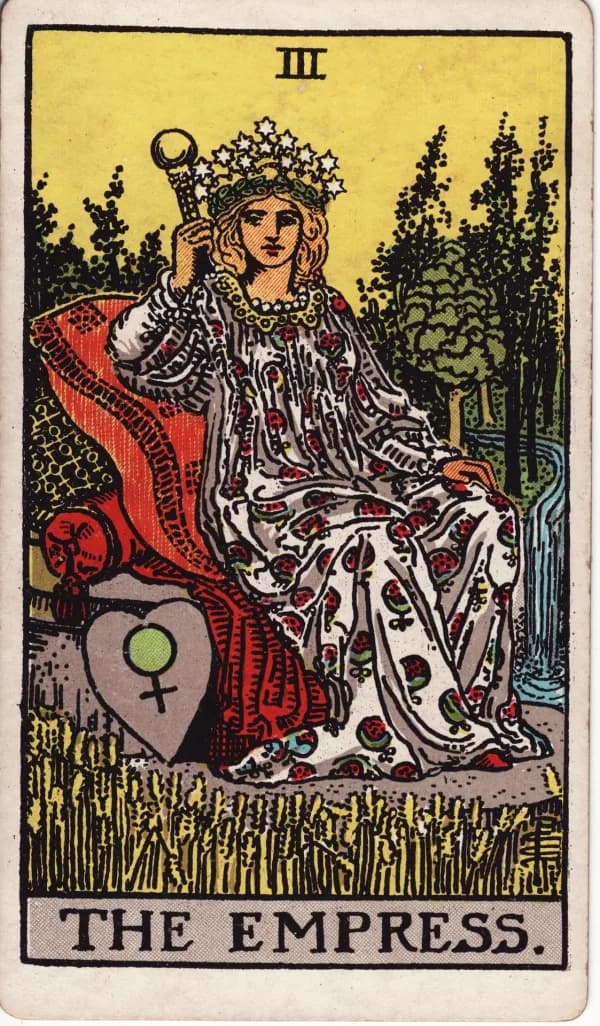
Look at the Rider-Waite-Smith Empress, and start at the right edge. Past the cypress trees, a waterfall drops into a stream, painted the same teal as the water in the Ace of Cups. Robert Wang, in The Qabalistic Tarot, puts that stream first: "The real key to this card is the stream of crystalline pure water flowing downward at the right."
Then the woman herself. Twelve stars in her crown, pearls at her throat, a gown printed with pomegranates, wheat at her feet. Beside her rests a heart-shaped shield marked with the sign of Venus, her planet. Wang is dry about the shield: "The heart shape of the latter is a rather trite way of showing that she is the Goddess of Love."
She's card III, with the Golden Dawn's Hebrew letter Daleth, meaning door, and Aleister Crowley summed her card up as "the Gate of Heaven." Rachel Pollack, in Seventy-Eight Degrees of Wisdom, needs five words: "The Empress is pure emotion."
Crowley's Thoth deck moves the water into her hands. His Empress holds a lotus whose "roots are in the earth beneath the water, or in the water itself." Her heraldry adds a pelican feeding its young from its own heart, the old emblem of care that costs the giver something.
Now look at the Ace of Cups.
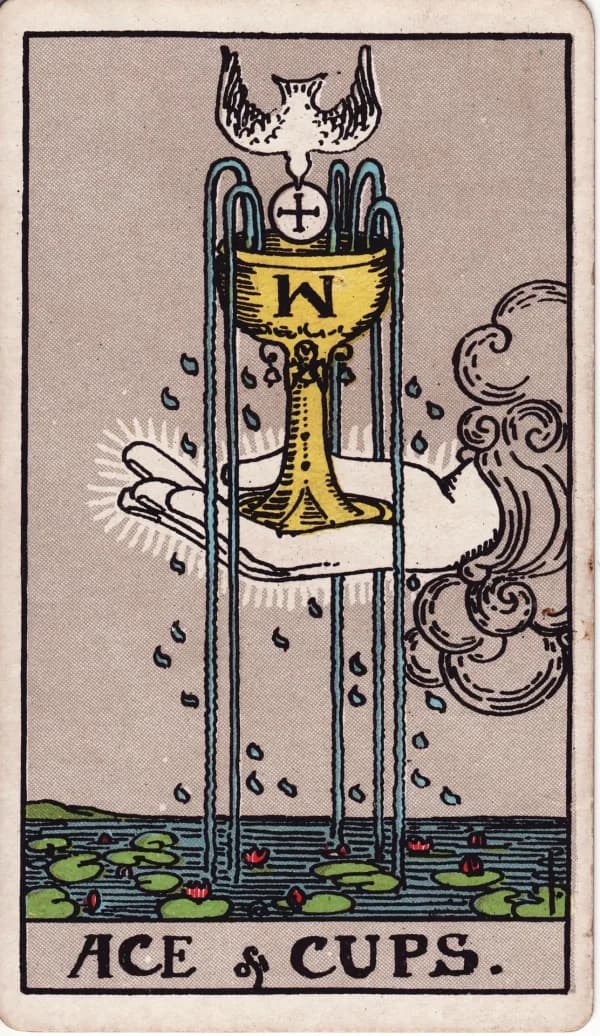
A gold cup rests on a hand that juts from a cloud on the right. Water arcs over the rim and falls into a pond of lily pads, while a dove dives toward the cup with a cross-marked wafer. Count the streams. A.E. Waite's text says "four streams are pouring." But Pamela Colman Smith, who drew his deck, gave the cup five. Mary K. Greer asks the obvious question on her tarot blog: "Why five streams of water and not the four that Waite specifies in Pictorial Key to the Tarot?"
The Ace counts as 1. It doesn't have a Hebrew letter of its own, since only the Major Arcana get one each. And the Golden Dawn set the Aces above the zodiac altogether. Pollack gives the plainest reading: "The Ace of Cups has the immediate meaning of a time of happiness and love, a gift of joy." A gift. Hold on to that word.
Look at where those five streams land. If that pond were one part of your life, which part would it be, and what's been falling into it?
Why readers put the Empress and the Ace of Cups together
These two share something most pairs don't, and it's printed in Waite's own book. In The Pictorial Key to the Tarot, his meanings for the Empress open with "Fruitfulness," and his list for the Ace of Cups includes "nourishment, abundance, fertility." No other card's list uses either word. Most combinations need a reader to build the shared meaning. This one arrives with it.
Waite's lists give the word birth to other Aces, never to these two, though he calls the Empress a mother. So the literal pregnancy reading you've probably heard is modern. Astrology.com's page on the pair calls it "the birth or renewal of an emotionally fulfilling relationship" and never mentions pregnancy.
It's a Major Arcana card beside a Minor, so read it with the helicopter view. The Empress is the aerial picture: the field itself, how settled and looked after you feel right now. The Ace of Cups is the ground-level detail, one gift dropping into that field. A feeling, maybe, or an offer you didn't see coming.
Put them together and the reading is this: something new is being offered, and it needs a place to land. Offered isn't the same as arrived. A place to land isn't a promise either. And the pair leaves the timing open, which is the honest thing for any reading to do.
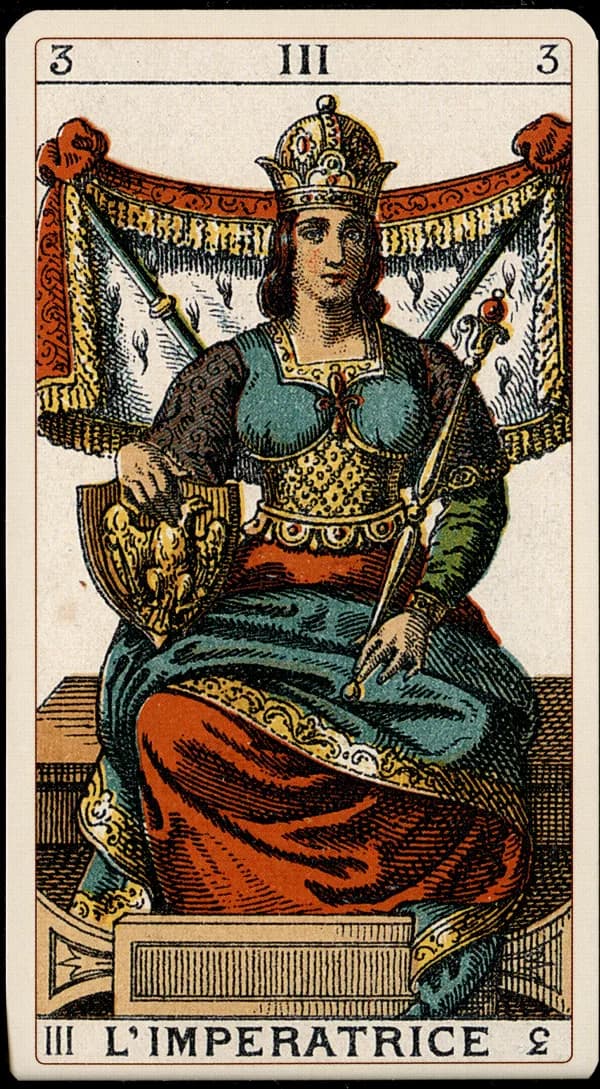
Crowley goes further. He calls the Ace "the essential form of the Holy Grail" and the lotus in his Empress's hand "a living form of the Holy Grail." So the gift and the care that holds it are one cup at two stages. The Golden Dawn pair below shows water falling into a pool on both cards.
If the Ace is what's being offered and the Empress is what holds it, which half feels more real to you: the gift, or your readiness for it?
What the pair says when you ask about pregnancy or new love
Many people find this pair through one question: pregnancy. Theresa Reed, The Tarot Lady, calls the Empress "one of the best indicators of pregnancy," and Biddy Tarot says the Ace "can signify conception, pregnancy or birth." Both mean it as a real possibility. But a card has no way to check.
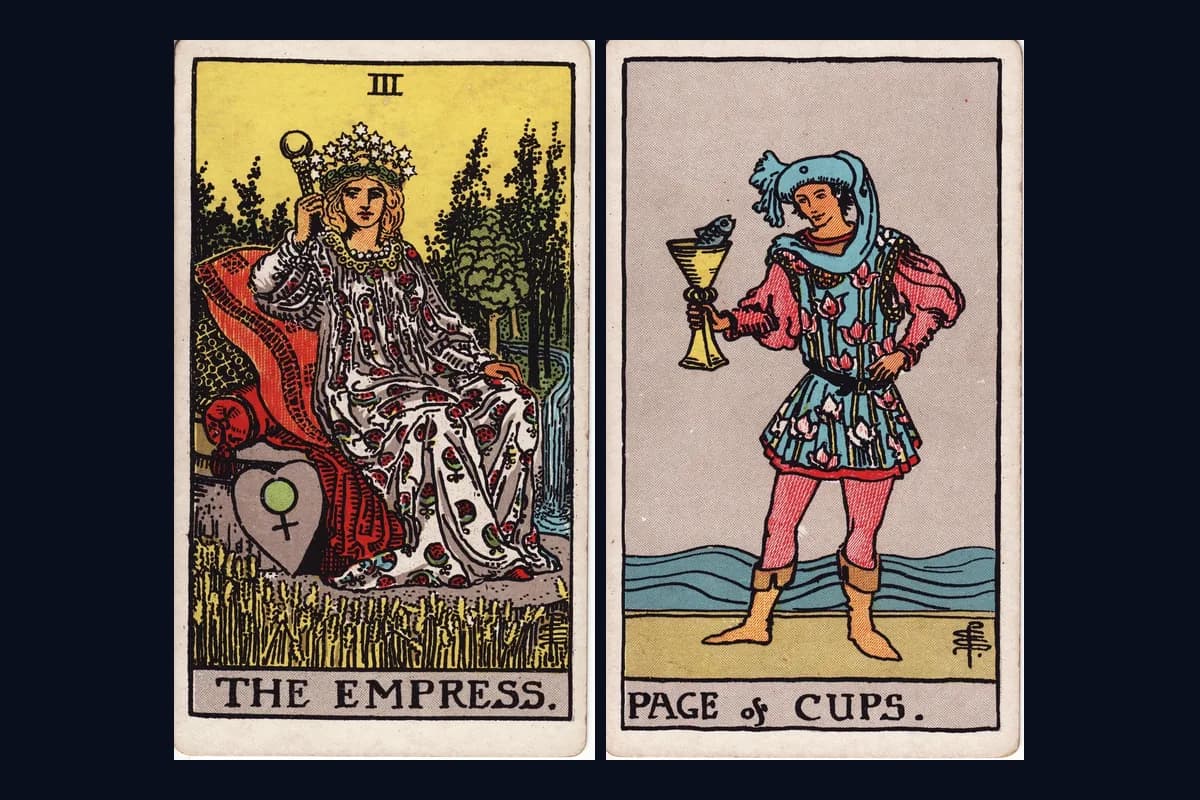
Reed adds that the Empress can also point to "the ability and readiness to be a good parent." A reading can describe the readiness. No card gets to grade the ability. When the Page of Cups sits beside the Empress instead, the Empress and Page of Cups combination reads the same hope as early news.
For health and pregnancy questions, the cards are not a medical opinion, and if your question is about your body, talk to someone who went to school for it. If you might be pregnant, take a test, whichever answer you're hoping for. And don't let a reading decide when to take it. If you're trying to conceive, or you're already pregnant, a doctor or midwife is your person.
Nothing in this pair is keeping score, whether you've been trying for a long time, you've had a loss, or you're pregnant and worried. The pair can't see how a pregnancy is going, so if something feels wrong, call your doctor or midwife now. Readiness, here, means room in your life: time, help, a heart that wants it. And your body isn't being graded.
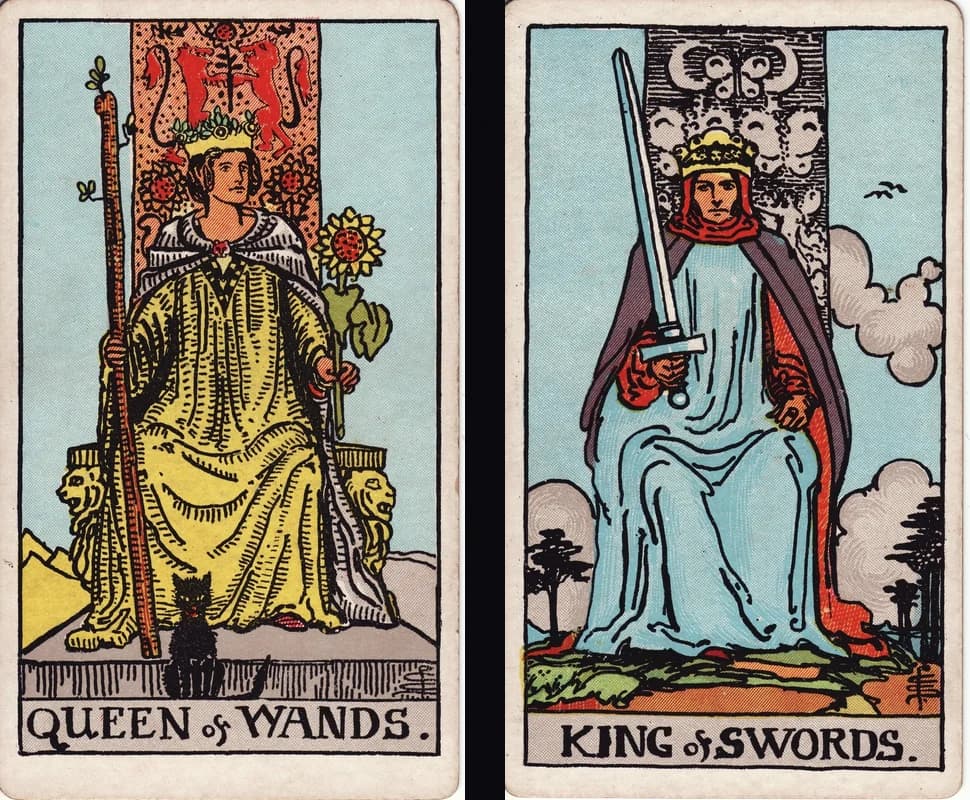
Asked how someone feels about you? This pair reads warm: the Ace as real affection, the Empress as someone who looks after you. Whether they'll act on it is another matter. When the warmth comes from someone still grieving, turn to the Five of Cups and Ace of Cups combination.
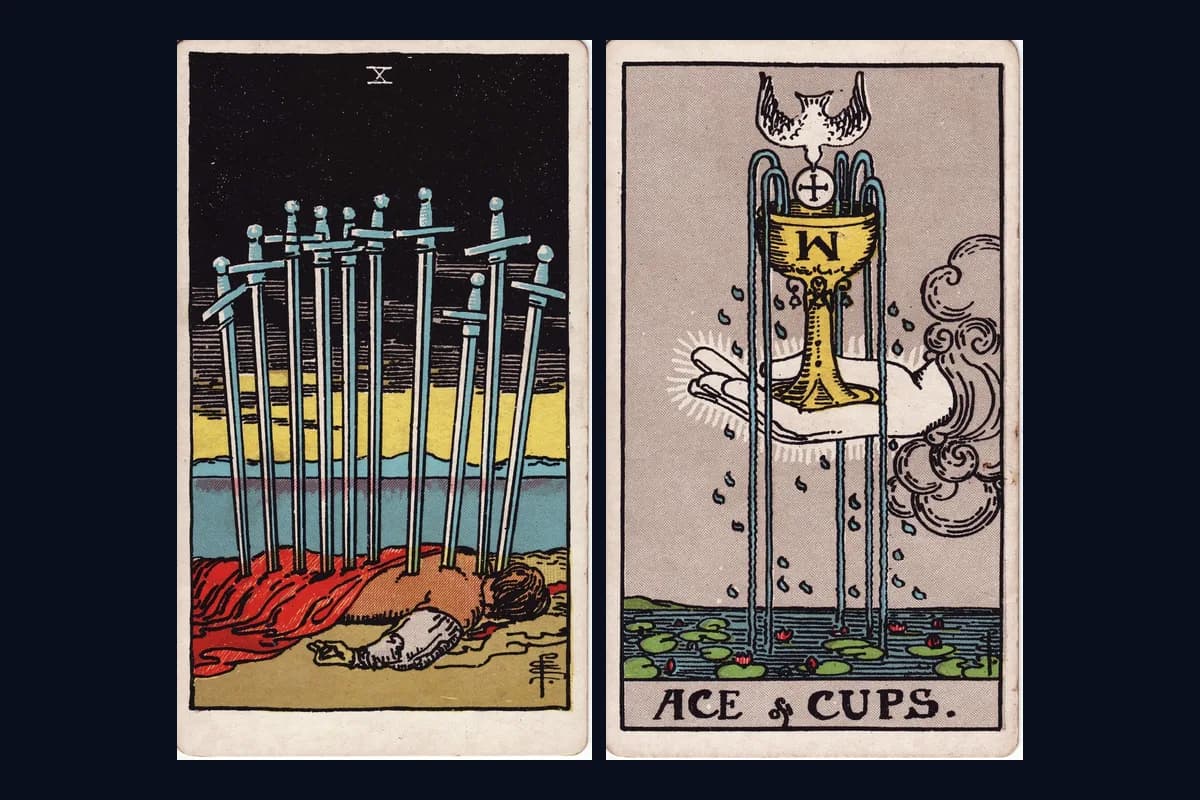
In love readings, it's a beginning with room to grow. Reed reads the Ace as a sign "that a romantic offer awaits you." Single? A new feeling with somewhere to go. Together? Maybe moving in, or making it official. Pollack's rule holds either way: "Love, and ultimately life, cannot be seized, but only accepted." If the cup turns up after a betrayal instead, the Ten of Swords and Ace of Cups combination asks whether you're ready to take it.
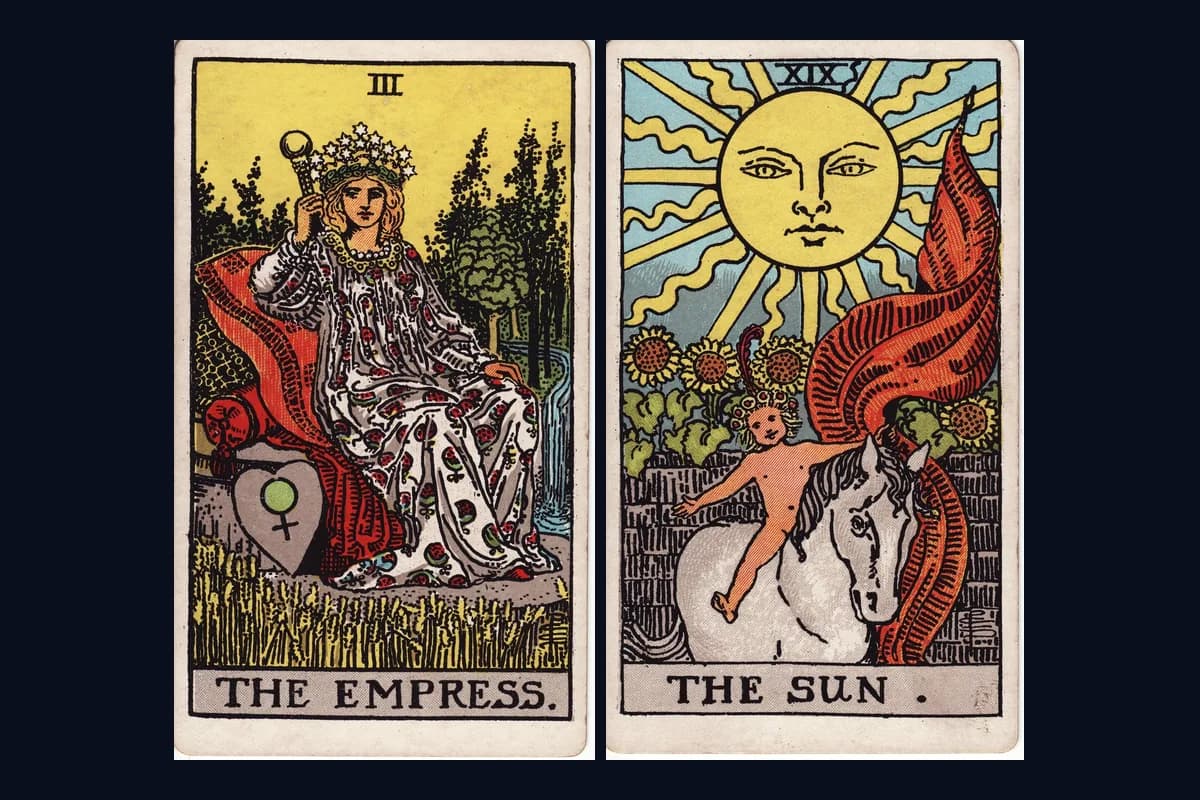
For creative work, the Ace brings the first idea that moves you. The Empress keeps it fed until it's done, if you're doing it for love of the work. Once it's finished and out where people can see it, the Empress and Sun combination picks up the story.
In a Celtic Cross, Pollack's example puts this Ace at the center, where it "would indicate a time of happiness in a person's life, or more precisely a chance of happiness, since the Aces represent opportunities." Lay the Empress across it, and Pollack's note that a crossing card can "form a second influence supporting the first" fits: care standing behind a chance.
If you're asking yes or no, check which question you mean. Is something new ready to begin, like a relationship or a project you've been circling? Upright, closer to yes, as long as you give it time and care. An Ace is an opportunity, not a finished thing. Are you pregnant, or will you be? On that, the cards don't vote. They'd look exactly the same either way.
What does your ready ground look like? A garden bed, a kitchen table, a blank page, a pair of open hands? Now picture what pours into it from your cup. That image belongs in your deck.
The Ace of Cups and the Empress, in either order
The Empress first, then the Ace of Cups: readiness leads, and the gift follows. Lay the two Rider-Waite-Smith cards out in this order and the Ace's hand reaches out of its cloud toward her, while her waterfall runs down the side nearest the cup. The pictures face each other. A new feeling meets care you've already been giving, or an idea turns up at a ready desk.
The Ace of Cups first, then the Empress: the gift arrives before the plan. With the cards in this order, the hand reaches off the edge, away from her, and room for the gift gets made afterward. In love, it's a feeling you weren't looking for. In creative work, it's an idea that beats you to the desk. So let the feeling or the idea settle before you promise anything.
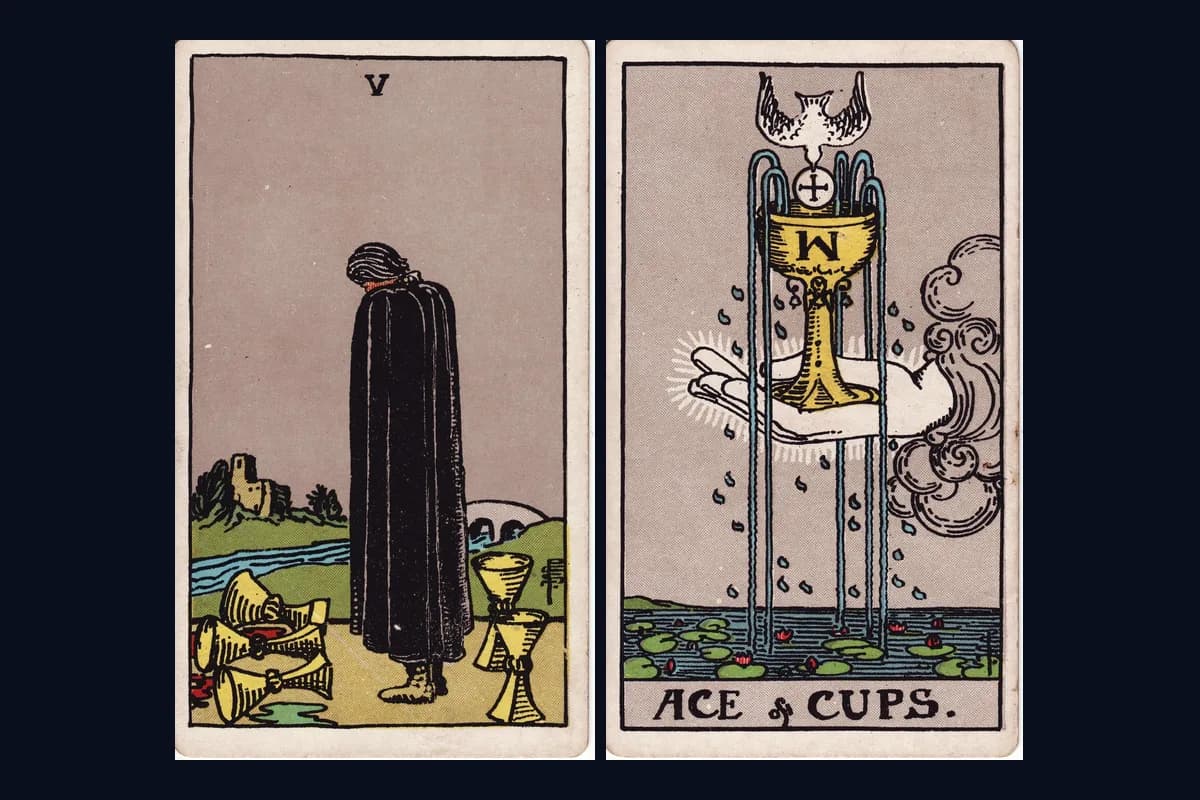
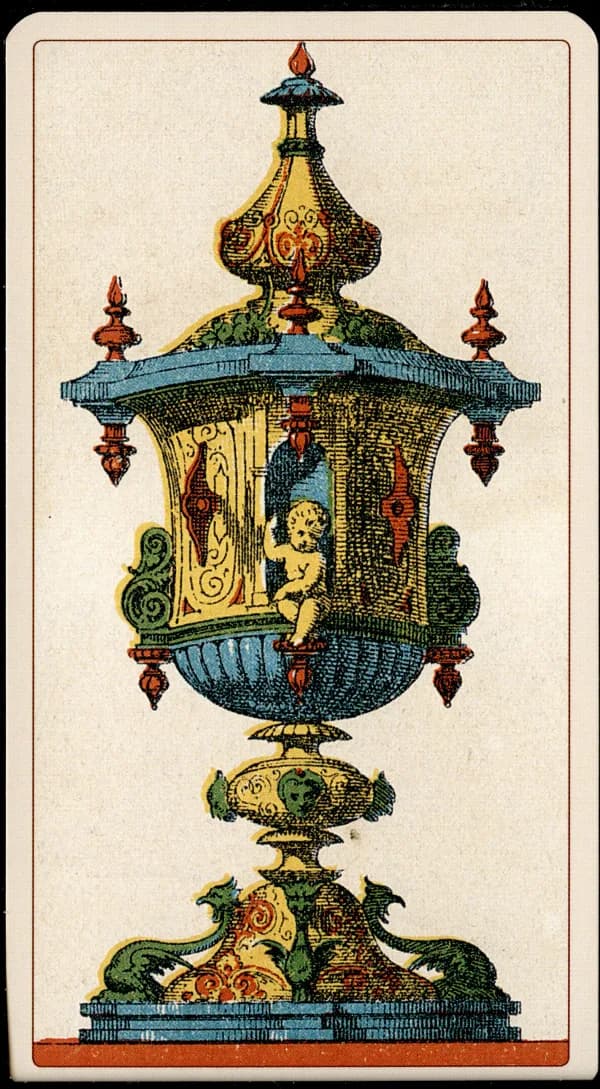
The Milanese Ace below keeps its lid on. A small figure sits in an arched opening on the vessel: an ornament, not a forecast. In the older deck, the gift arrives with a roof over it.
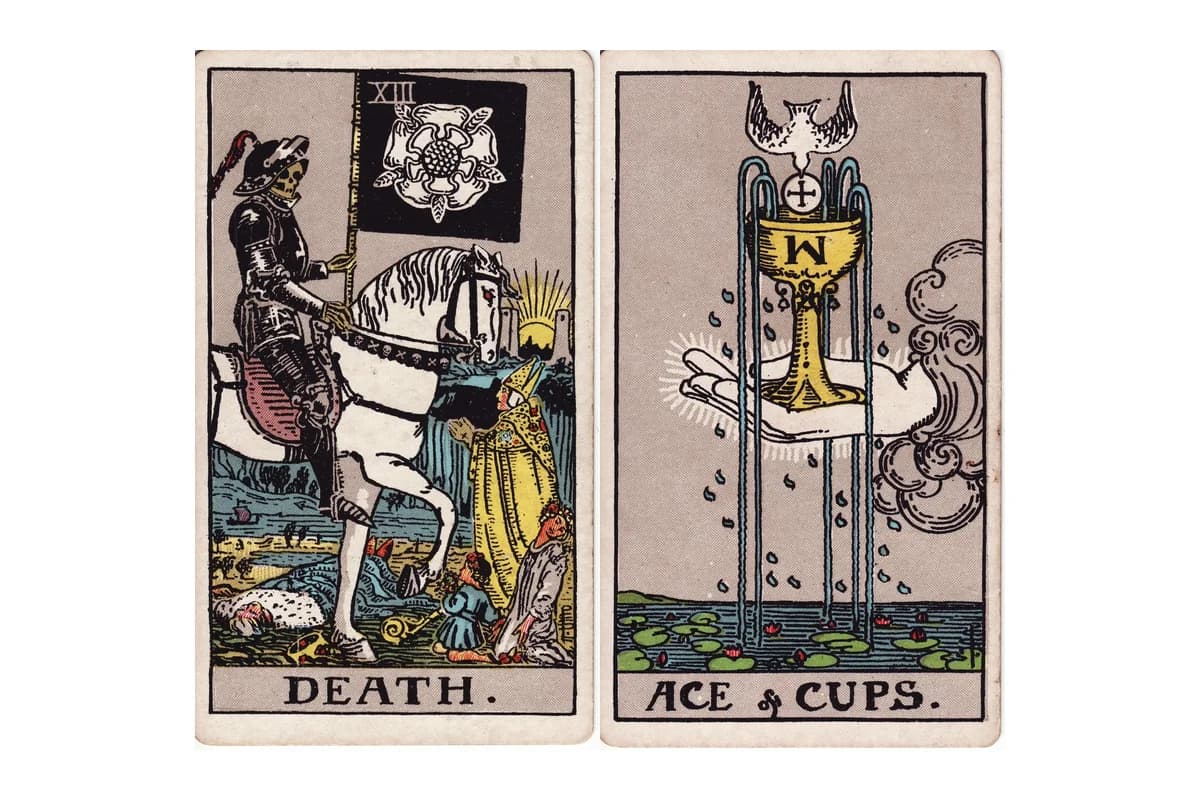
In a three-card spread of past, present and future, the Empress past and the Ace present: earlier care has left room for this. The Ace past and the Empress present: a spark has become part of how you live. The Empress present and the Ace future: what you tend now is clearing space for something new. If a breakup or a finished job sits in the past slot instead, you're closer to the Death and Ace of Cups combination, where the same cup follows an ending.
Orientation matters too. A reversal turns the question from what's being offered to what needs support. Waite's reversed Ace is the "House of the false heart," feeling that won't hold steady. Some modern readers take a reversed Empress as trouble conceiving. But that's more than a card can know, so read her reversal as care running thin. No row below is a verdict on a body.
| Orientation | Reading |
|---|---|
| Both upright | A real offer meets a life with room for it; something new can start, given time and care |
| Both reversed | A pause, not a closed door; feeling is guarded and help is scarce, so ask for support first |
| Empress upright, Ace reversed | The care is there, but the feeling is held back; turn some of that care toward yourself |
| Empress reversed, Ace upright | The offer arrives while you're worn out; lean on the people around you |
If your life so far were a layout, would the Ace's hand reach toward her, or off the edge?
Where the planet meets the water
The Empress has a planet. The Ace of Cups has an element. The Golden Dawn gave her Venus and no element; Earth is a modern habit, usually traced to Venus's sign Taurus. The Ace gets no planet and no sign. It's the seed of Water itself.
Do they get along? Yes, in elemental dignities, the Golden Dawn method of reading neighboring cards by whether their elements feed or fight. Benebell Wen's study sheet Elemental Dignities in Tarot files the Empress under Earth, and in its worked examples, "Water and Earth strengthen one another." But plenty of readers skip dignities.
The closer link runs through Venus. A planet's exaltation is the sign where astrologers say it's most honored, and Venus's is Pisces. Water again. Ptolemy, the second-century astronomer, gave a reason like a weather report: she's exalted in Pisces, "where the beginning of the moist spring is indicated." So the Empress's planet is at her best in the Ace's element.
Wang finds Venus in the Ace too, reading Waite's dove as "a symbol of Venus as the Great Mother." Waite meant the dove as the Holy Spirit, so this is a second reading. Still, it puts Venus in both pictures: assigned to one, read into the other.
On the Tree of Life, the Kabbalah's map of ten spheres, Daleth's path leads into Binah, the Great Mother. The Ace sits in Kether, the top sphere, but Crowley fills the cup from Binah's dark sea.
Venus enters Pisces on March 26, 2027, and stays about three and a half weeks, crossing the three slices of Pisces the Golden Dawn gave to the Eight, Nine and Ten of Cups. The Empress's planet walks the last stretch of the Ace's own suit. Those weeks are weather around your question. They hold no date for its answer, and no planet dates a pregnancy.
Venus is most honored in Pisces. Where is your care most welcome, and what tends to grow there?
The card hiding in the sum
The Empress is 3. The Ace of Cups is 1. Add them and you get 4. Nothing left to reduce. Four is the Emperor.
He's the card right beside her. Waite introduces him as "by imputation the spouse of the former," a careful way of saying tradition paired them. But you don't have to read him as a partner. In this sum he's the frame: the walls and the routine around whatever the Empress grows. So what kind of home would you want around something new?
Be honest about the arithmetic, too. Any Ace beside the Empress lands on 4. Her letter, Daleth, is worth 4, but that match is built in: the Golden Dawn starts its letters with the Fool, so every early Major Arcana card carries a letter one higher than its number. Call it a neat echo and leave it there.
The card no other Ace gives her is the Four of Cups, the 4 inside the Ace's suit. In the Rider-Waite-Smith deck, a young man under a tree stares at the three cups he already has, and the Ace's hand comes back: "an arm issuing from a cloud offers him another cup," Waite writes. The offer turns up while his eyes are elsewhere. That's timing. His worth doesn't come into it.
Picture the young man under the tree. In love or work, is a cup being held out to you that you haven't looked up to see?
Questions readers ask about this combination
Does the Empress and Ace of Cups mean pregnancy?
The Empress and Ace of Cups can't confirm or rule out a pregnancy, now or later. Many readers treat them as a pregnancy pair, and Waite's meanings give fruitfulness to the Empress and fertility to the Ace. But the pair describes readiness: a gift being offered, and room in your life for it. If you think you might be pregnant, take a test; a doctor or midwife can help with everything after that.
What does the Empress and Ace of Cups mean in a love reading?
In a love reading, the Empress and Ace of Cups point to a new feeling with somewhere to go: a relationship starting, or a couple moving toward a shared life. Read for someone's feelings, the pair is warm, with the Ace as real affection and the Empress as someone who wants to look after you. It can't show what anyone will do next, so watch what they actually do.
What does it mean when the Empress and Ace of Cups are both reversed?
Both reversed, the Empress and Ace of Cups read as a pause, not a closed door: feeling held back, and support running low around you. Look after yourself and ask for help before deciding anything. If your question was about pregnancy, the reversal says nothing about your body, and it shouldn't delay a test or a talk with a doctor or midwife.
What element connects the Empress and Ace of Cups?
Water and Earth. The Ace of Cups is the root of Water. The Golden Dawn gave the Empress a planet, Venus, and no element, but modern readers usually file her under Earth. In elemental dignities, a way of reading neighboring cards by their elements, Earth and Water strengthen each other. Venus turns up in both cards, too: the Venus symbol is on the Empress's shield, and Robert Wang reads the Ace's dove as Venus.
Is the Empress and Ace of Cups a yes or no combination?
Upright, the Empress and Ace of Cups lean yes on whether something new is ready to begin, such as a relationship or a project you've been weighing, as long as you give it time and care. An Ace is an opportunity, not a finished thing. On pregnancy, the cards can't say yes or no. A test can tell you whether you're pregnant now, and a doctor or midwife can help with questions about getting pregnant.