Tarot Card Combinations
Five of Cups and Ace of Cups
The Five of Cups and Ace of Cups tarot combination says a heart can grieve one love and still feel another. A figure in a black cloak bows over three spilled cups. Two more stand behind. Then the Ace: a white hand holds a gold cup running over. Asking if someone still mourning a past love can feel something for you? Look at the cups nobody's watching.

Climate scientist, ashtanga practitioner, and advocate for human rights and LGBTQIA+ equality.
Each picture on its own
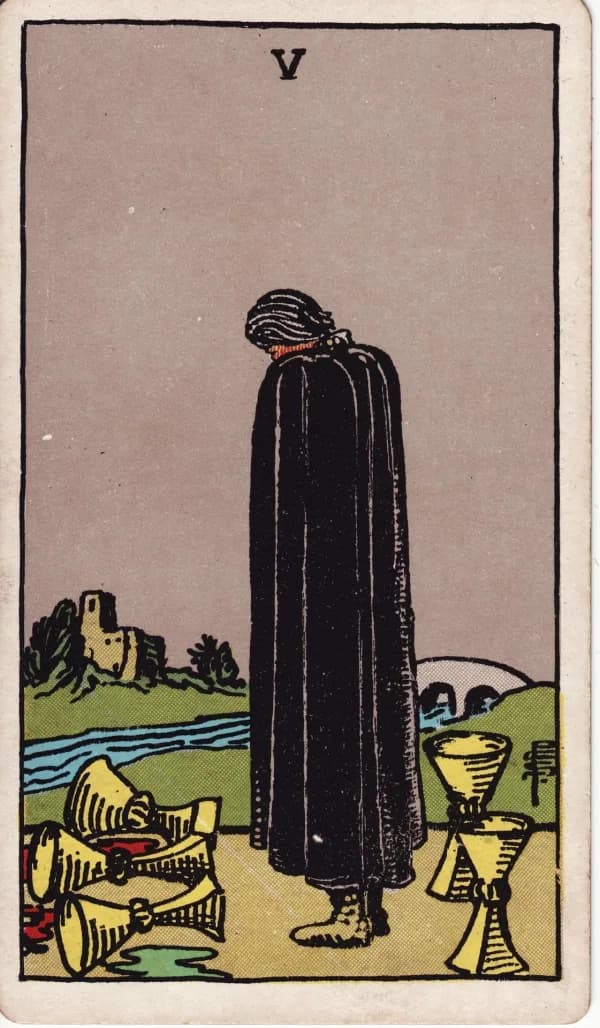
Look at the Rider-Waite-Smith Five of Cups, and count the cups before you look at the figure. Three lie on their sides at the left, red and green running out onto bare ground. Two still stand at the right. Between them, a figure in a long black cloak bows toward the spill, back turned to the two that stayed upright. Behind runs a river, with a small stone keep on the far bank and a bridge at the right.
A.E. Waite called it "a card of loss, but something remains over." Rachel Pollack, author of Seventy-Eight Degrees of Wisdom, calls the figure androgynous, someone who "stands rigid, wrapped in black, the colour of grief." Waite writes him. Pollack writes her. So the cloak can fit you, or the person you're asking about.
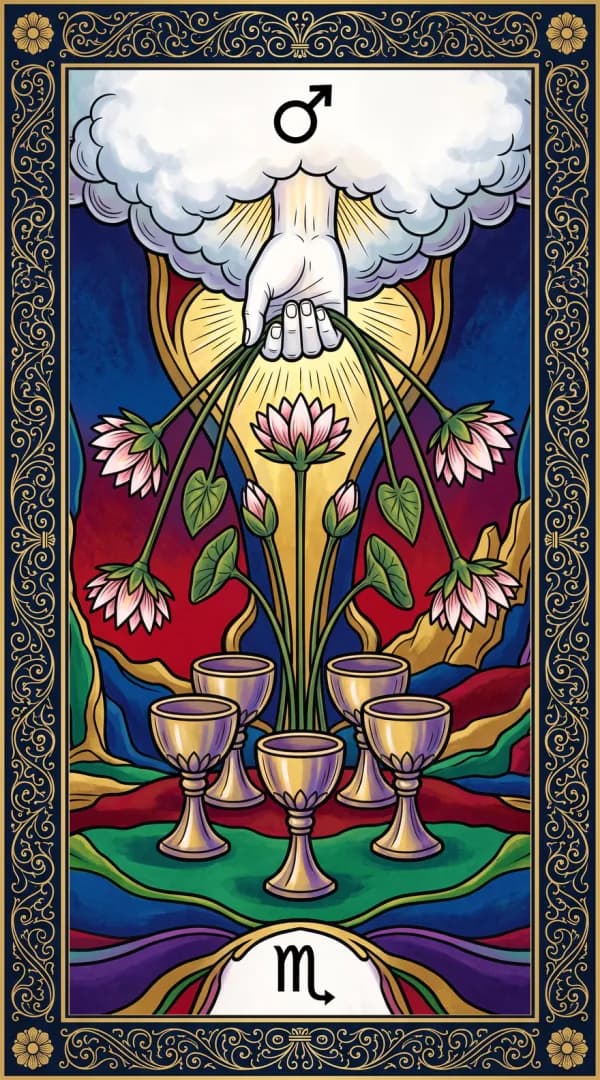
The Golden Dawn titled the Five the Lord of Loss in Pleasure and gave it Mars in Scorpio. Numbered Minor cards don't have a Hebrew letter of their own; the order filed every Cups card under Heh, meaning window. The order's own Five keeps nothing at all: no figure, no spill, five cups standing empty. Aleister Crowley named his Thoth version Disappointment.
And then the Ace of Cups.
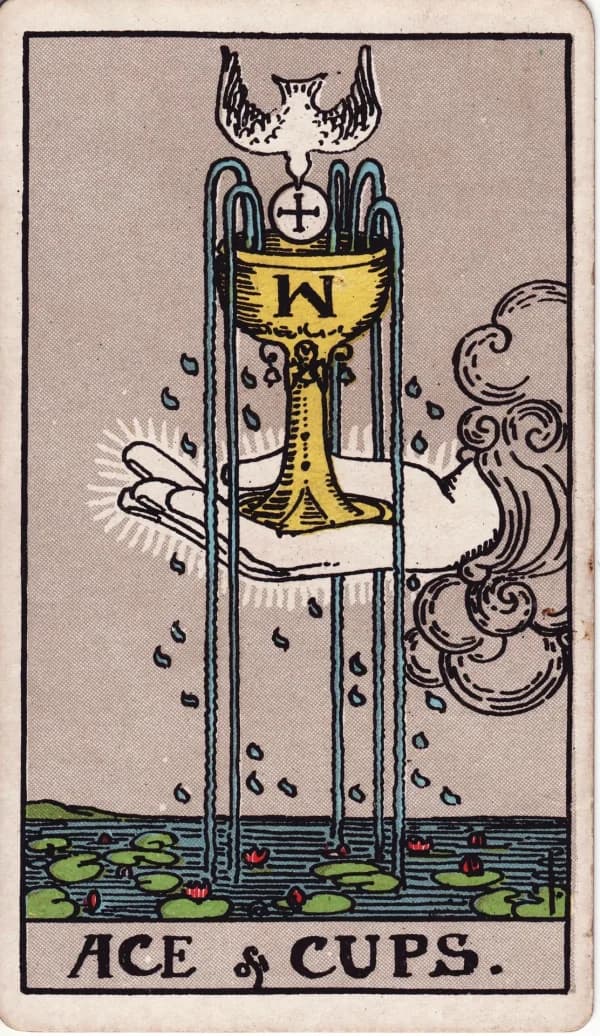
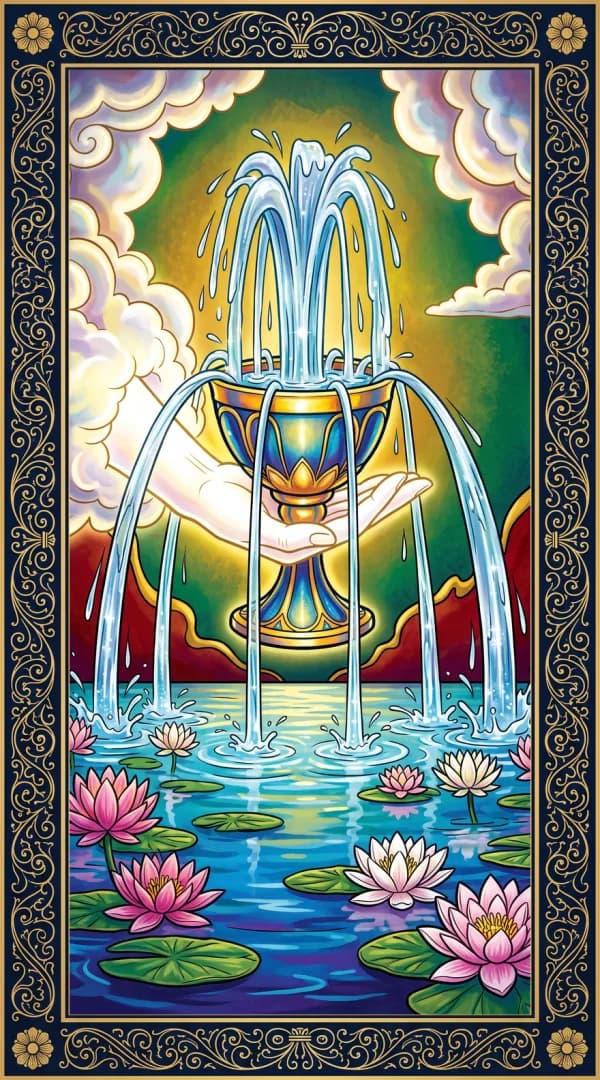
From a cloud at the right edge, a white hand lifts a gold cup. Streams run off the rim into a pond of lilies and red blossoms, and a dove drops toward the cup, a cross-marked wafer in its beak. Robert Wang, in The Qabalistic Tarot, says this water "pours dynamically from the Cup, but becomes calm and stable beneath."
The Ace is 1, the first card of the suit and the Golden Dawn's Root of the Powers of Water. But the standard Marseille Ace is closed, with no hand and no water, only a cup topped with towers. Sherryl E. Smith of Tarot Heritage reads it as "withdrawal behind barriers and a fear of intimacy." The Waite-Smith Ace opens the gates.
Step inside the black cloak for a moment. Are your eyes still on the three cups in the spill, or have you noticed the two standing behind you?
What the Five of Cups and Ace of Cups mean together
What these two share is rare: in both pictures, the water won't stay in the cup. On the Five it has soaked into the dirt. On the Ace it falls among the lilies. Same motion, two landings. One card lost what it held. The other holds more than it can keep.
And the Golden Dawn pair below gives that a single word: fountain. Book T, the order's manual, has the Five's lotus stems rise "in the manner of a fountain, but no water flows therefrom." Of the Ace it says, "From it rises a fountain of clear and glistening Water." Put the Waite-Smith black cloak beside that white fountain and you have the whole pair in two colors.
Both are Minors from one suit, so no Major sets a theme over them, and the reading stays at the size of one heart and one stretch of time. No classic text takes up this exact pair, but Pollack wrote about a near cousin. When the Four of Cups crosses the Ace, she reads apathy, then adds: "The apathy, however, would not cancel out the opportunity." Grief isn't apathy. But the logic holds.
In this pair, the new feeling is real, the grief is real, and neither one cancels the other. A reading can't prove what someone feels, or what they'll do with both. Only they can tell you.
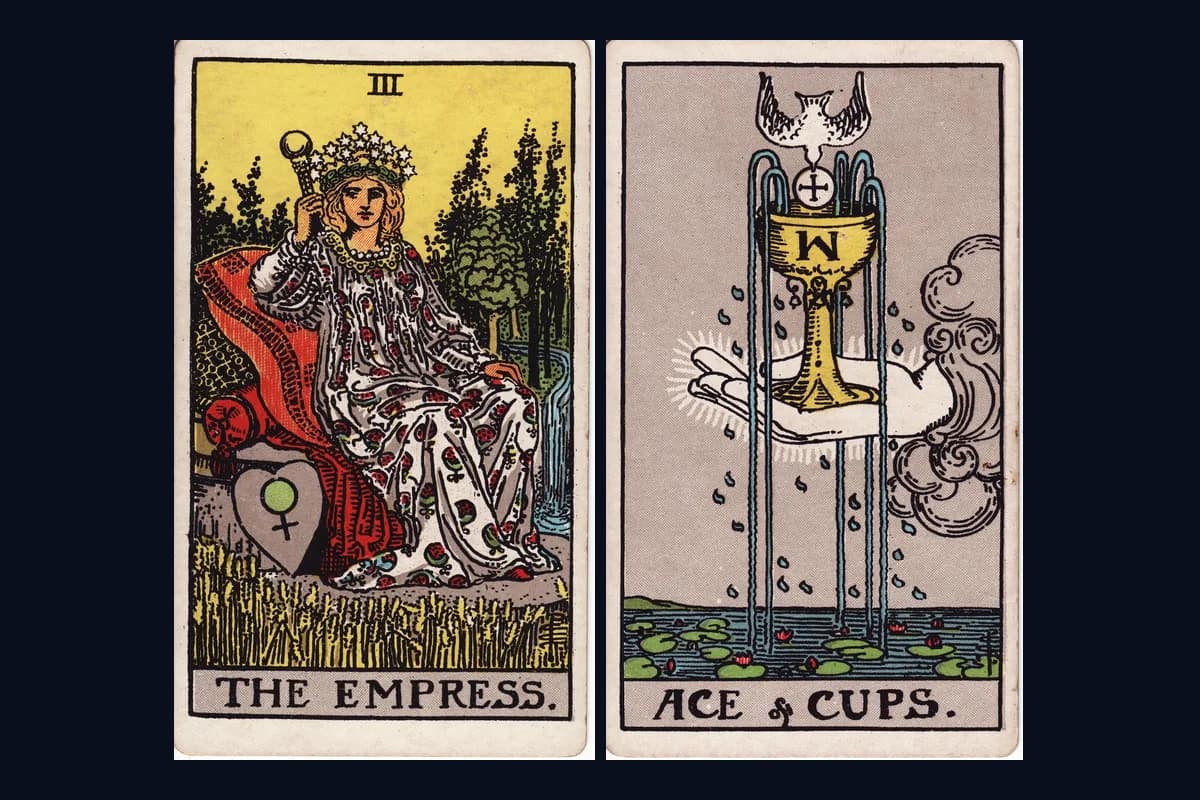
Count the cups across both cards. Three spilled. Three still holding: two standing behind the figure, one held out from the cloud. Without the grief in front of it, the Ace's cup reads like the Empress and Ace of Cups combination, an offer with nothing in its way.
If you love someone who's still grieving, can you let their three spilled cups be real without reading them as a verdict on you?
What it means for his feelings, and for yours
If you're asking whether he has feelings for you while he's still mourning his ex, you're asking two things. Does he feel something? Even if you pulled the Five to clarify the Ace, the reading takes that feeling at face value. Grief alone doesn't make it a rebound.
Is he free to act on it? That's the Five's question, and its figure is still looking at the spill. Mary K. Greer, reading this Ace through Jung, writes, "there is no way I can tell you what meaning the Ace of Cups will have for an individual." If the Ace is that personal, no card settles what it means to him. So ask him, one question at a time.
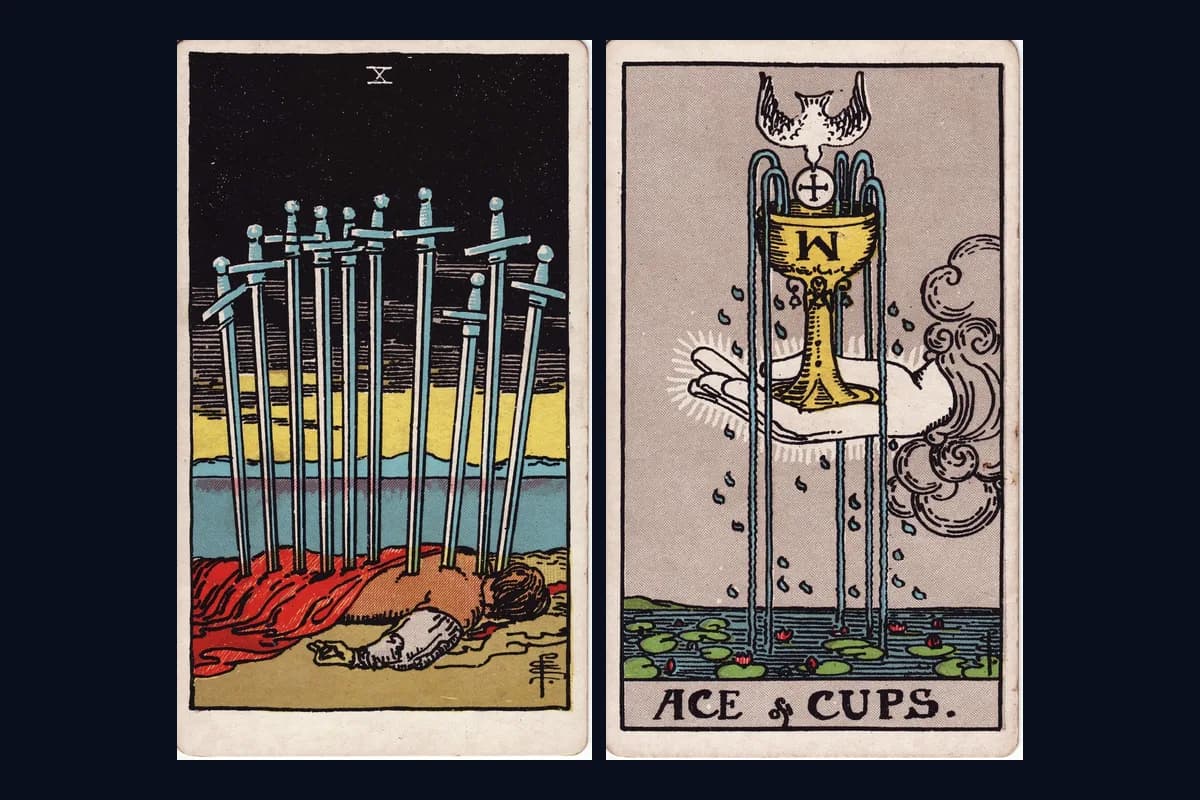
If you're the one grieving and someone new has your attention, this pair doesn't ask you to finish mourning first. A new feeling doesn't dishonor what you lost, and it doesn't prove you're over it. Go as slowly as you need. If the loss came as a betrayal, the Ten of Swords and Ace of Cups combination reads the same cup after a sudden blow.
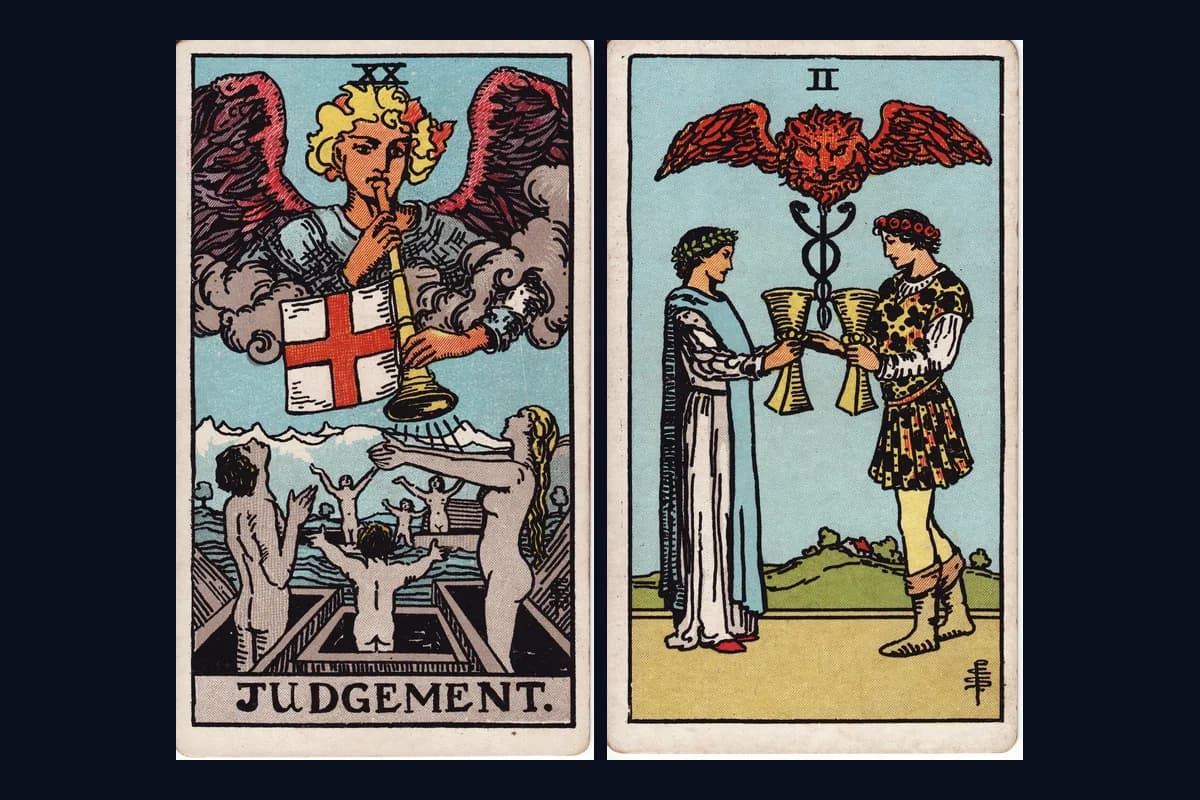
Hoping an old love comes back, or afraid he'll go back to his? Neither card promises a reunion, yours or his. Pollack has often seen the Five's two standing cups read as the Two of Cups, "support from a lover or friend." Notice the friend. And the Ace never says whose cup it is. The Judgement and Two of Cups combination takes the will-they-come-back question head-on.
Sometimes the person being mourned has died. Then the Five pictures grief that's already here, cloak and all. Caring for someone new takes nothing from the one who's gone.
In a Celtic Cross, start with the two cards at the center, one laid across the other. Five underneath, Ace across: the situation is mourning, and the challenge is a new feeling. Swap them and grief is what blocks an opening. In one of Pollack's sample readings, the Five crosses the Magician, and "the Magician has covered his dazzling white and red robe in a black cloak." His strength is still under the cloak, and with the Five across the Ace, so is the full cup.
For health questions, think of the pair as the weight grief puts on you. The cards are not a medical opinion, and they can't diagnose or treat what grief does to a body. If low mood won't lift, or grief is taking your sleep or appetite, talk to a doctor, a therapist or a grief counselor. If it's started to mean not wanting to be here, call or text 988 in the US, or your local crisis line or emergency number, now.
For a yes or no: on whether the feeling is real, closer to yes than no. Acting on it depends on the Five. Upright, its figure still faces the spill; reversed, it turns toward the standing cups: the pair's clearest yes. With the Ace reversed, the feeling is held back. Neither card says when, or whether, any of this changes. Take the yes as a reason to talk with him, not as his answer.
What did your own spilled cups hold, and what would you pour into the full one? That image belongs in your deck.
Card order and reversals change the reading
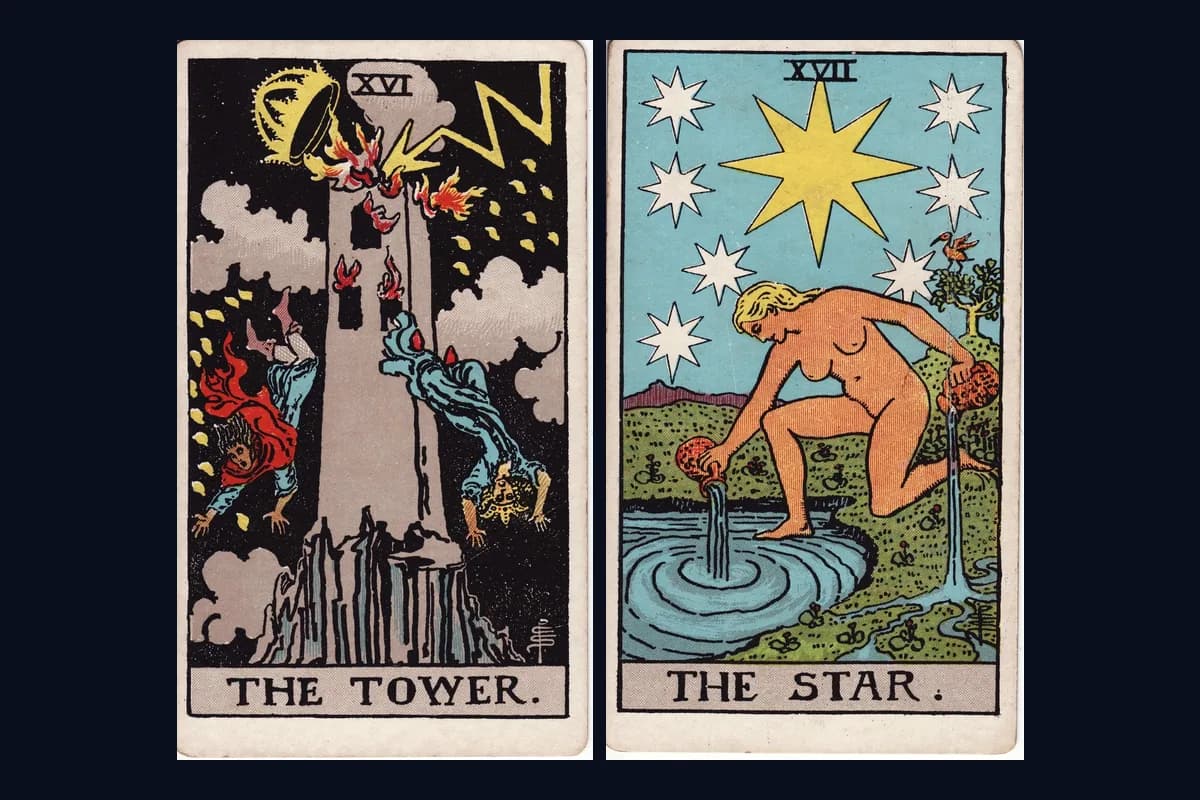
Five first, then Ace, is the hopeful order. In this layout, the Waite-Smith Ace's hand reaches in from the right, past the two upright cups. Already at the mourner's back: the full cup. Pollack's classic example of one card following another is the Tower, then the Star, where "an explosion in the person's life would lead to a release of hope and energy." The Tower and Star combination tells that story at Major Arcana size.
Ace first, then Five, is the cautionary order. The story starts with the new feeling and ends on the grief. Now the mourner faces the Ace, eyes on the spill, while the hand holds its cup out the other way. But the new feeling can last while the old loss takes the turn it's owed. If you drew this about him, grief is in the picture, and only he can say how much of any distance it explains. Whether that's enough is your call.
In a three-card spread of past, present and future, check where the Ace lands before you decide it's someone new. Ace in the past, Five in the present: the Ace is the old love, and the Five is the mourning after it. Five in the past, Ace in the present: the loss is the ground the new feeling grows from. Five now, Ace last, or the reverse: the future card shows where things lean, not when.
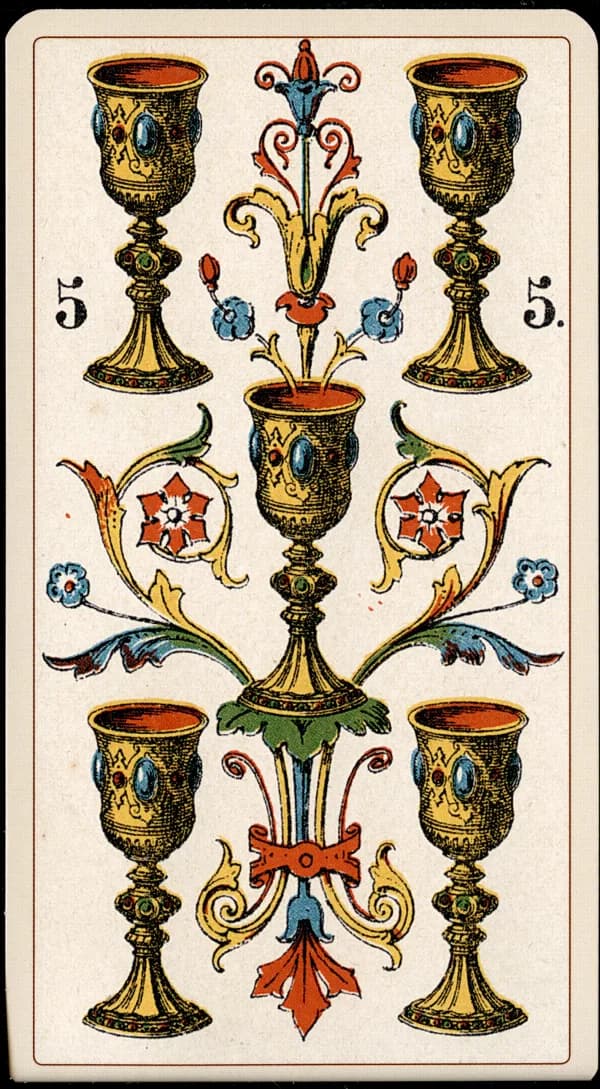
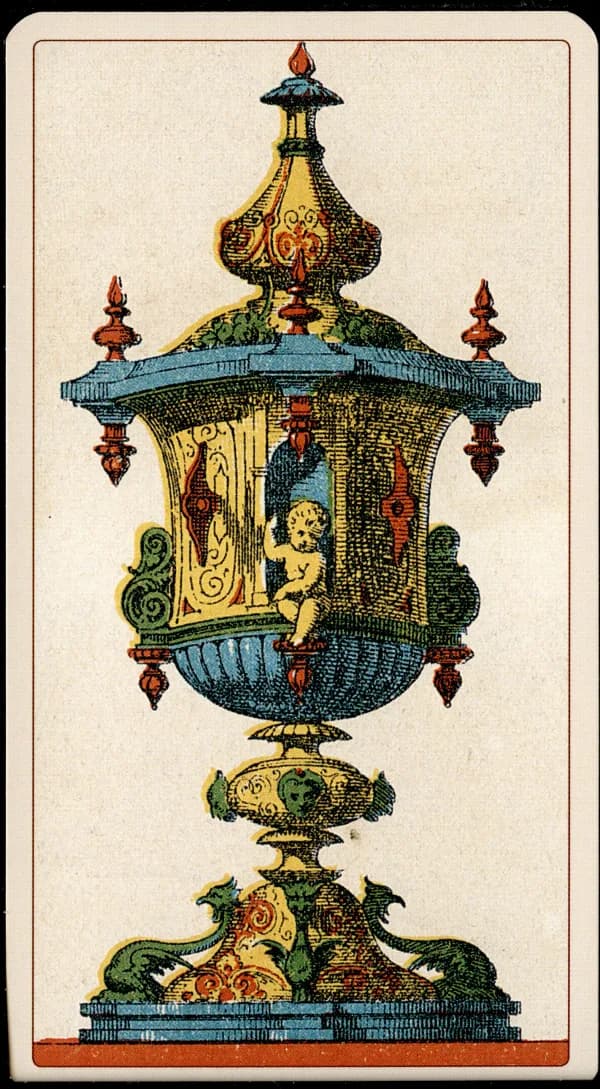
Orientation matters too. Reversals are optional, and plenty of readers skip them. The table uses one of Pollack's three reversed Fives, the mourner who "turns from the three to the two." But the Milanese pair below has nothing to turn from: five upright goblets and an Ace built like a lidded urn, with a child sitting in its window.
| Orientation | Reading |
|---|---|
| Both upright | Real grief and a real new feeling at once; the cup is offered while the mourning still shows, so go slowly |
| Both reversed | Everything turned inward; quiet mending before anyone new, or grief and love both held back, and the cards around them tell you which |
| Five upright, Ace reversed | Grief in full view, and the Ace tipped over like a fourth spilled cup; the feeling can be real but held back, too unsteady to lean on |
| Five reversed, Ace upright | The mourner turns toward the upright cups and the one being offered; the clearest yes here, though turning isn't the same as finished |
Which card landed first in your spread, the spill or the full cup? Is the grief behind this new feeling, or standing between you and it?
How Mars, the Moon and Scorpio shape the pair
Both cards are Cups, so both are Water, and the Five is Water twice. Its decan, the ten-degree stretch of the zodiac the Golden Dawn gave it, is the first third of Scorpio, and Mars rules both the sign and those degrees in traditional astrology. Wang puts it plainly: "Mars in the water Sign Scorpio produces an extremely emotional effect." A Fire planet, deep in Water.
The Ace has no planet and no decan. It's the element before any sign divides it, though in Crowley's version the Moon sits under its cup. Mars is in its fall in Cancer, the Moon's sign, and the Moon is in its fall in Scorpio. A planet's fall is a sign where traditional astrology says it's weakened. The grief's planet and the new feeling's light struggle in each other's home. That's the friction.
But the elements agree. If you read with elemental dignities, the Golden Dawn's system for weighing a card by the elements beside it, opposite elements weaken each other and cards of one suit do the reverse. Book T says, "Cards of the same suit on either side strengthen it greatly," a rule written for a card between two neighbors, so reading a pair this way is an adaptation. The grief gets louder. So does the new feeling.
Two dates mark this pair, both in Universal Time. On April 20, 2027, a full Moon falls at 0°37' Scorpio, inside the Five's own ten degrees. Mars enters Scorpio on September 2, 2027 (the evening of September 1 in the Americas) and crosses that same decan through mid-September. These dates aren't a deadline for grief or a forecast about anyone's feelings.
Mars runs hot and the Moon runs quiet. Which one has been doing the talking in you lately?
Where five plus one lands
Add the Five of Cups to the Ace and you get 6. A single digit, so no reducing.
In the Major Arcana, 6 is the Lovers. Hold that one loosely here. Read as a choice, it can turn your question into a contest over who he'll choose, and this pair stages none. So stay inside the suit, where 6 is the Six of Cups.
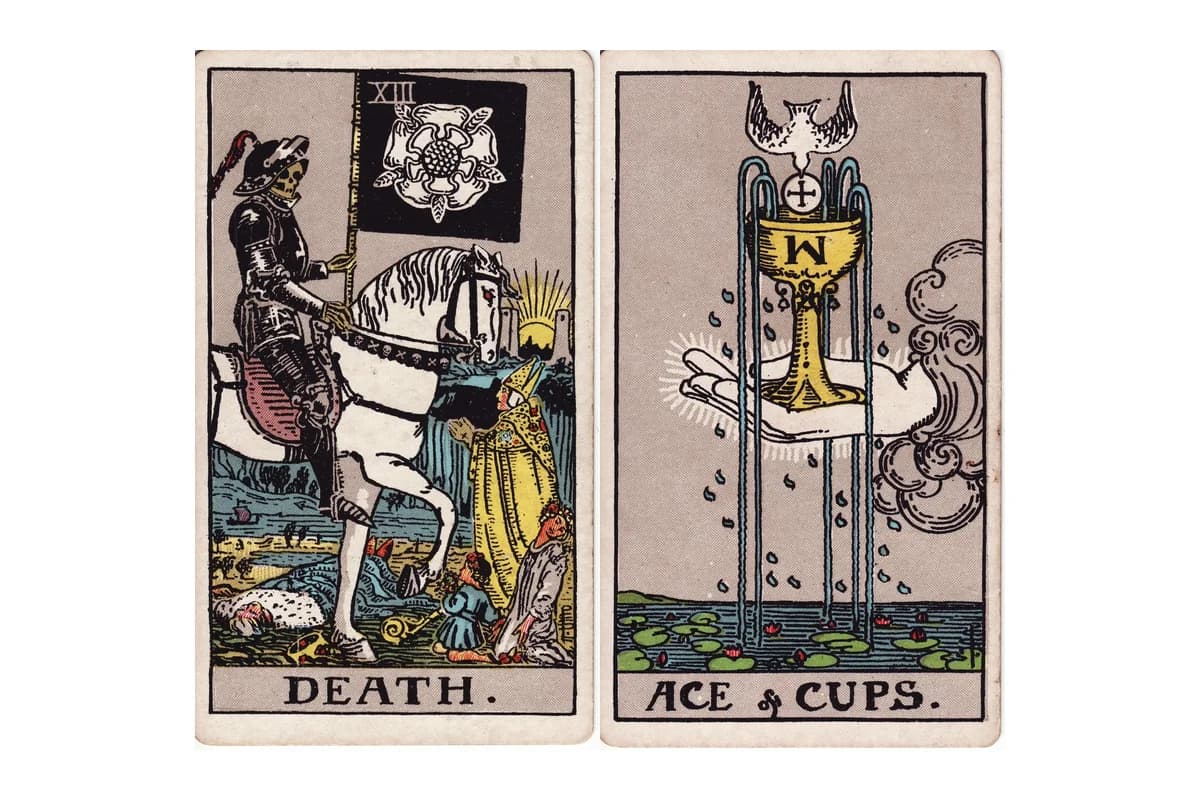
That sum comes cheap, though. An Ace adds one to whatever sits beside it, so the sum always lands on the next number. The Death and Ace of Cups combination reaches Temperance, the card that follows Death, the same way. What matters is which card comes next.
The Golden Dawn gave the Six of Cups the ten degrees of Scorpio right after the Five's. So the sum and the zodiac point at the same card. Lord of Loss in Pleasure becomes Lord of Pleasure. The loss leaves the name. But it doesn't have to leave the heart. Wang calls the Six "the beginning of pleasure." Book T shows the Five's dry fountain running again: "From these flowers a white glistening water flows into the cup as from a fountain, but they are not yet full."
On the Golden Dawn's Tree of Life, a Kabbalistic diagram of ten spheres, the Ace belongs to Kether, sphere one, the Crown. The Five belongs to Geburah, sphere five, the sphere of Mars. Sphere six is Tiphareth, Beauty, at the center, and the Six of Cups lives there. You don't have to add card numbers at all; the Golden Dawn read each card by its own place on the Tree.
In the Waite-Smith deck, the Six shows two children in a garden with cups full of flowers. Wang sees "the implication, though not the assurance" that the Six's pleasure will build. For Pollack, "the Cups signify sweet memories" here, and that addresses the mourning question: a past love can stay a memory while a new feeling grows. Memory keeps the past in the room without bringing anyone back.
Of everything you lost, which memory is one you'd want to keep?
Questions readers ask about this combination
Does the Five of Cups and Ace of Cups mean he has feelings but is still mourning his ex?
Often, that's how the pair reads. The Ace of Cups is a feeling the reading takes at face value, and the Five of Cups is a grief that isn't finished, so both can live in one heart. But no card can prove what he feels or say how long he'll grieve. Treat the reading as a reason to ask him, then listen to his answer and watch what he does.
What does the Five of Cups and Ace of Cups mean in a love reading?
In love, the Five of Cups and Ace of Cups describe a new feeling arriving while an old loss still hurts, whether that loss was a breakup or a death. The feeling can be real before the grief is done, and neither card sets a timeline. The cards are not a medical opinion. If grief won't lift, or it's taking your sleep or appetite, talk to a doctor, a therapist or a grief counselor.
What does the Five of Cups reversed with the Ace of Cups mean?
With the Five of Cups reversed and the Ace of Cups upright, the cloaked figure on the Five turns toward the two cups still standing, and the new feeling has room to land. It's the pair's clearest yes, though turning isn't the same as finished. With both reversed, everything turns inward: quiet mending before anyone new, or grief and love both held back. The cards around them show which. Not every reader uses reversals.
What element connects the Five of Cups and the Ace of Cups?
Water, twice over. Both are Cups, and the Golden Dawn made the Ace of Cups the root of Water itself, while the Five of Cups is Mars in Scorpio, a Fire planet in a Water sign. Elemental dignities, the Golden Dawn's rules for how neighboring cards affect each other, let cards of one suit strengthen each other, for good or ill. Applied to a pair, that makes the Five's grief and the Ace's new feeling both run stronger.
Is the Five of Cups and Ace of Cups a yes or no combination?
Closer to yes, with a condition. Is the new feeling real? With the Ace of Cups upright, the reading leans yes. Are they ready to act on it? The upright Five of Cups shows grief still holding their attention, and neither card says for how long. Reversed, the Five gives the pair's clearest yes. With the Ace reversed, the feeling is held back. Use the yes to start a conversation; it doesn't promise what anyone will do.