Tarot Card Combinations
Judgement and Two of Cups
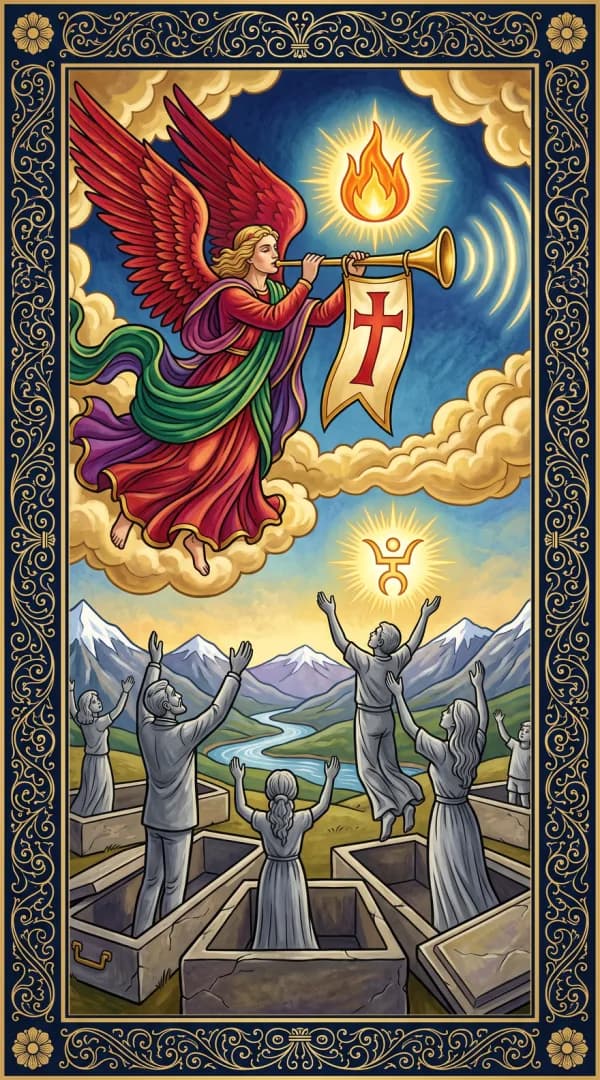
The Judgement and Two of Cups tarot combination weighs a second chance, and it isn't one person's to answer. An angel blows a gold trumpet from the clouds. Below, gray figures rise from open coffins, arms lifted to the sound. On the other card, a couple hold gold cups out to each other under a winged red lion's head. Wondering whether your ex will come back? Start with what's changed.

Climate scientist, ashtanga practitioner, and advocate for human rights and LGBTQIA+ equality.
What each card means on its own
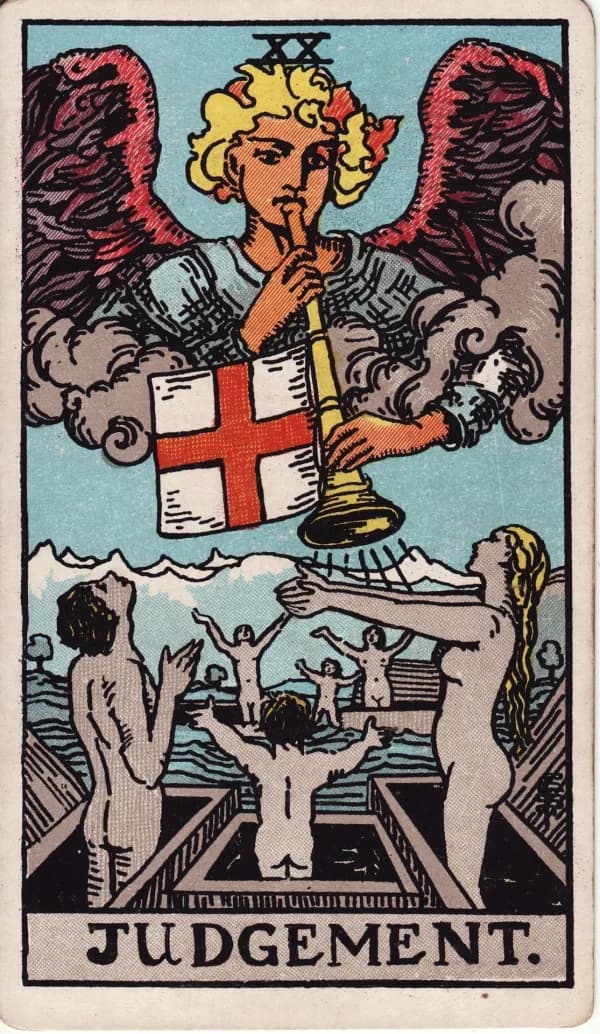
Look at the Rider-Waite-Smith Judgement card from the top down. A huge angel leans out of gray clouds, gold curls on his head, dark wings edged in red. A.E. Waite, who planned the deck's symbols, describes him plainly: "The great angel is here encompassed by clouds, but he blows his bannered trumpet, and the cross as usual is displayed on the banner."
Below him, six gray, naked figures rise from open coffins floating on a blue-green sea, with snowy peaks behind. In front, a man looks up with his hands held close, a woman stretches both arms toward the angel, and between them a child stands with his back to you. Rachel Pollack, in Seventy-Eight Degrees of Wisdom, reads the child's turned back: "The new existence is a mystery, with no way for us to know what it will be like until we experience it."
Judgement is card XX. The Golden Dawn, the magical order Waite belonged to, gave it the Hebrew letter Shin and the element Fire. Shin means tooth, and Robert Wang, in The Qabalistic Tarot, says the word suggests "hardness, sharpness and biting." So this card has teeth.
It wasn't always called Judgement. In fifteenth-century Italy it was most often called Angel, and only became universally known as Judgement after tarot reached France. Look again. Nobody here is on trial. Everyone is answering.
Now the Two of Cups.
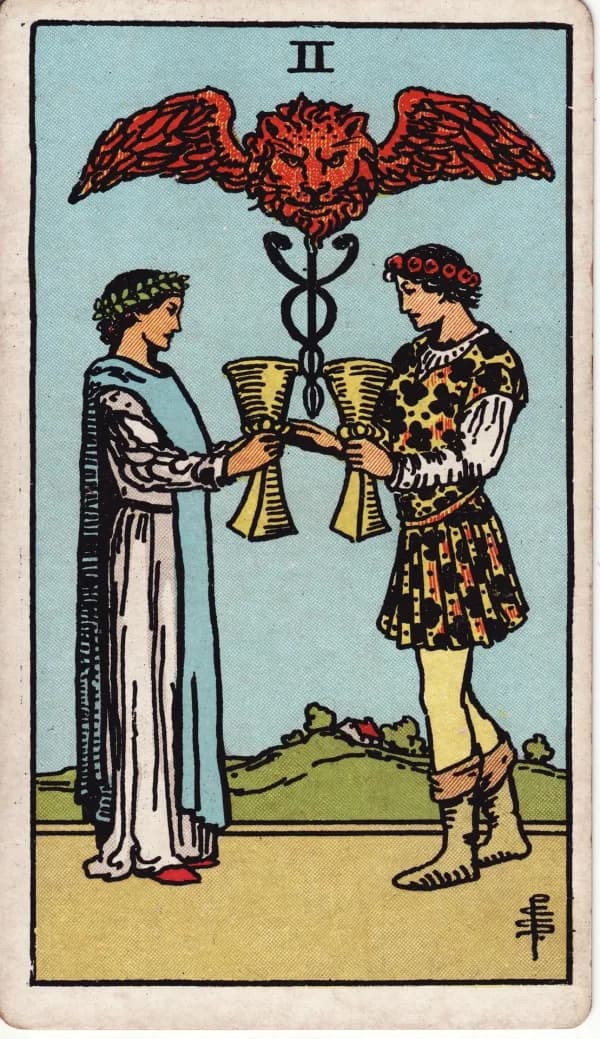
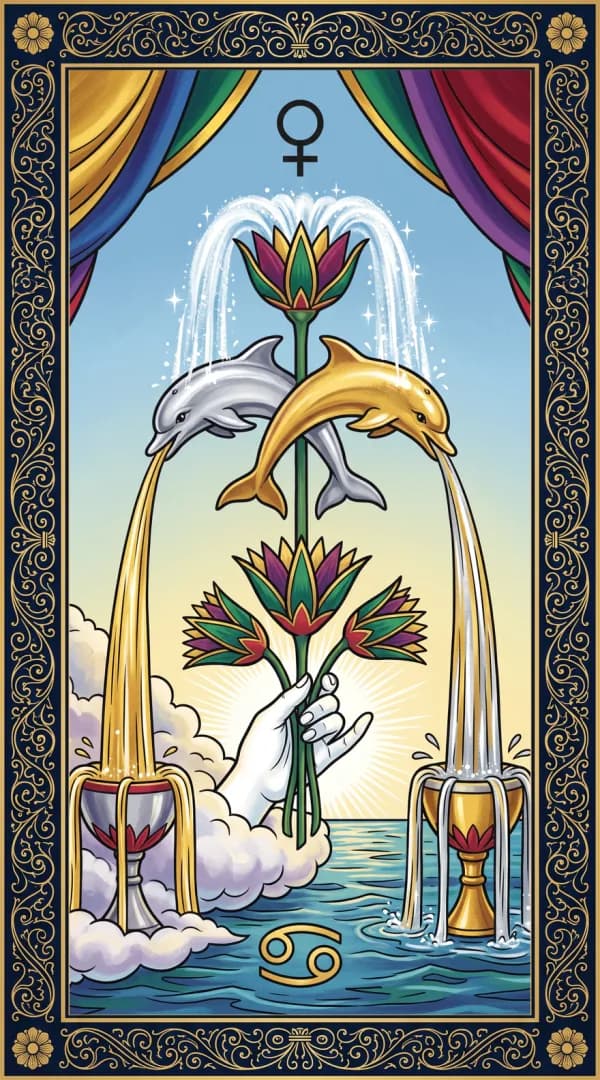
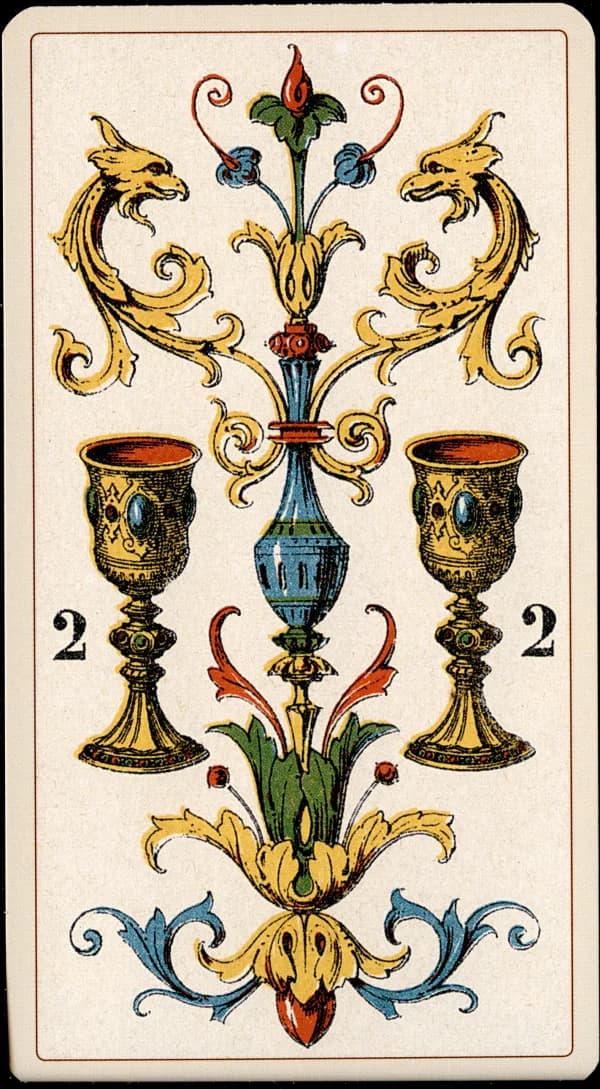
It's a quieter picture. A young woman and a young man stand on level ground, gold cups held out close enough to touch. Above them, a red lion's head spreads red wings over the staff of Hermes. The lion only watches. Whatever happens here happens at eye level.
Like every Cups card, it belongs to Water. Aleister Crowley calls it "perfect and placid harmony, radiating an intensity of joy and ecstasy." But Wang is warier: it's "a card of feeling and romance (particularly in material things) which has the potential for energy misspent." Same two cups. Crowley sees the ideal. Wang sees the cost.
Six figures hear the same trumpet. The woman reaches up. The man keeps his hands close. The child opens his arms to whatever comes next. Which of them is closest to you right now?
Why Judgement and the Two of Cups need each other
These two cards share something most pairs don't: neither picture is finished by one side. On Judgement, a trumpet sounds and the figures below answer it, which Waite reads as a summons a person hears and answers from within. On the Two of Cups, a cup is held out and another comes up to meet it. One card is a call. The other is two people answering each other. That parallel comes from the pictures alone.
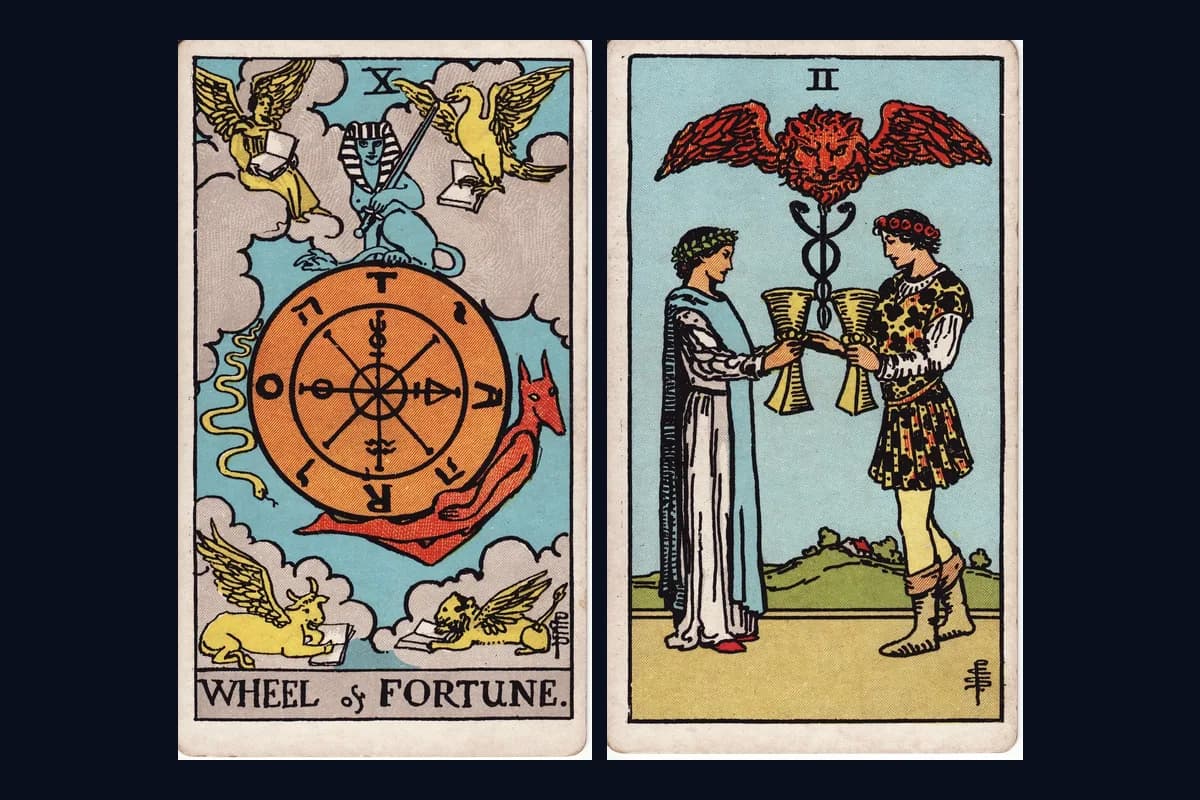
Judgement is a Major Arcana card and the Two of Cups a Minor, so the trumpet sets the scale: a turning point. Waite's meanings for Judgement begin with "Change of position, renewal, outcome." The Two brings that down to one relationship and one conversation. A wheel turns whether or not anyone answers; a trumpet needs someone listening. That's the difference between this pair and the Wheel of Fortune and Two of Cups combination.
Theresa Reed, The Tarot Lady, files this pair under love at first sight and calls it a "romantic wake up call." Waking people up is the trumpet's job.
Readers don't agree on Judgement. Its picture is resurrection, which is likely why reconciliation lists include it. But the Golden Dawn's meaning reads like a courtroom: "Final decision. Judgment. Sentence. Determination of a matter without appeal on its plane." Read "on its plane" as this question, not your worth. So which is it: back to life, or settled for good?
It can be either, and neither one brings back the old version. Pollack writes that Judgement "indicates not a change of circumstances but a new consciousness." An ex getting back in touch is a change of circumstances; the new consciousness is each of you seeing clearly why it ended. Put that beside the Two of Cups and you get this: whatever comes back after this kind of reckoning comes back new, and only if both of you answer.
In the Golden Dawn Judgement below, the gray figures rise from separate stone tombs, arms up. Each on its own.
If someone from your past is behind this reading, think about the last time either of you reached out. Did the other person answer, or only reply?
What the pair says about getting back together
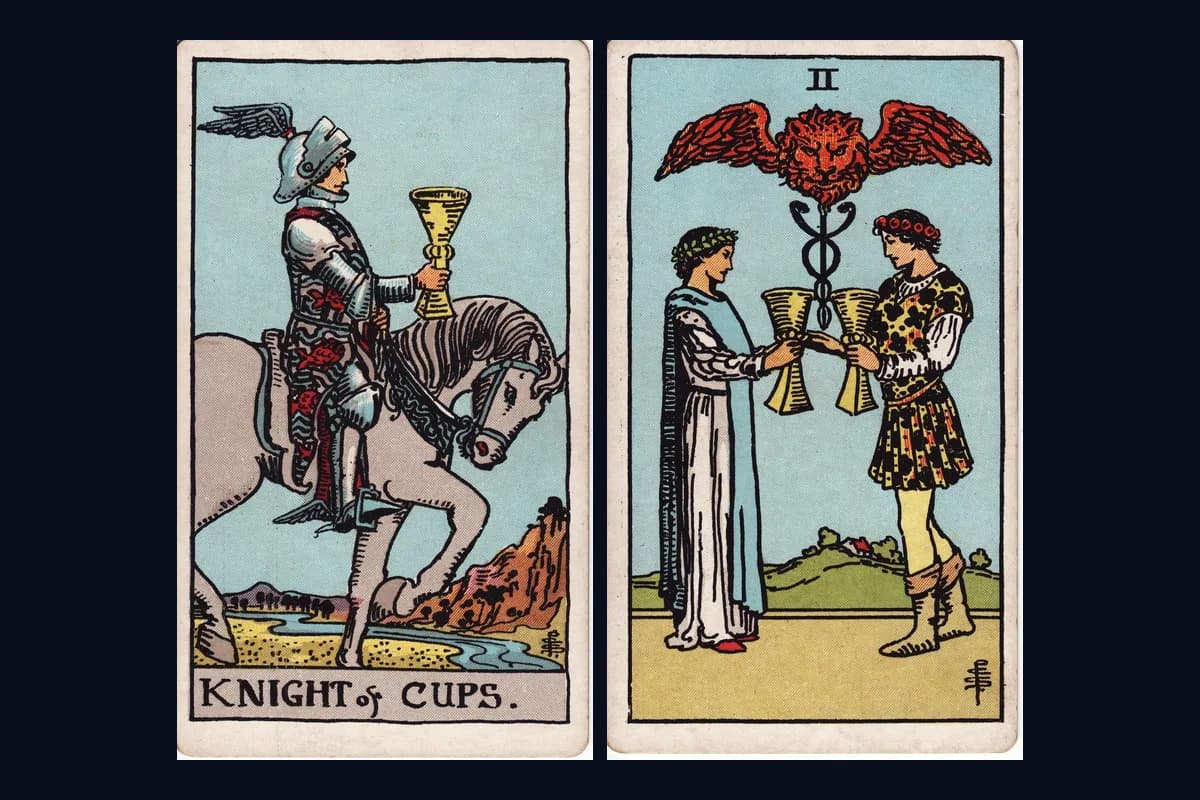
Will your ex come back? These cards show what a return would take, not whether one is coming, and neither can decide for someone else. If nobody has reached out at all yet, the Knight of Cups and Two of Cups combination reads whether anyone makes that first move.
If it ended because you weren't safe, the questions below aren't for you. A good apology and a few kind weeks are easy to give, and no card can tell you someone is safe to go back to. If you're afraid they'll come back, call a domestic violence helpline. And if your ex has asked you not to get in touch, a spread can't override that.
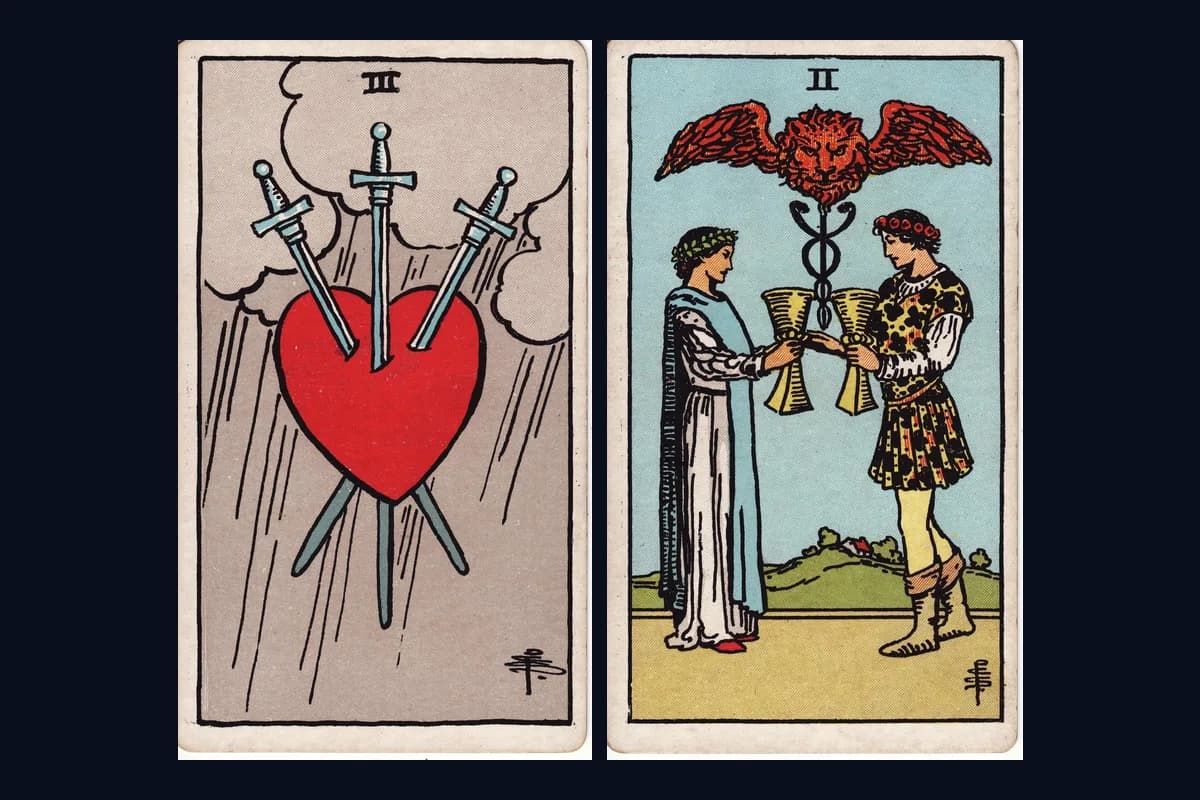
So how do you tell real repair from wishful thinking? Give each card its own question. Judgement's: has what ended it been named out loud, and has anything changed since? The Two's: does the effort run both ways, or are you holding both cups? Wishful thinking runs on signs: a late message, a redrawn spread. Pollack's reversed Two of Cups names it: "infatuation, when people pretend to others, to themselves, that a love affair means more than it actually does." If trust is what broke, read the Three of Swords and Two of Cups combination.
If you're the one asking for the second chance, the trumpet may be pointed at you. Joan Bunning of Learning the Tarot writes, "It is possible to judge without condemning." Answer for your part, plainly. Whether they answer back is their call.
For couples still together, the reckoning happens inside the relationship, after an affair or a long cold stretch. Bunning, on the Two: "If you are in conflict, look for truce and the chance to forgive and be forgiven." Only the one betrayed decides whether to forgive. If the talk turns to marriage, the Hierophant and Two of Cups combination takes that up.
In a new relationship, the wake-up call can feel like a second chance at something you'd given up on. Same test, only earlier: is the effort running both ways yet? If they're still grieving an ex, see the Five of Cups and Ace of Cups combination.
For a Celtic Cross, here's a real Angelorum reading. Someone asking about an ex drew Judgement at the heart of the situation, the Two of Cups at the root, the Two of Wands crossing, and Justice elsewhere. The reply: "It looks a lot like it is all up in the air and very much dependent on the choices you are making now, with all those 2 energy cards." The bond was there underneath; the outcome wasn't settled.
Yes or no? Upright, it's a qualified yes to a second chance, if what ended it has been faced and both of you want to try. That yes is about repair; whether a person returns is up to them. With Judgement reversed, it's not yet: nobody has looked honestly at what happened. With the Two reversed, it's no for as long as the effort runs one way, and with both reversed it's no on these terms, which isn't the same as never. None of these means you have to wait for them.
Set the hope aside and look for evidence. What would you need to see to believe things are different this time? What would your Judgement look like if it showed the moment you saw clearly? That image belongs in your deck.
Judgement first, or the Two of Cups first
No tradition fixes this pair's order: the first card is the start, the second the direction.
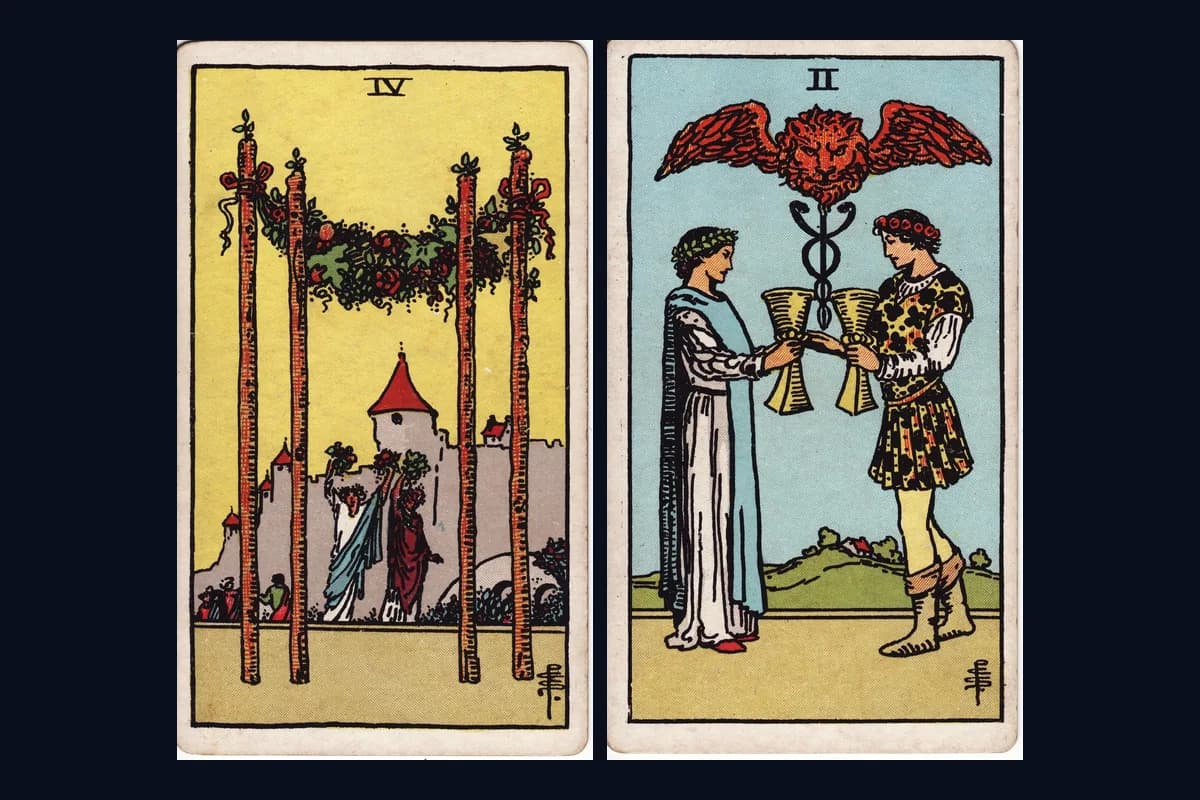
Judgement first, then the Two of Cups: the hopeful order. The reckoning comes first; the cups come up after. Whatever you rebuild stands on what you've both faced. The old relationship ended. If something returns, it's something else. If what returns is ready to be celebrated, the Four of Wands and Two of Cups combination reads that party.
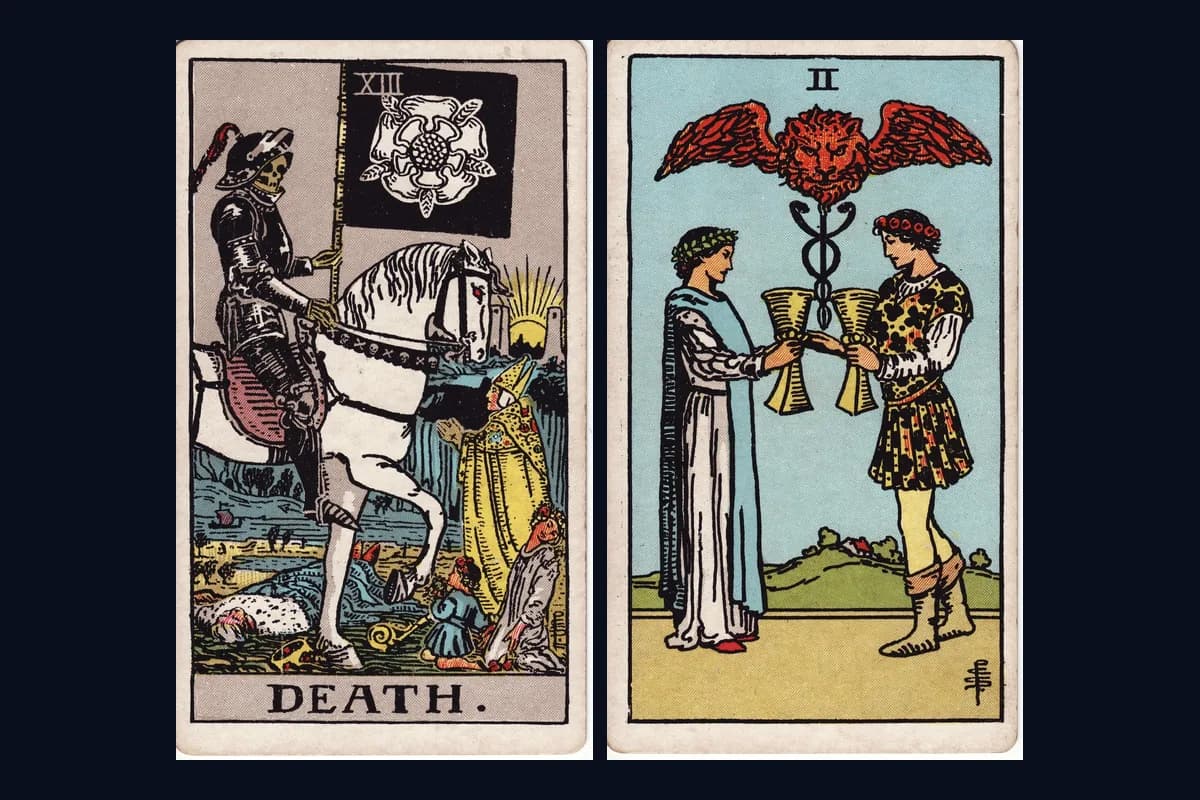
The Two of Cups first, then Judgement: the cautionary one. The bond comes first and the reckoning lands on it: maybe you reunited fast, on warmth alone, and the old problem resurfaces. Can the feeling stand the truth? If Death follows the Two instead, see the Death and Two of Cups combination.
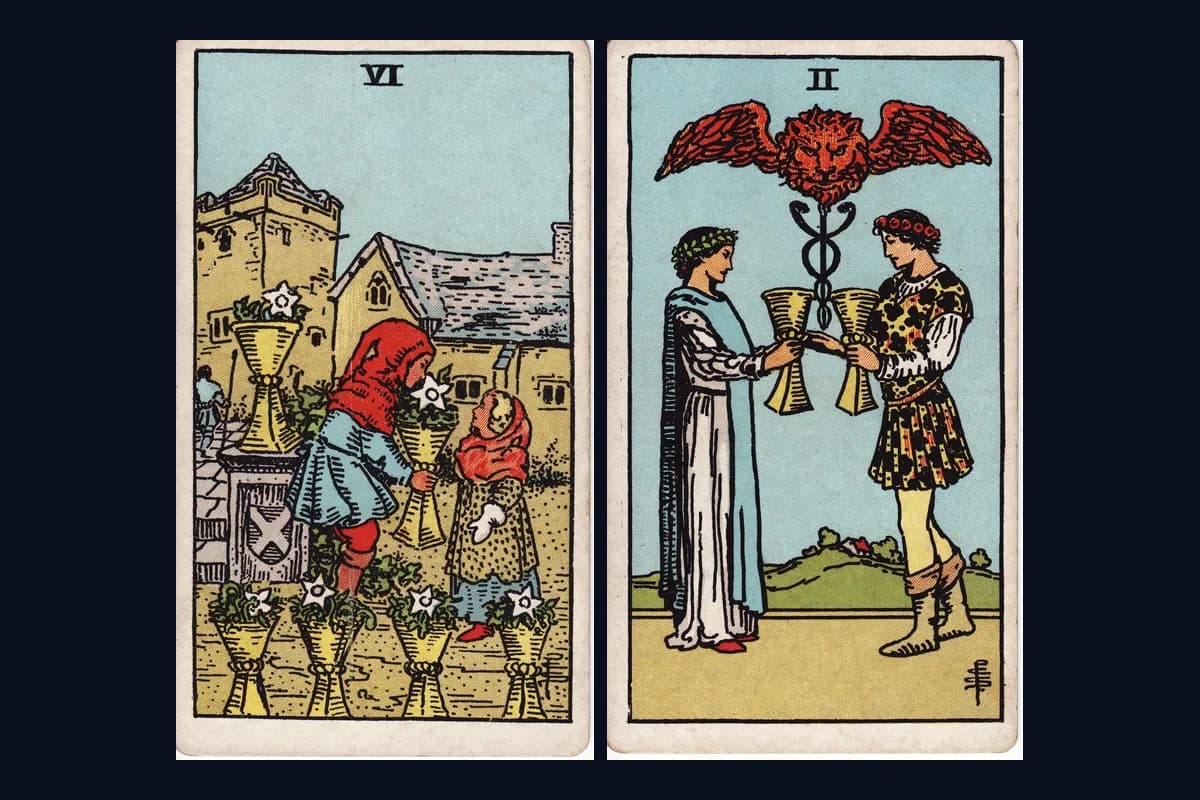
In a three-card spread of past, present and future, another Angelorum visitor drew Judgement, the Six of Cups and the Two of Cups, in that order. Angelorum's reading: "This could mean someone from your past coming back into your life." Could, not will. For that middle card's pull, see the Six of Cups and Two of Cups combination. Judgement now with the Two ahead is hopeful. But with the Two behind you and Judgement now, see clearly first, then choose new terms or let it rest.
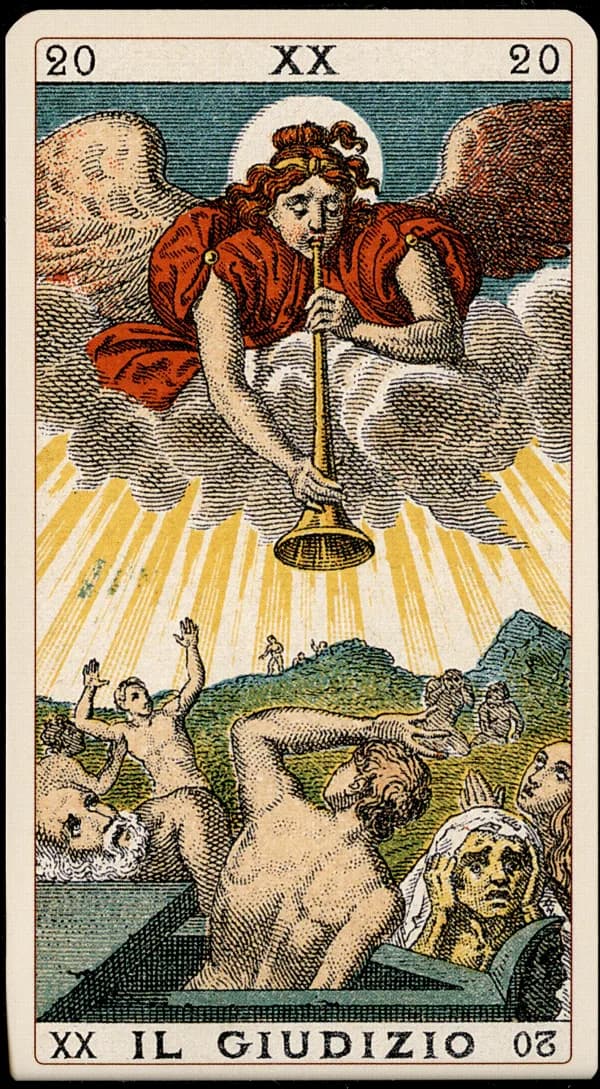
The Milanese Judgement below isn't all joy. At the lower right, a shrouded figure clutches its head as it rises.
Orientation matters too, if you read reversals. Pollack writes that reversed Judgement "can indicate that the person wishes to answer the call but does not know what to do." She goes on: "More often it shows someone trying to deny the call, usually from a fear of the unknown." That could be the Milanese figure. Benebell Wen reads the reversed Two this way: "Maybe one side is giving more than the other."
| Orientation | Reading |
|---|---|
| Both upright | An honest look at what ended it, and effort from both sides; if you can point to both, a second chance |
| Both reversed | The honest look keeps getting put off and one person does the reaching; no on these terms |
| Judgement upright, Two reversed | You see it clearly now, including that the effort runs one way; that's an answer |
| Judgement reversed, Two upright | There's warmth, but nobody has named what broke it; naming it comes first |
Which card came first in your reading, the trumpet or the cups? And if one came up reversed, which half is missing: the honest look back, or the effort from both sides?
What the sky adds to a second chance
The Two of Cups is Venus in the first ten degrees of Cancer, the sign Crowley calls "the House of the Moon." Judgement gets no planet, only Fire, and Book T, the Golden Dawn's tarot manual, titles it "The Spirit of the Primal Fire." Modern tables give it Pluto, but the order used only the seven classical planets. The Pluto glyph under the flame on the Golden Dawn Judgement is a modern touch.
So that's Fire beside Water. In elemental dignities, the Golden Dawn's rules for how neighboring cards strengthen or weaken each other, those are contraries. Mary K. Greer quotes MacGregor Mathers, one of the order's founders: contrary elements "weaken each other greatly for good or evil." In practice, she adds, he often canceled them out. The feeling can soften the honest look, or the honest look can cool the feeling.
But Wen notes that a weakened, or ill-dignified, pair isn't necessarily a bad one, and she gives Judgement to Water, which makes this pair Water with Water and takes the clash away.
On the Tree of Life, the Kabbalistic map of ten spheres, the two cards stand on opposite sides. The Two of Cups belongs to Chokmah (Wisdom), which Wang places "at the head of the Pillar of Mercy." Judgement's path climbs from Malkuth, the physical world, into Hod (Splendor), "the base Sephira and completion of the Pillar of Severity." Mercy and severity. Forgiveness and accountability.
The Moon is full at 2 degrees Cancer, inside the Two of Cups' ten degrees, on December 24, 2026 (Universal Time; the evening of December 23 in the Americas). At a Full Moon, the Sun and Moon face each other. In her planetary groupings, Greer puts Judgement with the Sun, and Cancer is the Moon's sign: a call and an answer, overhead. But the Moon still can't answer for anyone.
Fire wants the truth told. Water wants to be close again. Which one is doing the talking in you?
The hidden card in the numbers
Add Judgement's 20 to the Two of Cups' 2 and you get 22. No trump carries that number. And when Pollack lays the trumps out in rows of seven, Judgement sits under the Lovers and Death: love, an ending, then a reckoning.
Plenty of readers never add card numbers. Some numerologists keep 22 whole as a master number. But reduce it, 2 + 2, and it's 4, the Emperor. Wang reduces Judgement on its own: "the number of the card, 20, reduces to 2, that of THE HIGH PRIESTESS." A Two meeting a Two, and the sum still lands on 4.
The Emperor is structure. A feeling can come back by itself. Terms can't. They're what both of you agree to out loud: what will be different, and how you'll talk when it gets hard. Wishful thinking stops at two. Repair gets to four.
Book T files the Two of Cups as Chokmah of Heh: Chokmah (Wisdom), the Tree's second sphere, in Heh, the Hebrew letter the Golden Dawn gives to Cups. In the same system, Heh, meaning window, is also the Emperor's letter, and Wang calls him "the bridge between The Father (Chokmah) and The Son (Tiphareth)." Tiphareth is the Tree's heart. Your third card begins where the Two of Cups lives.
Four is a structure two people build on purpose. If you tried again, what's the one thing you'd both need to say on the first day?
Questions readers ask about this combination
Does Judgement and the Two of Cups mean my ex will come back?
Not on its own. Judgement shows a reckoning: what ended things gets an honest look, and whatever comes back after that comes back changed. The Two of Cups shows two people meeting as equals, so a return needs an answer from both of you. No card can make that choice for someone else. If the relationship ended because you weren't safe, no reading makes going back safe, and a domestic violence helpline can help.
Is Judgement and the Two of Cups a real second chance or wishful thinking?
With Judgement and the Two of Cups, real repair shows up in specifics: what ended the relationship has been named out loud, something has been done differently since, and the effort runs both ways. Wishful thinking runs on signs, like a late message, while the hard conversation never happens. Judgement's test is the honest look, and the Two of Cups' test is whether both people are reaching. If it ended because you weren't safe, none of this applies.
What does it mean when Judgement and the Two of Cups are both reversed?
When Judgement and the Two of Cups are both reversed, the honest look back keeps getting put off and one person does the reaching. That's a no on these terms. It isn't never, and it isn't a reason to wait. Rachel Pollack says reversed Judgement can show someone, maybe you, who wants to respond but doesn't know what to do. Start with your own part. Not every reader uses reversals.
What element connects Judgement and the Two of Cups?
Fire and Water, which pull against each other. The Golden Dawn gave Judgement the Hebrew letter Shin and the element Fire, and made the Two of Cups Venus in Cancer, a Water sign. In elemental dignities, the Golden Dawn's rules for how neighboring cards affect each other, contrary elements weaken each other. The warmth can soften the honest look, or the honest look can cool the warmth. To Benebell Wen, Judgement is Water, so the pair doesn't clash.
Is Judgement and the Two of Cups a yes or no combination?
Upright, Judgement and the Two of Cups give a qualified yes to a second chance, if what ended the relationship has been faced and both of you want to try. That yes is about repair; whether a particular person returns is up to them. With Judgement reversed, it's not yet. Reverse the Two and it's no while the effort runs one way. With both reversed, it's no on these terms. None of these means you have to wait for them.