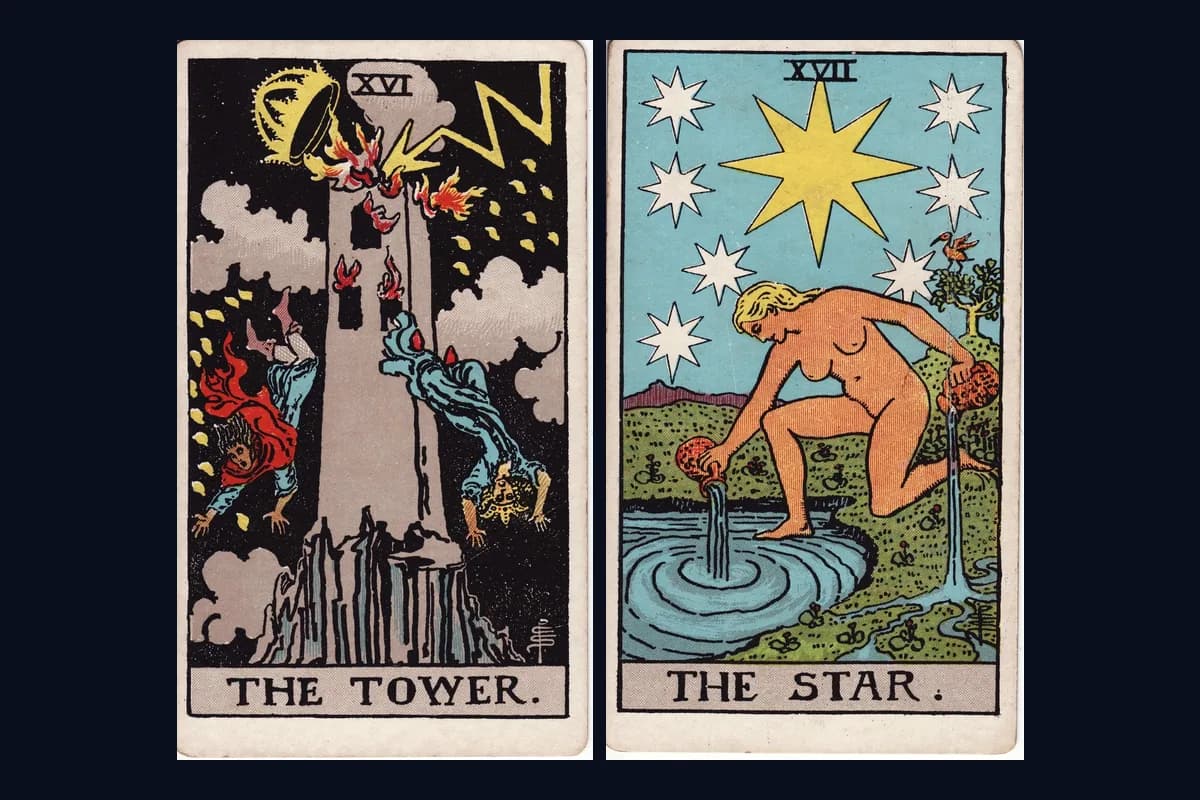
Tarot Card Combinations
Ten of Swords and Ace of Cups
The Ten of Swords and Ace of Cups tarot combination asks whether your heart can open again after the worst has happened. Black sky, then a band of yellow above the hills. Ten swords stand in a fallen man's back. On the other card, a white dove dives toward a gold cup that's spilling over. Warning or hope? In your reading, it's the first card that starts the answer.

Climate scientist, ashtanga practitioner, and advocate for human rights and LGBTQIA+ equality.
What each card shows on its own
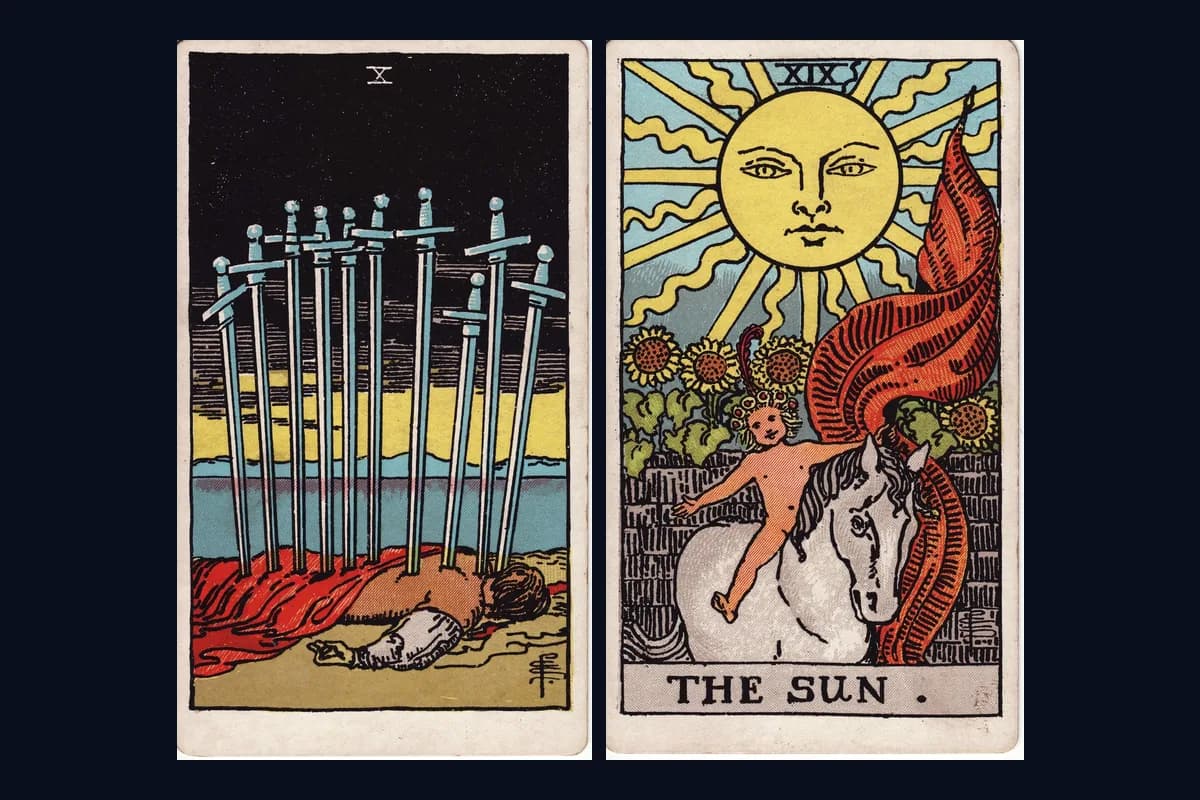
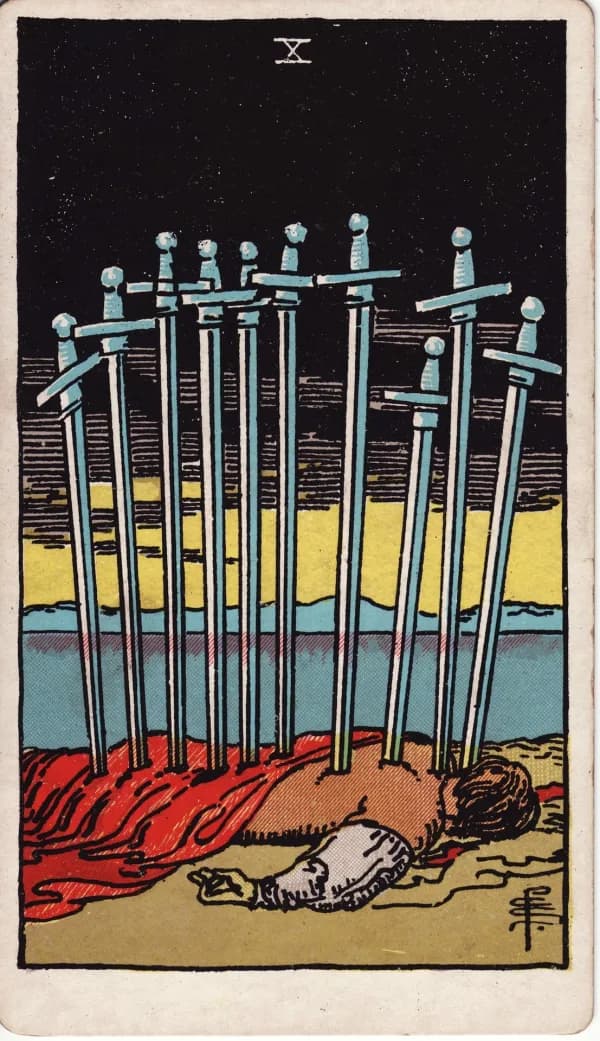
Look at the Rider-Waite-Smith Ten of Swords, and start with the sky, not the blades. It's black almost all the way down. Then, just above a line of blue hills over still water, comes a band of yellow.
A man lies face down on the shore under a red cloth, ten swords planted in a row from his neck to his legs. Only the back of his head shows.
But find his hand, resting on the ground. Mary K. Greer points out on her tarot blog that "his hand makes the Hierophant's sign of benediction." A blessing, from a man who can't get up. Rachel Pollack, author of Seventy-Eight Degrees of Wisdom, goes further: "Despite the extreme picture the card does not represent death, or even especially violence."
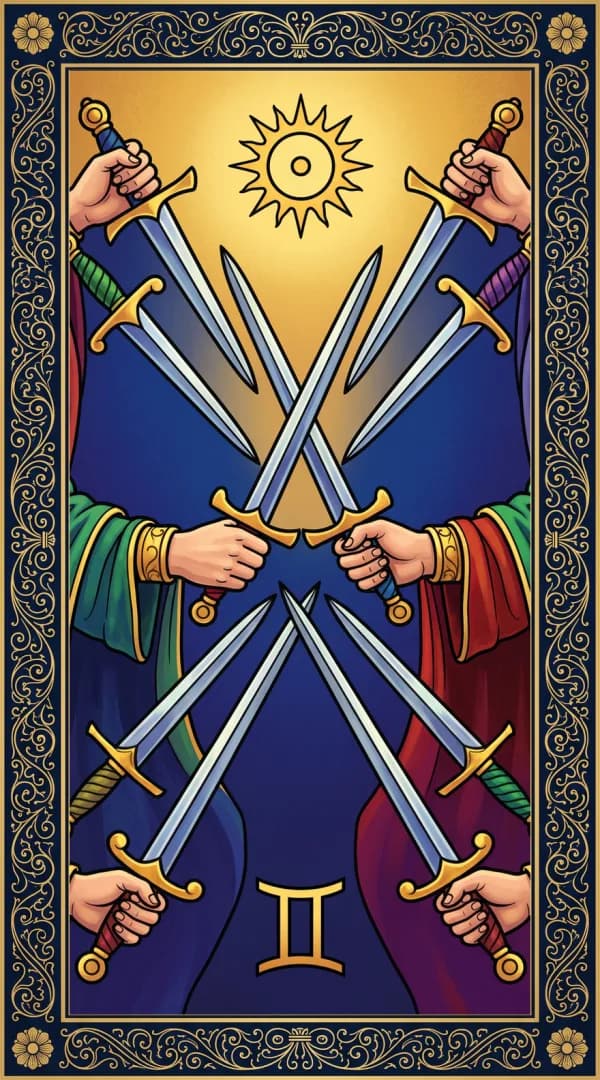
Much of the deck's symbolism comes from the Golden Dawn, a magical order that called this card the Lord of Ruin and gave it the Sun in Gemini. The order's manual, Book T, files the card under the Hebrew letter it gives to Swords: Vav, meaning nail. Aleister Crowley's Thoth deck has no man at all, only blades, and their points shatter "the central Sword (six) which represents the Sun, the Heart." There, the heart is what breaks.
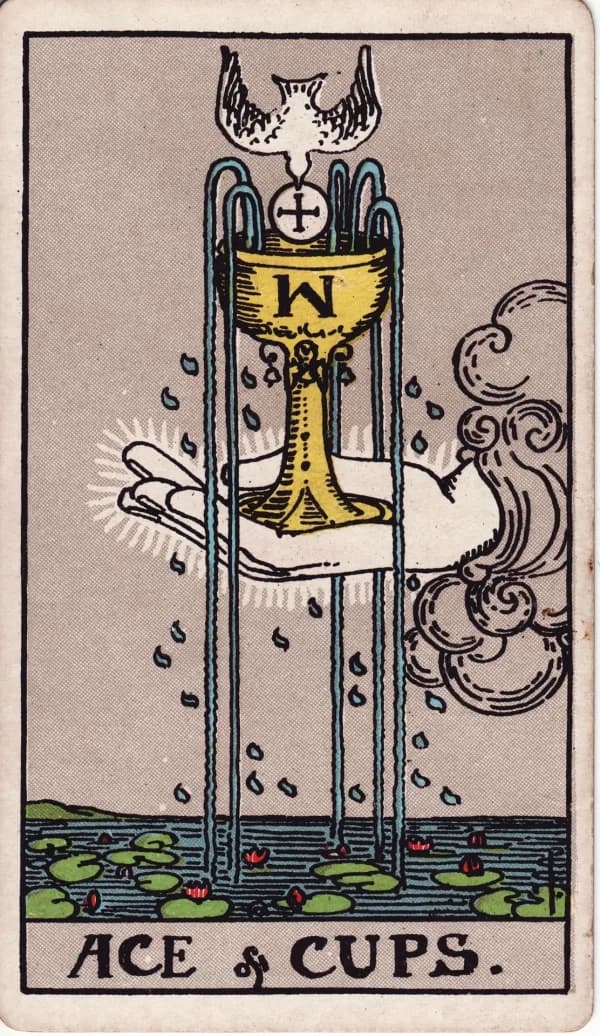
The Ace of Cups has a hand, too.
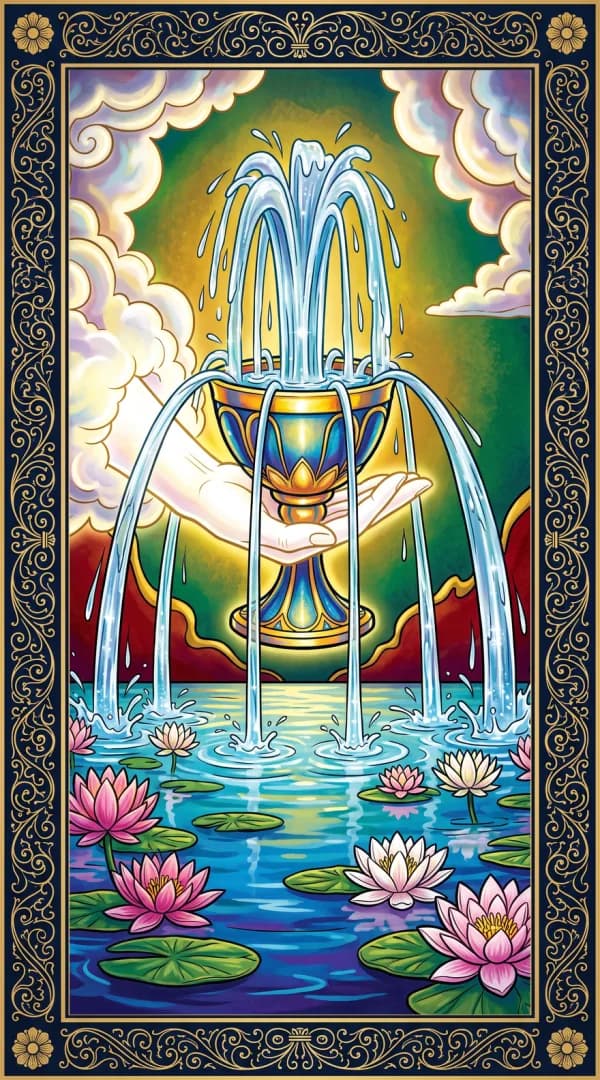
A white hand comes out of a cloud, palm up, ringed in light. On it stands a gold cup bearing a letter like an upside-down M. A white dove descends toward it carrying a wafer marked with a cross, and water spills over the rim into a pond of lilies. Pollack writes that the Smith picture, "with its dove and wafer, specifically shows the Holy Grail."
The Ace counts as 1. A.E. Waite's Pictorial Key to the Tarot gives it a phrase worth keeping here: "House of the true heart." Book T asks for the "great letter Heh" to be traced in the fountain's spray. Heh is the order's letter for Cups, and its name means window. So the Golden Dawn's Ace writes an opening into the water itself.
Two hands are in these pictures: the fallen man's, still making its sign of blessing, and the one holding the cup out of the cloud. Which one looks more like yours today?
What the Ten of Swords and Ace of Cups mean together
These two share something most pairs don't: they sit at the two ends of a count. A Ten is where it stops. An Ace is where one begins. And the suits differ. The count that just ran out is Swords, the suit of thought. The one starting is Cups, the suit of feeling. Brigit Esselmont of Biddy Tarot reads Swords beside Cups as "balancing the head and the heart."
Neither is a Major Arcana card. Two Minors keep the reading the size of your own life: one ending, one heart, the months that follow. Swap the Ace for a Major and the scale changes. The Ten of Swords and Sun combination sets the same fallen man in full daylight.
So is it a warning or a message of hope? Astrology.com puts the warning plainly: on the surface, it says, the combination "may indicate a sudden and unexpected end to a positive emotional situation." Other readers call it a message of hope. Order and orientation settle it. With the Ten first, the pair puts rock bottom behind you and the cup after it. With the Ace first, it's a warning about pace.
Then look at the bottom of each Rider-Waite-Smith card. Under the Ten's black sky, Pollack observes, "the water lies placidly." Under the Ace, Greer reads the lily pond as the emotions, which "here have become serene and calm." Whatever the swords did, they didn't reach the water.
What happened can't be undone, but your heart can still open. The cup is held out, not handed over. Nothing on either card says whose hand is holding it, or whether you'll reach for it.
The Golden Dawn pair below says it with hands: on the Ten, every hand you can see is a fist around a hilt, and on the Ace, one open palm holds the cup. You can't take a cup with a closed fist.
Thought or feeling: since things fell apart, which one has been doing most of the work?
What it means after heartbreak or betrayal
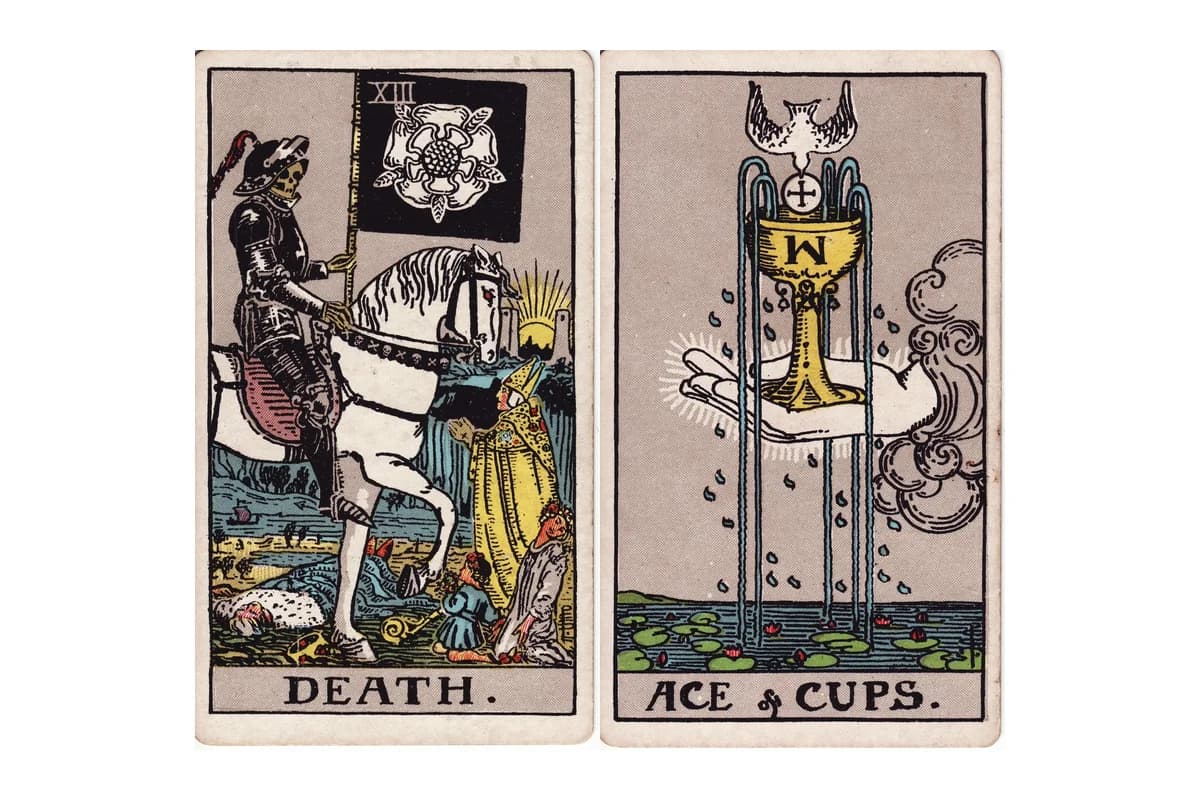
In love readings, this pair most often describes life after a breakup. Biddy Tarot calls the Ten "a painful yet inevitable ending," and the Ace takes none of that back. Theresa Reed, The Tarot Lady, lists "Healing the old to make way for the new" among the Ace's meanings. If your ending felt more like a slow release than a blow, the Death and Ace of Cups combination reads the same cup after a quieter loss.
If it was a betrayal, the Ten has long carried that meaning. Tarot author Benebell Wen ties it to "the pain of being double-crossed, and the breach of trust." But the card shows the wound, not the evidence, and a direct conversation will tell you more than another draw. Pollack calls the card "more of a reaction to problems than the problems themselves." That fits when the story has outgrown the facts, not when someone really lied to you.
When you're still together after something broke between you, the Ten can be the end of one version of the relationship, and the Ace a fresh start if you both want it. One person can't fill the cup for two. And opening your heart again doesn't mean opening it to someone who's still hurting you. If you don't feel safe, reach out to a domestic violence hotline or your local emergency number.
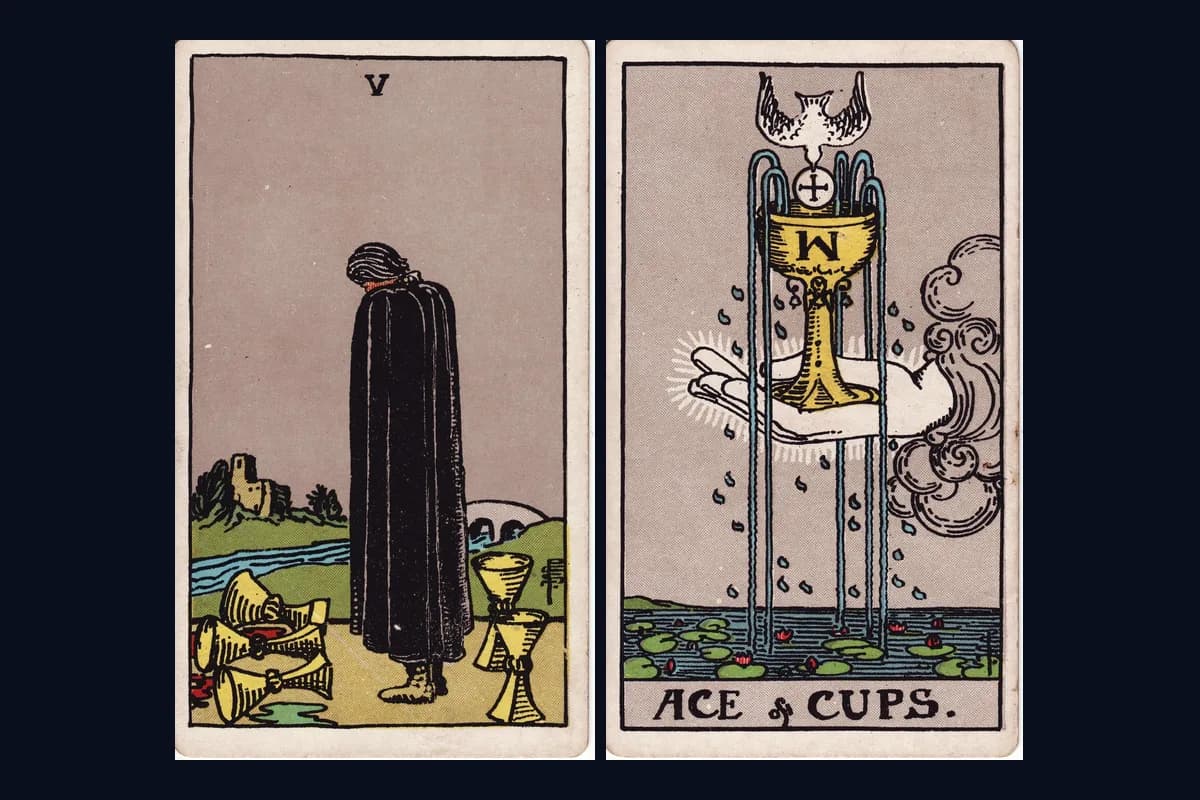
Hoping an ex comes back? The Ace's cup isn't addressed to anyone, and beside the Ten, the relationship as it was has ended. No card can tell you someone will return. Someone new who's still mourning an ex is a different question, and the Five of Cups and Ace of Cups combination takes it up.
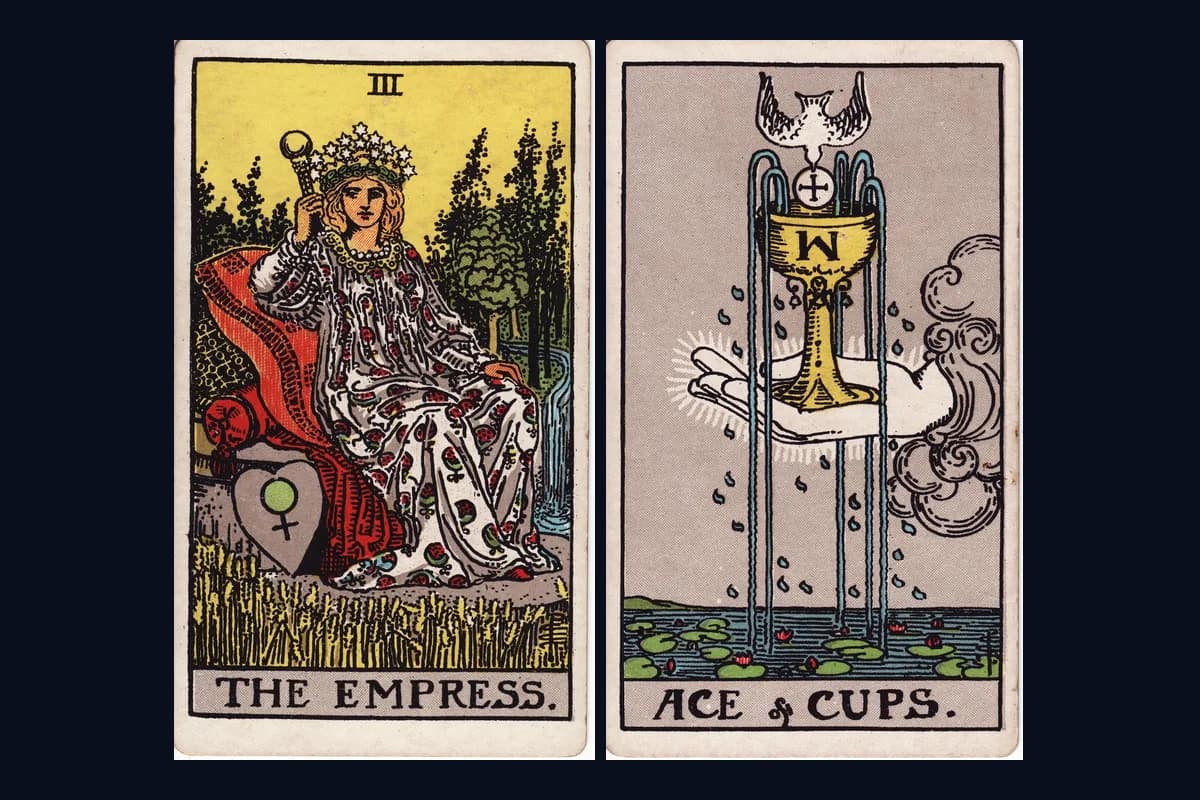
With someone new, the question is timing. Relief isn't readiness, and a new person can be right and still early. Biddy Tarot sees a reversed Ace as a sign that you're "withholding your emotions for fear of getting hurt." On readier ground, the Empress and Ace of Cups combination turns the Ace's cup into an offer with room to land.
In a Celtic Cross, the clearest draw has the Ten in the recent past and the Ace in the near future. The Ace can also land in the ninth position, hopes and fears, which Esselmont notes "are closely intertwined." When the Ten sits earlier in the spread, the Ace there can be both: you want to love again, and you're afraid of it.
For health questions, read the pair as emotional exhaustion. The cards are not a medical opinion, and if your question is about your body, talk to someone who went to school for it. If the hurt has started to mean not wanting to be here, call a crisis line or your local emergency number now.
Asking yes or no? Check which question you mean. Can what ended go back to how it was? No. A Ten is a finished count. Can your heart open again? With the Ten first, closer to yes, and slowly. With the Ace first, the pair ends on the Ten, so hold that yes more loosely. The Ace is an opening, not a person, and it comes with no date. Biddy Tarot asks the Ace's question outright: "Will you take it?"
Picture your own Ace of Cups, painted for the other side of your Ten of Swords. What fills the cup, and whose hand is holding it out? It could be yours. That image belongs in your deck.
How order and orientation change the answer
The Ten of Swords first, then the Ace of Cups: the hopeful order. The fall, then the cup. Lay the Rider-Waite-Smith cards out this way and the man's head lies at the edge nearest the cup, while the Ace's hand reaches back toward him from the cloud. In the Tower and Star combination, two Majors fall in this order.
The Ace of Cups first, then the Ten of Swords: the cautionary order. An opening, then a fall. Here, the Ace's hand reaches off the far edge and the man's head points away from the cup. Already living through the loss? This may just be the order it came in, and opening your heart didn't cause it. And if the Ten still lies ahead, read it as a reason to go slowly, not a verdict on the person in front of you.
For a three-card spread, try one of Esselmont's layouts: what you can change, what you can't change and what you may not be aware of. If the Ten lands in what you can't change, that's the ending, whatever someone else did. If the Ace lands in what you can, that's whether you let anyone in, and how fast. The other way around, the hurt is the part you can work on, and the new feeling can't be forced.
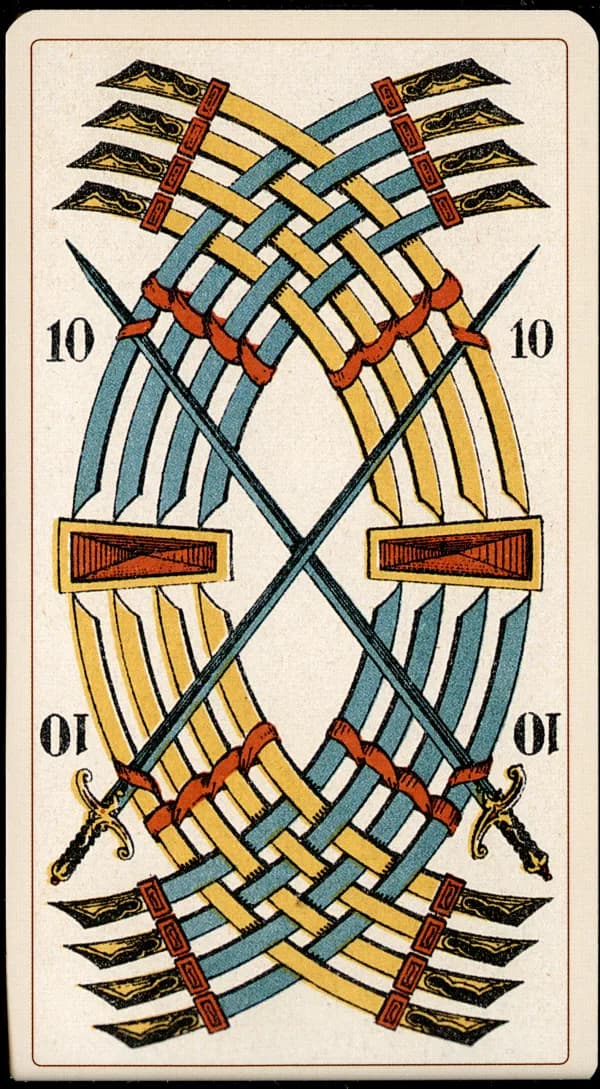
The Milanese Ten below prints its 10 four times, twice upside down, so it reads from either end. But its two straight swords keep their hilts at the bottom. Even a card built to be turned has a right way up.
Orientation matters too. Not every reader uses reversals. Most who use them read a reversed Ten as recovery, with a catch. Pollack adds a caution: when a situation changes, "the problems may go away for the moment." Change something while the relief lasts. A reversed Ace is emotion held back.
| Orientation | Reading |
|---|---|
| Both upright | A real ending beside an open heart; the cup is offered, to take at your own pace |
| Both reversed | Unfinished grief and a heart shut to stay safe; slower, not hopeless, and the first step is yours |
| Ten upright, Ace reversed | The wound is fresh and the cup held back; go slowly with anyone new and look after yourself |
| Ten reversed, Ace upright | The swords are working loose and your heart is open; the one trap is sliding back into the old pattern |
Find your own row in the table. Does it say wait a little longer, or start letting people in again?
How the sky moves from Air into Water
The Golden Dawn gave the Ten of Swords an exact address in the sky: the Sun in the last ten degrees of Gemini. The Ace got none. Book T calls it the Root of the Powers of the Waters and sets the four Aces at the North Pole to turn the heavens instead of standing in them. Crowley gives the Ace one light, though: "At the base of the Cup is the Moon." The Sun rules one card. The Moon sits under the other.
Air and Water aren't enemies. Book T counts Air as friendly with Water in elemental dignities, the Golden Dawn's rules for how neighboring cards affect each other. Greer rates the pair only "somewhat friendly" and warns that "the term 'friendly' does not mean that the cards act nicely toward each other." So the Ace doesn't wash the swords away.
Mercury, Gemini's ruler and the planet of thought and talk, makes the move from Air into Water in July 2027, after one step back. It turns retrograde in Cancer, a Water sign, on June 10, 2027. The Sun leaves the Ten's slice of Gemini for Cancer at the June solstice, on June 21, 2027. Five days later, on June 26, 2027, Mercury backs into that slice. It turns direct there on July 4, 2027, and re-enters Cancer on July 12, 2027 (all Universal Time).
Call it one more pass through the old story before the mind follows the light into Water. But it's weather around your question, not a date for a new love or anyone's return.
Mercury goes back over old ground before it moves on. What would you go over one last time, and then let rest?
The card the numbers point to
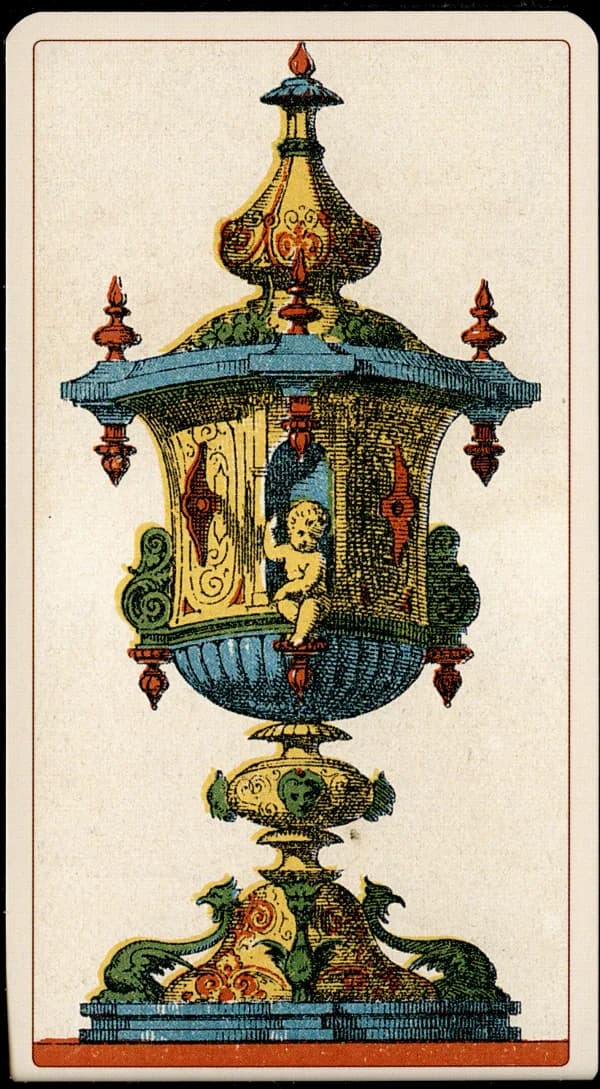
Add the Ten of Swords to the Ace of Cups and you get 11: Justice in the Rider-Waite-Smith deck, Strength in the Milanese.
And 11 is one more than the Tree of Life allows. The Sepher Yetzirah, an early Kabbalistic text that Robert Wang quotes in The Qabalistic Tarot, counts the Tree's spheres as "ten and not nine, ten and not eleven." The Golden Dawn set every Ten in Malkuth, the tenth and lowest sphere. So the Ten fills the count, and the Ace is the one left over, a first number again.
Count once more: 1 + 1 = 2, and inside the Ace's own suit, 2 is the Two of Cups. Fair warning: any Ten beside this Ace lands there. The zodiac singles out this Ten. Book T's decans, its ten-degree slices of the zodiac, run from the Ten of Swords, the Lord of Ruin, straight to the Two of Cups, the Lord of Love, at the start of Cancer. The numbers and the zodiac point at the same card.
The Rider-Waite-Smith Two of Cups shows two people facing each other, each holding a cup, under a winged lion's head. In Biddy Tarot's words, "If the Ace of Cups represents the flow of love from within, the Two of Cups is the flow of love between two people."
Notice the order: within comes first. No number can tell you if or when anyone will hold the other cup, or promise it's someone who already left. What the count says is smaller: there has to be a 1 before there's anything to share.
Two people, two cups. Which is harder for you right now: holding yours out, or taking the one that's offered?
Questions readers ask about this combination
Is the Ten of Swords and Ace of Cups a warning or a message of hope?
For the Ten of Swords and Ace of Cups, card order decides most of it. With the Ten first, it reads as hope: the ending is behind you and the Ace's cup comes after. With the Ace first, it's a warning about pace, and if the ending has already come, opening up didn't cause it. A reversed Ten leans toward recovery, a reversed Ace toward holding back. This pair can't promise new love or an ex's return.
What does the Ten of Swords and Ace of Cups mean in a love reading?
In love, the Ten of Swords and Ace of Cups usually describe life after a breakup or a betrayal: the hurt is real, and the Ace is your capacity to love again. The cards can't prove anyone cheated, promise a new partner or say whether an ex will come back. Still together? They can show a rupture it takes two to repair. If a partner makes you feel unsafe, an open heart doesn't mean staying. Call a domestic violence hotline.
What does the Ten of Swords reversed with the Ace of Cups mean?
With the Ten of Swords reversed and the Ace of Cups upright, most modern readers see recovery under way and a heart that's open again. Once the pain eases, the one trap is sliding back into the old pattern. With both cards reversed, an unfinished grief sits beside a heart shut to stay safe: slower, not hopeless. Some readers skip reversals entirely.
What element connects the Ten of Swords and the Ace of Cups?
The Ten of Swords is Air, and the Ace of Cups is the root of Water. Book T, the Golden Dawn's manual, counts Air as friendly with Water in elemental dignities, the rules for how neighboring cards affect each other. Mary K. Greer rates the pair only somewhat friendly. Either way, neither card cancels the other, and the Ace doesn't wash the Ten's hurt away.
Is the Ten of Swords and Ace of Cups a yes or no combination?
The Ten of Swords and Ace of Cups give two answers, because you're usually asking two questions. Can what ended go back to how it was? No: a Ten is a finished count. Can your heart open again? With the Ten first, closer to yes, slowly and on your terms. With the Ace first, hold that yes more loosely. Neither card names a person or a date, or answers for someone else.