Tarot Card Combinations
The Hermit and The Star
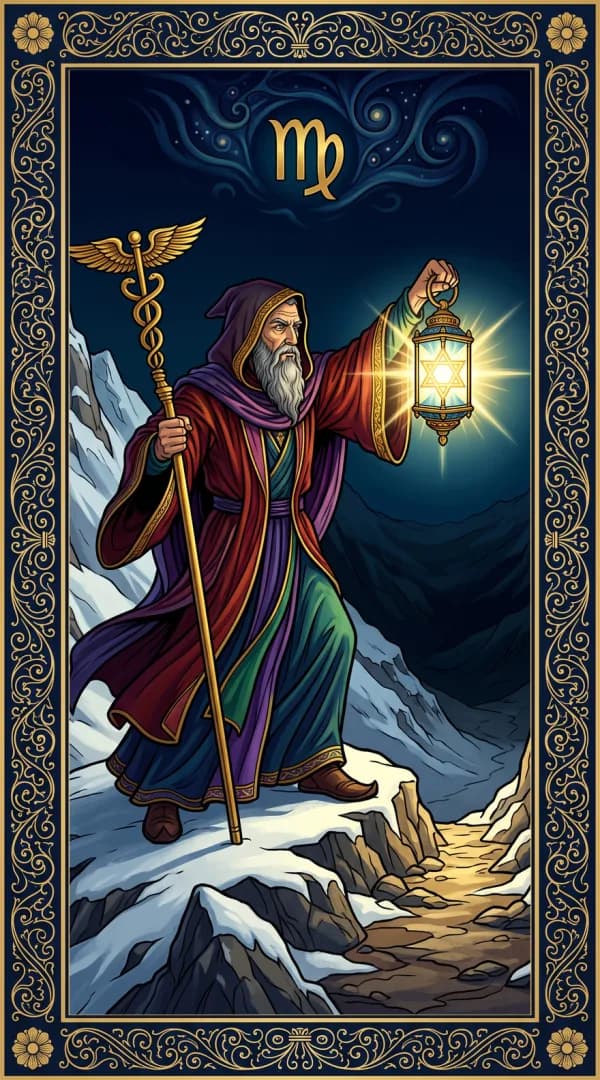
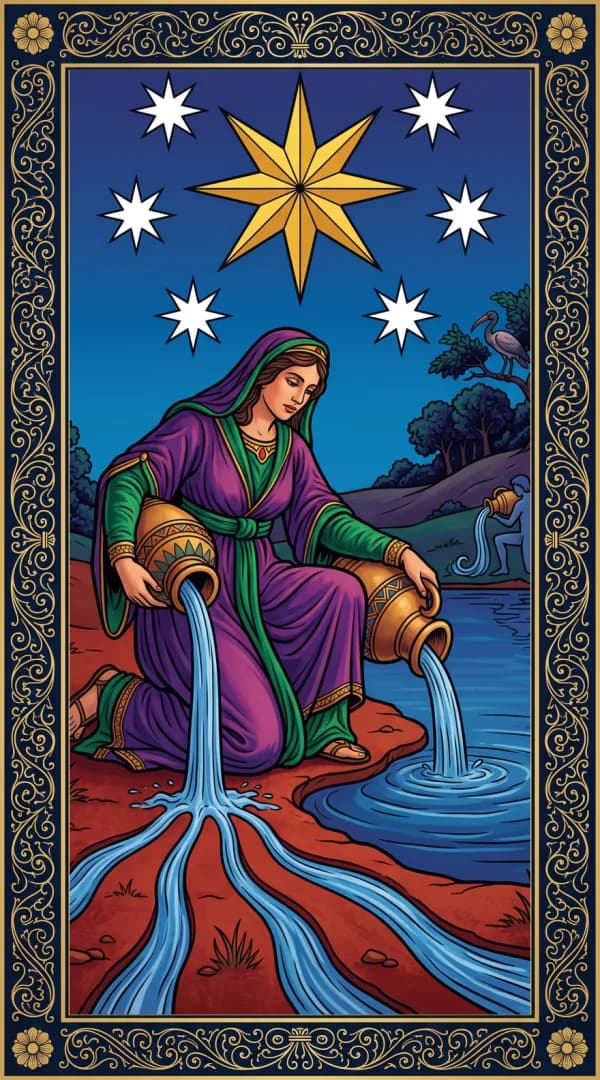
The Hermit and the Star tarot combination signals a spiritual awakening that begins alone and ends in hope. An old man stands on a snowy ridge. He holds up a lantern with one star inside. On the Star card, eight stars with eight points each hang over a woman emptying both her jugs. One star carried, many given. If you've been alone with your one light, look up.

Climate scientist, ashtanga practitioner, and advocate for human rights and LGBTQIA+ equality.
What each card brings to the reading
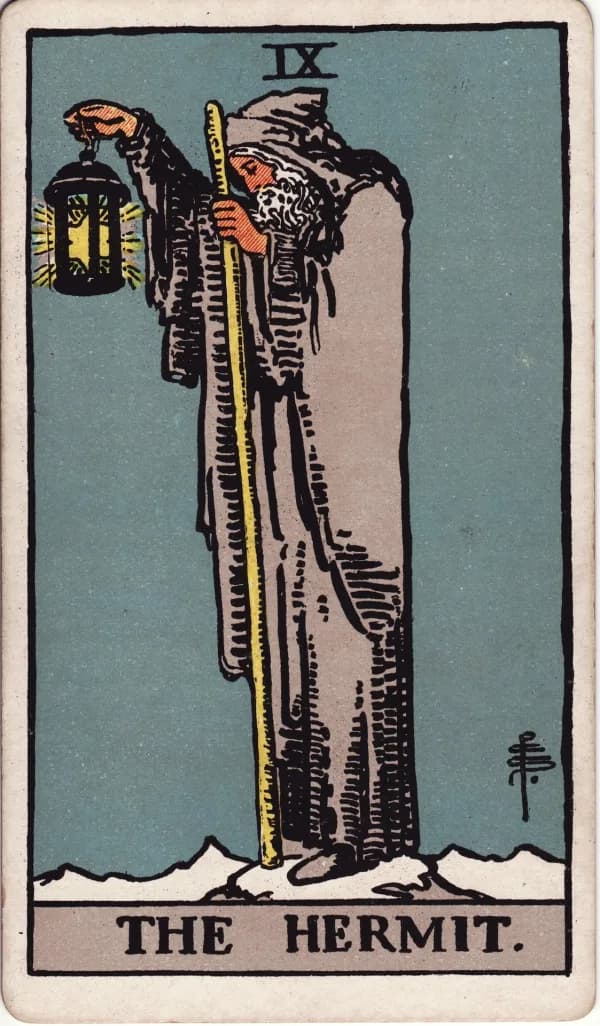
Look at the Rider-Waite-Smith Hermit first. Snow, a ridge and an old man in a long gray hooded robe, eyes lowered, a yellow staff in one hand. His sky is pale and empty. The only light is the one he's holding up: a lantern at shoulder height, a star glowing behind its bars.
A.E. Waite, who planned the deck Pamela Colman Smith drew, put it plainly: "It is a star which shines in the lantern." Biddy Tarot, Brigit Esselmont's site, counts six points on it and calls it the Seal of Solomon. Waite also wouldn't call the old man lost: this is "a card of attainment," he wrote, rather than "a card of quest." The raised light tells anyone below that "where I am, you also may be."
The Hermit is card IX. The Golden Dawn gave him Virgo and Yod, the Hebrew letter for a hand. The Tarot de Marseille hid part of his light. His cloak half covers the lamp, and Waite said uncovering it was his only change to the card. Rachel Pollack, author of Seventy-Eight Degrees of Wisdom, reads the covered lamp as "the light of the unconscious hidden under the cloak of the conscious mind." That Hermit is still looking. Waite's has found it.
Now look at the Star (XVII).
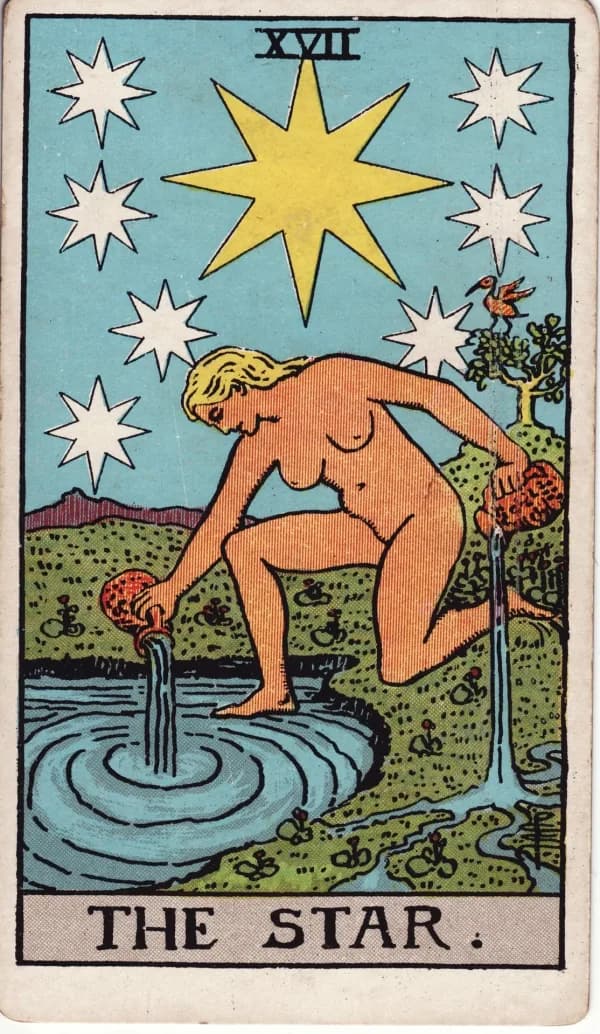
Same pale sky, now full. Eight stars, every one with eight points: a big yellow one at the top and seven small white ones down the sides. Below them a naked woman empties two red jugs, one into a pool and one onto the grass. Her eyes stay on the water. Waite's line for her is "That which the figure communicates to the living scene is the substance of the heavens and the elements." So she takes what's overhead and hands it to the ground.
For the Golden Dawn, she's Aquarius, and her letter is Tzaddi, Hebrew for a fishhook. Many early Star cards looked more like the Hermit's. Sherryl E. Smith of Tarot Heritage notes that the hand-painted Visconti-Sforza card and the printed Budapest card "show a person reaching up to seize a star." One star, wanted. The kneeling woman took over in the seventeenth century, when "the Tarot de Marseille design gave the world an entirely new Star card." And the oldest recorded meaning, from Bologna about 1750, is "Gift."
Which picture are you in tonight: up on the ridge with one small light, or down at the water under eight of them?
What the Hermit and the Star mean together
These two cards share something most pairs don't. Their light is a star. The Hermit carries one, and the Star works under a sky of them. On the Golden Dawn pair below, you can count the points: six on the star in his lantern, eight on every star in her sky.
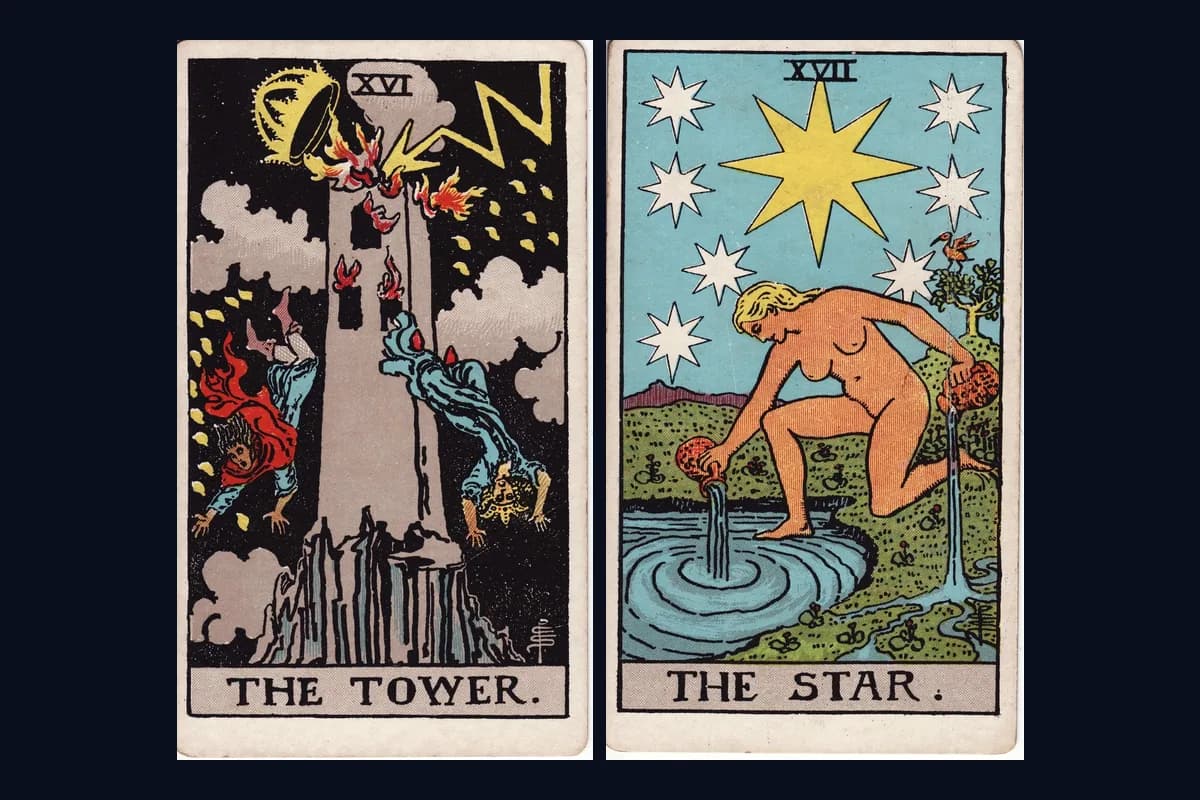
Both are Major Arcana, which marks something bigger than a passing mood. The Hermit is IX and the Star is XVII, with seven cards between them, from the Wheel of Fortune to the Tower. In the Tower and Star combination, the two cards are neighbors, XVI and XVII. But here there's ground to cover between the lantern and the sky, and that's the pair's first honest message: the hope comes after a wait.
For Pollack, the Hermit means "a withdrawal from the outer world for the purpose of activating the unconscious mind." Her Star chapter picks up the same thread: "Trump 17 indicates the unconscious activated, but in a very benign way." The Hermit does the work. The Star is that work landing.
Put them side by side and the simplest reading is this: a retreat you choose ends in hope, as long as it stays a choice.
Waite recorded one of the Star's mottoes as "Gifts of the Spirit," and that's the second card's half of the story; what you carry alone for a while becomes something you can hand on. The tarot author Benebell Wen says as much of the Hermit himself: "Shine for others, so others can see themselves and the world clearer." But look at the order. He rests first. She pours second, and only what the sky gives her.
In the Rider-Waite-Smith pair, nobody else is in either picture, and neither figure is hiding. Alone, and still open.
What has time on your own shown you that you'd want someone else to see?
How the pair reads for awakening, burnout and love
For a spiritual awakening, this pair is slow on purpose. The Hermit is the practice: the walk before work, the notebook nobody reads. The Star is what the practice starts giving back, a calm that doesn't depend on how the day went. But an awakening shouldn't cost you your sleep, your meals or the people you love. If it has, see a doctor.
For chosen solitude, ask one thing: does the time alone fill you up, or empty you out? Tina Gong of Labyrinthos writes that even with the Hermit reversed, if you'd like to be alone, "there is nothing wrong about that." She names the other kind too, a loneliness "being forced on you instead of one that you are initiating yourself." The upright Hermit beside the Star is the first kind. If yours is the second, the cards aren't blaming you, and reaching out to one person is a start.
For burnout, the Hermit is the step back. Theresa Reed, The Tarot Lady, writes: "Sometimes a player needs a break from the grind." Then comes the Star, and it starts small: an evening when you've got something left over. But the cards are not a medical opinion. They can reflect how tired you feel, never why, and this pair's wait is no reason to put off help. If rest isn't lifting the exhaustion, or your mood has been low for weeks, talk to a doctor or a therapist.
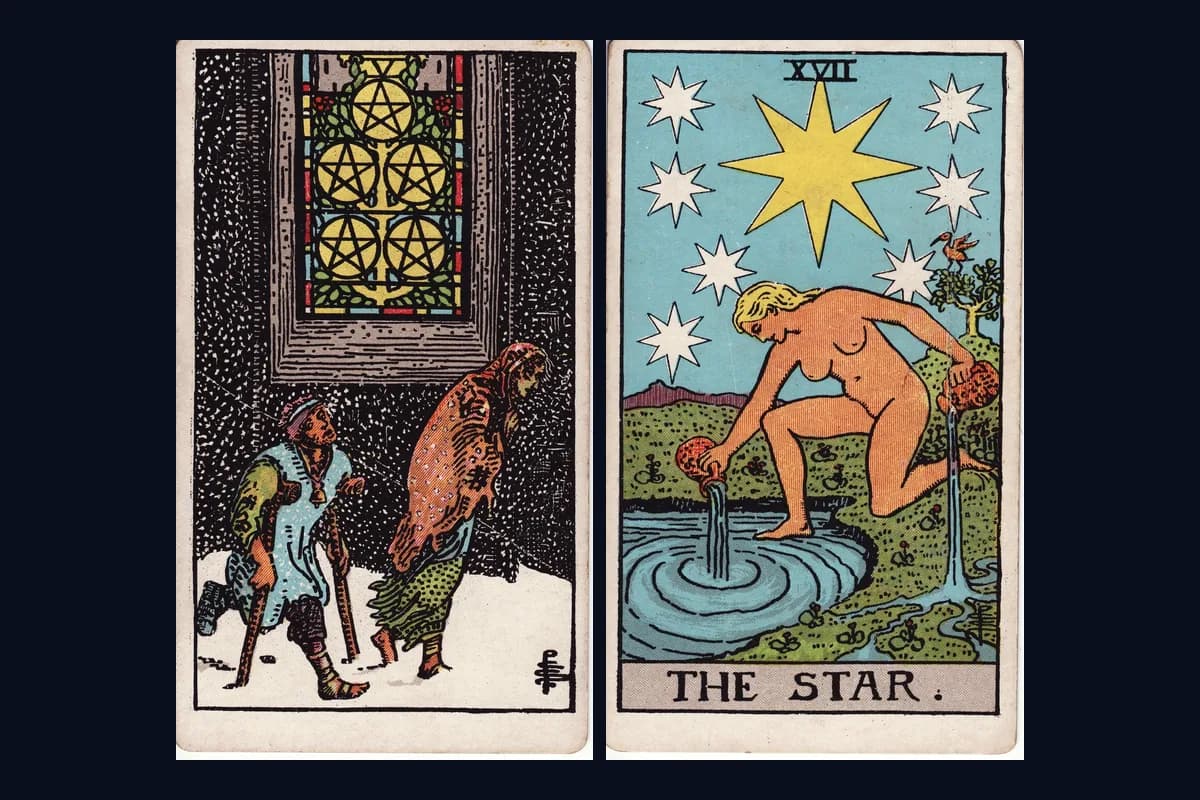
For career questions, use the Hermit's time away to ask whether the work still fits. The Star's part is a reason to work, in this job or the next. No card hands you an offer letter. Lost your paycheck too? The Five of Pentacles and Star combination looks at hope when money runs short.
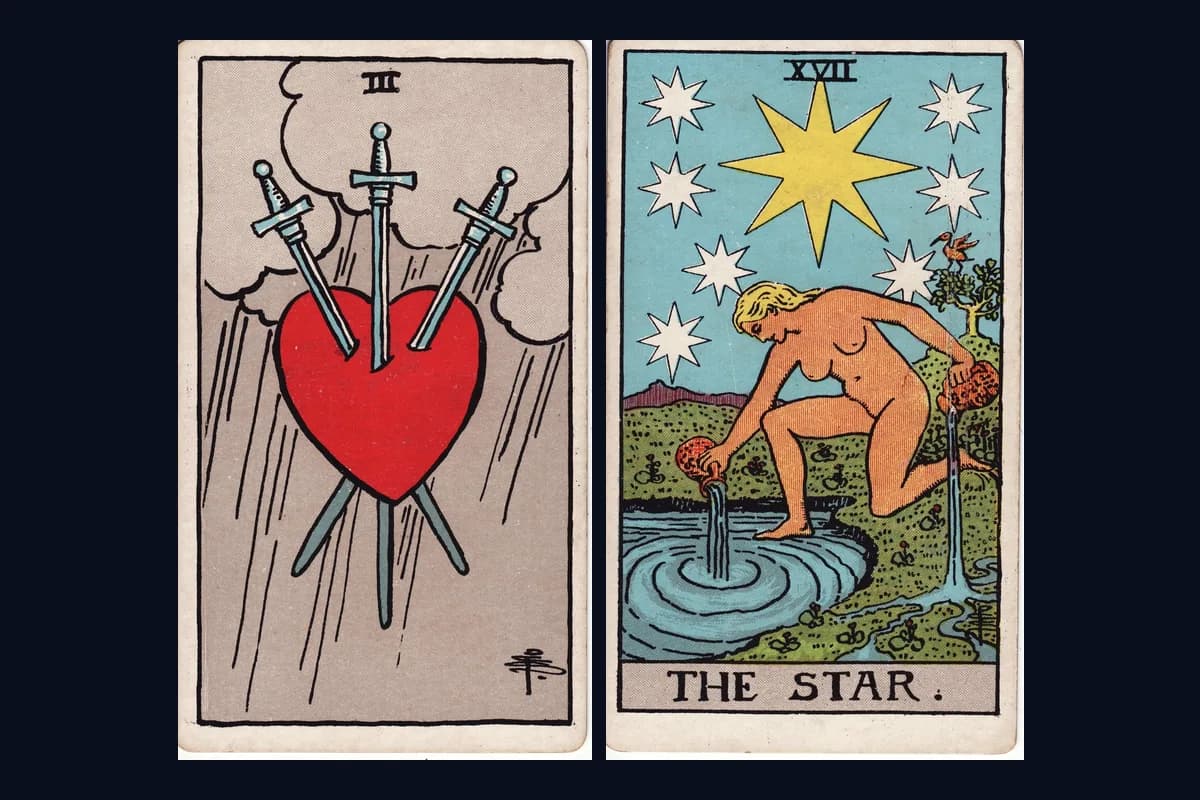
If you're waiting for a soulmate, Benebell Wen's love table gives the Hermit "Not a good time to seek relationships" and the Star "A hopeful, optimistic love." That's this pair's shape. A wait, then hope. Neither card names a person or a date, and the hope is yours before it's about anyone else. Being on your own by choice can be the whole answer. If the waiting began with a heartbreak, the Three of Swords and Star combination stays with the part that still stings.
Already with someone? The pair often means one of you needs room to think. If it's your partner who's pulled back, only they can say why. Ask them.
In a Celtic Cross, watch the ninth position, hopes and fears, which shares the Hermit's number. The Star there is the hope said out loud. The Hermit there is often the fear under a soulmate question: that you'll be alone for good. That's the fear talking, not a forecast.
Yes or no? Yes, after a wait, and the cards don't say how long. If the Star comes first, the hope is already here, and the risk is hiding it. One reversed card sends the yes through other people. Both reversed, it's not yet. For the soulmate question, the yes is to hope. It doesn't promise a person.
If your Hermit carried a lantern through this stretch of your life, what would be burning inside it? That image belongs in your deck.
The Hermit then the Star, or the Star then the Hermit
Esselmont's rule: "Change the order of the cards and you get a different story."
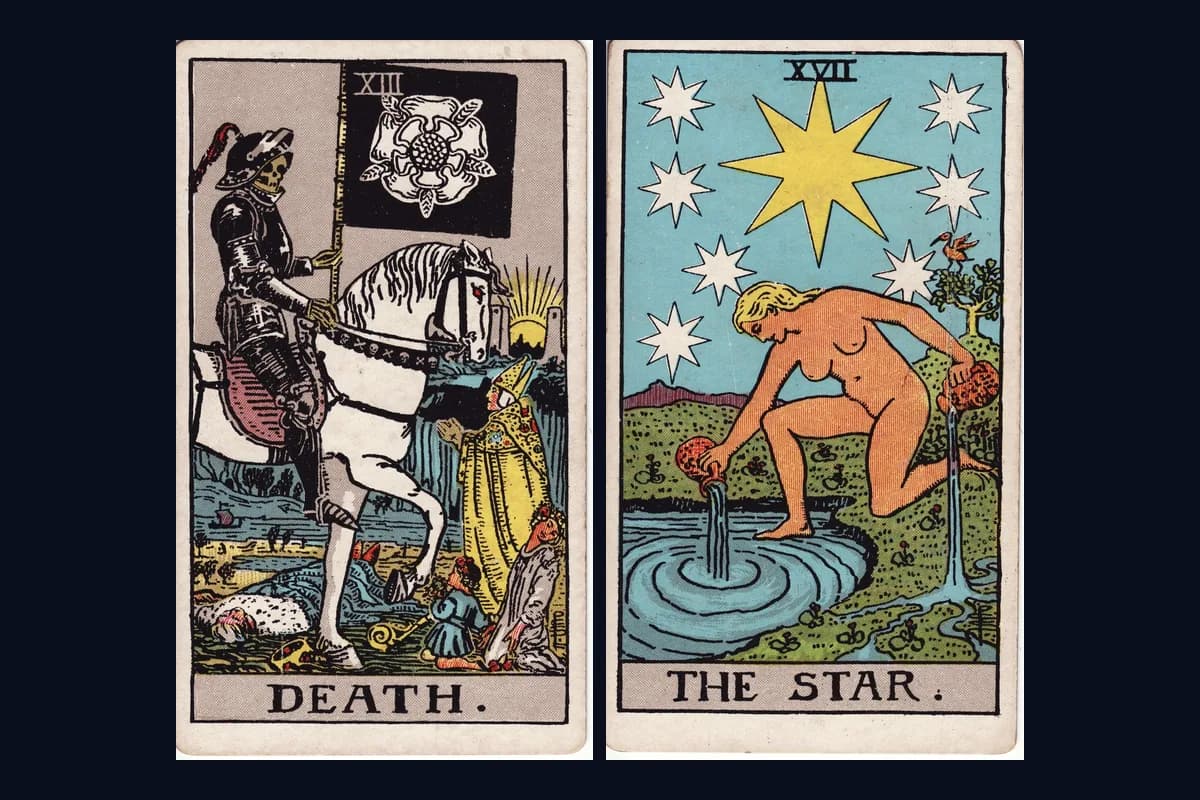
The Hermit first, then the Star is the deck's own order and the hopeful reading. You go quiet on purpose. The hope that follows is what the quiet was for. Some retreats begin because something ended, and the Death and Star combination starts there.
The Star first, then the Hermit is the cautionary one. Hope has already arrived, and now it wants to be taken somewhere private and kept. That can be wise. Or it can be relief turning into hiding, a hope pulled back before it's ever tested.
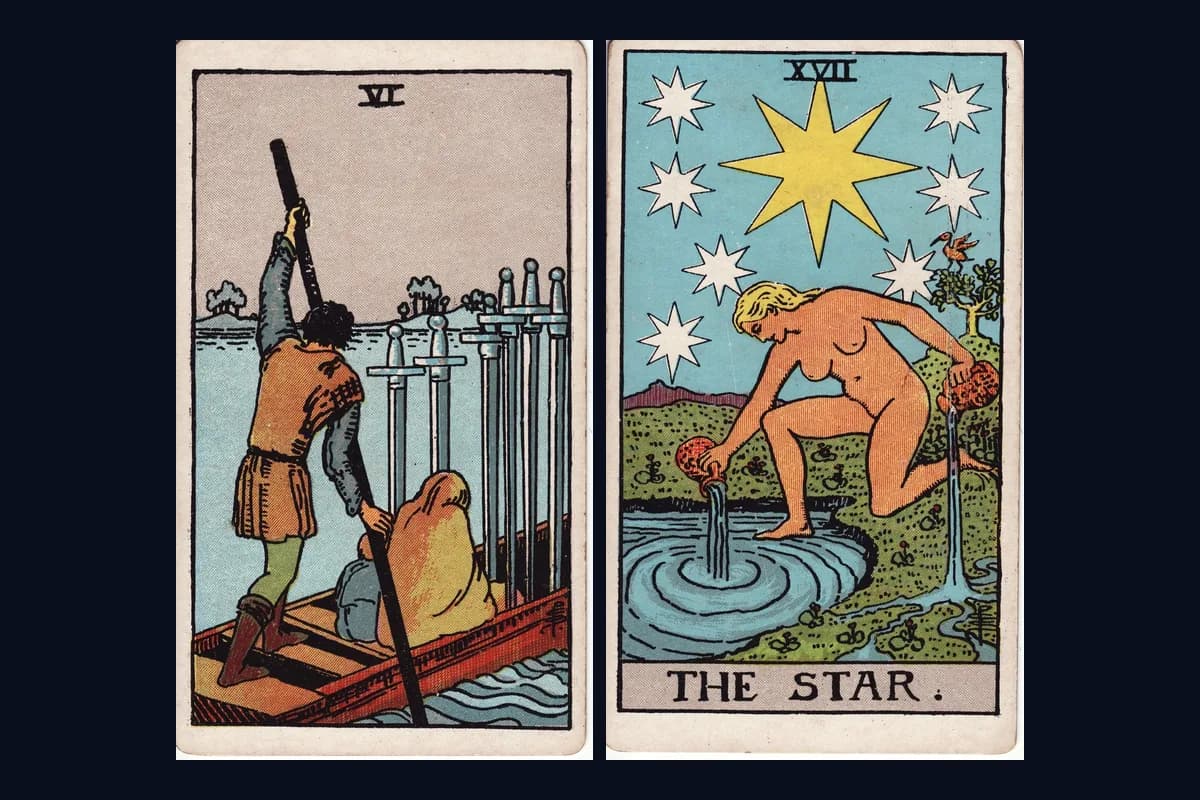
In a three-card spread of past, present and future, the Hermit now with the Star ahead is the most hopeful layout for burnout: you're in the rest, and the reading points past it. The Hermit behind you with the Star now can reflect recovery starting, even if it's small. The Star behind you with the Hermit now is harder. A hopeful stretch ended, and you're taking stock. Weighing a move? The Six of Swords and Star combination covers the crossing.
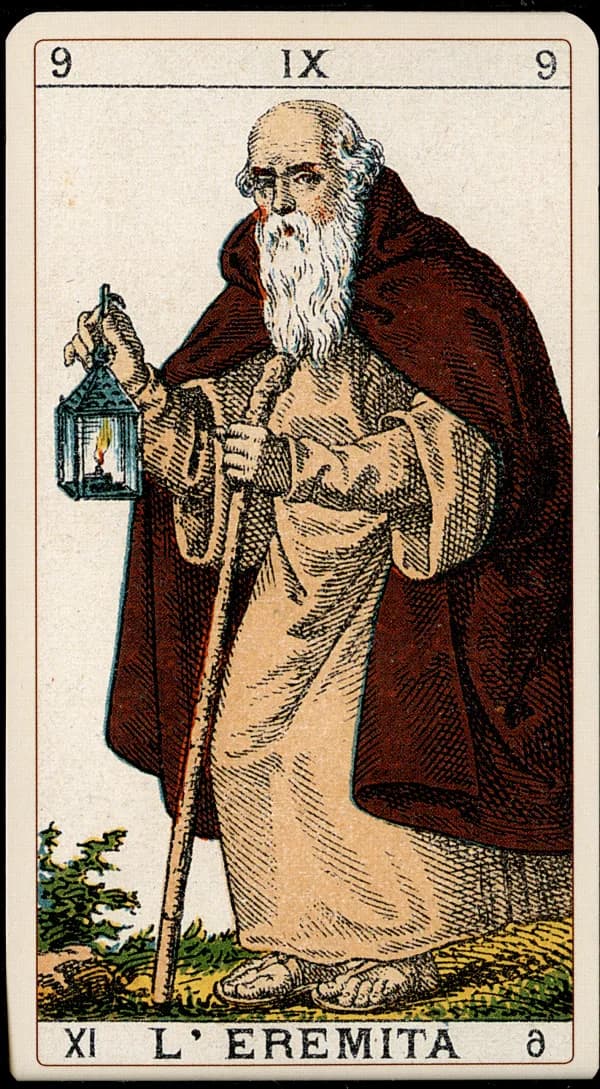
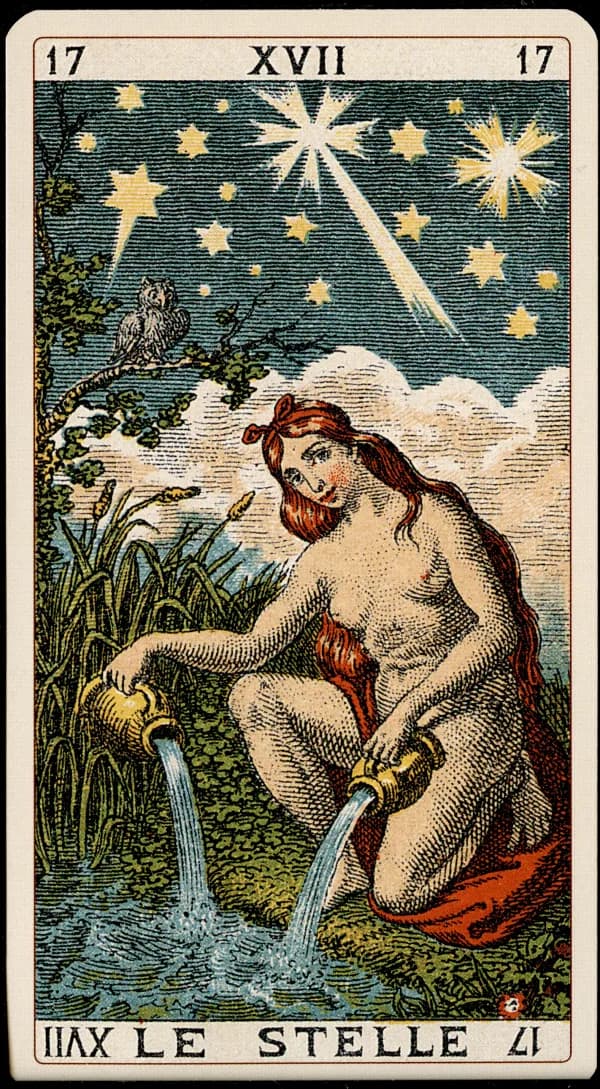
The Milanese pair below breaks the one-star pattern. Its Hermit, L'Eremita, holds his lantern low. Inside it, a candle flame. Its Star goes by a plural name, Le Stelle, and her sky is crowded with small five-pointed stars. In this deck, every star belongs to the second card.
Orientation matters too, if you read reversals. Pollack warns in Seventy-Eight Degrees of Wisdom: "When we reverse the card we corrupt the idea of withdrawal." Every reversed row below points back toward people.
| Orientation | Reading |
|---|---|
| Both upright | A retreat you chose, then hope that returns unforced; protect the stillness a little longer, and don't mistake feeling better for being done |
| Both reversed | Time alone has hardened into isolation, and hope feels far off; the way out starts with one person or one kind of help |
| Hermit upright, Star reversed | The retreat is sound, but relief hasn't come yet; rest more gently, and let a friend or a doctor know how you're doing |
| Hermit reversed, Star upright | Hope is there, and it comes through people this time; let someone in |
If the quiet ever turns into not wanting to be here, call or text 988 in the US, or your local crisis line or emergency number, now.
Which came first in your spread, the lantern or the sky? And did you choose the quiet you're in?
What the sky adds to this reading
Virgo, the Hermit's sign, is mutable Earth, ruled by Mercury, the planet of careful thought. Aleister Crowley, author of The Book of Thoth, adds: "Yet not only is Virgo ruled by Mercury, but Mercury is exalted therein." Exalted means especially strong. Aquarius, the Star's sign, is fixed Air, ruled in traditional astrology by Saturn. The oldest Hermit was Father Time, hourglass in hand, and Tarot Heritage ties him partly to astrological Saturn. So the slow planet stands behind both.
Robert Wang, author of The Qabalistic Tarot, says the Hermit could be called the "First Earth," with a fire inside, though he's clear it isn't elemental Fire. Not every reader uses elemental dignities, the Golden Dawn's rules for how neighboring cards strengthen or weaken each other. In them, Earth and Air are contraries. Contraries weaken each other, for good or ill, and here that's useful. The Hermit won't let the Star's hope drift into wishing. And the Star won't let his door lock.
On the Golden Dawn's Tree of Life, the Kabbalistic map of ten spheres joined by twenty-two paths, the Hermit's path reaches Tiphareth, the Sun's sphere at the center, and Wang says the lamp points there. In Crowley's own deck, the Hermit "holds a Lamp whose centre is the Sun." The Star's path sits lower and reaches Yesod, the Moon's sphere, which only reflects that light.
Two eclipses, two weeks apart, one for each card (dates in Universal Time). On February 6, 2027, the New Moon in Aquarius makes an annular solar eclipse: the Moon leaves a thin ring of Sun showing. On February 20, 2027, the Full Moon at 2 degrees of Virgo slips through the pale outer edge of Earth's shadow in a penumbral eclipse. If you draw this pair that month, the sky is doing what the cards do: dimming a light without putting it out. Don't read either eclipse as a schedule for your recovery, or for anyone you're hoping to meet.
If you planned your retreat the way Virgo would, what would it need: an end date, or someone who knows where you've gone?
The card hidden in these numbers
Add the Hermit's 9 to the Star's 17 and you get 26. No Major Arcana card carries that number, so add the digits: 2 + 6 = 8. Strength, the card right before the Hermit.
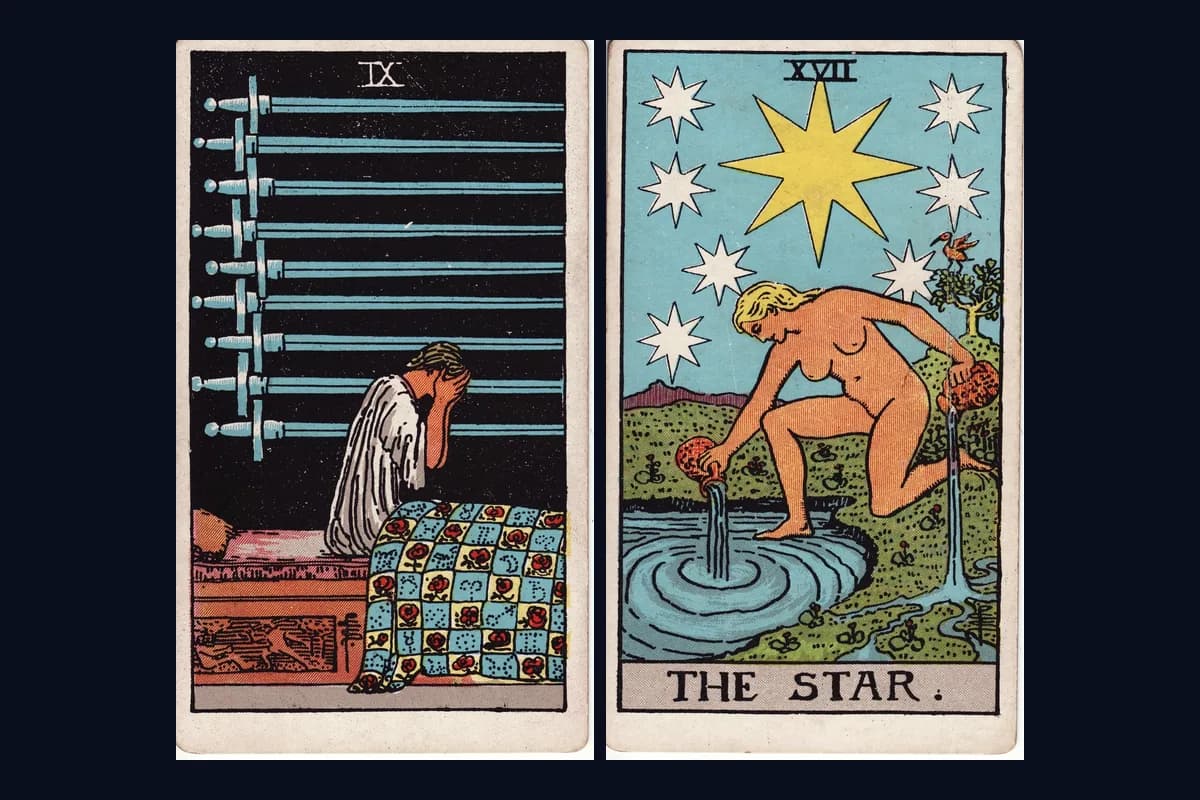
The Nine of Swords and Star combination lands on the same 26, because its Nine is a 9 too. But here all three cards are Majors, so the sum reads like a sentence.
Pollack keeps finding Strength at the Hermit's door. In her chapter on him, she writes that a guide appears "after the traveller has found the Strength to begin." Wang reports that the Golden Dawn grouped the Hermit with Strength and the Chariot as its three great initiatory cards, cards of deliberate inner change. In the Tarocchino Milanese, Justice is card 8 and stands at that door instead. To Pollack, that order means an honest look at what your life has meant, then a decision to search inward.
Now reduce first. The Star's 17 becomes 8, and there's Strength again. Add the Hermit's 9 to that: 9 + 8 = 17. The Hermit plus Strength gives you the Star. Nine does that for every card from X to XVIII, so it's a pattern, not a timetable. And this Strength is the steady kind, enough to let you stop.
Pollack also lays the Majors after the Fool in rows of seven, and there the Hermit sits directly below the High Priestess, taking on "her principle of withdrawal." The Moon and High Priestess combination follows that same withdrawal into the question of what to trust.
What's one steady thing in you that could carry you into a real rest?
Questions readers ask about this combination
Does the Hermit and the Star mean a spiritual awakening?
Often, yes: the Hermit and the Star read as a spiritual awakening in a slow, quiet form. The Hermit carries one star in his lantern and steps back from the noise, and the Star card shows a sky full of them. Read together, they describe a practice, like a walk before work, and then the calm it starts to give back. Neither card puts a date on any of it.
Does the Hermit and the Star mean I'm waiting for my soulmate?
In love, the Hermit and the Star describe a wait that ends in hope, but no card can promise a soulmate or say when someone arrives. Each Rider-Waite-Smith card shows one figure alone, so the reading is about your side first: time on your own, then openness coming back. If you chose to be single, that can be the whole answer. If you're partnered, it often means one of you needs room to think.
Does the Hermit and the Star mean healing after burnout?
The Hermit and the Star can reflect the shape of a recovery from burnout: stepping back to rest, then the first signs of hope returning. The pair describes the shape, not the length, and it can't diagnose or treat exhaustion or low mood. Its wait is no reason to put off help. If you've felt drained or low for weeks, or the tiredness is affecting your sleep, eating or work, talk to a doctor or a therapist.
What does it mean when the Hermit and the Star are both reversed?
With the Hermit and the Star both reversed, time alone may have hardened into isolation, and hope feels far away. It's the heavier version of the pair, but there's still a way out, usually through one person or one kind of help. Not every reader uses reversals. If you've felt low for weeks, tell a doctor or a therapist, and if you ever stop wanting to be here, call a crisis line or your local emergency number.
Is the Hermit and the Star a yes or no combination?
The Hermit and the Star give a qualified yes that comes after a wait, and neither card says how long. With the Hermit first, the quiet stretch leads somewhere hopeful. If the Star comes first, the hope has already arrived, and the risk is hiding it before it's tested. One reversed card sends the yes through other people; with both reversed, it's not yet. The yes is to hope returning. It promises no partner and no date.