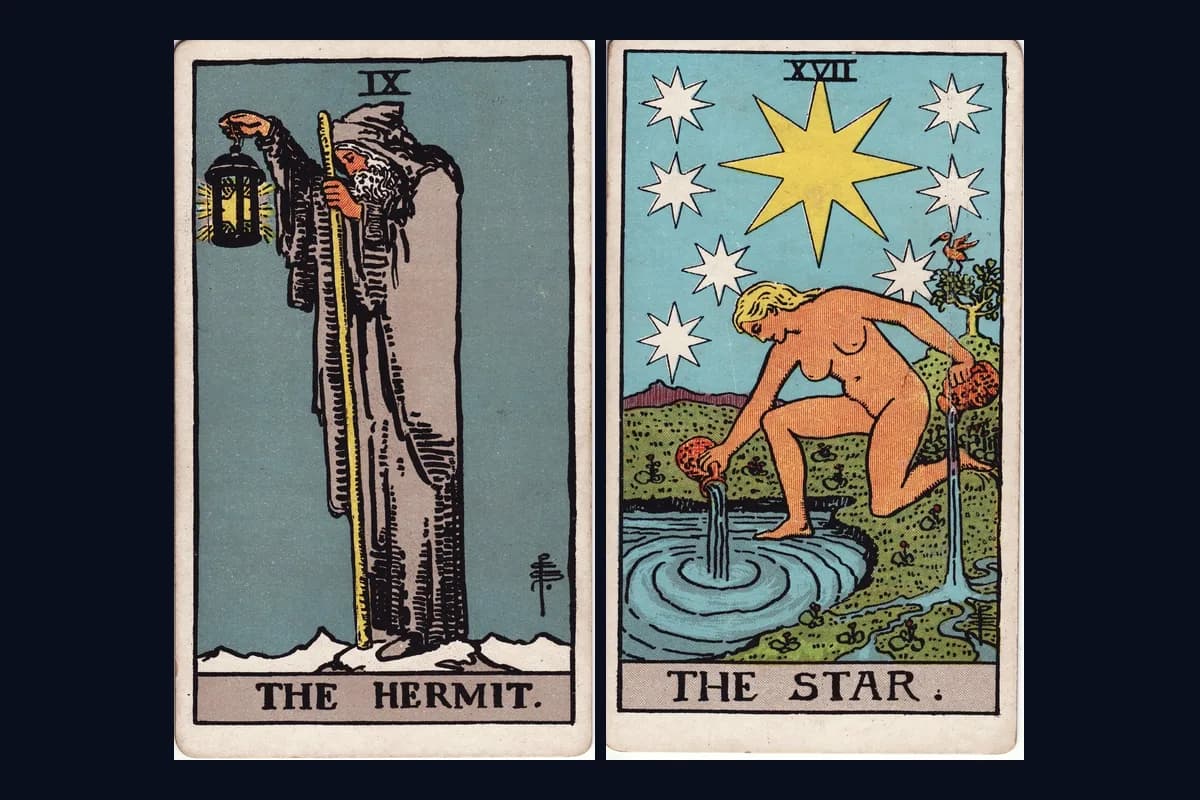
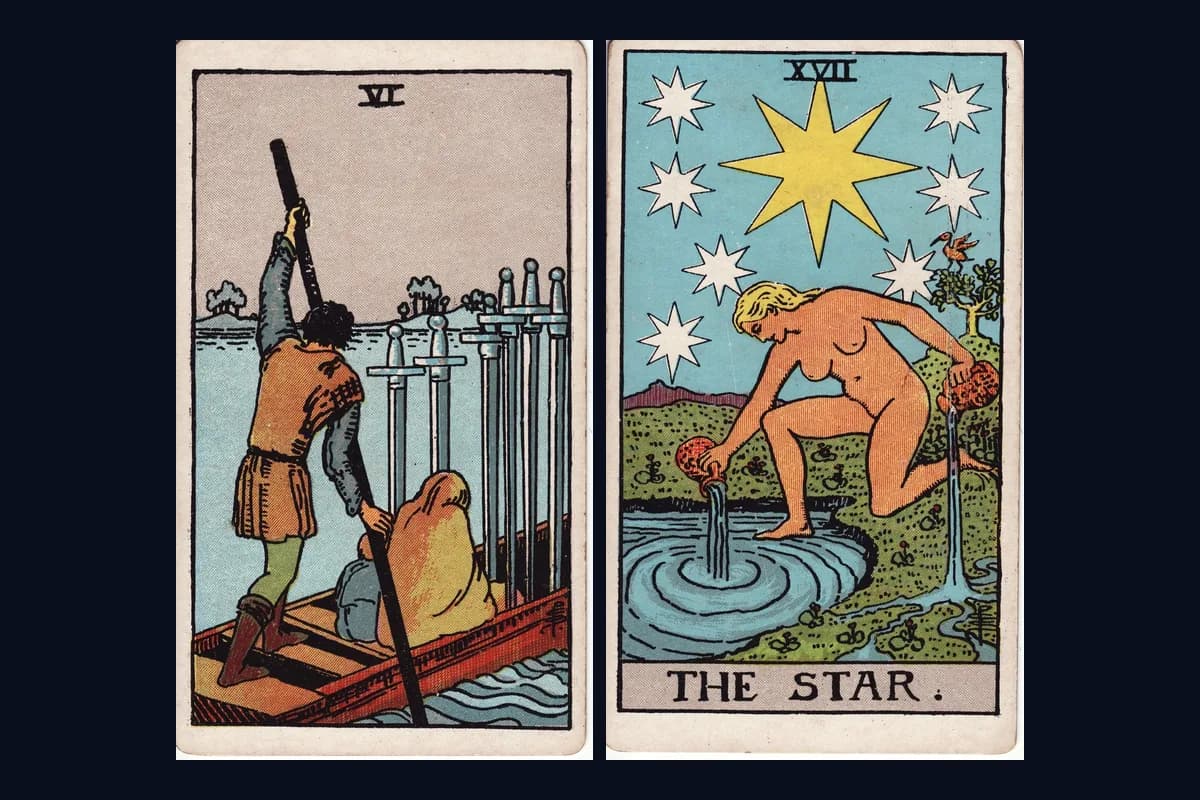
Tarot Card Combinations
Five of Pentacles and The Star
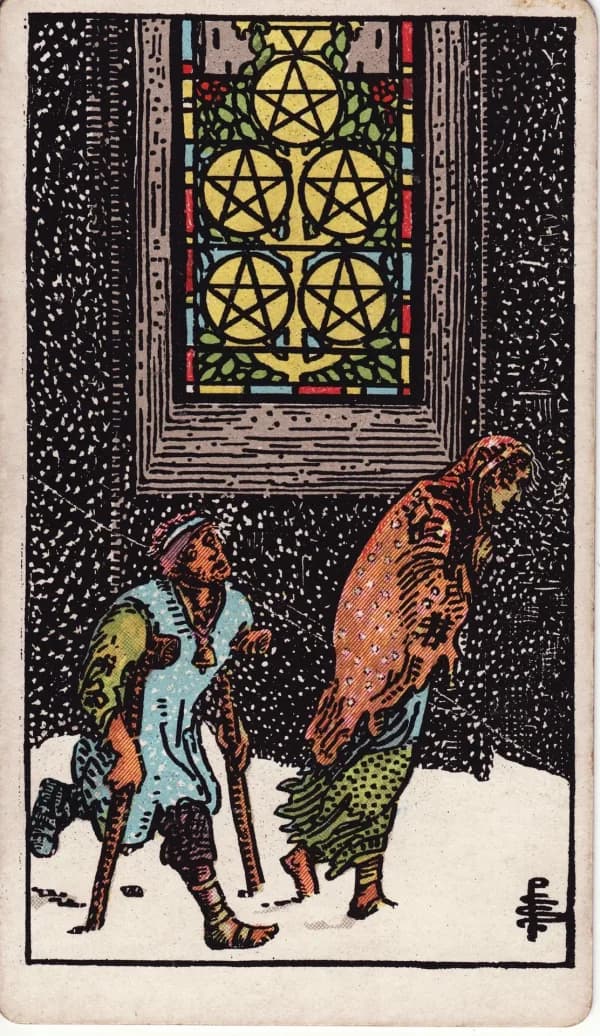
The Five of Pentacles and the Star tarot combination signals hard times with help closer than it looks. Snow falls from a black sky. Two people, one on crutches, one barefoot, pass a church window lit gold from inside. On the next card there's no wall and no glass: a woman kneels under an open sky, pouring water. Will it get better? Start with that window.

Climate scientist, ashtanga practitioner, and advocate for human rights and LGBTQIA+ equality.
What each card means on its own
Look at where the light sits on each Rider-Waite-Smith card first. On the Five of Pentacles, it's high in a stained-glass window set in a gray stone frame: five gold pentacles on a vine. The wall around it is black, and the snow comes down thick. A.E. Waite gave the picture one sentence: "Two mendicants in a snow-storm pass a lighted casement."
Below the window, a man on two crutches lifts his face. The woman a step ahead walks barefoot with her head down. And there's no way in. Rachel Pollack, author of Seventy-Eight Degrees of Wisdom, caught that: "The card shows no door to the church." In her other reading, the church "represents rest and relief from the storm. The people, however, do not see it."
The Five is card 5 of Pentacles, the suit of Earth. The Golden Dawn gave it to Mercury in Taurus and called it the Lord of Material Trouble. Waite echoes the title: the card "foretells material trouble above all."
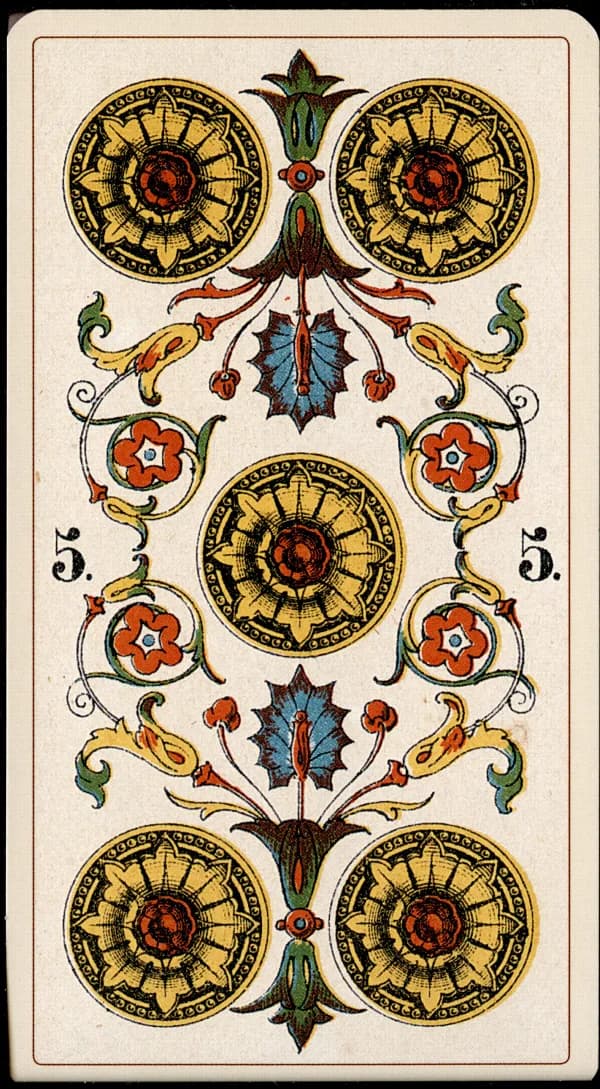
The snow scene is newer than the card. The Marseille and Milanese patterns drew it as five coins and leafwork with no people at all, and some fortunetellers took it as a love card. Waite kept both readings: "These alternatives cannot be harmonized." The walkers and the window? Pamela Colman Smith painted them in 1909.
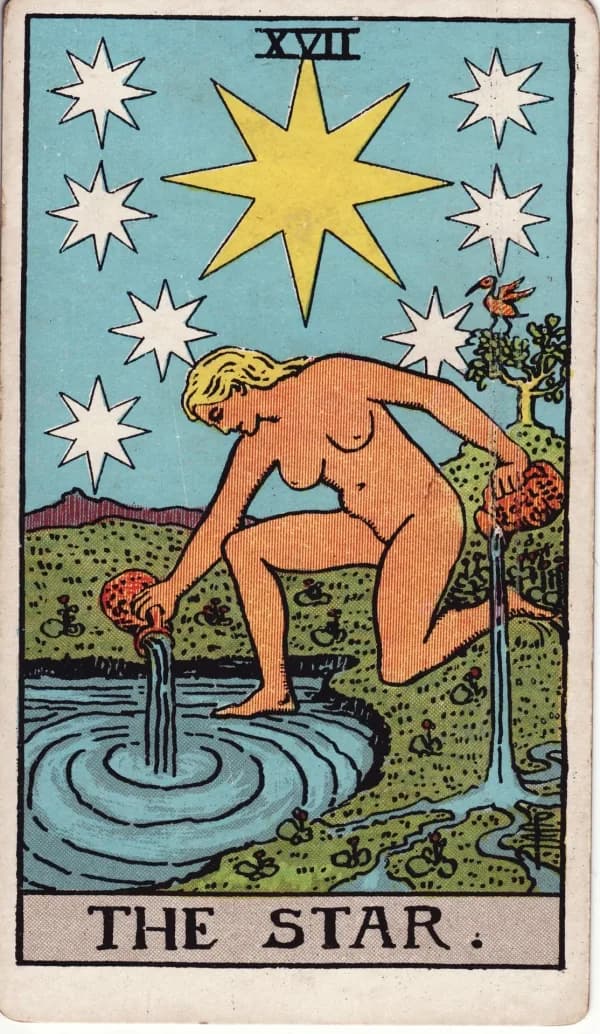
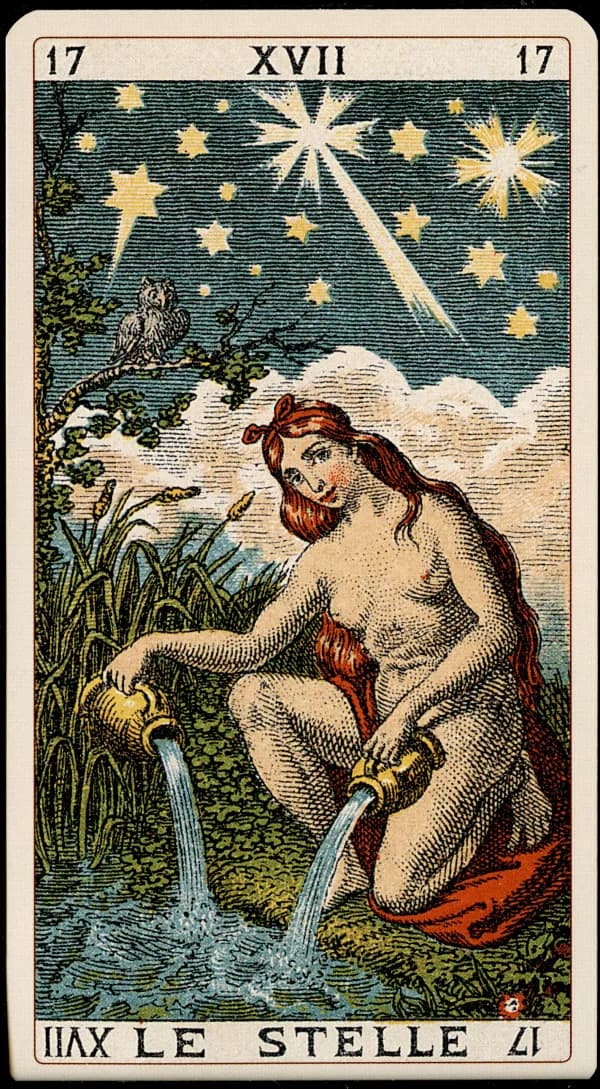
Now look at the Star. Its light isn't behind anything. A big yellow star, the same yellow as the window, hangs among seven small white ones in a pale, open sky. A woman kneels with one knee on the land and one foot on the pool, and Waite notes she "is entirely naked." She pours from two jugs, into the water and onto the bank.
The Star is card XVII, given to Aquarius and to Tzaddi, the Hebrew letter for a fishhook. Waite passes on the usual meaning, hope, then adds a stranger line: "On other planes it has been certified as immortality and interior light." Interior light. You'd expect that phrase for the church window. But he gives it to the open sky.
Aleister Crowley didn't leave it there. His Book of the Law says Tzaddi is not the Star, so he swapped the Star's letter with the Emperor's, and his Star carries Heh. Heh means window. In his Thoth deck, the card with no walls is the window card.
If you were walking with those two in the snow tonight, would you be watching the window or your feet?
What the Five of Pentacles and the Star mean together
These two cards share something most pairs don't: bodies with next to nothing between them and the sky. Two people cross the snow in rags, and a woman kneels by a pool with no clothes at all. But each card has its own kind of light. The Five's glows through stained glass on the warm side of a stone wall, lit for whoever's inside. The Star's hangs in the open and falls on anyone under it.
Now count the coins. Nobody in the card holds a coin. All five are set into the glass. What the two need exists, but not where they're standing, and with no door drawn, it isn't clear they could reach it. If you've asked for help and been turned away, look at that wall again. The card drew it too. The missing door is the wall's failing, not yours. Benebell Wen looks at Waite's word for the window, casement, and finds the other half.
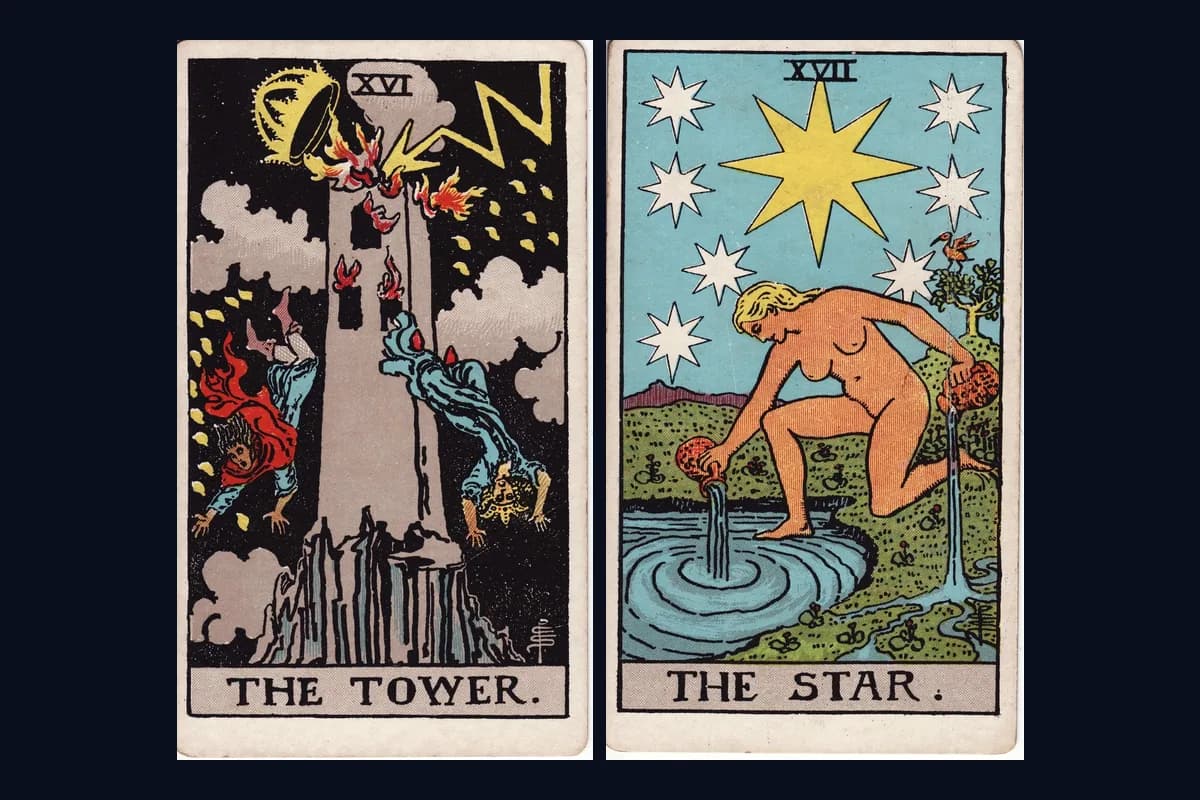
A Major Arcana card beside a Minor reads from the air first. The Star is the aerial view: your life bending back toward hope. The Five is the ground. It's the rent. It's the job that ended. Since the Major carries more weight, the hardship is the situation, not the verdict. The Tower and Star combination gets to hope by lightning; this pair walks there through snow.
So here's the pair in one line: the hope is bigger than the hardship, but it reaches you through help you let yourself take.
That last part is the hard one. Pollack sets the Five beside the Six of Pentacles, where two beggars kneel for a merchant's coins, and sees in the Five "pride and independence, sometimes to a foolish degree when help is genuinely offered." Pride gets plenty of people through a bad year. But in this pair, it can also keep them walking.
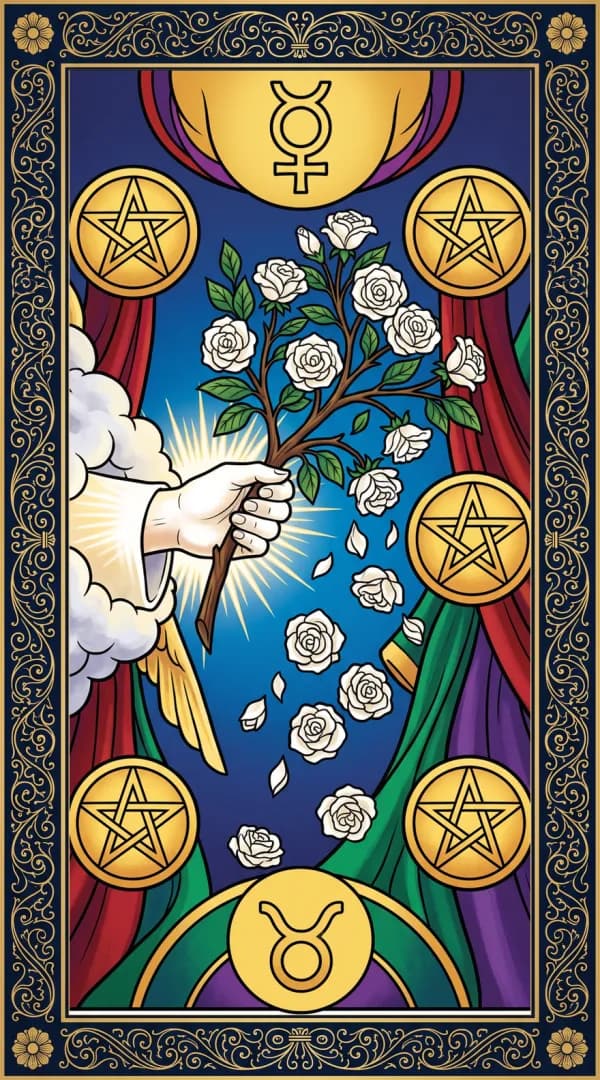
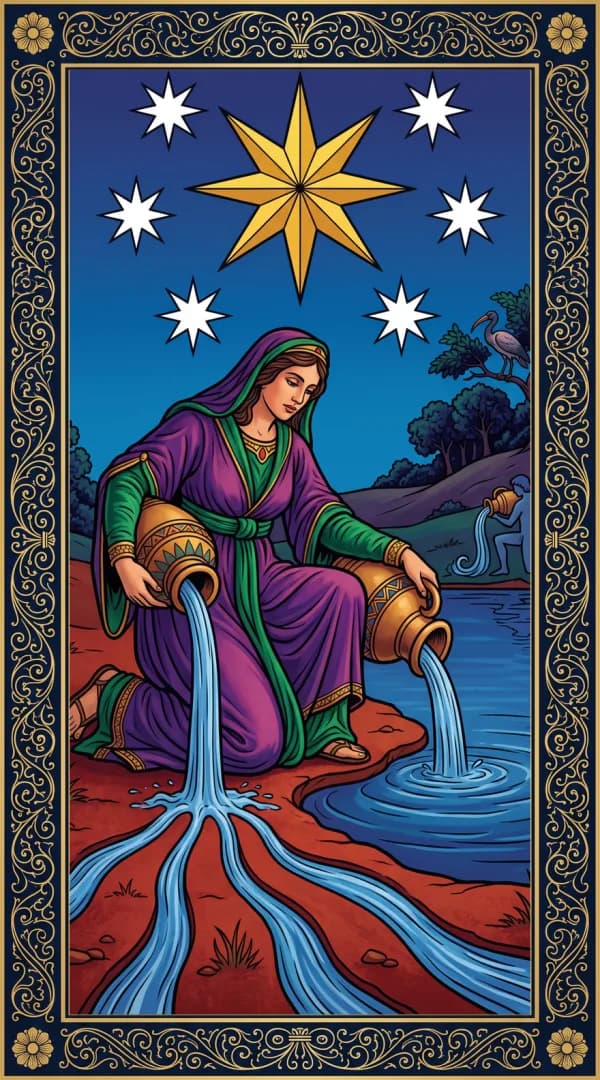
The Golden Dawn Five below drops the people. A hand reaches out of a cloud with a branch of white roses, and the roses fall past five gold coins. On the Golden Dawn Star, a robed woman kneels under a deep blue night sky, pouring from two gold jugs. Something leaves a hand in both. In the Five it's slipping away. In the Star it's given.
When's the last time someone offered you help, and what made it easy or hard to say yes?
What the pair says when money runs out
In a Celtic Cross, don't skip the eighth card. Waite calls it "his house, that is, his environment": your place in life and the people near you. With the Five there and the Star as the outcome, you feel shut out now, but those people may be your way back. Ask them first.
For money trouble, the Five is the month the numbers don't add up: the overdue bill, the balance you're scared to check. Under the Star, you find the calm to check it anyway. But no card can tell you whether money is coming, when, or how much.
Joan Bunning, author of Learning the Tarot, says it straight: "the Star is inspiring, but it is not a card of practical solutions or final answers." Theresa Reed, The Tarot Lady, warns: "This may not be the time to take risks." So nothing here is a reason to put money you need on a long shot, or to borrow against money you're only hoping for. The cards aren't a financial plan, either. For rent, talk to your landlord early; for debt, call your lender's hardship line or a nonprofit credit counselor.
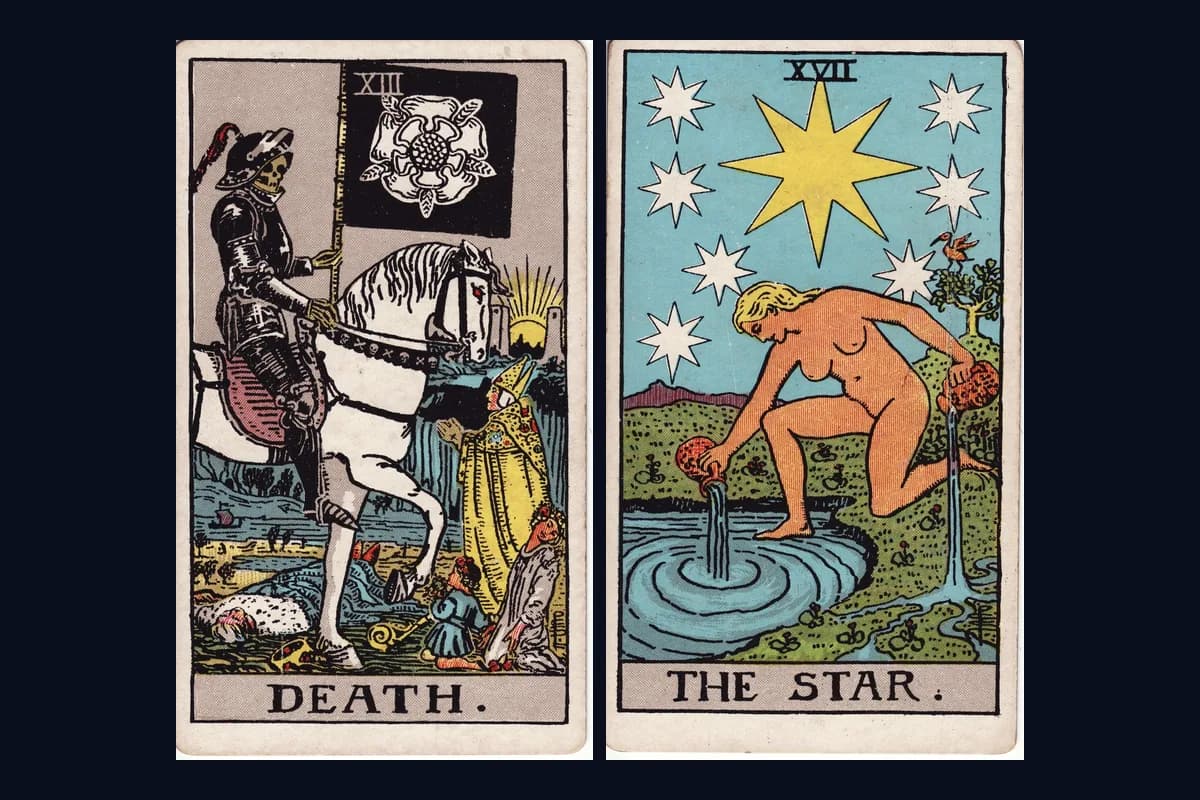
After a job loss, the Five is the layoff and the weeks that follow. Robert Wang, in The Qabalistic Tarot, reads it as "loss of profession and monetary resources." The Star is your nerve coming back, enough to make the call you've put off. Apply for any benefits you qualify for, and tell people you're looking. If the job was also who you thought you were, the Death and Star combination reads that slower ending.
Isolation rides along more than people admit. You skip the dinner you can't afford and go quiet in the group chat, and the Star's answer is small: one message, sent tonight. Chosen quiet belongs to the Hermit and Star combination.
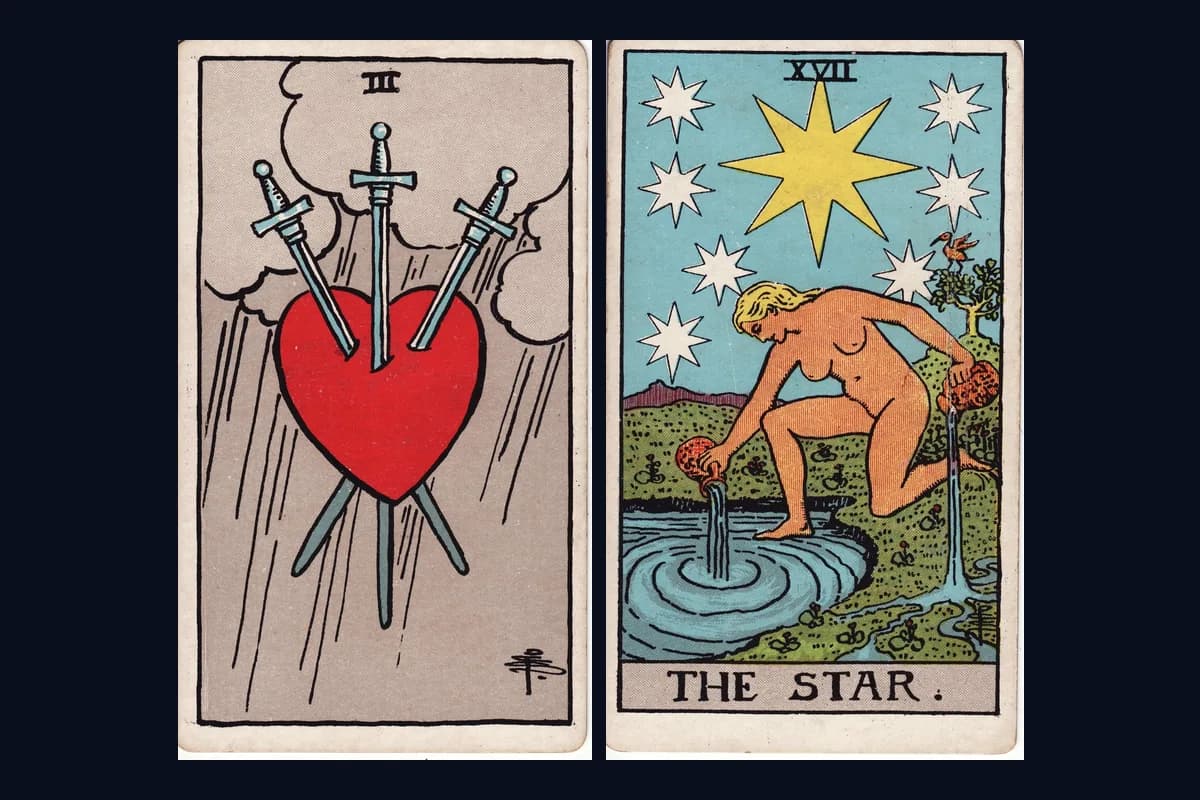
In love readings, the Five puts two people in the snow together, and Pollack sees love there, "especially that of two people holding together in a bad situation." Look how they walk, though: one ahead, one behind. Money stress can do that to a couple. The Star's move is to look up together and say the numbers out loud. A breakup on top of the bills is its own grief, and the Three of Swords and Star combination is written for it.
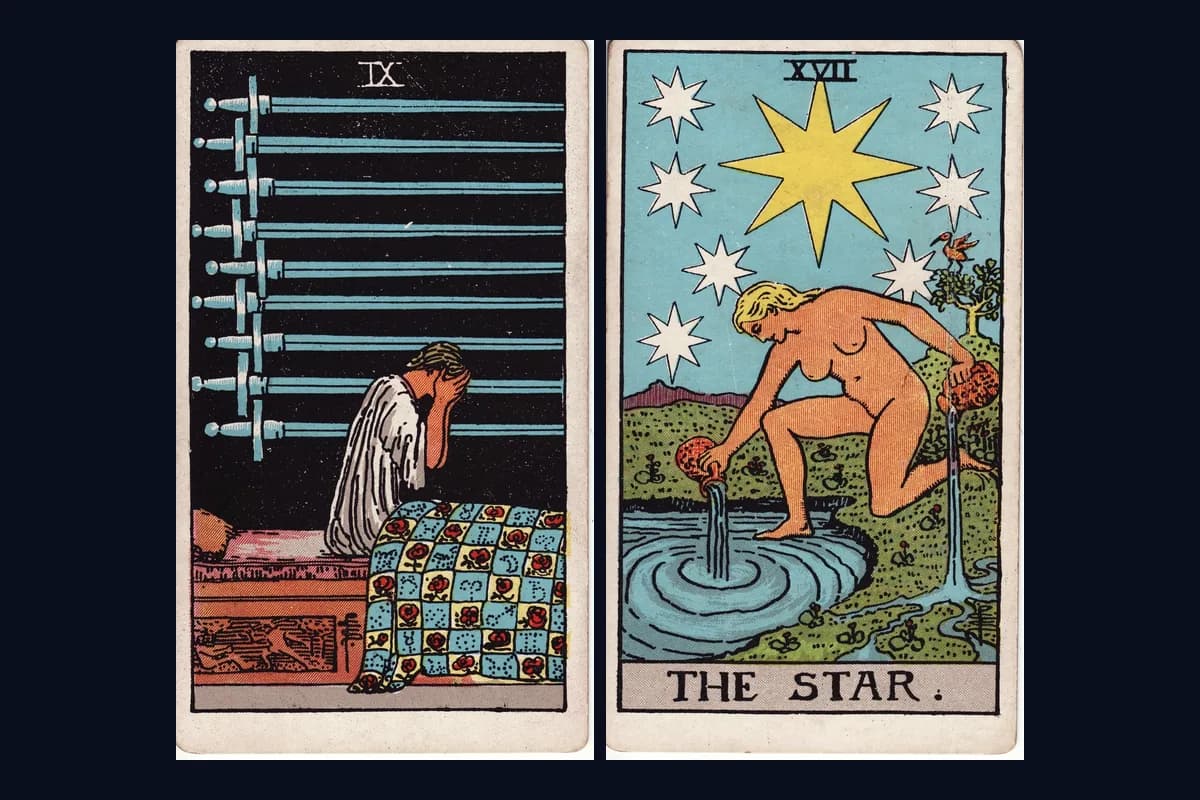
For health questions, read the pair as what months of money worry do to sleep and mood; the Nine of Swords and Star combination covers the nights you lie awake. The cards are not a medical opinion, and if your question is about your body, talk to someone who went to school for it. If your mood has been low for weeks, tell a doctor or a therapist. If you ever feel you can't keep going, call or text 988 in the US, or call your local emergency number.
If you're asking yes or no, it's yes, slowly, and not on its own. Taken singly, the cards disagree: the AstroTwins call the Five "a no in a yes or no reading" and say the Star "offers a strong yes." The Star is the Major, so the pair tips its way, on two conditions: you let help in, and you take the next practical step, even a dull one. With the Five first, it's yes by degrees; with the Star first, it's not yet. The yes is about getting through this. Neither card puts money on a calendar.
Help in a hard stretch isn't usually grand: a meal, a ride, a call that runs long. If you designed the window in your own Five of Pentacles, what would be lit behind the glass? That image belongs in your deck.
Hardship then hope, or hope then hardship
Five of Pentacles first, then the Star is the hopeful order. The hardship is where you are; the Star is where you're looking. So read it as a turn that's started, not a recovery that's finished. If the turn means moving for cheaper rent, see the Six of Swords and Star combination.
The Star first, then the Five of Pentacles is the cautionary one. Hope comes first. Then a lean stretch tests it. In a sample career reading with the Star and the Queen of Pentacles, Benebell Wen called the seeker hopeful "but maybe even a bit wishful." Keep the hope, but put a floor under it. If you're counting on a sudden payout, the Ace of Pentacles and Wheel of Fortune combination explains why no card can promise one.
In a three-card spread, try Biddy Tarot's Situation, Problem, Action layout. With the Five as the situation and the Star as the action, keep pouring, like the woman tipping both jugs: one more application, one more ask. The middle card names what's in the way, so give it the most time. If the Star lands in the problem seat, question any plan resting on luck.
Orientation matters too. Not every reader uses reversals, and the reversed Five splits those who do. Waite's list runs grim: "Disorder, chaos, ruin, discord, profligacy." But Theresa Reed reads it as help arriving. Pollack sits between them: "When people accustom themselves to suffering, a collapse may release them."
| Orientation | Reading |
|---|---|
| Both upright | Real hardship with hope in view; things can ease slowly, mostly through help you accept and steps you take |
| Both reversed | The pressure may be shifting before you feel it; hope runs low, so rest first and let someone else hold the plan for a while |
| Five upright, Star reversed | Hardship with hope worn thin; this is when you most need company, so ask anyway, even if you expect a no |
| Five reversed, Star upright | The squeeze may be easing and hope holds; rebuild slowly, and don't spend the breathing room too fast |
Five first or Star first, what's one small step you could take before this week is out?
What the sky adds to a hard season
The Five of Pentacles is Mercury in Taurus: the planet of thinking and talking, in the first ten degrees of the earthy bull. The Star belongs to Aquarius, and that's fixed Air, for all the water on the card.
In elemental dignities, the Golden Dawn's rules for how neighboring cards strengthen or weaken each other, this is Earth beside Air. Benebell Wen writes that "Air and Earth attenuate one another and thus result in a weakening effect." And it cuts both ways. The Five's grip loosens, and the Star's hope doesn't arrive at full strength.
You don't have to work with dignities to read this pair. If you do, Wen's point that "Majors tend to vibrate with stronger external forces than Minors" leaves the Star setting the direction.
There's a thread, too. Robert Wang notes: "In Hebrew the word kokab means star, but more specifically it means Mercury." The Five's planet hides in the word for star.
Mercury turns retrograde on February 9, 2027, just past Aquarius, then backs into the Star's sign and turns direct there on March 3, 2027 (both Universal Time). Brigit Esselmont of Biddy Tarot treats a retrograde as time to review and rework. The budget. The résumé. The bill you've been avoiding. But don't hold off on a job offer or a benefits claim because of it.
Earth wants something solid in your hand, and Air wants room to breathe. Which have you been shorter on lately?
The number that connects these two cards
Add the Five of Pentacles to the Star and you get 22. The Major Arcana don't go past 21, so keep adding: 2 + 2 = 4. The Emperor.
He sits on a stone throne carved with rams' heads, bare mountains behind him. He's the card of order, of plans and rules. And four is the number five breaks. The Pythagorean Tarot, one modern deck built on Greek number lore, gives four the keywords "Consolidation, Order" and five a single word, "Crisis." Crowley says the same of his Five of Disks: "The soft quiet of the Four has been completely overthrown; the card is called Worry."
The Emperor is also the Star's partner in Crowley's letter swap, so Heh, the window letter, turns up around this pair either way: on the Emperor for the Golden Dawn, on the Star for Crowley.
The Five breaks the order of four; add the Star, and the sum finds its way back to four. It's a way of looking, not a forecast.
The Golden Dawn drew the same shape on the Tree of Life, the Kabbalah's diagram of ten spheres. Every Five sits in Geburah, the fifth sphere, also called severity. Wang writes, "The Fives simply announce that a difficulty exists." But every Four sits in Chesed, mercy, straight across the Tree. The pair starts in severity and settles in mercy. Mercy often looks like help that reaches you.
What's the smallest piece of the Emperor's order, a list of every bill or one set hour for the job search, that could hold your hope up this month?
Questions readers ask about this combination
Does the Five of Pentacles and the Star mean things will get better?
The Five of Pentacles and the Star lean toward things getting better, slowly, and not on their own. The Star is the pair's Major Arcana card, so hope sets the direction, and the hardship is the situation, not the verdict. The change usually starts at the Five's lit window, when you let help reach you and you take the next practical step. The pair doesn't set a date or name an amount of money.
What does the Five of Pentacles and the Star mean for money and work?
For money and work, the Five of Pentacles and the Star describe a real hardship, like a layoff or an overdue bill, with hope beside it. No card can say whether money is coming, when, or how much, so this pair is never a reason to borrow against money you're only hoping for. Apply for any benefits you qualify for. For rent, talk to your landlord early; for debt, call your lender's hardship line or a nonprofit credit counselor.
What does it mean when the Five of Pentacles and the Star are both reversed?
With the Five of Pentacles and the Star both reversed, the pressure may be shifting before you can feel it, while hope runs low. Rest first, and let someone else hold the plan for a while. Not every reader uses reversals, and the reversed Five splits those who do. If your mood has been low for weeks, tell a doctor or a therapist; the cards aren't a medical opinion.
What number connects the Five of Pentacles and the Star?
Four. The Five of Pentacles is 5 and the Star is 17, which add up to 22, and 2 plus 2 makes 4: the Emperor, the card of order and plans. Four is the number five breaks, so the pair's sum finds its way back to four. It's a way of looking, not a forecast.
Is the Five of Pentacles and the Star a yes or no combination?
Yes, slowly, and not on its own. The Five of Pentacles and the Star tip toward yes on two conditions: you let help in, and you take the next practical step, even a dull one. With the Five first, it's yes by degrees. With the Star first, it's not yet, because hope still has to outlast a lean stretch. The yes is about getting through, not about money arriving.