Tarot Card Combinations
Knight of Swords and Knight of Cups
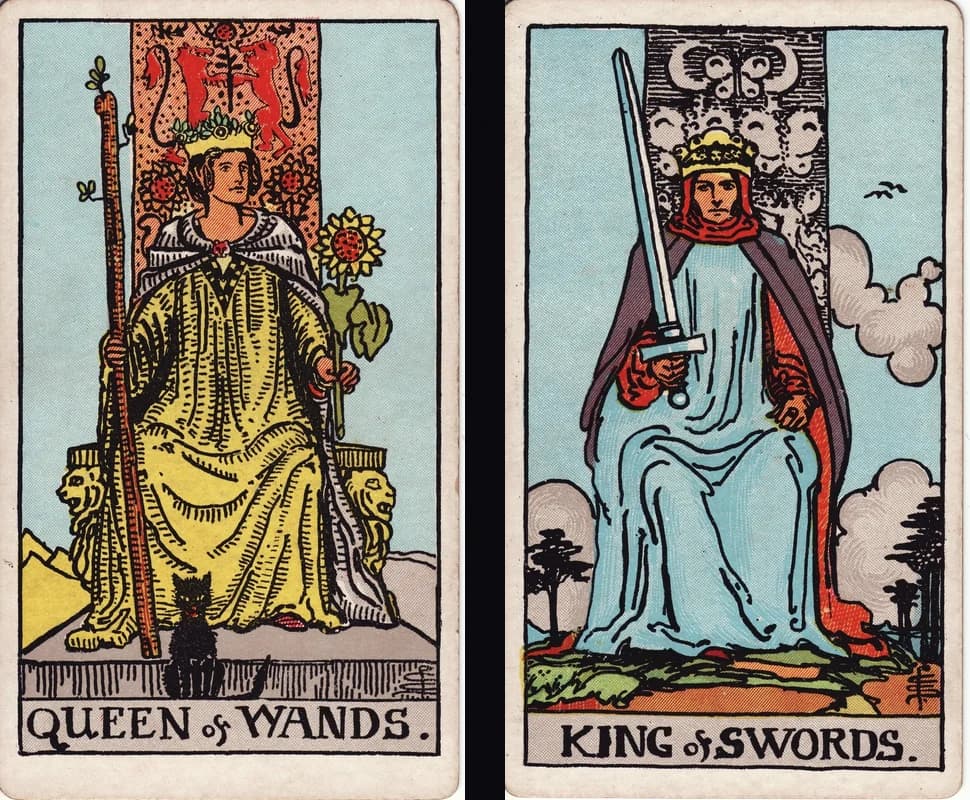
The Knight of Swords and Knight of Cups tarot combination signals someone about to make a move, at two different speeds. One knight charges at full gallop under wind-torn clouds, sword raised. The other walks his horse beside a calm river, a gold cup held out level. If you're the one waiting, which rider have you been listening for?

Climate scientist, ashtanga practitioner, and advocate for human rights and LGBTQIA+ equality.
What each card brings on its own
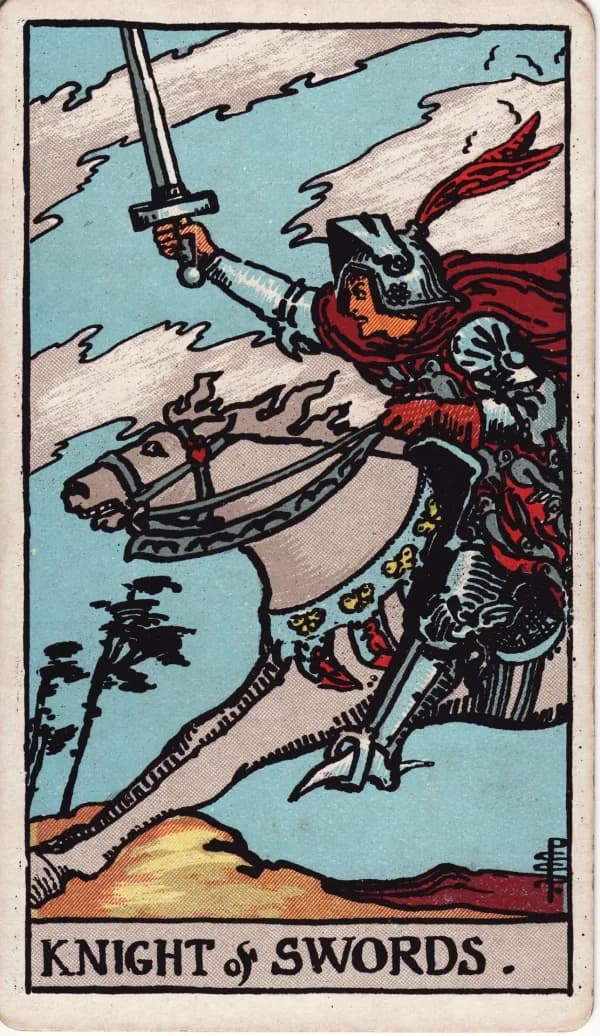
Look at the horse first. In the Rider-Waite-Smith Knight of Swords, it's at full stretch, forelegs flung out, mouth open, mane streaming back. Its rider holds his sword straight up. Clouds tear past; two thin trees bend. Even so, a small red heart hangs on the horse's bridle. He isn't looking at you. He's looking down the road.
A.E. Waite, who designed the deck with Pamela Colman Smith, starts with the speed: "He is riding in full course, as if scattering his enemies." Rachel Pollack, in Seventy-Eight Degrees of Wisdom, has him ride "directly into the storm." Then the catch: "And yet he often does not know how to sustain a long struggle." But fast isn't false. Waite also wrote, "He might almost be Galahad, whose sword is swift and sure because he is clean of heart."
The card has no number. Swords are the suit of Air, of thought and speech. The Golden Dawn deck in section II gives both Knights' places to Princes, whose Hebrew letter is Vau, meaning nail or hook.
Older fortune-tellers saw a soldier here. Benebell Wen says, "In the Marseille, this is the quintessential soldier." Waite's own list of extra meanings starts "A soldier, man of arms, satellite, stipendiary," a man paid to serve someone else's purpose. So a fast approach may be about the errand he's on. Not about you.
Now look at the Knight of Cups.
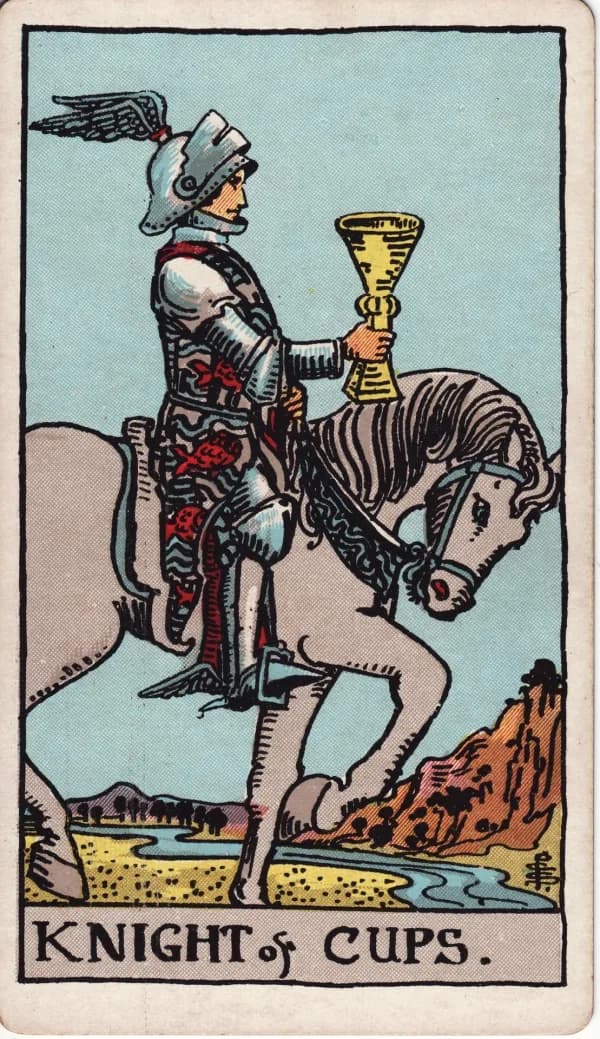
His horse walks with its head bowed and one front hoof lifted, as if nobody here is in a hurry, while a narrow river winds across the sand below and not one cloud crosses the sky. He holds a gold cup straight out in front of him, the way you'd offer someone a drink. Wings rise from his helmet and his heel.
Waite has him "riding quietly." Pollack sees "a slow horse, and a knight lost in the enticements of his cup." Cups are the suit of Water, of feeling, and he carries his in plain view. What he hasn't done yet is say a word.
Think of the last time you told someone how you felt. How long had you carried that cup?
What the Knight of Swords and Knight of Cups mean together
Any two Knights share a rank. These two share more. They ride matching pale gray horses, and they're doing the same job: carrying something toward someone. What sets them apart, beyond their suits, is speed. One gallops. One walks.
Neither card is a Major, so the scale is everyday: a text or a confession that comes out a little early. Two court cards often mean two people, or two speeds inside one person. Joan Bunning of Learning the Tarot reads any two Knights together as "two extreme, opposing sides of self." Mary K. Greer sorts the suits: "Two Courts in Yang suits (Wands and Swords) will egg each other on, while the Yin suits (Cups and Pentacles) will counsel patience." Stretch it to a mixed pair and you get both: one rider egged on, one counseling patience.
Side by side, the two Knights say that a move is on its way, and the open question is whether the words and the feeling get there together.
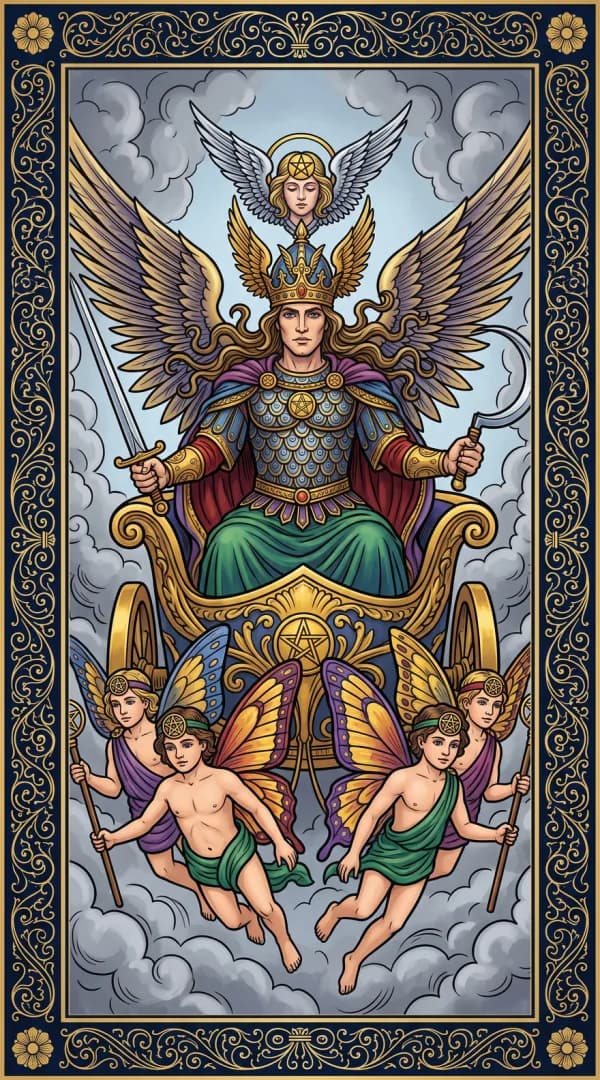
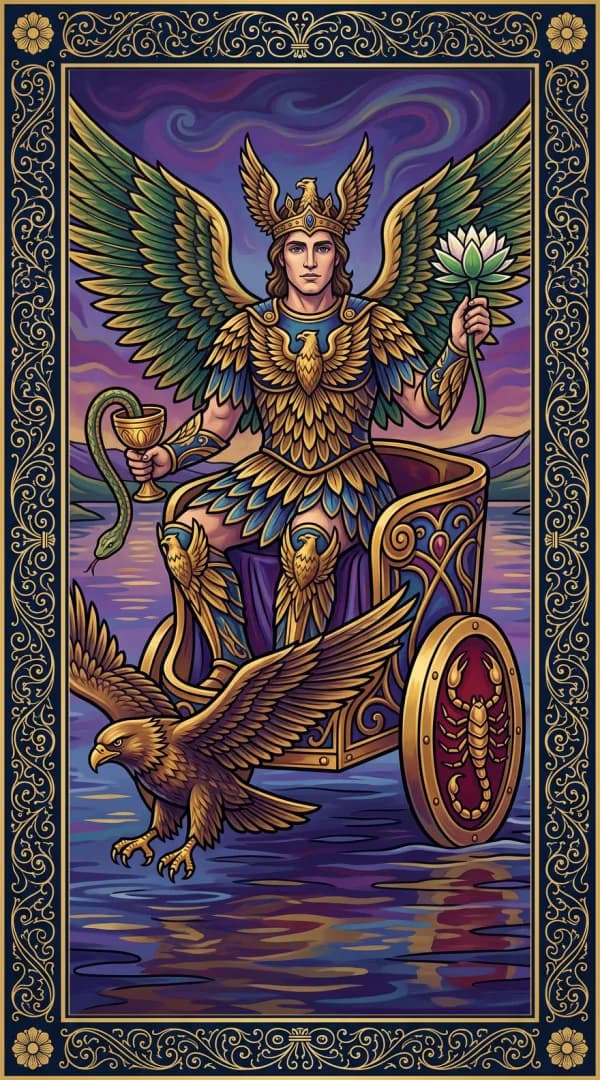
In the Golden Dawn pair below, neither Prince rides a horse. Each sits in a chariot and gets pulled, the Prince of Swords by four children with butterfly wings, the Prince of Cups by an eagle over water. And the tempo flips. Book T, the Golden Dawn's tarot manual, calls its Prince of Swords "slow, over-cautious." Aleister Crowley writes of the Prince of Cups, "On the surface he appears calm and imperturbable, but this is a mask of the most intense passion."
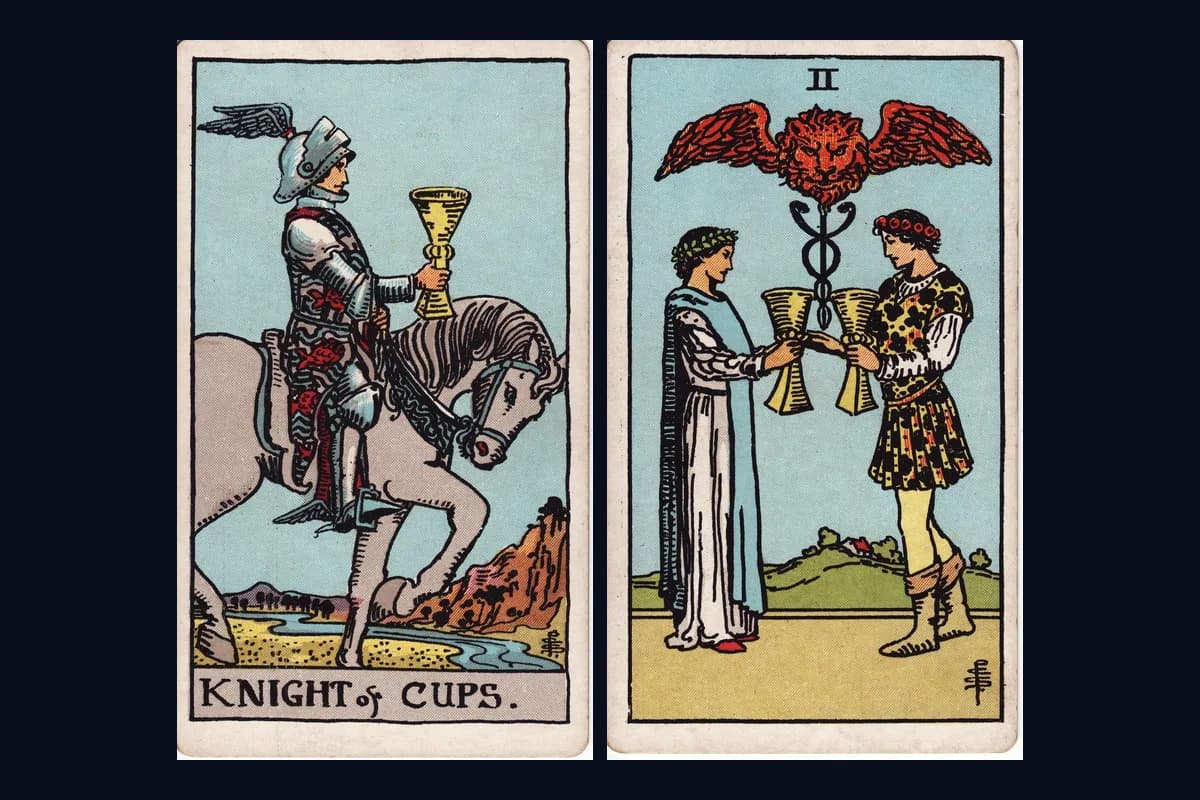
So the gallop beside the walk is Waite and Smith's 1909 pairing. Underneath, the fast rider can be careful and the slow one fierce, and speed proves nothing about sincerity either way. Give the walking rider an answer instead of a rival, and you have the Knight of Cups and Two of Cups combination.
When you picture the move you're hoping for, what arrives first: the words, or the feeling behind them?
When you're waiting for someone to make a move
If you're waiting on a sudden confession, the Knight of Swords is the moment it gets said: fast, direct, maybe at an odd hour. Brigit Esselmont of Biddy Tarot says he "is always making the first move." The Knight of Cups is the feeling it claims to come from. You can't read another person's feelings off a card, though. Hear them out and ask one plain question back. Then watch whether the warmth keeps pace with the words.
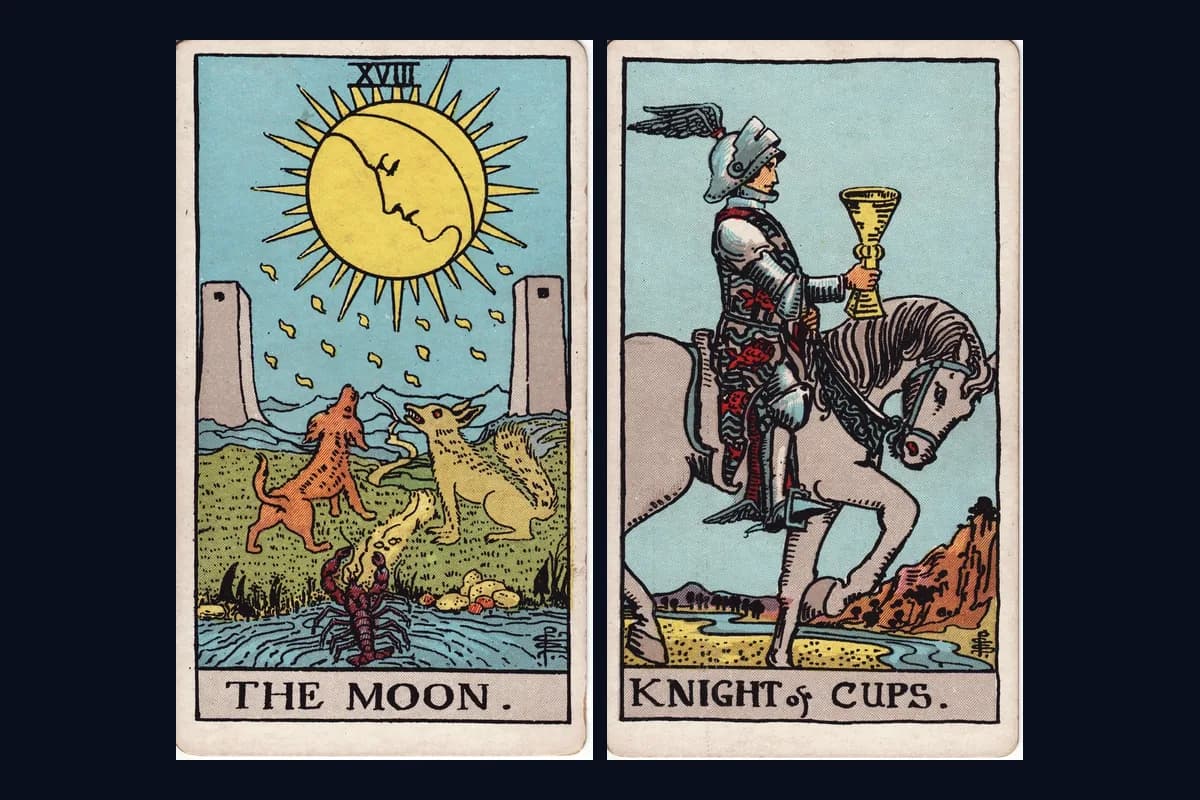
Fast words against a slow heart is the gap this pair is drawn around. Upright, it's about pace. Some people say it before they've fully felt it; others feel it for months before they can say it. In Waite's lists, honesty only comes up with the Knight of Cups reversed, and an upright one guarantees nothing. Benebell Wen, reading that reversal, describes "a duplicitous, two-faced person, saying one thing, but meaning or intending to do another." But even then, it's a reason to ask. If your doubt is about honesty itself, the Moon and Knight of Cups combination reads this rider by poor light.
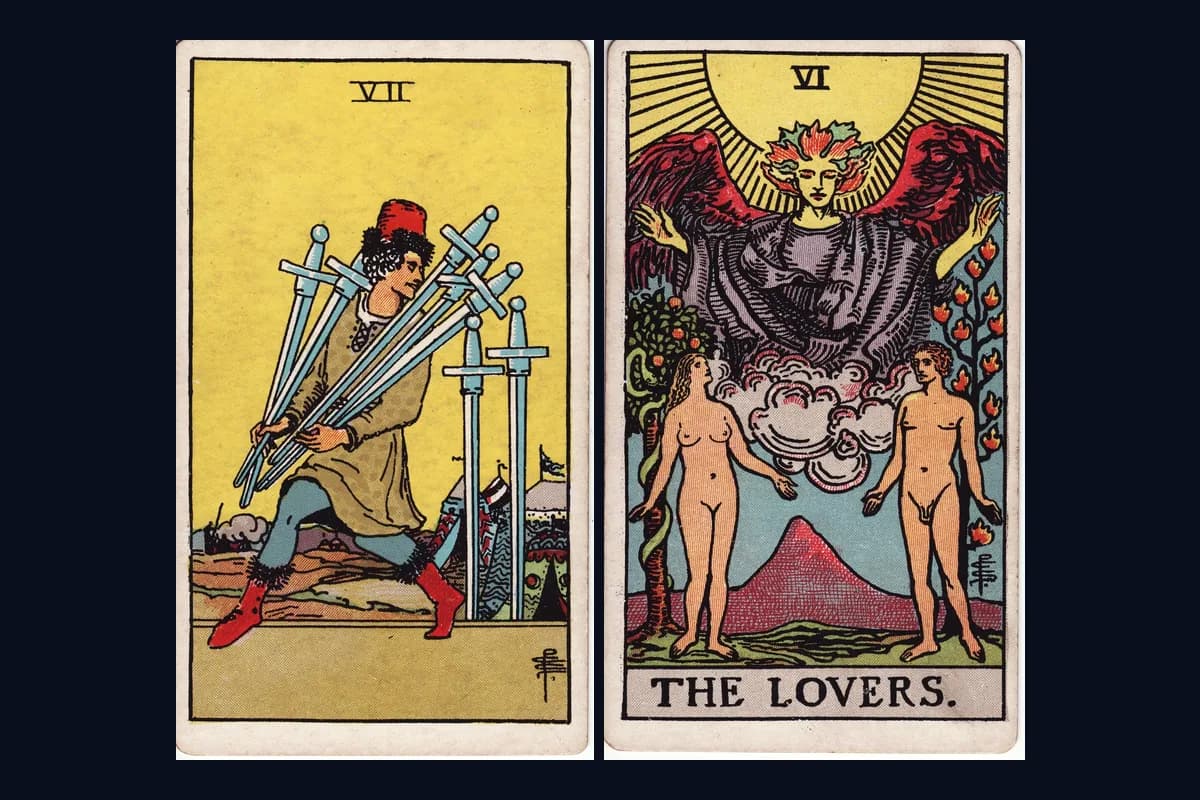
With two people interested at once, it's tempting to give each a card and let the deck choose. It won't. Court cards describe how someone moves. The Swords rider is quick and can push; the Cups rider is warm and can drift. Watch what each person does once the talking stops. When one of them is already with someone and wants it kept quiet, that secret is the subject of the Seven of Swords and Lovers combination.
Either Knight can be you, too: the one who blurts it out, or the one who's carried the cup for months, waiting to feel sure. Greer writes, "Reversals can represent refusing to act like that Court Card." A reversed Knight may just mean you aren't ready to go first. And that's allowed.
Reversed, the Knight of Swords has a harder side. Theresa Reed of The Tarot Lady lists "Words that wound," and warns, "This card can sometimes indicate a mentally and/or physically abusive partner." If that matches your life (someone who won't take no, messages that frighten you, anger whenever you hesitate), put the cards down, whichever way they fell. It's a safety question. Talk to someone you trust or a domestic violence hotline where you live, and if you're in danger right now, call your local emergency number.
Yes or no? Upright, the pair leans yes: someone's likely to make a move, and it might be you. A move only counts once what follows matches what was said, and no card can give a date or say how it ends. With the Knight of Cups reversed, it's yes to the words and no to taking them at face value. With only Swords reversed, clumsy words earn a second try; frightening ones don't. Both reversed, a no for now. If the first move is yours, say it plainly and leave room for an answer.
Picture the moment you're waiting for as a single card. Is the rider galloping or walking, and what is the sky doing above them? That image belongs in your deck.
The Knight of Swords first, or the Knight of Cups first
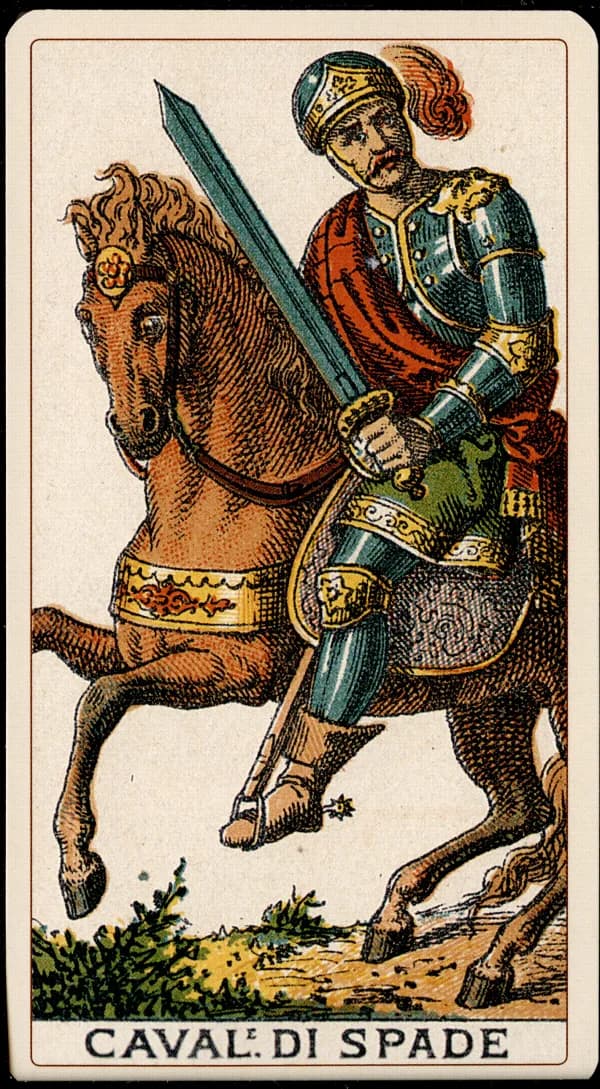
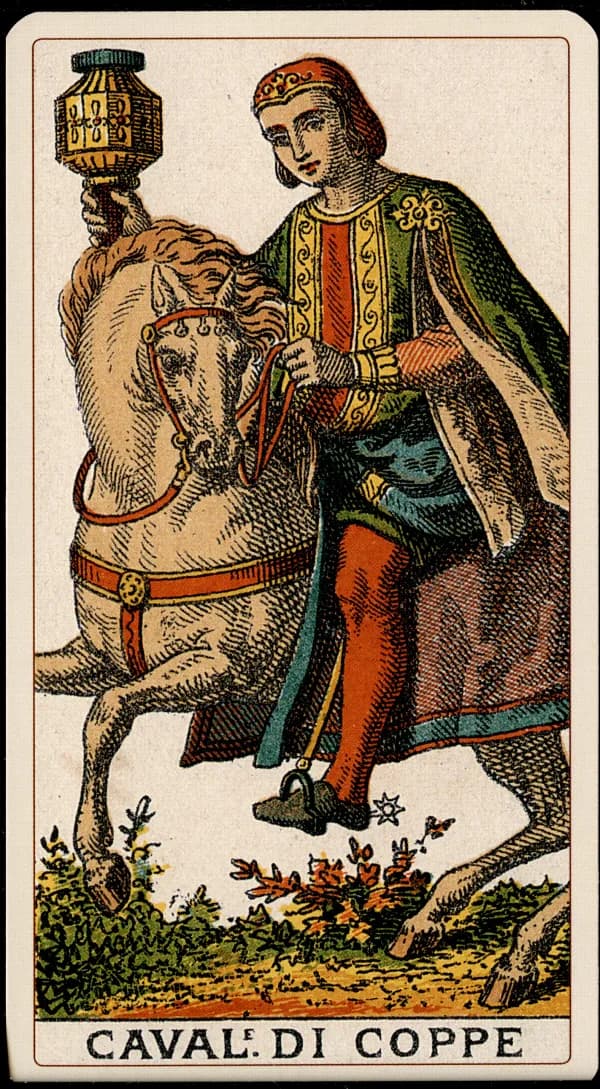
In the Rider-Waite-Smith pair up top, the Knight of Swords gallops left and the Knight of Cups walks right. Lay them down Swords first and they ride away from each other. Cups first, they ride toward each other. Esselmont asks of any two cards that show people, "Are they facing towards each other or looking away?" The Milanese riders below can't answer that: both face left, at the same prance.
Knight of Swords first, then Knight of Cups is the cautionary order. The words get there before the feeling. A message at midnight, a declaration nobody saw coming. But that doesn't make them untrue. Answer with a question, and let the conversations after it show the rest.
Knight of Cups first, then Knight of Swords is the hopeful one. Here the feeling comes first. It's kept quiet a while, and the sword is the moment it turns into a sentence. But the risk sits at the end, when words held back that long come out too sharp. With two people interested, order doesn't say which one reaches you or who's right.
In a Celtic Cross, start at the center. Bunning writes, "Look at Cards 1 and 2 to find out the central dynamic." Card 2, laid across card 1, is what's in the way. Put the Knight of Swords at the center with the Knight of Cups across him, and the move is already in words; the obstacle is a feeling that isn't ready. Swap them, and words cross the feeling: a push, or a verdict reached too early.
For a three-card spread, lay out the words, the feeling and the follow-through. Swords on the words and Cups on the feeling is the plain reading; swapped, the talk is soft and the feeling urgent. Either way, check the third card against what the person does.
Orientation matters too, and one row needs care. Clumsy and cruel are different problems. A confession blurted at the wrong moment is a matter of skill. If a reversed Knight of Swords matches pressure or threats in your life, the table doesn't apply. See the safety paragraph in section III.
| Orientation | Reading |
|---|---|
| Both upright | A move comes into the open, words and feeling close together, even if one rider runs ahead; the follow-through shows whether it holds |
| Both reversed | The move stalls or doesn't hold: a message drafted and deleted, a confession taken back |
| Swords upright, Cups reversed | Quick, polished words the feeling may not back up; hear the confession out, then judge it by what follows |
| Swords reversed, Cups upright | A warm offer, words that misfire; a calmer second talk can mend clumsy words, but words that frighten you are a safety matter |
Which way were your riders facing? If the words came first, what would this person need to do before you believed them?
What the sky adds to this pair
Waite's riders have two possible matches in Book T: its mounted Knight and its Prince in a chariot. The Golden Dawn deck uses the Prince. So does Robert Wang in The Qabalistic Tarot: "The Prince of Swords is Air of Air, Specific Air of Primal Air." His Prince of Cups is Air of Water. The Swords Prince rules from 20 degrees of Capricorn to 20 degrees of Aquarius, both traditionally ruled by Saturn. The Cups Prince rules from 20 degrees of Libra to 20 degrees of Scorpio. That's mostly Scorpio, whose traditional ruler is Mars.
In elemental dignities, the Golden Dawn's way of weighing a card by the elements beside it, Book T says, "Swords are friendly with Cups and Wands." Mary K. Greer says pairs like this "show relatively ineffectual interactions." So neither card hurries the other. Where's the tension, then? In the sky. The two stretches of the zodiac start exactly 90 degrees apart, a square, which astrologers read as friction that pushes someone to act. Every pair of Princes lands square or opposite, so it isn't theirs alone.
Each ten-degree slice of the zodiac also has a numbered card, three to each Prince's stretch. The Swords Prince's cards include the Six of Swords, given to Mercury, the planet of messages. Mars gets one of the Cups Prince's three, the Five of Cups, so the quiet rider carries the planet of action under the water.
The Sun enters the Swords Prince's stretch on January 10, 2027, and Aquarius on January 20. Mars enters the Cups Prince's stretch on August 17, 2027, enters Scorpio on September 2 and leaves the stretch on October 1 (all dates Universal Time). Pull this pair in those weeks and the sky echoes your spread. But it can't tell you when someone will speak. Ask them.
Air says it. Water feels it. Where in your life are you the quiet rider, calm on the surface, with more heat underneath than anyone knows?
What two moving Knights add up to
Knights carry no printed number, so pick a count. The Golden Dawn seats its Princes in Tiphareth, the sixth of ten spheres on the Kabbalah's Tree of Life. Their letter, Vau, is worth 6 as well. So each counts as 6, and 6 and 6 make 12. Popular numerology counts on past the Ten instead (Page 11, Knight 12), so each Knight is a 12 by himself.
Twelve turns up either way. That's the Hanged Man.
Look at him after those two horses. A man hangs upside down by one foot from a beam of living wood, a halo around his head. Waite saw "life in suspension, but life and not death," and his list of meanings opens with "Wisdom, circumspection, discernment."
The move belongs to the Knights. The pause after it belongs to you. The Hanged Man doesn't say they'll stall, and he gives no date. He's the stretch after the words, when you watch whether actions follow. You set how long that lasts, and you can end it.
His Hebrew letter is Mem, meaning water. Water is the element of Cups. So fast words and a slow heart add up to a Water card. Whatever gets said, the number lands on what's felt.
Count the popular way and the pair makes 24, which reduces to 6 (2 + 4), the Lovers. But both Knights carry the same number in every system, so the arithmetic can't rank one person over another. Plenty of readers leave court cards out of sums like this, and that's fair.
If the Hanged Man here is a pause, what are you doing with it: learning who this person is from what they do, or rehearsing what you hope they'll say?
Questions readers ask about this combination
Does the Knight of Swords and Knight of Cups mean they'll make a move?
It leans yes. Upright, the Knight of Swords and Knight of Cups describe a move on its way: a confession or a message. What the pair can't settle is whether the feeling keeps pace with the words, and no card gives a date. Judge what's said by what the person does afterward. And the first move can be yours.
What does the Knight of Swords and Knight of Cups mean in a love reading?
In love, the Knight of Swords and Knight of Cups often point to one of three situations: a sudden confession, fast words from someone whose feelings move more slowly, or two people interested at once. The cards describe two speeds of approach. They can't show what another person feels, and they never choose between two people for you.
What does it mean when the Knight of Swords and Knight of Cups are both reversed?
With the Knight of Swords and Knight of Cups both reversed, a move stalls or doesn't hold: a message drafted and deleted, a confession taken back. For now, it's a no. If a reversed Knight of Swords matches pressure, intimidation or threats in your life, that's a safety question rather than a reading. Talk to someone you trust or a domestic violence hotline where you live, and if you're in danger now, call your local emergency number.
What element connects the Knight of Swords and the Knight of Cups?
By suit, the Knight of Swords is Air and the Knight of Cups is Water. Book T, the Golden Dawn's tarot manual, calls Swords friendly with Cups in elemental dignities, its way of weighing a card by the elements beside it. Mary K. Greer grades the pairing neutral. So neither card does much to strengthen or weaken the other. Read as Golden Dawn Princes, both Knights are the airy part of each suit, so they also share Air.
Is the Knight of Swords and Knight of Cups a yes or no combination?
Upright, the Knight of Swords and Knight of Cups lean yes to a move. Later actions decide whether it counts. With only the Knight of Cups reversed, the words may outrun the feeling, so don't take them on faith. When only the Knight of Swords is reversed, clumsy words deserve a second try, but frightening ones are a safety matter: tell someone you trust. Both reversed, it's a no for now. The cards promise no date or outcome.