Tarot Card Combinations
Seven of Swords and The Lovers
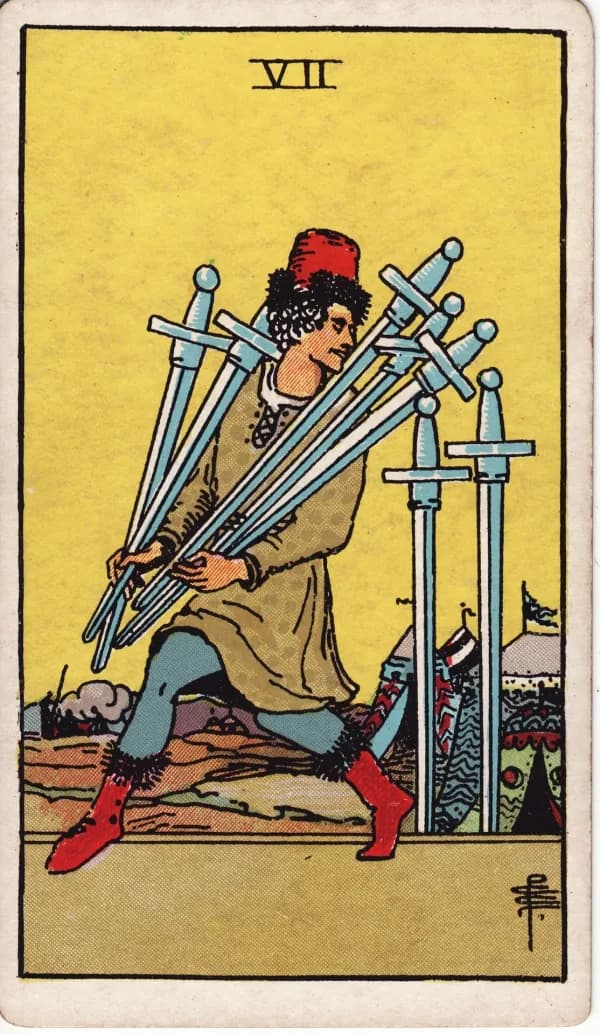
The Seven of Swords and the Lovers tarot combination turns on whether everything in a relationship is being said out loud. Under a sunless yellow sky, a young man slips out of camp with five swords, looking back. Beside him, a man who could be his twin stands naked in full sun, hands open. Is he cheating? Two cards can't answer that. They can help you name what's gone unsaid.

Climate scientist, ashtanga practitioner, and advocate for human rights and LGBTQIA+ equality.
What each card holds on its own
Look closely at the Rider-Waite-Smith Seven of Swords. A young man in a red cap hurries away from a camp of patterned tents under a sickly yellow sky, five swords bundled against his chest. His feet carry him one way while his head turns back the other. A.E. Waite describes the scene in one line: "A man in the act of carrying away five swords rapidly; the two others of the card remain stuck in the ground."
Notice what the older texts leave out. Waite's meanings for the card are "Design, attempt, wish, hope, confidence; also quarrelling, a plan that may fail, annoyance," and he admits "the design is uncertain in its import." He never calls the man a thief.
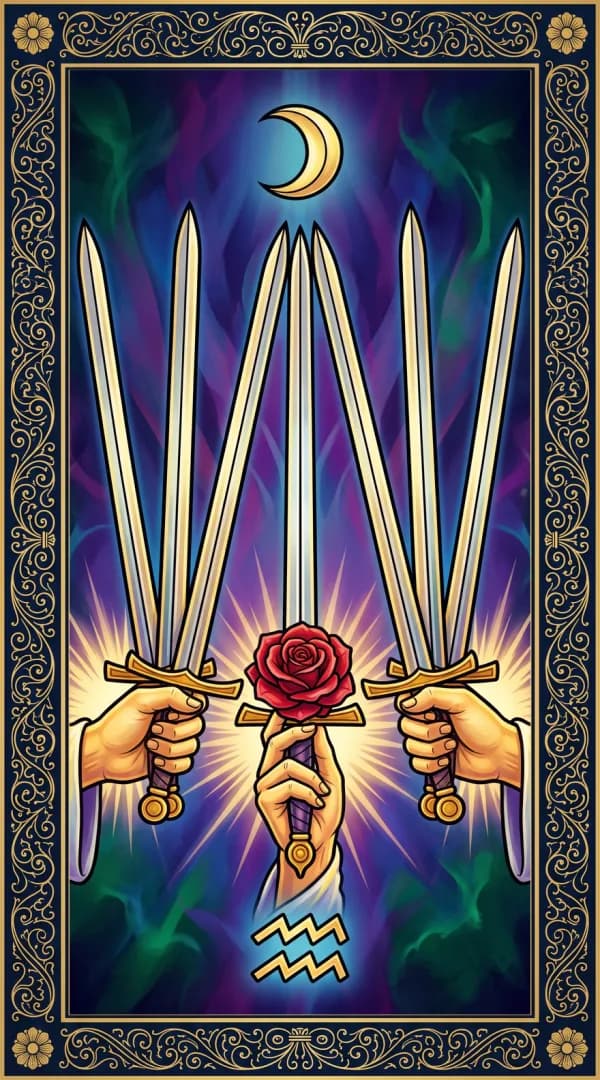
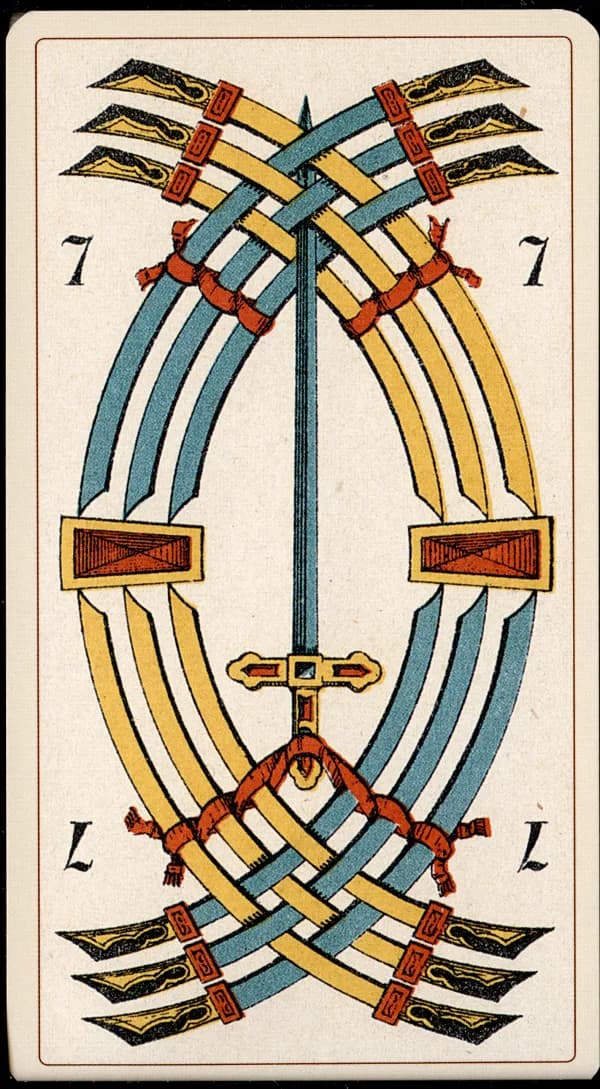
Swords are the suit of Air. The Golden Dawn, the magical order Waite belonged to, gave this card to the Moon in Aquarius and titled it the Lord of Unstable Effort. Its notes, as Robert Wang reproduces them in The Qabalistic Tarot, describe "yielding when victory is within grasp" and add, "Inclined to betray confidences, not always intentional." Untrustworthy, then, but not always on purpose. Aleister Crowley named it Futility and saw in it "a wish to compromise." On the Milanese Seven further down, there's no man at all, only blades.
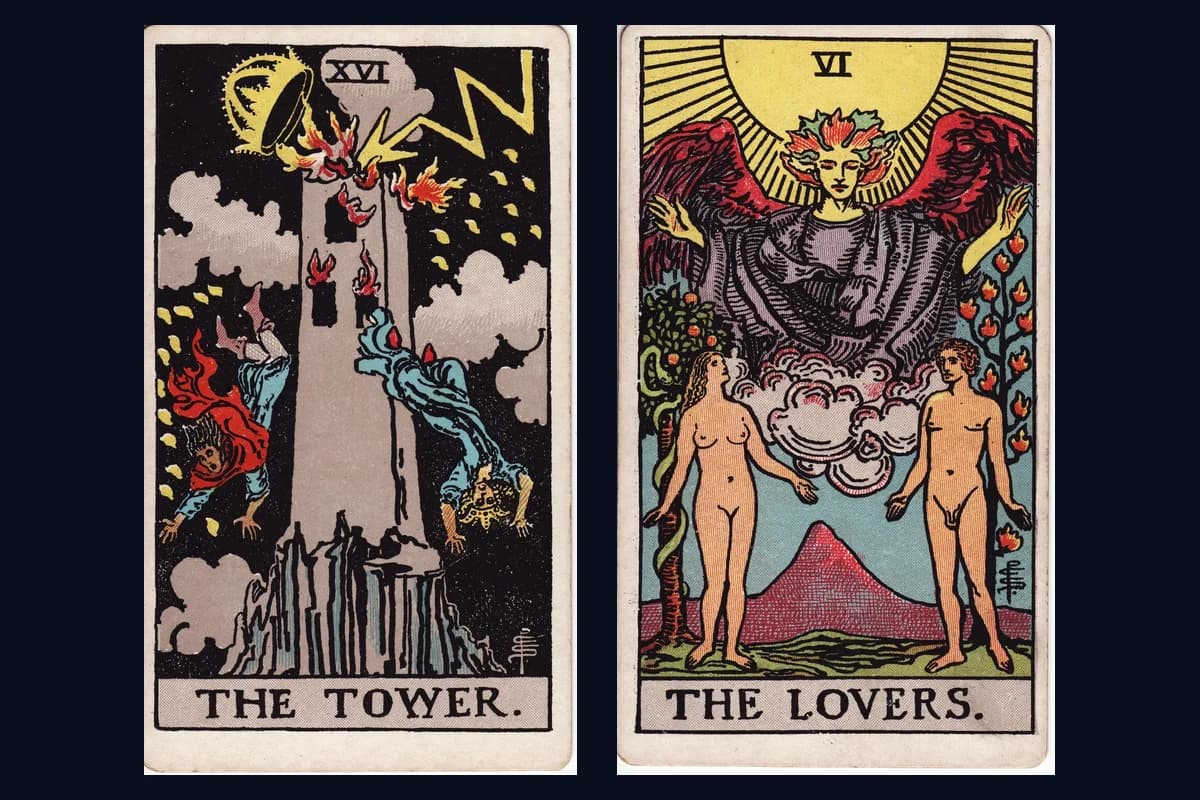
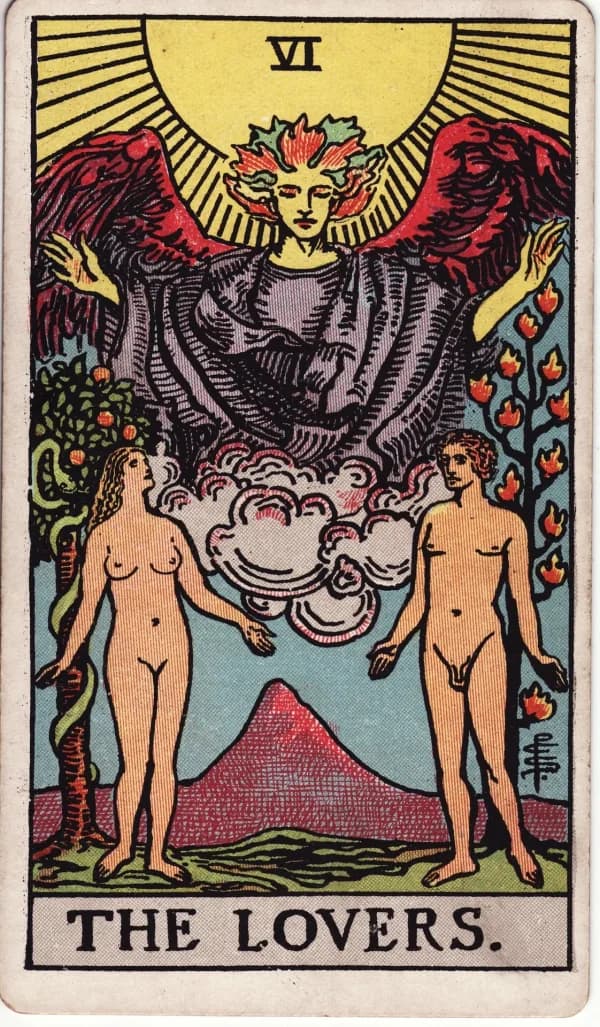
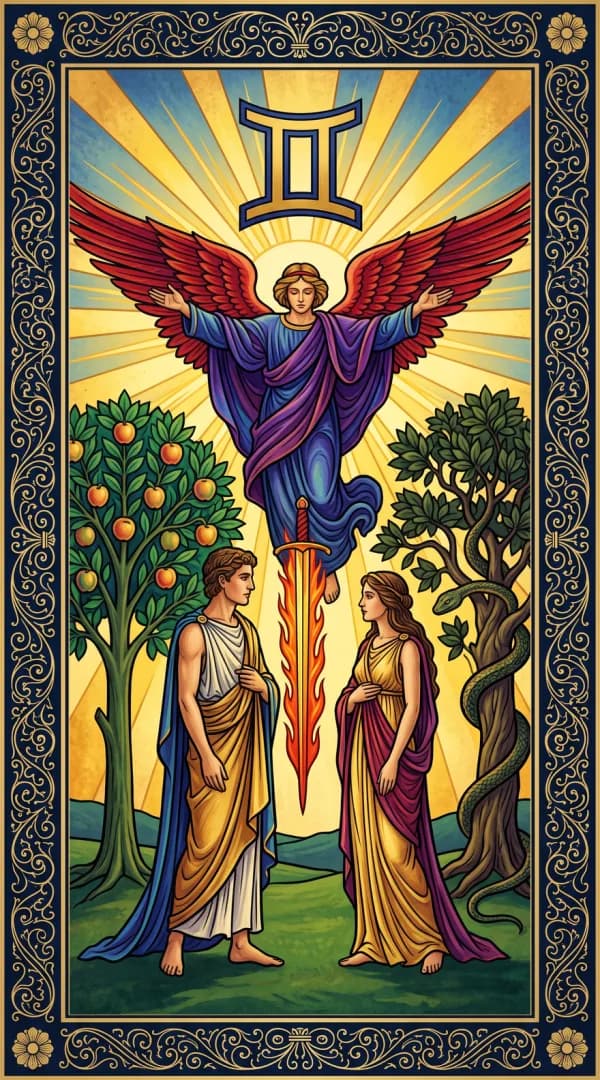
Now look at the Lovers. "The sun shines in the zenith," Waite writes, and below it an angel spreads its arms over a man and a woman in a garden, "unveiled before each other." The card is VI, given to Gemini, the sign Mercury rules. Its Hebrew letter is Zain, which Wang translates as "Sword or Armor." A sword cuts things apart. Armor keeps you covered. And the Lovers' own letter holds both.
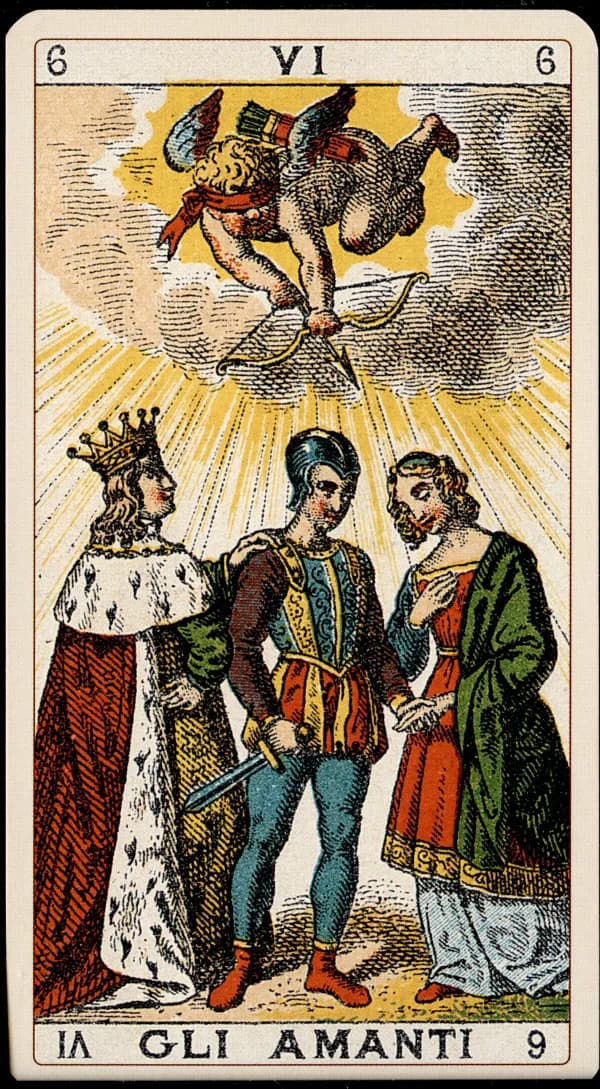
The older card was about choosing. Rachel Pollack, in Seventy-Eight Degrees of Wisdom, notes that it "sometimes bears the title 'The Choice'," and it shows a young man between two women, with Cupid overhead. On the Milanese Lovers, that young man keeps a sword at his side.
Set the two Rider-Waite-Smith cards side by side, the Seven on the left, and the men look like twins: young, clean-shaven, with short curls. One has his arms full. The other has nothing in his hands, and nothing on. And the man with the swords walks away from the Lovers while he looks back at it.
In one card your hands are empty and you're facing the person beside you. In the other your arms are full and you're looking back. Which one are you standing in right now?
Why the Seven of Swords and the Lovers both carry a sword
What these two share, and most pairs don't, is a sword. The Seven of Swords holds seven, in plain sight. The Lovers hides its one. Waite's card shows no blade at all; the sword lives in the letter, Zain. The Golden Dawn's own design put it in Perseus's hand as he came to free Andromeda, and the deck below hangs it, flaming and point down, between a robed couple. Crowley wrote, "The Sword is primarily an engine of division." So is a choice.
This is a Major Arcana card beside a Minor, so take the helicopter view. The Lovers is the aerial picture: a bond, or a decision about one, big enough to shape what comes next. The Seven is the ground-level detail, how that decision gets handled day to day. One card says it matters. The other says it's out of sight.
Few writers give this exact pair more than a template. Astrology.com's combination page reads the Seven here as "one partner who may be keeping secrets, lying, or acting dishonestly." May be. And one partner could mean either of you.
Pollack's thief works alone, "unable or unwilling to get anyone's help." Beside the Lovers, that means something real is at stake, and someone is deciding about it alone. That's the problem, and it carries its own way out. The one thing the Seven avoids is a conversation.
These cards don't say whose hands hold the swords. The secret might be your partner's, or yours: a doubt you haven't voiced, a door you're keeping open. Or it might belong to you both, when the relationship itself is what's being kept quiet.
What in your relationship is still being decided quietly, and what would change if it were said out loud?
What the pair says when you're asking about cheating
If your question is fidelity, many readers do tie the Seven to cheating. Theresa Reed of The Tarot Lady lists it on her page about cheating as "Doing something behind someone's back," and next to the Lovers, any secret sits inside something real. But the Seven covers many secrets: an affair, a lie about money, a plan to leave, a doubt nobody has raised. A card can name a worry. It can't confirm one.
Reed's advice is to "be practical and do your due diligence." Here, that means noticing what someone actually does, then asking about something specific, calmly. It doesn't mean going through a phone. That urge is the Seven's own move, and the Golden Dawn's notes even list a habit "to detect and spy on another." So a secret search gets you a hidden answer and still no conversation.
If asking a plain question feels unsafe, or you're the one being accused and checked up on, this isn't a tarot question. Talk to someone you trust, or a domestic violence hotline where you live, before you talk to a deck.
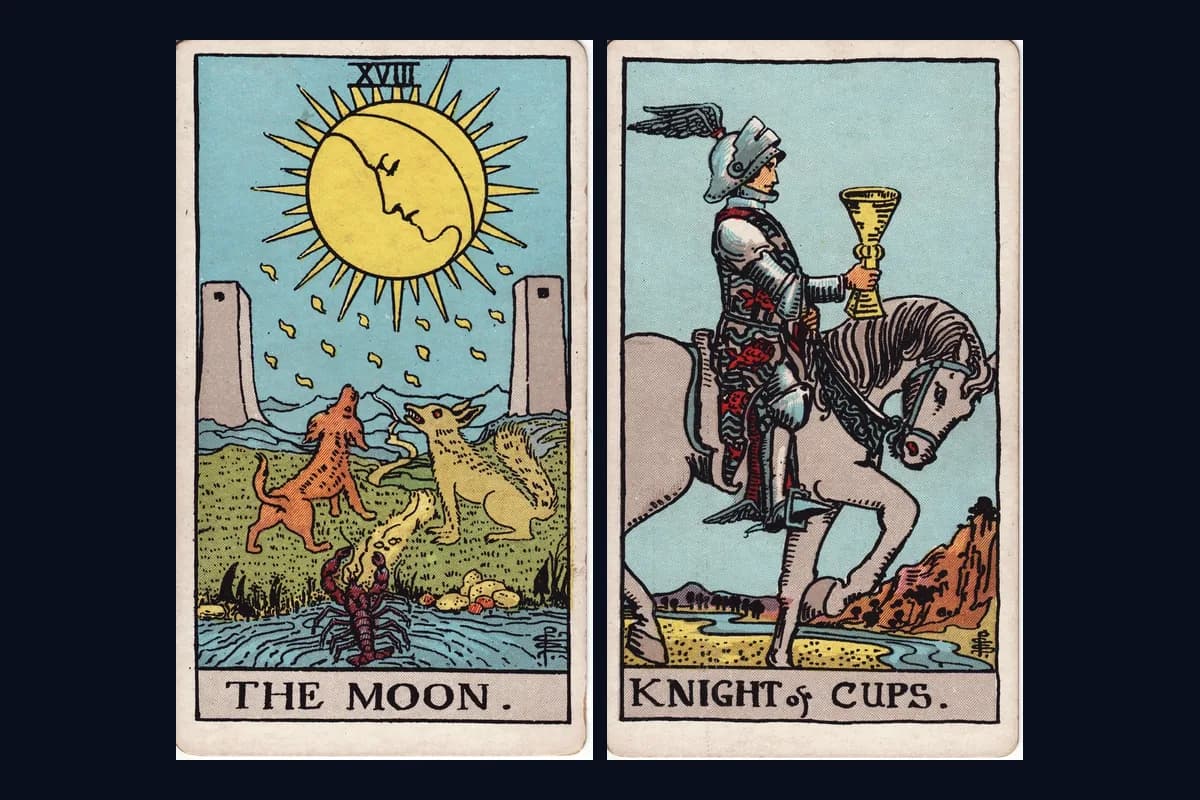
Ask is he lying? and the Seven widens the question. Not every hidden thing is a lie. Tarot author Mary K. Greer grants the card can still mean lying, cheating or stealing, then asks "for what purpose, against whom or what?" Doubting whether someone means what they say? The Moon and Knight of Cups combination stays with that doubt.
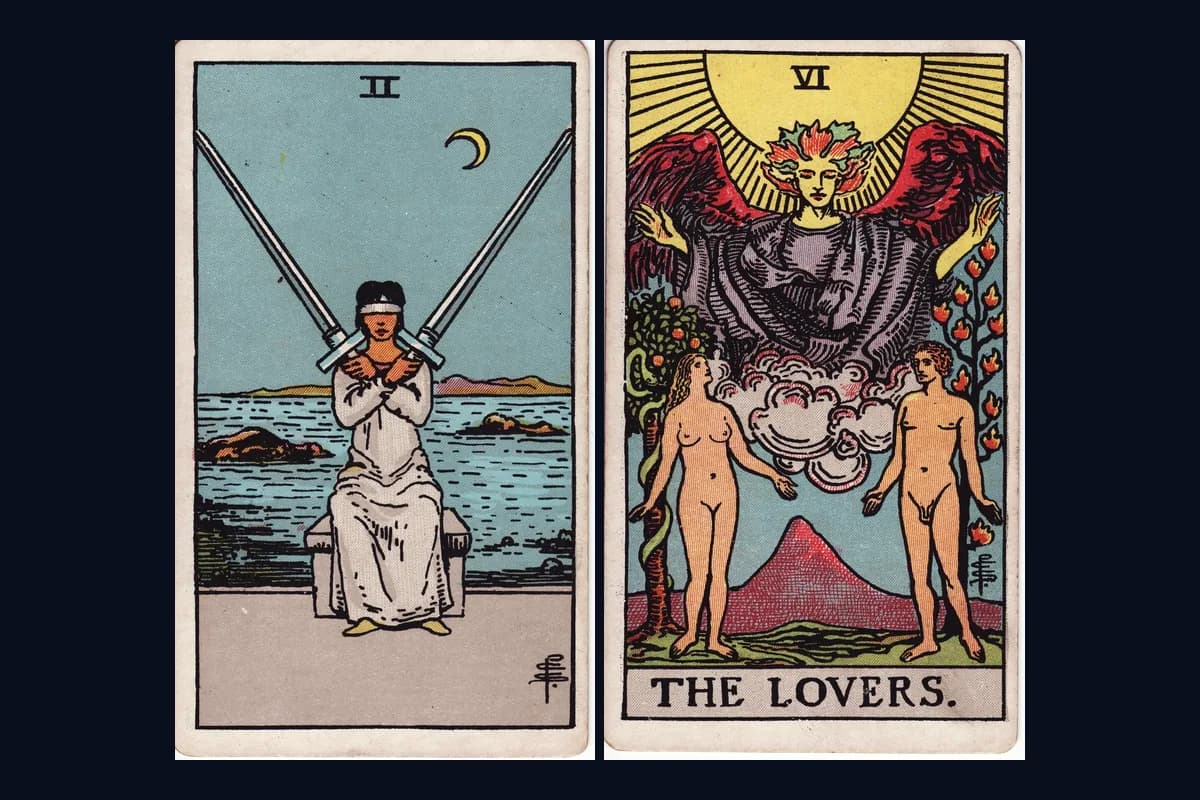
Sometimes the Seven is you. Biddy Tarot says it directly: "You may attempt to run away from commitment, responsibility, hard work or love." Maybe you haven't told your partner you're unsure, or there's someone else. Go back to the man with the swords. As Pollack puts it, "he cannot even carry all the swords." You can't keep every option and keep it quiet. And if you can't bring yourself to choose at all, the Two of Swords and Lovers combination looks at that standoff.
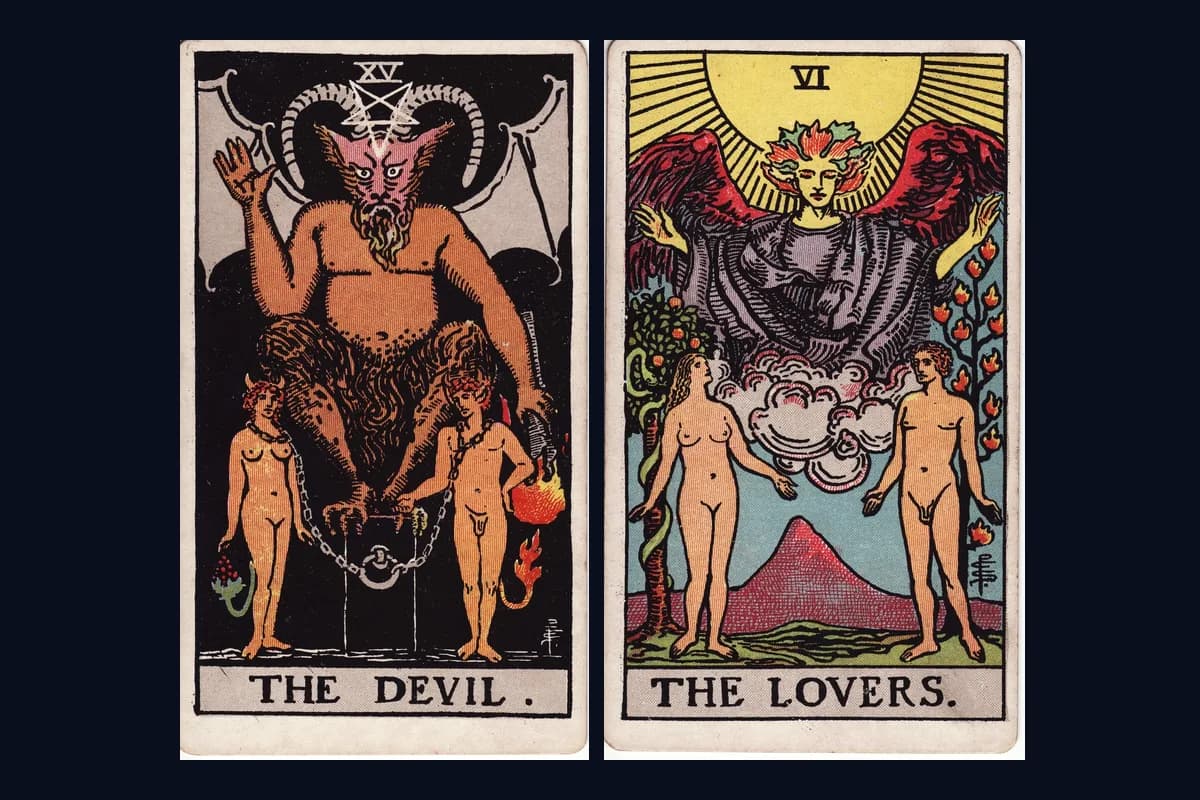
Sometimes the relationship itself is the secret. Some couples stay private because one of them isn't safe to be out, or because a family won't accept them. Pollack's hider keeps things back "often for no real reason," but yours may have a good one. If you're the one being hidden, the Lovers isn't a promise they'll choose you. It says a choice is waiting. If the bond feels less like a choice than a hold you can't break, the Devil and Lovers combination reads that version.
If you're asking yes or no, change the question first. No spread can answer is he cheating? with a yes or a no. Ask instead whether everything between you is being said out loud. With the Seven upright, that leans no for now: something hasn't been said, and the cards don't say by whom. With the Seven reversed, it turns toward yes. Should you say what you've noticed? Yes, if it's safe to. Commit while something stays unsaid? Not yet.
Separate what you've seen from what you're afraid of. What would your Lovers look like if both people in it had nothing left to hide? That image belongs in your deck.
The Seven of Swords first, or the Lovers first
The Seven of Swords first, then the Lovers: the secret comes first, then the choice. The man in the red cap leaves camp with his arms full, and the next card finds him in open sun, holding nothing. That's the hopeful order. The Lovers doesn't say which way the choice goes, only that it can be made in daylight. The Tower and Lovers combination is what happens when the secret breaks out all at once.
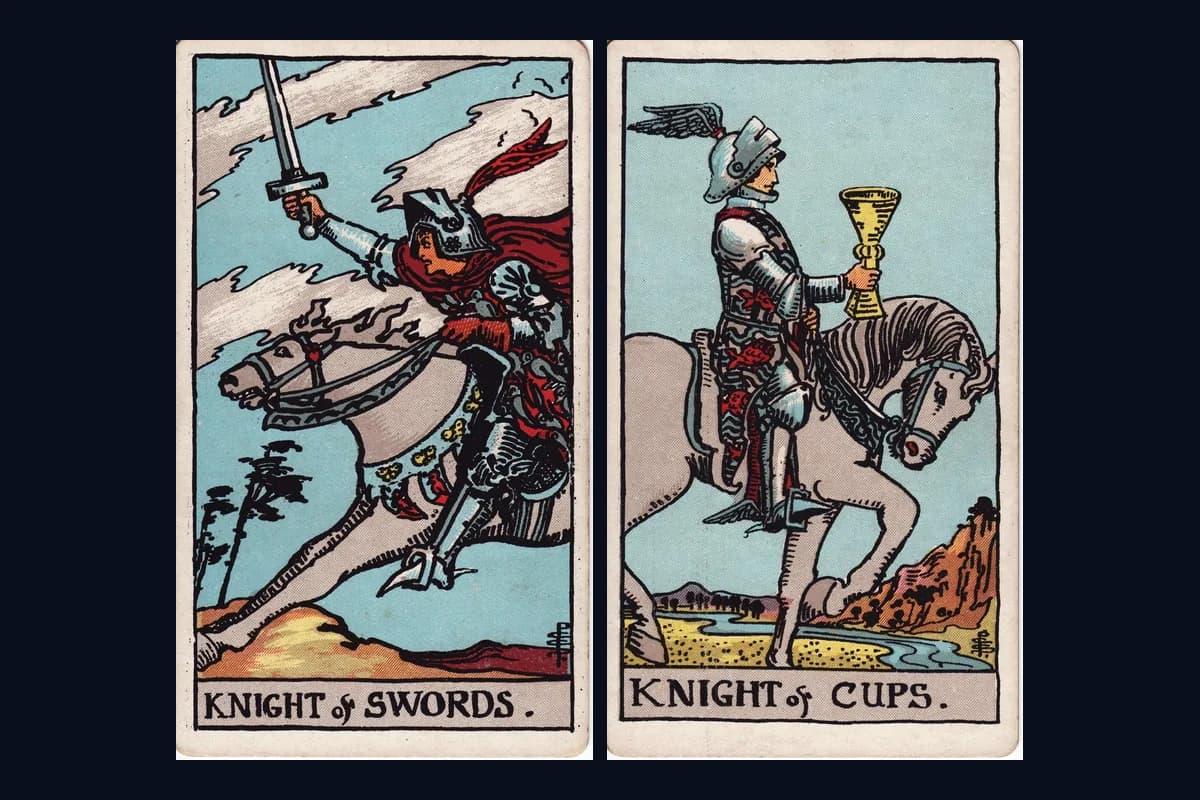
The Lovers first, then the Seven of Swords: the bond came first and the hiding later. That's the cautionary order. Ask what changed, and when. A newer secret sits nearer the surface, so there's still room to talk before it hardens. When words outrun feeling, see the Knight of Swords and Knight of Cups combination.
In a three-card spread of past, present and future, the Lovers behind you with the Seven in the present is the warning arc. But swap them, and an old secret is behind the choice you're facing now. A Seven in the future slot is where things head if nobody speaks, not a forecast.
In a Celtic Cross, two of Waite's positions ask whose secret it is. The seventh card is you. The eighth is your house, the people around you. In the seventh slot, the Seven points at something you're keeping quiet; in the eighth it finds secrecy in friends, family or gossip, without naming anyone.
Orientation matters too. Not every reader uses reversals. For those who do, Waite's reversed Seven is "Good advice, counsel, instruction, slander, babbling." Things get talked about, not always truthfully or by the right person. Pollack's reversal is kinder: "The isolation turns around to become communication, in particular seeking advice on what to do about one's problems."
| Orientation | Reading |
|---|---|
| Both upright | A real bond with something kept out of sight; decide in the open before the secret decides for you |
| Both reversed | The pretense is wearing thin in a bond that's already cooled; the talk is overdue, and it may land hard |
| Seven upright, Lovers reversed | The hardest of the four: hiding in a bond that's out of step; ask what the relationship is still for before you ask who's hiding what |
| Seven reversed, Lovers upright | A secret gets said, or advice gets asked for, in a bond with room to hear it; the most hopeful of the four |
Which came first in your spread, the secret or the choice? And what's the next honest move that's yours to make?
What the sky adds to this pair
The Golden Dawn gave the Seven of Swords to the Moon in Aquarius and the Lovers to Gemini, ruled by Mercury, the planet of speech. Swords, Aquarius and Gemini all belong to Air, the element of thought and talk. By element, these two are made of nothing else.
In elemental dignities, the Golden Dawn's method of reading a card through the elements of the cards beside it, matching elements strengthen each other. In Mary K. Greer's summary of the rules in Book T, the order's manual, such cards are "very strong for either good or evil." Book T gives that rule for the suits, so stretching it to the Lovers is a reader's choice. If you do, this pair won't soften a secret; it turns up the volume on whatever is already there.
Of their differences, one matters here. Aquarius is fixed; Gemini, the Twins, is mutable, which older astrologers called double-bodied. A fixed sign holds a secret steady. And a mutable one keeps a choice circling. Wang argues the Lovers doesn't represent "the mundane love of two persons" but "the dualities of a single individual." Look at the two men again.
Decans are ten-degree slices of the zodiac, and the Golden Dawn gave the Seven the last slice of Aquarius, 20 to 30 degrees. The Sun crosses it from February 9 to February 18, 2027 (dates in Universal Time), so Valentine's Day falls inside the Seven of Swords' slice. A week built around telling someone how you feel is a fair time to start saying what you've been holding.
On August 17, 2027, during a penumbral lunar eclipse too faint for most eyes, the Moon is full at 24 degrees of Aquarius: the Seven's planet, inside the Seven's own slice. But neither date tells you whether anyone is lying. A transit isn't evidence, and neither is a card.
What conversation have you been rehearsing in your head instead of having out loud?
The card hiding inside this pair
7 + 6 = 13. That's Death.
In a reading, Death is the card of something running its course, and it doesn't predict that anyone dies. Here that might be the secret, the long stretch of not choosing, or the relationship in the shape it's had. A pattern, not a person.
Pollack's layout shows the same sum. She sets the numbered trumps in "three groups of seven," so adding seven drops you one row, and the Lovers sits "directly above Death."
The Tree of Life, the Kabbalah's map of ten spheres joined by paths, gets to the same card by another road. In the Golden Dawn's system, every Seven sits on Netzach, Victory, the seventh sphere, which Crowley calls "the Sephira of Venus." The Lovers' path runs into Tiphareth, the sixth, at the heart of the Tree. And the path joining those two spheres belongs to Death.
Wang places Death's path "between Tiphareth and Netzach" on the Flaming Sword, the lightning-shaped route the order drew down the Tree. Another sword. He describes the work of that path as "leaving the desire nature of Netzach and being absorbed into Tiphareth."
Not every reader adds cards together, and nothing in the tradition says the sum was meant to point at that path, but the arithmetic and the Tree still land on the same card. The one direct road from the Seven's sphere to where the Lovers' path arrives runs through Death. The private plan has to end before the shared choice can begin.
And 13 still reduces: 1 + 3 = 4, the Emperor, the card of rules and structure. For this pair, that means the terms of your relationship, spelled out. What you are to each other. What's okay and what isn't.
What would you need to hear, or to say, before you could trust what the two of you are building?
Questions readers ask about this combination
Does the Seven of Swords and the Lovers mean he's cheating?
No card can tell you that. The Seven of Swords and the Lovers describe a relationship, or a choice, where something hasn't been said. The secret could be your partner's or yours, or it could be a decision nobody has made yet. Noticing what actually happens, then asking about it calmly, will tell you more than another spread. If asking feels unsafe, talk to someone you trust or a domestic violence hotline where you live.
What does the Seven of Swords and the Lovers mean in a love reading?
In a love reading, the Seven of Swords and the Lovers point to a real bond, or a real choice, being handled out of sight. The secret can belong to either of you, and sometimes the relationship itself is what's kept quiet, for good reasons or bad ones. If you're asking how someone feels, the Lovers says something real is at stake, and the Seven says not all of it is being said.
What does it mean when the Seven of Swords and the Lovers are both reversed?
With the Seven of Swords and the Lovers both reversed, a pretense is wearing thin inside a bond that has already cooled. A.E. Waite's meanings for the reversed Seven include good advice and counsel, but also slander and babbling, so what was hidden starts to get talked about, not always truthfully or by the right person. The talk is overdue, and it may land hard. It's a time for plain words. Not every reader uses reversals.
What element connects the Seven of Swords and the Lovers?
Air. Swords are the Air suit, and the Golden Dawn gives the Seven of Swords to the Moon in Aquarius, an Air sign. The Lovers takes Gemini, another Air sign, and its Hebrew letter, Zain, means sword. In elemental dignities, the Golden Dawn's method of reading a card through its neighbors' elements, matching elements strengthen each other for good or ill. The rule was written for the suits. Stretch it to the Lovers and the pair heightens whatever is there.
Is the Seven of Swords and the Lovers a yes or no combination?
The Seven of Swords and the Lovers can't say yes or no to whether someone is cheating, and no card can. A better question is whether everything between you is being said out loud. Upright, the Seven leans no for now, without saying who is holding back. Reversed, it turns toward yes. Raising what you've noticed is a yes, if it's safe to. Committing while something stays unsaid is a not yet.