Tarot Card Combinations
Two of Swords and The Lovers
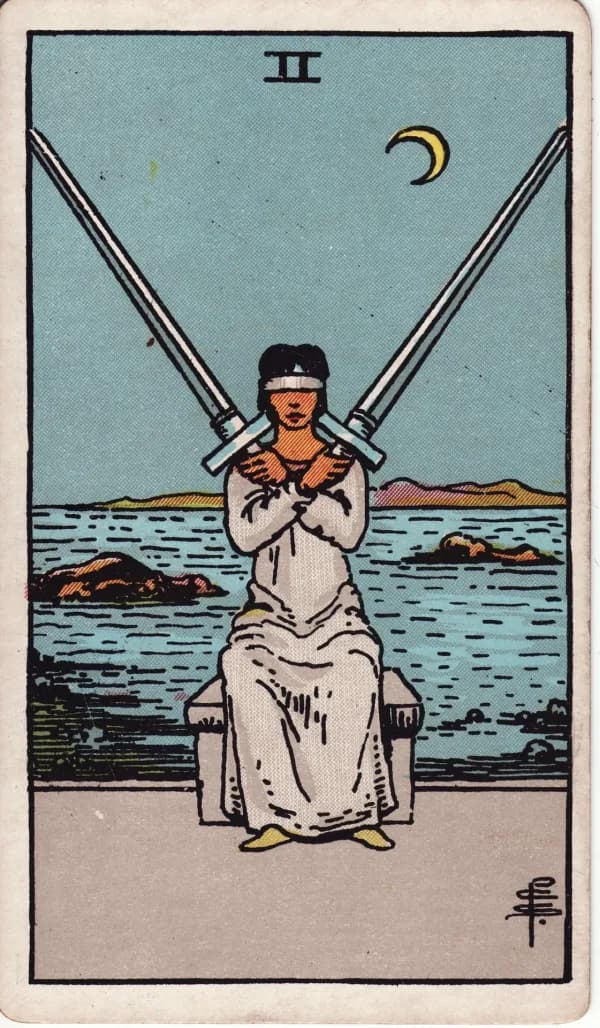
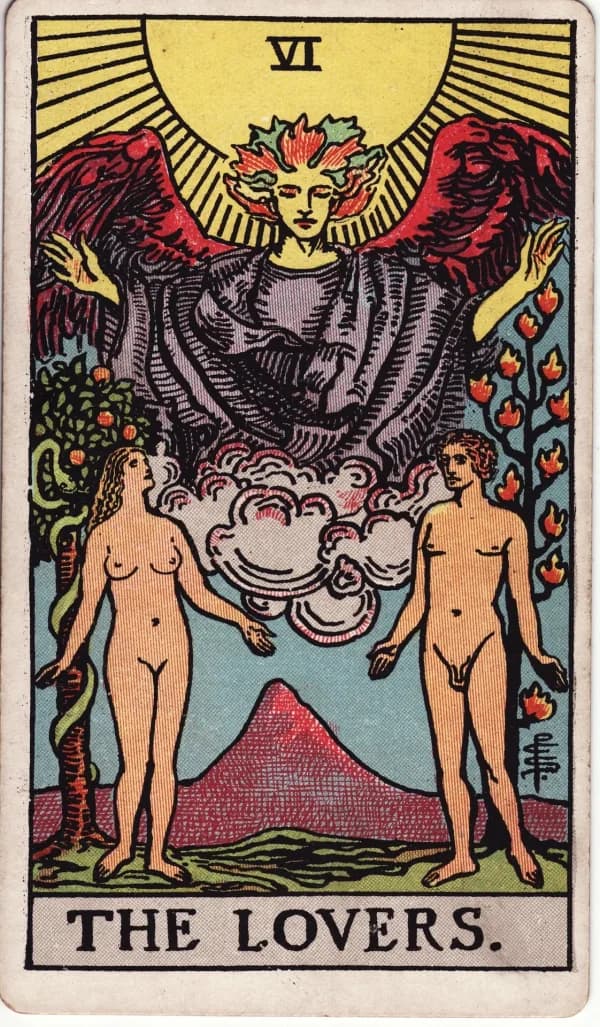
The Two of Swords and the Lovers tarot combination signals a choice in love you haven't let yourself see. Under a crescent moon, a woman sits with her back to the sea, a cloth tied over her eyes and a sword in each hand. Beside her, two lovers stand naked in full sun, eyes open. You came asking which one. These cards show you the blindfold.

Climate scientist, ashtanga practitioner, and advocate for human rights and LGBTQIA+ equality.
What each card shows on its own
Look at the Rider-Waite-Smith Two of Swords for a moment. A woman in a long white gown sits on a stone bench, a blindfold knotted over her eyes. Her arms cross tight over her chest, a sword in each hand, and the blades rise past her head in a wide V. Behind her, rocks break the surface of the sea. A crescent moon hangs in a pale sky. It's the only sign of evening, and she has her back to all of it.
A.E. Waite gives her a single line: "A hoodwinked female figure balances two swords upon her shoulders." In its oldest sense, hoodwinked just means blindfolded. Rachel Pollack, in Seventy-Eight Degrees of Wisdom, calls the blindfold "a deliberate closing of the eyes," tied on "so that she will not have to choose between friend and enemy." And choosing would mean letting people back in.
It's card two in Swords, the suit of Air, and as a Minor card it has no Hebrew letter of its own. The Golden Dawn assigned it to the Moon in Libra and titled it the "Lord of Peace Restored." A truce, then.
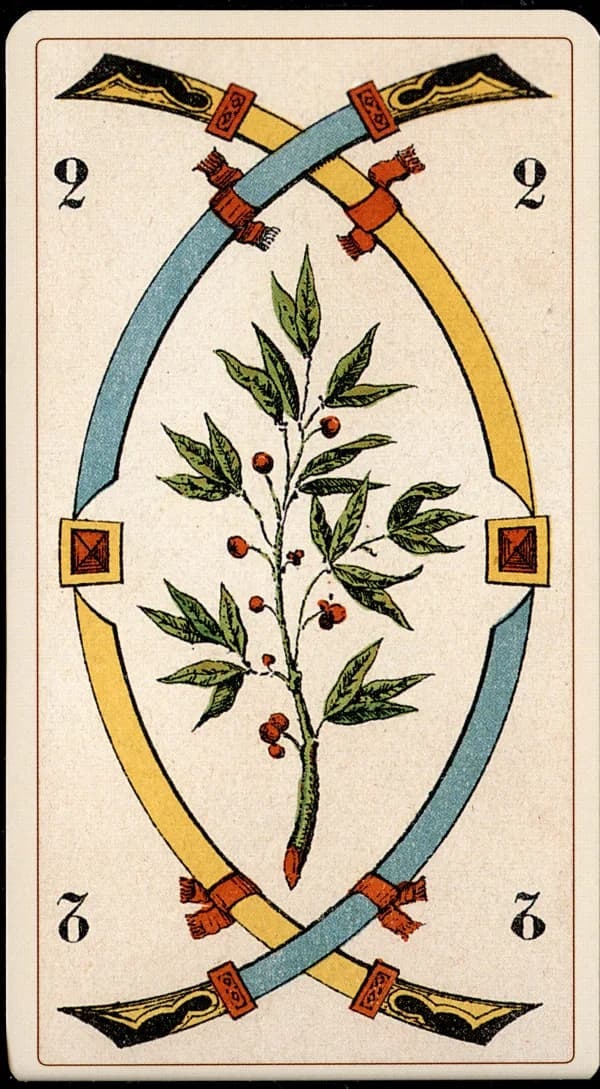
The blindfold is younger than it looks. Pollack notes that nearly every deck before Waite's gave its numbered cards plain patterns, and the Milanese Two of Swords further down still has one: two curved blades crossed around a sprig of red berries. Benebell Wen says the old Marseille card is "about valor, honor, integrity, a firm resolve." Waite's own list starts with gentler meanings, and Pollack says Pamela Colman Smith's 1909 picture pulls against them: "particularly the two of Swords, the picture almost contradicts the meaning."
Now look at the Lovers.
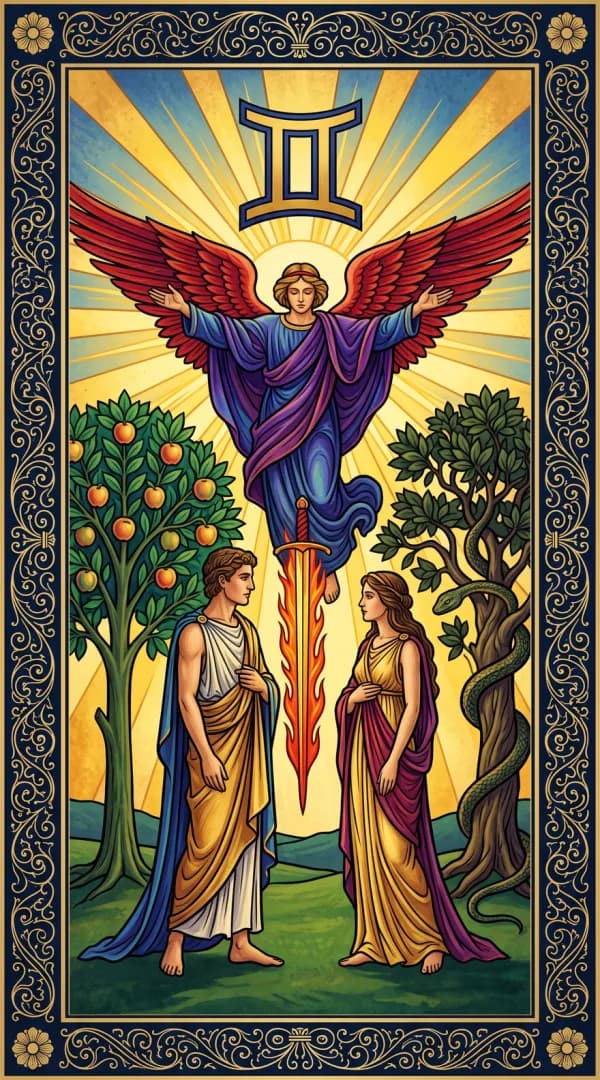
A huge sun fills the top of the card. Under it, a winged angel rises from a cloud, arms raised and palms open, over a naked man and woman. Pollack points to where the eyes go: "Notice that while the man looks at the woman the woman looks at the angel." It's card VI, given to Gemini and its planet, Mercury. Its Hebrew letter is Zain, which Crowley says "means a Sword."
The older Lovers asks your question outright. Pollack describes the Marseille card's "young man struck by Cupid's arrow and forced to choose between two women." But Waite replaced that old card, and with it "the later follies which depicted man between vice and virtue."
Sit on that stone bench, arms crossed over your heart. If you untied the knot, what's the first thing you'd see that you already know is there?
What the Two of Swords and the Lovers mean together
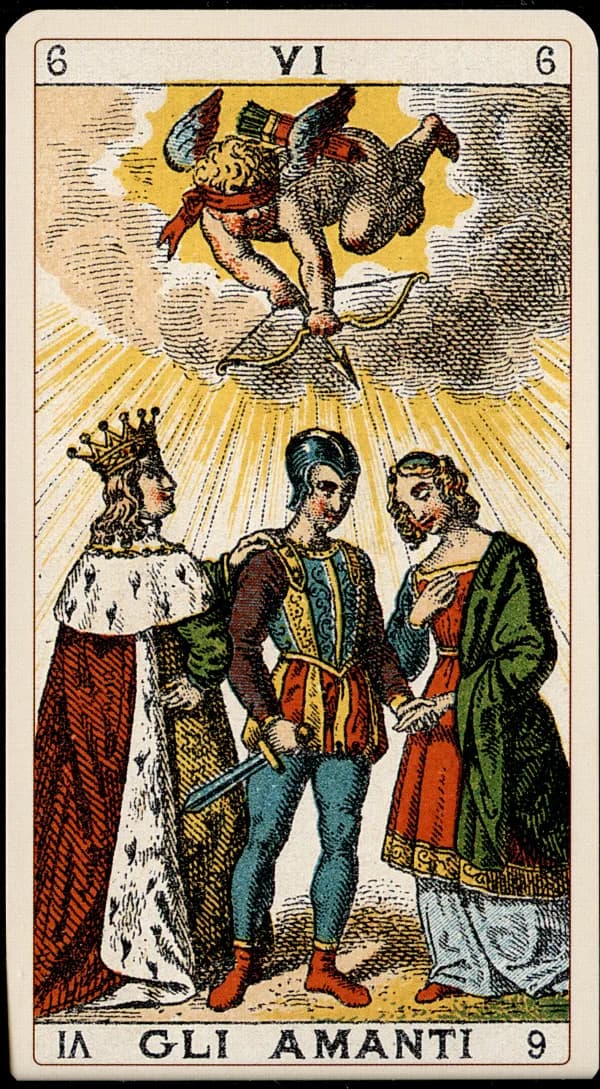
Most pairs don't share a blindfold. This one does. On the Milanese Lovers further down, Cupid draws his bow with a red band tied across his eyes, aiming at a young man between a crowned figure and a young woman. Love is blind there, and the chooser can see. In Aleister Crowley's Book of Thoth, Cupid wears a blindfold too. Waite took Cupid and the rival off his Lovers. Smith's Two of Swords brings the choice back, with the blindfold moved onto the person choosing.
This is a Major Arcana card beside a Minor, so read it from two heights. The Lovers is the view from above: a choice about love big enough to change who you are. The Two of Swords is the ground-level detail, how you're handling it this week. Arms crossed. Nothing moving.
Astrology.com's combination page says the pair points to "a need to make a difficult choice regarding a relationship." But set the two pictures side by side and they say something sharper: there's a real choice in front of you, and the stalemate is how you've agreed not to look at it.
Barbara Moore of Llewellyn asks a fair question about the woman on the bench. "Is the person in the image refusing to face facts or is she cutting off all external input so she can apply only her logic to the dilemma?" Both happen. Sometimes you tie the blindfold on to stop hearing everyone's opinion. The trouble starts when it stays on for months. And since it's yours, no honest reading will pick a person for you.
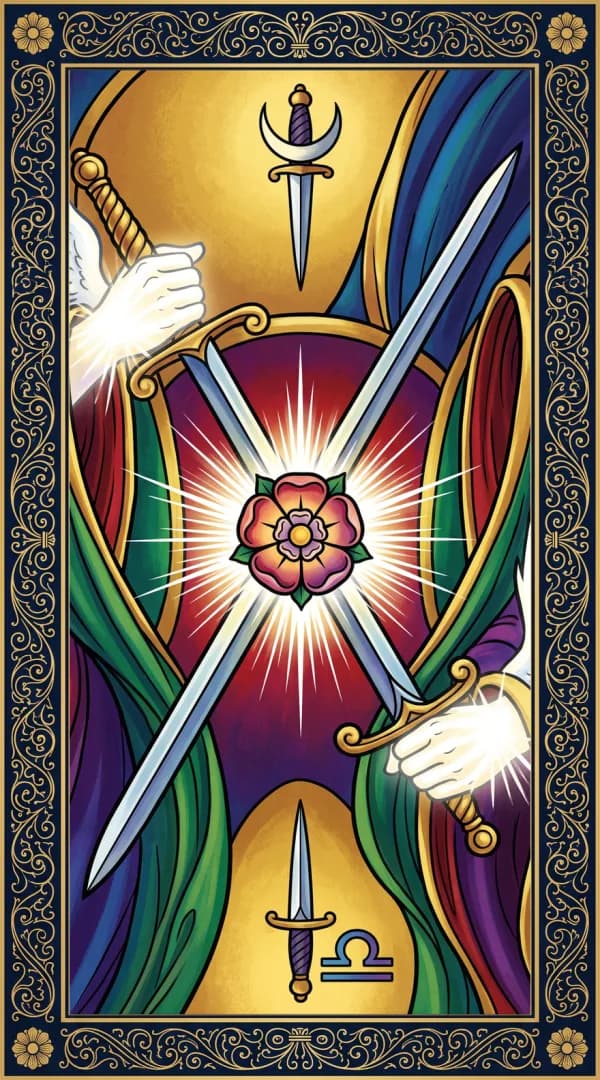
The Golden Dawn Two of Swords below crosses its blades over a rose, with a crescent moon on a small dagger above and the sign of Libra beneath. And the Lovers hides a blade too: its letter, Zain.
Choosing will cost you something either way. What are you protecting by not choosing yet?
What the pair says when you're choosing between two people
If you're choosing between two people (a partner and someone new, or an ex and the person you're seeing now), the cards won't name one. They show how you're holding it: eyes covered, a blade on each side. Tina Gong of Labyrinthos warns that "instead of being an active participant in your life choices, you may be attempting to avoid a choice altogether." Ask what each choice would cost, and who you'd have to tell. Choosing neither is an answer too, if you do it on purpose.
In an existing relationship, the pair can describe a stalemate you've settled into. You're not leaving. You're not deciding to stay, either. That's the truce in Book T, the Golden Dawn's tarot manual: the quarrel made up, the tension still in the room. Truces are allowed. They just make poor places to live. Next to the Lovers, the old question comes back: would you still choose this, today?
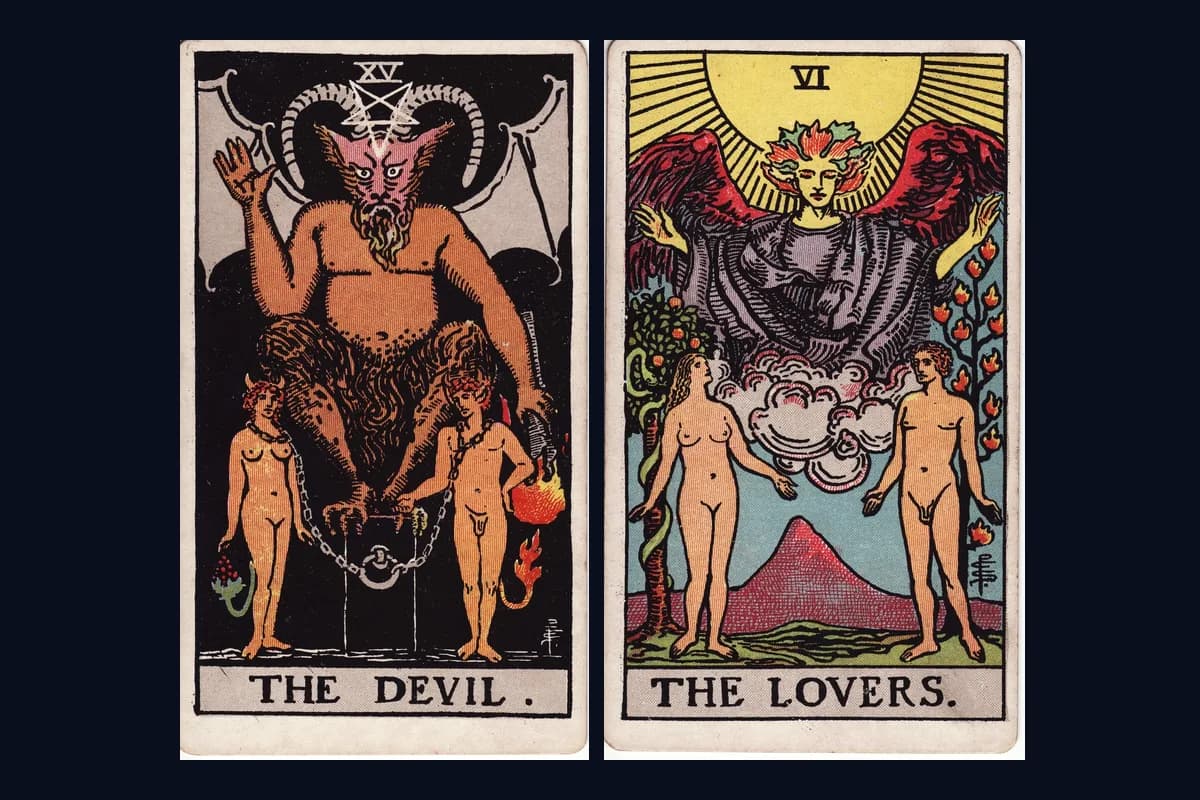
When it's a commitment you keep putting off (moving in, getting engaged, naming what you are), the Two of Swords is the deliberate non-answer. If you aren't deciding because you feel you can't, not because you won't, the Devil and Lovers combination sits closer to your question. And if you're afraid of what someone will do once you choose, put the cards down and talk to someone you trust, or call a domestic violence hotline in your area.
Maybe you aren't the one choosing. If you're waiting to be chosen, the blindfold in this pair is still yours, and no card can see what the person deciding feels. Your choice is how long you'll wait.
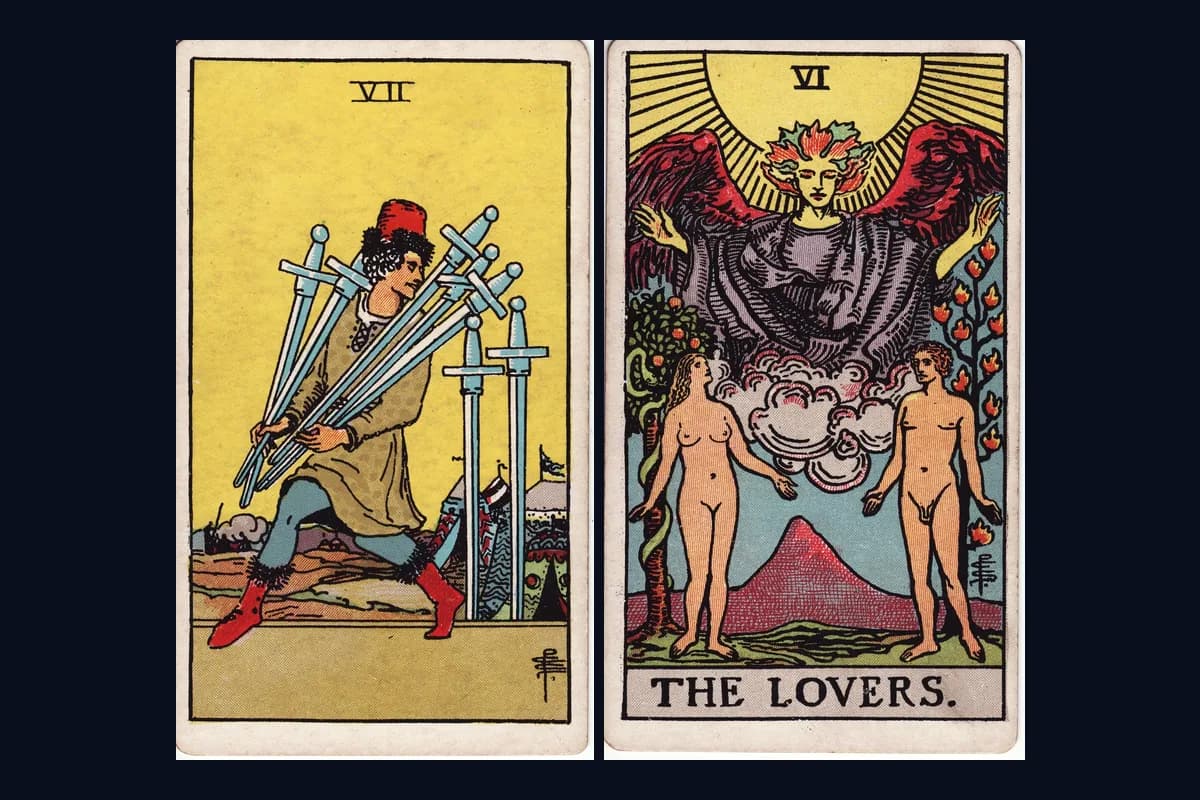
Sometimes one of the two people doesn't know about the other. If you're the one choosing, two other people are living inside your pause, one of them without the facts. Suspect your partner is the one who's torn? These cards aren't evidence about anyone but the person who drew them. When the worry is a secret more than a stalled choice, the Seven of Swords and Lovers combination reads that version.
Asking yes or no? Not yet, and closer to yes once you take the blindfold off. Theresa Reed of The Tarot Lady reads the Lovers as an emphatic yes to getting involved with someone. For her, the upright Two of Swords is a card for waiting: "The answer you seek will come after more reflection." So it's yes to the question being real, no to answering it blindfolded.
With the Two of Swords reversed, the answer tilts toward yes, because Reed reads that reversal as "the wait is over and action resumes." Benebell Wen reads it as "hitting a stalemate," so check which one you're living. Either way, any yes is to deciding, never to one person over another.
Picture the woman on the bench as the blindfold comes off. What would your Two of Swords look like then? That image belongs in your deck.
Which card comes first changes the story
The Two of Swords first, then the Lovers: the stalemate comes first and the choice follows. A crescent moon, then a sun overhead. That's the hopeful order. The pause can end in a decision you make while you can see. But the order won't tell you which way you'll go, or how soon.
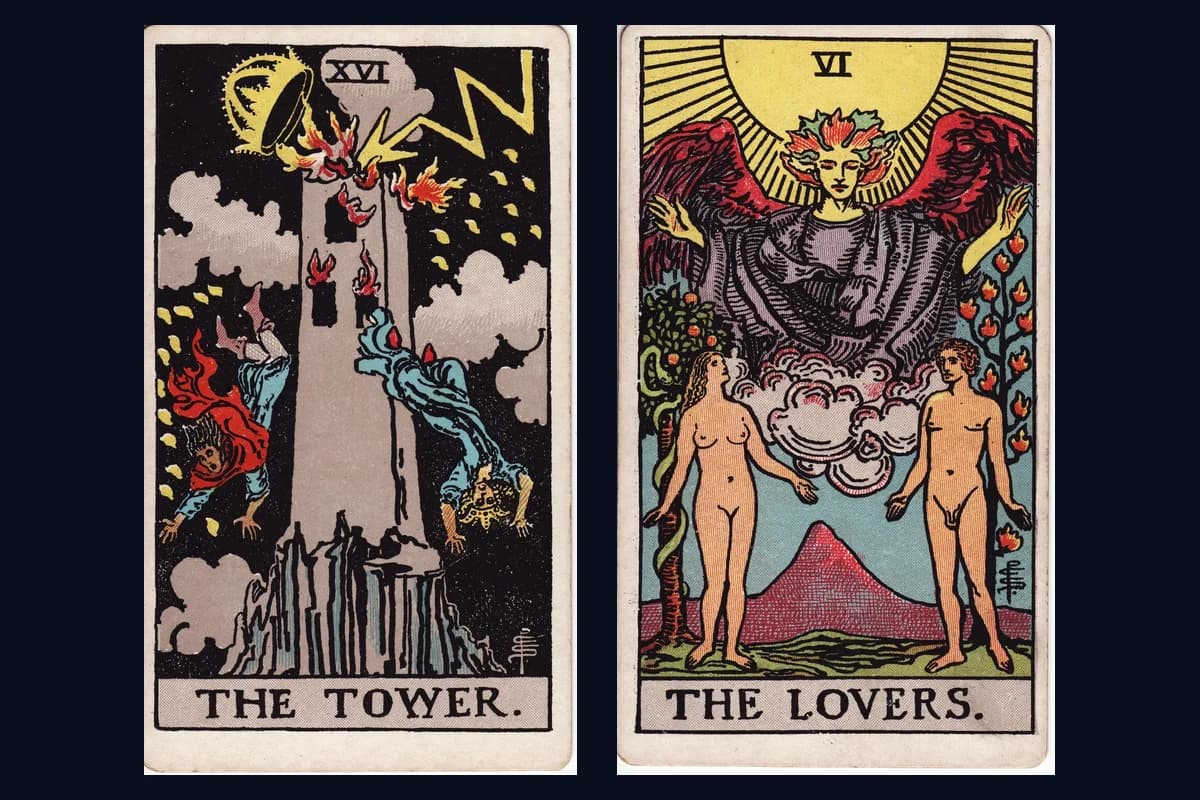
The Lovers first, then the Two of Swords: the feeling came first, the freeze later. That's the cautionary order. You had something clear, then stopped looking at it. Ask when the blindfold went on. If it gets torn off instead of taken off, the Tower and Lovers combination covers that harder version.
In a three-card spread, try Brigit Esselmont's Situation, Problem, Action layout from Biddy Tarot. With the Lovers as the situation and the Two of Swords as the problem, what needs solving is the blindfold, not either person; the third card is your first move.
In a Celtic Cross, watch the near future and the outcome, the tenth card. Pollack reads the near future as "some situation that the person will soon have to face." When the outcome is very different in character from the near future, she says, this might mean "the coming situation will have no lasting effect." With the Two of Swords in the near future and the Lovers as the outcome, the stalemate may be a passing stretch. Swap them, and the choice may not hold, leaving the stalemate as your current course. Courses change.
Orientation matters too. For readers who use reversals, Waite's list for the reversed Two of Swords is blunt: "Imposture, falsehood, duplicity, disloyalty." None of those words says whose. Start with the story you've told yourself about why you can't choose. And when the blindfold does come off, Pollack warns, it "can prove very emotional, even shattering if the person does not receive help from outside." Have someone to talk to.
| Orientation | Reading |
|---|---|
| Both upright | A real choice you've agreed not to look at; the pause protects something, so give it an end date |
| Both reversed | The stalemate breaks on its own inside a strained bond; events may rush the choice, so make yours on purpose |
| Two of Swords upright, Lovers reversed | A blindfold over a strained bond; ask if the pause is wisdom or fear before you ask which person |
| Two of Swords reversed, Lovers upright | The blindfold comes off and the choice is plain; the first look may sting |
Where did the Two of Swords land in your spread? If it's ahead of you, what could you look at today, before the pause sets in?
What the sky adds to a stalled choice
The Golden Dawn put the Two of Swords under the Moon in Libra, the Scales, and gave the Lovers to Gemini, the Twins, ruled by Mercury. It's all Air: Swords are the Air suit, and Libra and Gemini are Air signs. But the planets cross over. Libra belongs to Venus, the planet of love, while the Lovers answers to Mercury, the planet of talk. So the love card runs on talk, and the stalemate card sits in love's own sign.
The Golden Dawn judged each card partly by its neighbors' elements, a method called elemental dignities, and cards of one element make each other stronger, for better or worse. Stronger isn't calmer. Book T applies the method only to the suits, and some readers leave the Lovers out. If you don't, two Air cards give your reasons sharper edges, and the stalemate holds.
The Moon is the Two of Swords' planet, and it's in the picture. Robert Wang, in The Qabalistic Tarot, calls it "a very changeable and erratic planet which assumes some stability in Libra." The Lovers' picture has the Sun overhead instead, and on the Tree of Life (the Kabbalah's map of ten spheres), the card's path runs into Tiphareth, the Sun's sphere.
Each sign splits into three ten-degree decans, and the Golden Dawn gives the Two of Swords the first decan of Libra. In 2027 the Moon reaches both extremes there (dates in Universal Time). On March 22, 2027, the Moon is full at 1 degree of Libra, inside the Two of Swords' decan: her planet, fully lit. On September 30, 2027 (the evening of September 29 in most of the Americas), it's new at 6 degrees of Libra, in the same decan, and goes dark.
Neither date picks a person or tells you what anyone else feels. Don't wait for the dates. If you've worn the blindfold through a long dark stretch, the crescent that follows that new Moon and grows nightly is a fair cue to take it off.
The Moon changes shape every night. Has your answer to this changed with it, or stayed the same the whole time?
The card at the end of the sum
2 + 6 = 8. Your deck decides which card that is.
In the Milanese and Marseille decks, card 8 is Justice. The Milanese La Giustizia holds an upright sword and scales. Her eyes are lowered, but there's no blindfold, and an open eye is set into the gold collar at her throat. Crowley's Thoth deck keeps Justice at 8, as Adjustment, under Libra, the Two of Swords' own sign, but there she's masked.
Pollack notes the legal Justitia "was blindfolded to demonstrate that the law does not discriminate and applies to weak and powerful alike." Her conclusion: "The Tarot Justitia, therefore, wears no blindfold." Sword raised, scales in hand, Justice sits like the woman on the Two of Swords. The clearest difference is the cloth. This pair adds up to the Two of Swords with the blindfold off.
In the Rider-Waite-Smith and Golden Dawn decks, 8 is Strength instead. Waite also called it Fortitude, an old word for courage, and courage is on his list for the Two of Swords. But his Strength doesn't carry a sword: a woman closes a lion's jaws with her bare hands. So each open-eyed 8 undoes part of the Two of Swords' pose: Justice uncovers the eyes, Strength uncrosses the arms.
Adding cards is a reader's habit, not a rule. Inside the suit, the same sum lands on the Eight of Swords, where the blindfold stays on, though Waite calls it "rather a card of temporary durance than of irretrievable bondage."
The Two of Swords holds two blades; Justice holds one. Which of your reasons for waiting could you set down first?
Questions readers ask about this combination
Does the Two of Swords and the Lovers mean choosing between two people?
Often, yes, but the pair won't tell you which one. On the Marseille Lovers, Rachel Pollack sees a young man forced to choose between two women. On the Two of Swords, she says, a woman tied on her own blindfold so she wouldn't have to choose between friend and enemy. Side by side, the cards describe a real choice you've agreed not to look at. They can't pick a person, and no honest reading will.
What does the Two of Swords and the Lovers mean in a love reading?
In a love reading, the Two of Swords and the Lovers describe a bond with a decision on hold. Inside a relationship, that may be a commitment you keep putting off, or whether to stay once a quarrel is made up but the tension stays. Whether you're single or not, it may be which of two people to choose. The cards describe your own choice, not a partner's honesty or a third person.
What does it mean when the Two of Swords and the Lovers are both reversed?
With the Two of Swords and the Lovers both reversed, a stalemate inside a strained bond may break on its own. Readers split on the reversed Two: Theresa Reed reads it as the end of waiting, and Benebell Wen as hitting a stalemate. Next to a reversed Lovers, events may hurry the decision, so make your own. Neither reversal proves anyone is lying. Not every reader uses reversals.
What element connects the Two of Swords and the Lovers?
Air, and a sword. The Two of Swords is Air, and the Golden Dawn put it under the Moon in Libra, an Air sign. The Lovers belongs to Gemini, also Air, and Zain, its Hebrew letter, means sword. In elemental dignities, cards are weighed by their neighbors' elements, and like elements make each other stronger. Strictly, the method covers only the suits, but if you count the Lovers too, two Air cards sharpen both sides of your choice.
Is the Two of Swords and the Lovers a yes or no combination?
Not yet. The Lovers leans yes when the question is whether to get involved with someone, but an upright Two of Swords means waiting. So the answer stays on hold while the blindfold is on, and tilts toward yes once you take it off. With the Two of Swords reversed, some readers say the wait is already over. If a yes comes, it's to making the decision, and it never names a person.