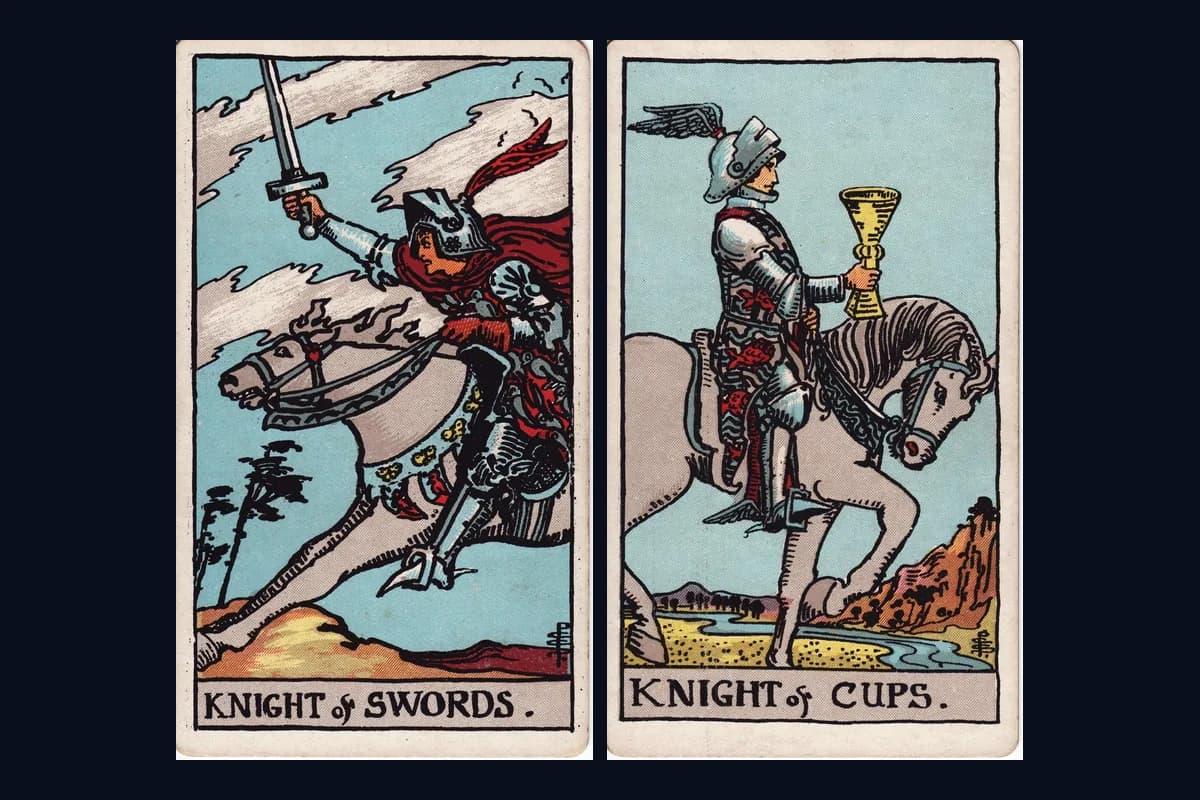
Tarot Card Combinations
Page of Wands and Knight of Wands
The Page of Wands and Knight of Wands tarot combination signals a beginning that's picking up speed. Two frames, one fire. In the first, a young man in a yellow salamander tunic stands in the desert, holding his wand still. In the second, the same tunic is in the saddle, and the horse rears above the pyramids. In your reading, that's a yes to starting, not yet to the finish.

Climate scientist, ashtanga practitioner, and advocate for human rights and LGBTQIA+ equality.
What each card says on its own
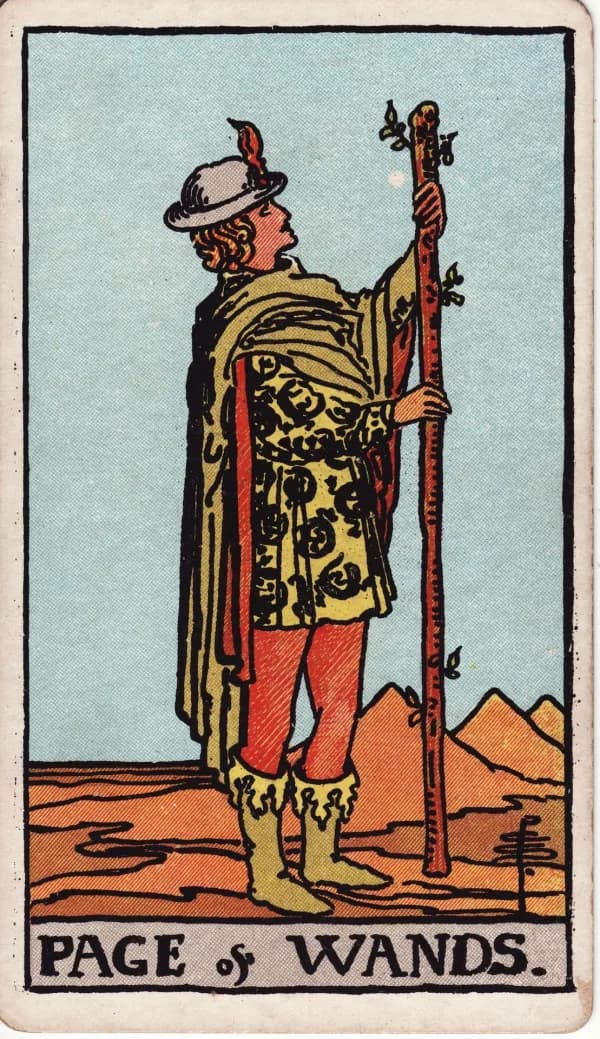
Look at the Rider-Waite-Smith Page of Wands. A young man stands in orange sand, three pyramids behind him, feet planted. He holds a wand taller than he is and tips his head back to study the new leaves at its top. His yellow tunic is printed with black salamanders. A gray hat carries one red feather, and his boots are cut into points of flame.
A.E. Waite says he "stands in the act of proclamation," yet his mouth is shut. He's reading the wand before he reads it out. Rachel Pollack, in Seventy-Eight Degrees of Wisdom, ties him to "the start of projects, and in particular an announcement to the world, and to ourselves, that we are ready to begin." And on a plainer level, she adds that "the Page can represent a messenger, message or information."
Court cards don't carry printed numbers. The Golden Dawn, the magical order Waite belonged to, gives the Page the final Heh of God's four-letter name, a letter that means window. His element is Earth of Fire.
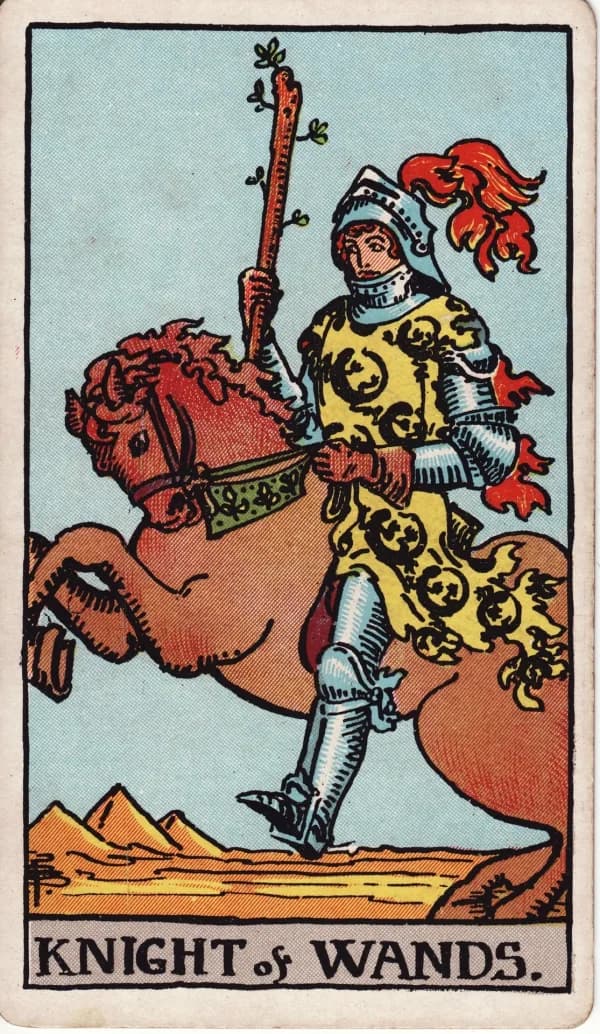
Now look at the Knight of Wands.
Same desert. Same three pyramids, now small and low at the card's edge. Same yellow tunic and black salamanders, with a red plume streaming back from the helmet. But this young man is in the saddle, and his chestnut horse rears with its forelegs high. Waite has him "passing mounds or pyramids," and adds, "The motion of the horse is a key to the character of its rider."
For Pollack, "The Knights translate the quality of each suit into movement," and this one "represents eagerness, action, movement for its own sake, adventure and travel." Read as the Golden Dawn's Prince, he takes Vau, the letter that means nail, the piece that joins two things. His element is Air of Fire.
Look at the two young men again: one in the sand studying his wand, one already riding out. Which of them is holding your idea right now?
What the Page of Wands and Knight of Wands mean together
Plenty of pairs share a suit. These two share a picture. Waite even opens his Page entry with "In a scene similar to the former," and in his book the former card is the Knight. Put them side by side and it's as if one young man got on a horse between frames.
With no Major Arcana card here, this is about the next step in front of you. Two court cards from one suit can be two people, and Brigit Esselmont of Biddy Tarot reads a pair of courts as "two people who are in relationship with one another." But they can also be one person at two speeds, or nobody at all: news, then motion.
Biddy Tarot's Knight of Wands entry draws the line between them: the Page is the spark, the Knight the pursuit. Together, they say that what you've announced is already moving, and neither card shows it finished.
Now look at the tunics again. Pollack points out that many of the salamanders on the Page's tunic "are complete, signifying not finished projects as with the King, but rather a simple wholeness in the self." On the Knight's tunic, "the salamanders' tails do not touch their mouths, symbolizing incomplete action, unformed plans." Small, but whole. Big, but unfinished.
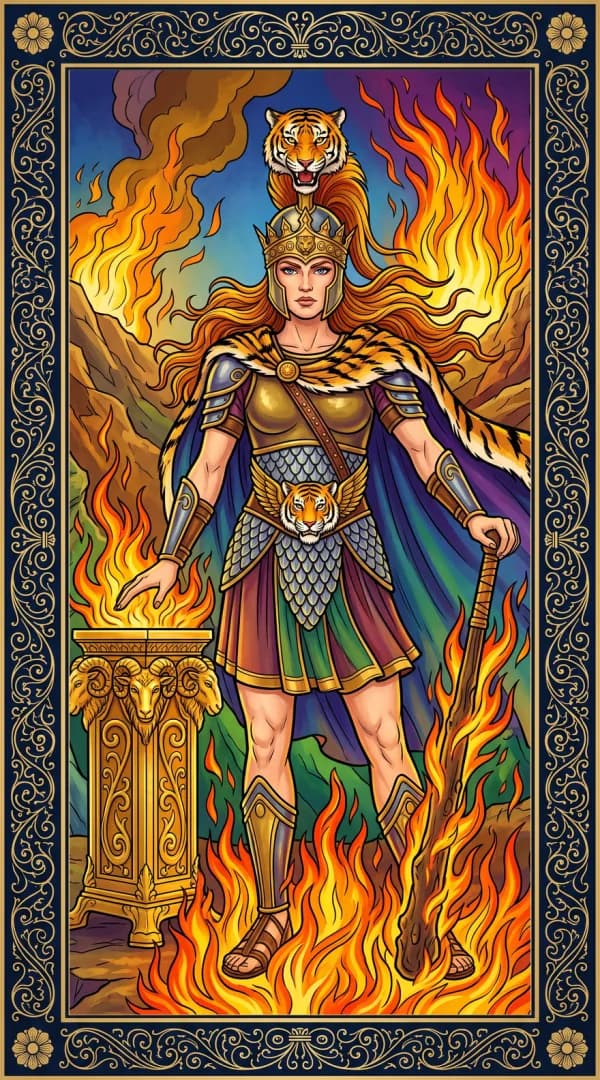
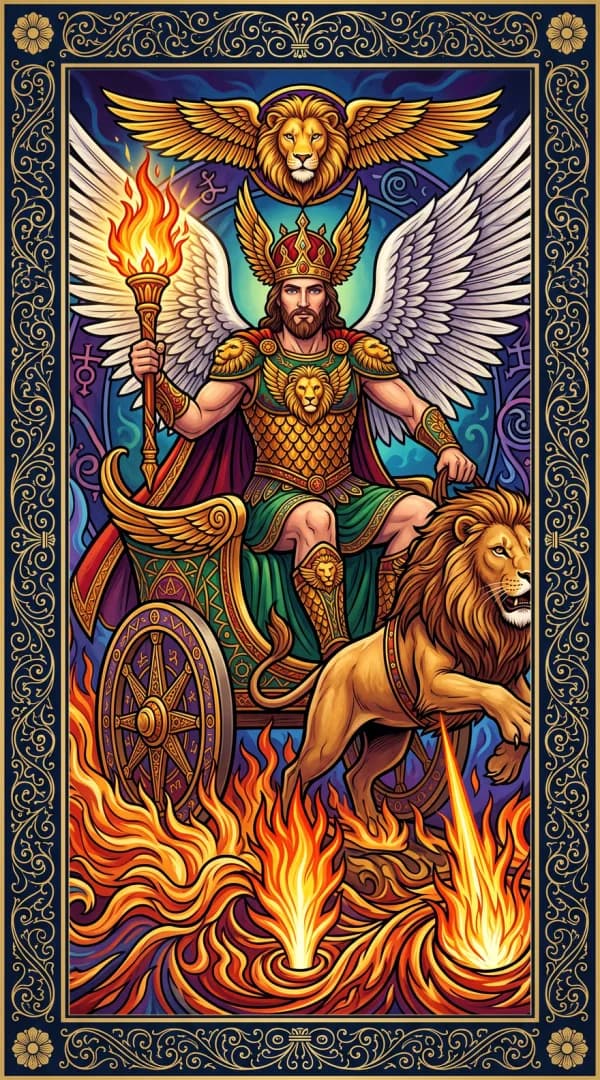
The Golden Dawn pair below changes the names. There the Page is the Princess of Wands and the Knight is the Prince, the match many modern readers make, following Robert Wang. Book T, the order's tarot manual, has its own Knight of Wands, but that card is closer to Waite's King.
Book T sets its Princesses "standing firmly by themselves" and its Princes "seated in chariots, and thus borne forward." So the Princess stands among flames, and a lion pulls the Prince's chariot. Wang adds that the Princes "often represent the coming and going of an event or person." That covers arrivals as well as departures.
What have you already announced, even if only to yourself, that hasn't left the sand yet?
What the pair says about a project, a message or a trip
For a creative project, it's a good pair to see. Theresa Reed of The Tarot Lady says the Page "can also advise to begin taking steps to start a business or a new creative venture." The Knight is the first rush of making it. Neither card covers the middle, so plan it while the fire's high: one deadline you set yourself, one person who'll ask how it's going. Yes to starting small. Not yet to quitting a job or betting the rent.
If you're asking will they contact me, the pair describes what contact looks like, not whether it comes. The Page is the message: Waite lists him as "an envoy, a postman." Think of a text or news through a friend. The Knight is a person in motion who turns up, sets off or leaves.
Whether a particular person gets in touch is their choice, and Barbara Moore of Llewellyn says why: "Situations involving others can be unpredictable, since we cannot control their decisions or actions." So treat the Page as a question for you: if the message were yours to send, what would it say? If they've asked for space, the Knight's speed belongs to your plans, not their inbox.
For travel news, the Knight is the trip. Waite's meanings for him open with "Departure, absence, flight, emigration." In that list, "flight" means fleeing, not air travel. The Page is the news that sets it going: an invitation, an offer, a confirmation. Both upright, they lean toward a trip or a move getting underway. But they don't name a date, and they can't approve a visa, so book what you control. If the Knight is someone else leaving, though, your question is what you do with the space.
In love readings, the pair can be attraction said out loud, then acted on. Labyrinthos warns that the Knight's "rash and volatile nature can make it difficult for them to settle down with one person." That's one reading of a temperament. Ask them where this is going.
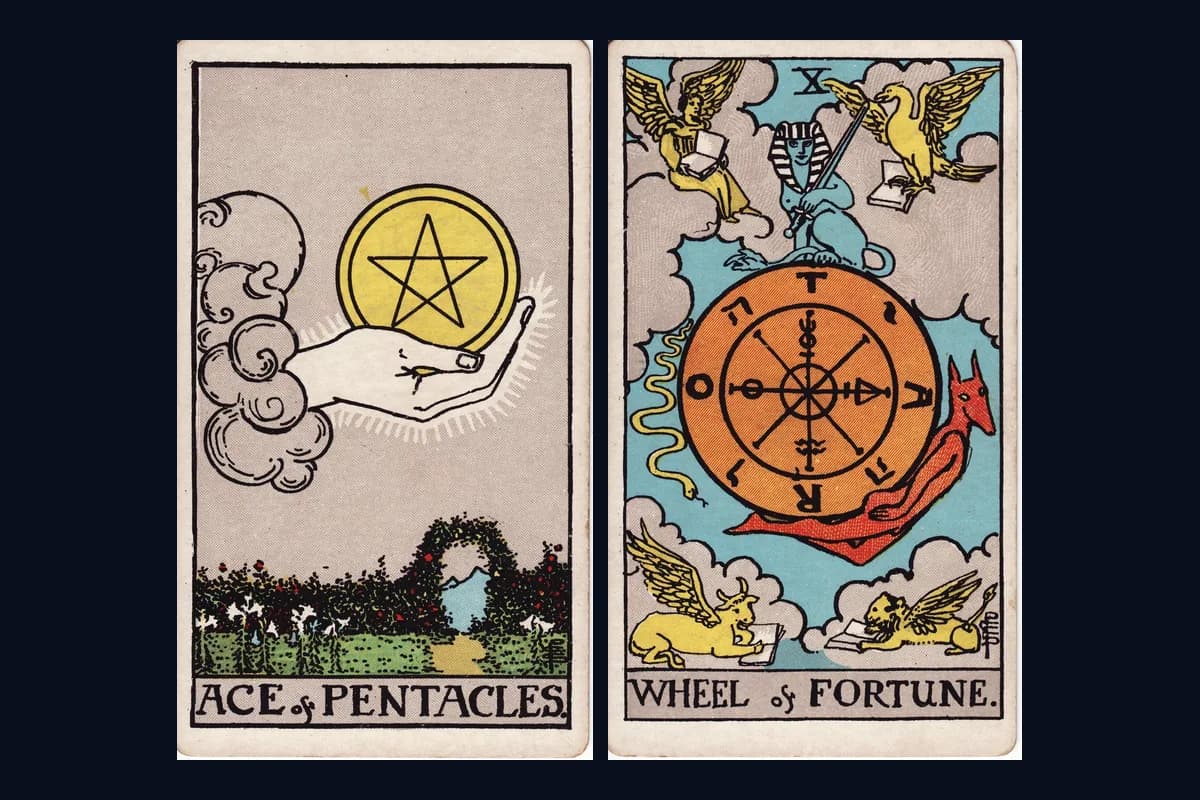
For career questions, Reed calls the Page "a particularly positive omen if you are waiting on a job offer." Keep your other applications going anyway. If you're really asking whether the money follows, the Ace of Pentacles and Wheel of Fortune combination reads that side.
If you're asking yes or no, the upright pair is closer to yes than no. Yes to starting. Yes to news moving and plans getting underway. Not yet to the finish. With the Page reversed, it's not yet: the idea or message isn't ready. With the Knight reversed, it's yes to the plan, not yet to the motion. Both reversed, it's no for now. The part that depends on someone else stays their choice.
Picture the idea you've been holding still, the way the Page studies his wand. What would your Page be holding, and where would your Knight ride with it? That image belongs in your deck.
The Page first, or the Knight first
Start with which way they face. The Page stands turned to the right, and the Knight's horse rears to the left. Lay them down Page first and they face each other across the gap, pyramids in the middle. Knight first, they turn their backs. Mary K. Greer tells readers, "Pay close attention to the position meaning, and/or the direction the Court Card is facing."
Page of Wands first, then Knight of Wands is the hopeful order, climbing Waite's ranks from Page to Knight. You send word, then you act on it. For a launch, it's the order you want: you've said it, and now you're making it. It still ends mid-ride.
Knight of Wands first, then Page of Wands is the cautionary one for a project. You're moving before you know what you're making, and the idea itself turns up late. But the Golden Dawn's ranks are kinder here, since its Princess comes last, where fire settles into something you can hold. For contact, it reads differently: someone may already have moved or left, and any word that comes is about that, not a promise about what's next.
In a Celtic Cross, Waite's second card crosses the first: "It shews the nature of the obstacles in the matter." A Page crossed by the Knight is a fresh idea whose obstacle is haste, and a Knight crossed by the Page is something moving, held back by inexperience or by a message nobody has sent. Land the Page in the tenth place, the outcome, and the reading ends at a beginning.
For a three-card spread, Esselmont keeps it simple: "It's the Situation, Problem, Action spread." With the Page as the situation and the Knight as the problem, the third card, the action, carries the weight. A steady card there (a Pentacles card, say) gives the idea a road. But another Wands court only adds speed, and Pollack's warning applies, since this Knight "tries to fly in every direction at once."
Orientation matters too. Waite gives the reversed Page "indecision and the instability which accompanies it." The reversed Knight gets four words: "Rupture, division, interruption, discord." Reversed, this pair reads as stalled or delayed. Some stalls restart and some don't.
| Orientation | Reading |
|---|---|
| Both upright | An idea goes public and starts moving; a message or a trip gets underway; the finish isn't in these cards |
| Both reversed | The launch stays on the ground; your message unsent, a trip on hold; the fire may only be indoors for now |
| Page upright, Knight reversed | The idea is sound, but the follow-through stalls; announced, then interrupted; keep the idea and rework the ride |
| Page reversed, Knight upright | Motion before direction; acting or traveling before you know what you want; slow down and name the idea |
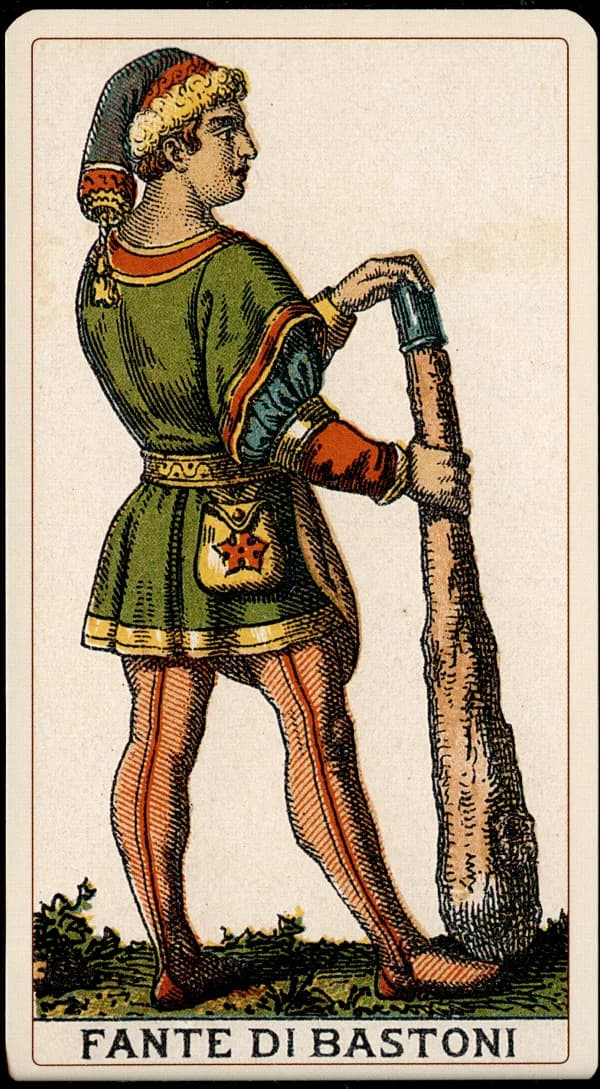
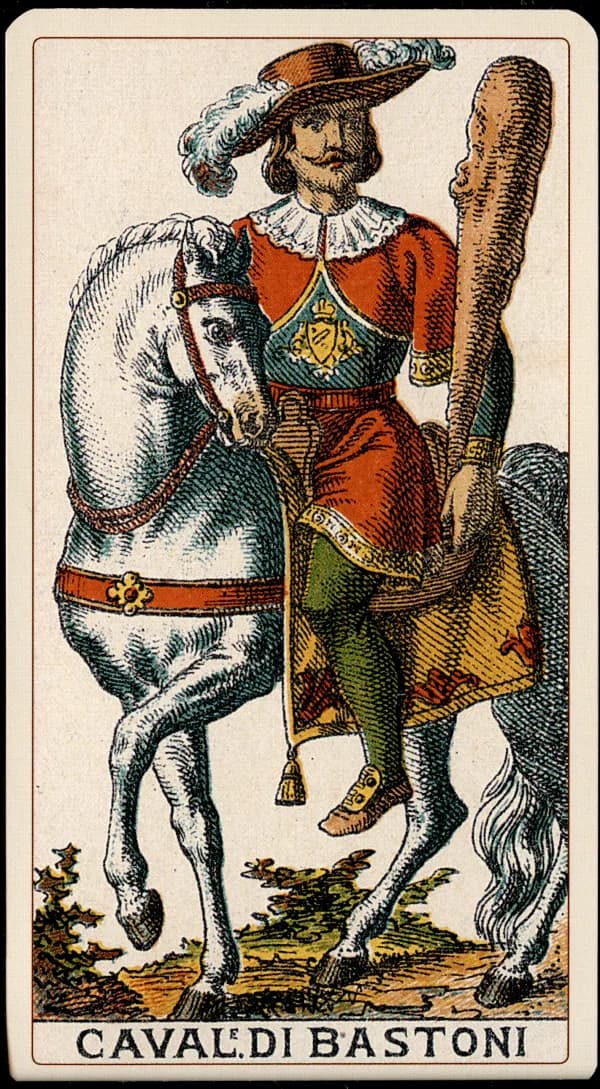
The Milanese pair below moves at a walk. The Fante di Bastoni, the Page, leans on a heavy club. The Cavaliere's white horse steps forward. One front hoof lifted. No horse rears, though the two still face each other. Pamela Colman Smith drew the rearing horse for Waite's deck in 1909.
Which way did your two figures face? And which half are you still waiting on: the word, or the ride?
What astrology adds to two Wands courts
Both cards are Wands, and Wands are Fire. The Golden Dawn splits that Fire one step further. Its Princess, your Page, is Earth of Fire, and Aleister Crowley calls her "the fuel of Fire." Its Prince, your Knight, is Air of Fire, with "its faculty of expanding and volatilising." Fuel and moving air. That's what a fire needs to spread.
Elemental dignities are the Golden Dawn's way of weighing a card by the suits beside it. Cards of the same suit "strengthen it greatly," Book T says, "for good or evil." Two Wands sit at full strength with nothing holding either back. If you read with dignities, that's why the pair moves fast. But that's also why it can burn through its fuel before the work is done.
Only the Knight has a stretch of the zodiac. Crowley writes, "He rules from the 21st degree of Cancer to the 20th degree of Leo," so he rides out of the Moon's sign into the Sun's. The Page has no sign; Book T gives the Princess a quarter of the sky around the North Pole instead.
On August 2, 2027, the Moon covers the Sun completely at 9 degrees 55 minutes of Leo. It's a total solar eclipse, visible from Spain across North Africa to Arabia. The eclipse sits inside the Knight's degrees, so the rulers of his two signs meet on his ground. It also falls in the first ten degrees of Leo, which Book T gives to the Five of Wands, "The Lord of Strife."
Every solar eclipse is a new moon, which often marks a start. But this one lands in the middle of the ride. That date belongs to the sky, not to your launch, message or trip.
Is your fire short on fuel right now, or short on air?
What the two cards add up to
Add the two cards' places on the Tree of Life, reduce the sum, and you land on the Chariot.
It matters whose count you use. The Tree of Life is the Kabbalah's diagram of ten numbered spheres. The Golden Dawn puts its Prince in Tiphareth, the sixth sphere, the Sun's place at the center. The Princess is down in Malkuth, the tenth sphere and the physical world. Six and ten make 16, the Tower's number. Reduce it, one and six, and you get 7, the Chariot. Some readers never add court cards, and you don't have to.
The Chariot was in the picture already. The Golden Dawn calls its Prince "The Prince of the Chariot of Fire," and his card above shows that chariot, lion and all. Book T's meaning for the Chariot card itself comes with a condition: "Success though sometimes not stable and enduring." A conditioned yes, in the Golden Dawn's own words. The cards bring the fire; you set the course.
Or count the popular way, straight past the Ten, and the Page is 11 and the Knight 12. That makes 23, and no Major Arcana card carries that number. Reduce it: two and three make 5, the Hierophant's number. In the pair's own suit, that's the Five of Wands, where Waite's youths brandish staves "as if in sport or strife," a scene he calls "mimic warfare." Its slice of Leo holds that eclipse.
So the two counts land on different cards. Seven says steer. The Five says the middle will be noisy.
A chariot goes where its driver points it. While this idea is still picking up speed, which way do you want it pointed?
Questions readers ask about this combination
Does the Page of Wands and Knight of Wands mean they'll contact me?
Whether someone gets in touch is their choice, and no card makes it for them. What the Page of Wands and Knight of Wands describe is the kind of contact. The Page is a message: a text or news through a friend. The Knight is a person in motion who turns up, sets off or leaves. The pair names no date. Read the Page as a question for you: what would the message say if it were yours to send?
What does the Page of Wands and Knight of Wands mean for a creative project?
The Page of Wands and Knight of Wands say yes to starting. The Page is the announcement, the moment you say the idea out loud, and the Knight is the first rush of making it. Neither card shows the finish: the salamanders on the Knight's tunic don't close. Plan the middle while the fire's high, with a deadline you set yourself and one person who'll ask how it's going. Start small, and don't bet the rent on it.
Does the Page of Wands and Knight of Wands mean travel?
Often, yes. Waite's meanings for the Knight of Wands begin with departure and include emigration, and the Page of Wands is the news that sets a trip going: an invitation, an offer, a confirmation. Upright, the pair leans toward a trip or a move getting underway. It doesn't name a date, and it can't approve a visa or vouch for a route, so book what you control.
What does it mean when the Page of Wands and Knight of Wands are both reversed?
With the Page of Wands and Knight of Wands both reversed, the launch stays on the ground. Your message stays unsent, a trip goes on hold, and the idea isn't ready to be said out loud. Read it as stalled or delayed rather than a final no. Waite's reversed Knight includes rupture as well as interruption, so some stalls restart and some don't. Ask whether the fire is out or only indoors for now. Not every reader uses reversals.
Is the Page of Wands and Knight of Wands a yes or no combination?
Upright, the Page of Wands and Knight of Wands sit closer to yes than no: yes to starting and to plans getting underway, but not yet to the finish. With the Page reversed, it's not yet: the idea or message isn't ready. With the Knight reversed, it's yes to the plan and not yet to the motion. Both reversed, it's no for now. The cards name no date, and if the answer depends on another person, the choice stays theirs.